Video wird geladen...

Video konnte nicht geladen werden

Zur Startseite

Enterprises are moving beyond AI experimentation. Now, it's being embedded across almost all workflows. Customer support, internal operations, even strategy decisions. But with that shift comes new expectations. It’s no longer just about model performance. It’s about reliability, data protection, and auditability at scale. Exploration can tolerate uncertainty, but...

10,824 Aufrufe • vor 4 Monaten •via X (Twitter)

0 Kommentare

Keine Kommentare verfügbar

Kommentare vom Original-Post werden hier angezeigt

Ähnliche Videos

I'm proud to share that Glean has surpassed $300M ARR, just five months after crossing $200M and growing ~3x over the past 15 months. This is an exciting milestone for Glean, and it's a signal about where the enterprise AI market is heading. We’ve long believed the real challenge in enterprise AI is not access to models. It is grounding AI in how a company actually works: its people, knowledge, workflows, permissions, and systems. That’s even clearer now. The companies creating real value with AI are not just adopting better models. They are building systems that understand their business well enough to deliver reliable outcomes at scale. That is the real moat, and it is what we’ve been building at Glean: an unrivaled context layer for enterprise AI. That context has to work across the business, not just inside a single team or use case. We see that in how customers adopt Glean: more than 85% use it across five or more job functions. It also has to meet the security and governance demands of complex enterprises. We see that in who is choosing Glean: our Fortune 500 customer count nearly doubled year over year. And it has to make economic sense as usage grows. In our recent benchmark with Claude Cowork, Glean was preferred roughly 2.5x as often as off-the-shelf MCP tools and used 30% fewer tokens on average. Better context improves both quality and efficiency. I enjoyed talking with CNBC's Deirdre Bosa about this broader shift. In enterprise AI, the winners will not be defined by better models alone. They will be defined by who builds the strongest foundation for enterprise context. Thank you to our customers, partners, and team for helping us build the future of enterprise AI.

Arvind Jain

280,790 Aufrufe • vor 2 Monaten

One year ago, our X account disappeared. No warning. No explanation. Just gone. With no way to explain what had happened, fear, uncertainty, and disbelief started to spread. People questioned what was happening. People assumed the worst. Silence filled the gaps. At the time, we didn’t even know why we’d been suspended. We attempted to create other accounts, but they were also taken down. That’s when it became clear this wasn’t random. We had to dig, investigate, and piece it together ourselves, with no X channel to explain anything publicly. I won’t pretend it didn’t hurt. It did. But instead of reacting, we had an internal conversation that changed everything. We made a simple decision: If we couldn’t talk, we would build. If we couldn’t defend ourselves in public, we would let the tech do it for us. So we went quiet. And we went all in. 💪 Day after day. No noise. No hype. Just execution. Over that year: • Final testnet phase completed • Mainnet went live • The routing layer started breathing, live on • Real workloads began moving • Nosana integrated directly into our execution layer • Strategic partnerships formed, including with Ozak AI • Relay launched to bridge Web2 enterprises into what we’ve actually built: attempted to create other accounts, but they were also taken down⚡️ Most people never saw it happen. And that’s okay. The people who mattered did. Getting our X back today isn’t about a social account. It’s symbolic. It closes a very difficult chapter. And opens the one we’ve been preparing for all along. 🚀 Now the outside world finally gets visibility into what’s already real. Not promises. Not decks. Not theory. Live infrastructure. ✅ Live routing. ✅ Live execution. ✅ The new website will be live very soon. The whole stack is finally coming together, and we can’t wait to show it to the world. This isn’t incremental. It’s a fundamental shift in how compute is routed. 2025 was about resilience and building through silence. 2026 is about adoption, scale, and making some serious waves. The internet routes data. We route compute. It’s good to be back. ❤️ Here’s a preview of the hero video from our new website, coming very soon. $OGPU

OpenGPU Network

10,979 Aufrufe • vor 7 Monaten

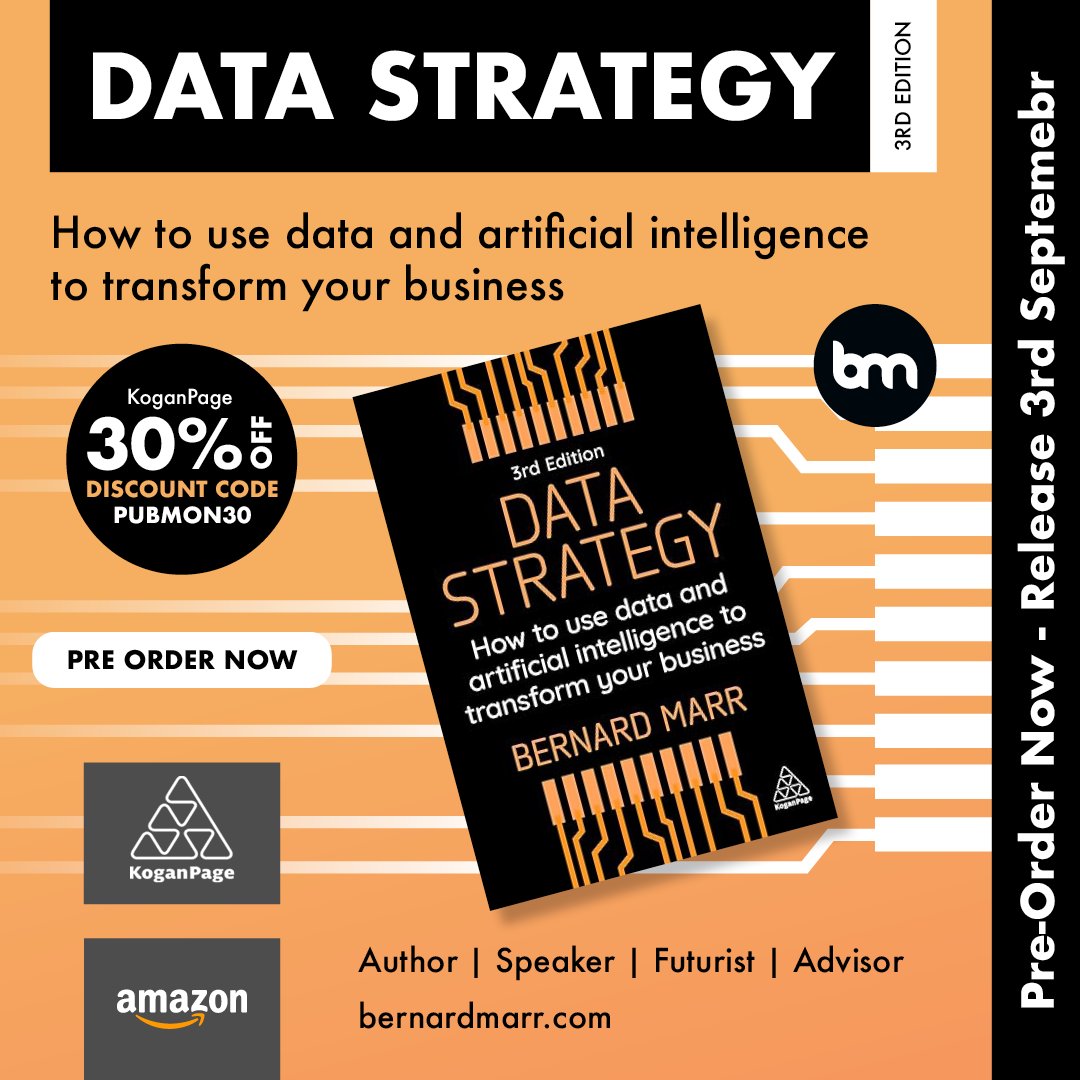
🚀 My New Book is Here: Data Strategy (3rd Edition) 🚀 I’m thrilled to share the release of my latest bestselling book, Data Strategy: How to Use Data and Artificial Intelligence to Transform Your Business. Every business today needs data to survive - but simply having data is not enough. What matters is how you use it. A well-designed data strategy is the key to unlocking value, driving insights, and giving your organisation the competitive edge it needs to thrive in the digital economy. From small organisations to global enterprises, I’ve seen first-hand how a data-driven approach can transform operations, improve decision-making, and unlock entirely new opportunities. That’s why I’ve poured my experience into this book — to help leaders and teams build strategies that don’t just talk about data, but actually deliver measurable impact. 🔍 In this third edition, I’ve expanded the book to reflect the latest developments in data and AI, including: ✅ Generative AI and its role in shaping business innovation. ✅ Synthetic data and how it can accelerate AI adoption. ✅ The potential of quantum computing and what it means for the future of data. ✅ Expanded guidance on cybersecurity, regulations, and ethics in a data-driven world. This isn’t just a theoretical framework - it’s a practical guide to collecting, managing, and using data effectively in order to drive growth, innovation, and long-term success. Whether you’re leading a start-up or a multinational, Data Strategy will equip you with the tools you need to stay ahead in a rapidly evolving landscape. 📖 Pre-order your copy today: 👉 Amazon - 👉 Kogan Page - I can’t wait to hear how this book helps you craft your own data-driven strategy and transform your business for the future.

Bernard Marr

10,980 Aufrufe • vor 11 Monaten

WHY AI NEEDS ROBOTS TO BE THE ECONOMY We keep hearing about the rise of AI - in finance, in art, in code. But here’s the part Elon said out loud: AI doesn’t scale the economy without a body. Right now, AI lives in data centers. It writes essays, diagnoses symptoms, maybe even talks you through a breakup. But it doesn’t fix the plumbing. It doesn’t pick fruit. That’s the missing link: robots. Real-world productivity - the kind that moves GDP - still runs on physical labor. You can automate all the spreadsheets you want, but if strawberries rot in the field or a construction site goes unmanned, you’re not growing the economy. You’re just writing better emails about the shrinkage. AI alone is smart. But AI with wheels, arms, and joints? That’s transformative. Think warehouses where bots stock shelves without lunch breaks. Think 3D-printed houses built in days, not months. Think carebots helping aging populations bathe, cook, and live with dignity. That’s not sci-fi - it’s the only way economies with shrinking workforces and ballooning eldercare costs survive. China’s already there. Japan’s aging crisis is pushing robotic adoption into every corner of daily life. And yet, the conversation stays stuck on chatbots and copyright lawsuits. Because here’s the catch: merging AI with robotics doesn’t just replace jobs - it reshapes civilization. The shift is seismic. It means redefining what “employment” means when machines can work 24/7 and never strike. It’s an economic revolution that doesn’t just disrupt - it displaces. But the choice isn’t between utopia or dystopia. It’s between preparing or pretending. If we want AI to boost productivity, solve labor shortages, and pay off its hype, it needs more than brains. It needs bodies.

Mario Nawfal

141,937 Aufrufe • vor 9 Monaten