Video wird geladen...

Video konnte nicht geladen werden

Zur Startseite

Entertain. Educate. Energize. That's the storytelling pattern. More than ever, leaders across every industry recognize how much storytelling matters to success. And it’s the same pattern behind every great story that sells, whether it’s F1 Movie, Barbie, celebrities sweating on Hot Ones or your company. Remember: People don’t hate...

66,278 Aufrufe • vor 11 Monaten •via X (Twitter)

0 Kommentare

Keine Kommentare verfügbar

Kommentare vom Original-Post werden hier angezeigt

Ähnliche Videos

Sequoia founder Don Valentine: “The art of storytelling is incredibly important” “The art of storytelling is incredibly important. And many—maybe even most of the entrepreneurs who come to talk to us can’t tell the story. Learning to tell a story is incredibly important because that’s how the money works. The money flows as a function of the stories.” The founder of Sequoia founder explains that the story is how you explain what you want to do, how long it’s going to take, who the competition is, and how much money you need. a16z cofounder Ben Horowitz shared a similar view in a 2014 Forbes interview: “Storytelling is the most underrated skill… Companies that don’t have a clearly articulated story don’t have a clear and well thought-out strategy. The company story is the company strategy.” He continues: “The story must explain at a fundamental level why you exist. Why does the world need your company? Why do we need to be doing what we’re doing and why is it important?… You can have a great product, but a compelling story puts the company into motion. If you don’t have a great story it’s hard to get people motivated to join you, to work on the product, and to get people to invest in the product.” This is the job of the founder and CEO: “The CEO must be the keeper of the story. The CEO is responsible for getting the story right, that it’s up to date, compelling, and can move the hearts of men and women. That’s the fundamental responsibility of the chief executive… The mistake people make is thinking the story is just about marketing. No, the story is the strategy. If you make your story better you make the strategy better.” Video source: Stanford Graduate School of Business (2010)

Startup Archive

258,577 Aufrufe • vor 1 Jahr

In 4 minutes, Kurt Vonnegut explained stories better than anyone I’ve ever heard. “The shape of the curve is what matters. Not their origins.” He plots stories on 2 axes: X: Time Y: Good fortune / ill fortune He goes on to say, “Somebody gets into trouble, then gets out of it again. People love that story. They never get tired of it.” Point 1: Stories have defined patterns. In Joseph Campbell’s Hero of a Thousand Faces, he makes the case for the Hero’s Journey. Since then, it’s become the most famous storytelling structure in the world. Vonnegut argued stories could be divided into 8 shapes. Each story, he said, fit one of the 8. Point 2: Vonnegut says, “Be a sadist. No matter how sweet and innocent your leading characters, make awful things happen to them — so the reader may see what they're made of.” To see who your characters really are, you have to make them suffer. Only then does your audience have someone worth cheering for. Point 3: End on a high note. Vonnegut says, “It’s not accidental that the line ends up higher than where it began. This is encouraging to readers.” The way a story makes people feel when they finish is how they remember it. It’s called recency bias. Lift people up and they will love you. *** “There are people. There are stories. The people think they shape the stories, but the reverse is often closer to the truth.” I wrote this with Robbie Crabtree. Follow him for lessons on storytelling + fundraising. And I talk about creative storytelling. Follow Nathan Baugh for more like that.

Nathan Baugh

6,249,241 Aufrufe • vor 3 Jahren

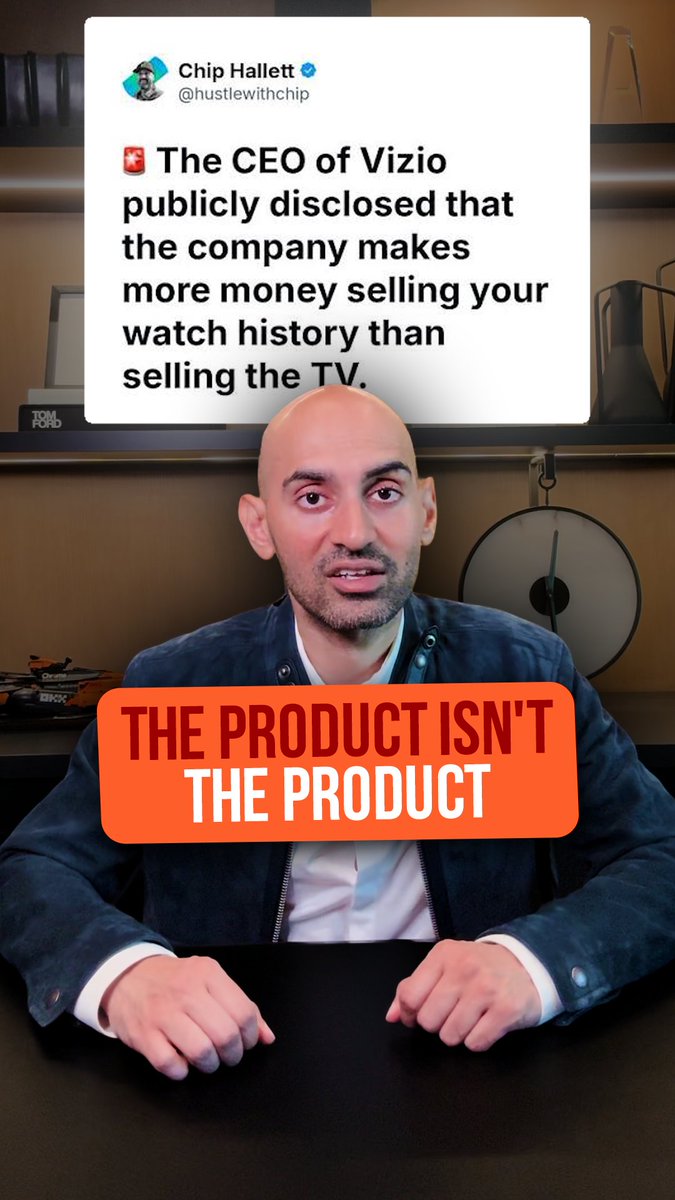
Big-screen TVs used to cost thousands of dollars. But then they got super cheap. Why? It's the same reason social media is free. Vizio doesn't make money selling TVs anymore. Last quarter, they actually lost money on the hardware. But they still made $109 million in profit. How? Their TV is now an ad platform. The ads, the data, the targeted recommendations that's the actual business. And it's not just Vizio. Samsung, TCL, LG, every major brand makes more from ads on your TV than from the TV itself. Here's why this should change how you think about your own business. The product isn't the product anymore. The customer relationship is. Vizio sells a TV. The relationship is the actual business. Tesla sells a car. The software subscriptions are the actual business. HP sells you a printer at a loss. Ink is the actual business. Same pattern across every industry, the first sale is just the entry fee. Smart operators are now willing to lose money on the first sale because they know what comes after. And here's how that plays out online. You run ads or build organic traffic. People land on an offer, a freebie, a guide, something worth their email. They join your list. From that moment on, your job isn't selling. It's nurturing. Email sequences. SMS follow-ups. Automations that keep the relationship warm until they're ready to buy and ready to buy again, and again. That’s what platforms like HighLevel, one of our partners, are built for.. The place where every customer relationship lives, builds, and compounds over time. So if you're still optimizing every transaction for profit, you're playing a game everyone else just stopped playing. Build the relationship layer before the shift hits your industry.

Neil Patel

12,338 Aufrufe • vor 1 Monat

Request for storytellers: I want to see a16z speedrun 🧊 applicants with exceptional storytelling skills. Storytelling is one of the most underrated founder superpowers, and one that only grows more important as AI tools make the earliest phases of building easier. This isn’t about hype or snake oil. Great companies are still built on great products. But the best storytellers give their companies a far greater chance at greatness: 1) They attract better talent. On paper, it’s irrational for a FAANG engineer to leave their comp package, stability, and perks to join a tiny startup. Founders must tell a story that transcends the facts—one that inspires belief in the mission. Without it, you won’t land the best people. 2) They win early customers. Like recruits, customers take a leap of faith when buying from a small, unproven company with no brand or reviews. A compelling story helps them cross that gap. 3) They raise more capital. Investors hear thousands of pitches from smart, credentialed founders with promising traction. Storytelling is what makes one pitch cut through the noise. The best storytellers I’ve seen combine vision and empathy. Vision paints a future so inspiring that anyone can understand it. Empathy ensures the story resonates with the specific audience in front of you. I've been so impressed with the first wave of Speedrun applicants so far. If you've been thinking about applying, now is the time. Link to the application below

Josh Lu

59,678 Aufrufe • vor 11 Monaten

Q: Why is company culture important? In the clip below, a16z cofounder Ben Horowitz argues that culture drives how people in your company behave on a daily basis—and particularly, how they behave when you’re not looking. Is that phone call so important I need to return it today or can it wait until tomorrow? Can I ask for a raise before my annual review? Is the quality of this document good enough or should I keep working on it? Do I have to be on time for that meeting? Should I stay at the Four Seasons or the Red Roof Inn? Should I go home at 5 p.m. or 8 p.m.? Should we discuss the color of this new product for five minutes or thirty hours? If I know something is badly broken in the company, should I say something? Whom should I tell? Is winning more important than ethics? None of these things are in your mission statement or OKRs, but they determine many important things for your company, such as how people experience your company, what you’re like to do business with, what your company is like to work at, etc. And as Ben describes, what drives the culture is all of the little behaviors and cues people take on: “this is what I have to do to succeed in this company.” Culture can feel abstract and secondary when you pit it against a concrete result that’s right in front of you, but it’s a strategic investment in the company doing things the right way when you are not looking. It’s the set of assumptions your employees use to resolve the problems they face every day. It’s how they behave when no one is looking. If you don’t methodically set your culture, then two-thirds of it will end up being accidental, and the rest will be a mistake. If you’re looking for a more in-depth guide to culture and how to build a great one, I’d recommend Ben’s book: What You Do Is Who You Are.

Michael McGuiness

180,646 Aufrufe • vor 3 Jahren