Loading video...

Video Failed to Load

Go Home

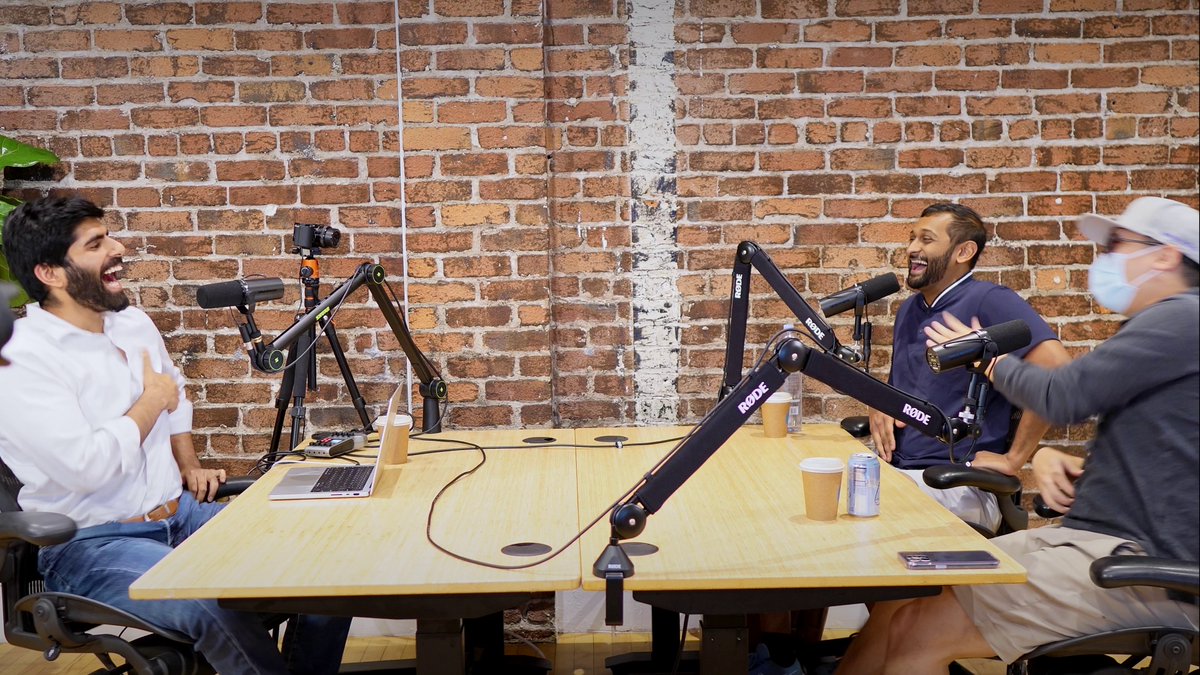
Every AI lab is starving for compute. Except Google. I spoke with Thomas Kurian, Google Cloud's CEO, to understand why Google doesn't just hoard compute before AGI, their relationship with Anthropic, and that viral tweet about Google's engineering culture. Watch now: 0:00 – Intro 0:42 – Google's Insane Compute...

506,750 views • 2 months ago •via X (Twitter)

0 Comments

No comments available

Comments from the original post will appear here

Related Videos

The Jeff Dean & Noam Shazeer episode. We talk about 25 years at Google, from PageRank to MapReduce to the Transformer to MoEs to AlphaChip – and soon to ASI. My favorite part was Jeff's vision for AGI as one giant MoE that is grown in bits and pieces over time like a forest, rather than trained all at once. Specialization, distillation, inference time scaling all emerge organically rather than by design. Noam bites every bullet: 100x world GDP soon; let’s get a million automated researchers running in the Google datacenter; living to see the year 3000. Links below. Enjoy! Timestamps 0:00:00 - Intro 0:03:29 - Joining Google in 1999 0:06:20 - Future of Moore's Law 0:11:04 - Future TPUs 0:13:56 - Jeff’s undergrad thesis: parallel backprop 0:15:54 - LLMs in 2007 0:25:09 - “Holy shit” moments 0:27:28 - AI fulfills Google’s original mission 0:32:00 - Doing Search in-context 0:36:12 - The internal coding model 0:37:29 - What will 2027 models do? 0:43:20 - A new architecture every day? 0:49:10 - Automated chips and intelligence explosion 0:53:07 - Future of inference scaling 1:02:38 - Already doing multi-datacenter runs 1:08:15 - Debugging at scale 1:12:41 - Fast takeoff and superalignment 1:20:51 - A million evil Jeff Deans 1:24:22 - Fun times at Google 1:27:51 - World compute demand in 2030 1:34:37 - Getting back to modularity 1:44:48 - Keeping a giga-MoE in-memory 1:49:35 - All of Google in one model 1:57:59 - What’s missing from distillation 2:03:10 - Open research, pros and cons 2:09:58 - Going the distance

Dwarkesh Patel

544,788 views • 1 year ago

Failing to Understand the Exponential, Again? My conversation with Julian Schrittwieser - Julian Schrittwieser (Anthropic, AlphaGo Zero, MuZero) - on Move 37, Scaling RL, Nobel Prize for AI, and the AI frontier: 00:00 - Cold open: “We’re not seeing any slowdown.” 00:32 - Intro — Meet Julian 01:09 - The “exponential” from inside frontier labs 04:46 - 2026–2027: agents that work a full day; expert-level breadth 08:58 - Benchmarks vs reality: long-horizon work, GDP-Val, user value 10:26 - Move 37 — what actually happened and why it mattered 13:55 - Novel science: AlphaCode/AlphaTensor → when does AI earn a Nobel? 16:25 - Discontinuity vs smooth progress (and warning signs) 19:08 - Does pre-training + RL get us there? (AGI debates aside) 20:55 - Sutton’s “RL from scratch”? Julian’s take 23:03 - Julian’s path: Google → DeepMind → Anthropic 26:45 - AlphaGo (learn + search) in plain English 30:16 - AlphaGo Zero (no human data) 31:00 - AlphaZero (one algorithm: Go, chess, shogi) 31:46 - MuZero (planning with a learned world model) 33:23 -Lessons for today’s agents: search + learning at scale 34:57 - Do LLMs already have implicit world models? 39:02 - Why RL on LLMs took time (stability, feedback loops) 41:43 - Compute & scaling for RL — what we see so far 42:35 - Rewards frontier: human prefs, rubrics, RLVR, process rewards 44:36 - RL training data & the “flywheel” (and why quality matters) 48:02 - RL & Agents 101 — why RL unlocks robustness 50:51 - Should builders use RL-as-a-service? Or just tools + prompts? 52:18 - What’s missing for dependable agents (capability vs engineering) 53:51 - Evals & Goodhart — internal vs external benchmarks 57:35 - Mechanistic interpretability & “Golden Gate Claude” 1:00:03 - Safety & alignment at Anthropic — how it shows up in practice 1:03:48 - Jobs: human–AI complementarity (comparative advantage) 1:06:33 - Inequality, policy, and the case for 10× productivity → abundance 1:09:24 - Closing thoughts

Matt Turck

235,526 views • 8 months ago

State of AI compute 2026: my conversation with stephen balaban of Lambda on the neocloud boom, data centers, GPUs and what's ahead 00:00 — Cold open 01:21 — Why GPU compute was never a commodity 02:45 — The H100 price index and what it gets wrong 04:02 — The real moat: technology or financing? 05:57 — Winner-take-all, or room for many neoclouds 06:48 — Are we overbuilding or underbuilding AI compute? 09:26 — What if AI gets 10x more compute-efficient? 10:44 — The real bottleneck: land, power, and shell 11:38 — The backlash against data centers — and the misinformation 15:00 — Opening the hood: from photons to tokens 17:11 — Extracting more value from the same chip 19:26 — Frontier inference and distributed training, explained 23:26 — What actually drives compute cost 25:21 — Lambda's chip stack and the NVIDIA relationship 26:17 — A multi-silicon world? CUDA, CUDNN, and NVIDIA's real moat 28:59 — Networking, storage, and the one-click cluster 34:46 — Renting vs. owning, and full vertical integration 36:24 — How global is Lambda? Does location still matter? 38:44 — The financing stack: off-take agreements, SPVs, and credit 41:16 — Why a 2023 GPU leases for more today 42:36 — A futures market for compute? 43:54 — Origin story: facial recognition, Perceptio, and Apple 47:03 — The Lambda hat and Dream Scope 48:59 — The $60K bet that became a cloud business 52:00 — Holding the team together through the hard times 54:30 — Bringing on a new CEO; Stephen as CTO 57:33 — Matching xAI on high-velocity deployment 59:29 — "AI won't write software — it will become the software" 01:01:30 — Neural software vs. vibe coding 01:04:25 — Do agents change the compute layer 01:06:14 — Self-assembling software inside Lambda 01:08:18 — Gigawatt-scale AI factories 01:08:57 — One person, one GPU 01:12:04 — Hot takes: overrated and underrated in AI

Matt Turck

70,916 views • 26 days ago

"Projects like the New Deal, the Apollo program pale in comparison to what we're doing right now." 🆕 Greg Brockman (Greg Brockman) joins us to talk GPT-5, GPT-OSS, and what's next on OpenAI's road to crystallizing all of human intelligence! “Energy turns into compute, turns into intelligence… crystallizing compute into potential energy you can release again and again.” 0:00:04 - Introductions 0:01:04 - The Evolution of Reasoning at OpenAI 0:04:01 - Online vs Offline Learning in Language Models 0:06:44 - Sample Efficiency and Human Curation in Reinforcement Learning 0:08:16 - Scaling Compute and Supercritical Learning 0:13:21 - Wall clock time limitations in RL and real-world interactions 0:16:34 - Experience with ARC Institute and DNA neural networks 0:19:33 - Defining the GPT-5 Era 0:22:46 - Evaluating Model Intelligence and Task Difficulty 0:25:06 - Practical Advice for Developers Using GPT-5 0:31:48 - Model Specs 0:37:21 - Challenges in RL Preferences (e.g., try/catch) 0:39:13 - Model Routing and Hybrid Architectures in GPT-5 0:43:58 - GPT-5 pricing and compute efficiency improvements 0:46:04 - Self-Improving Coding Agents and Tool Usage 0:49:11 - On-Device Models and Local vs Remote Agent Systems 0:51:34 - Engineering at OpenAI and Leveraging LLMs 0:54:16 - Structuring Codebases and Teams for AI Optimization 0:55:27 - The Value of Engineers in the Age of AGI 0:58:42 - Current state of AI research and lab diversity 1:01:11 - OpenAI’s Prioritization and Focus Areas 1:03:05 - Advice for Founders - It's Not Too Late 1:04:20 - Future outlook and closing thoughts 1:04:33 - Time Capsule to 2045 - Future of Compute and Abundance 1:07:07 - Time Capsule to 2005 - More Problems Will Emerge

Latent.Space

305,090 views • 11 months ago

Google just launched a direct attack on Nvidia's most valuable asset. Not their chips. Their SOFTWARE. And if this works, Nvidia's $4 trillion empire collapses. Here's what just leaked: Google is building "TorchTPU" - a secret project that makes PyTorch seamlessly run on Google's TPU chips instead of Nvidia GPUs. Why does this matter? PyTorch is the MOST USED AI framework on Earth. Every AI developer uses it. And PyTorch was built around Nvidia's CUDA software. Wall Street analysts call CUDA "Nvidia's strongest defensive wall." It's the reason companies can't easily switch away from Nvidia even when alternatives exist. You don't just buy Nvidia chips. You buy into their entire ecosystem. Switching costs MILLIONS in engineering work. Months of rewrites. Performance drops. So companies stay locked in. Even when Nvidia raises prices. Even when supply runs short. That's not a hardware moat. That's a SOFTWARE prison. And Google just found the escape route. Here's the problem Nvidia created for itself: Google's TPU chips are actually GOOD. Competitive performance. Better availability. Lower cost. But developers won't use them because Google's chips run JAX (Google's internal framework), not PyTorch. That means if you want to use Google TPUs, you have to rewrite your entire codebase. Nobody wants to do that. So Google TPUs sit unused while developers fight over Nvidia chips. Until now. TorchTPU makes PyTorch run natively on Google hardware. No rewrites. No performance loss. No months of engineering. You just... switch. And Google is partnering with META (who built PyTorch) to make it happen. They're even considering OPEN-SOURCING parts of it to speed adoption. Translation: Google is willing to give this away for free just to break Nvidia's lock. The implications are insane: Every company currently paying Nvidia's premium prices suddenly has a way out. Oracle, Microsoft, OpenAI - all locked into Nvidia's ecosystem - can switch to Google. Nvidia's pricing power evaporates overnight. And the timing is perfect: Nvidia is already facing heat. Semiconductor index dropped 3% today. Oracle just lost their biggest investor over AI spending concerns. Companies are realizing AI infrastructure costs are unsustainable. Now Google hands them an alternative. Same performance. Lower cost. Better availability. Jensen Huang knows exactly what this means. CUDA has been Nvidia's untouchable advantage for YEARS. It's why Nvidia trades at 50x earnings while AMD trades at 25x. The software moat justified the premium. But if Google removes that switching cost? Nvidia becomes just another chip company. And chip companies compete on price, not ecosystem lock-in. Here's what happens next: Google needs 12-18 months to make TorchTPU production-ready. If it works, cloud providers will adopt it instantly. They WANT an alternative to Nvidia's monopoly pricing. Amazon already building their own Trainium chips. Microsoft making Maia. They're all trying to escape Nvidia. Google just gave them the software bridge. Nvidia's response options are limited: They can't buy Google. Can't kill PyTorch (Meta owns it). Can't stop open source. Their only play is to keep improving CUDA faster than Google can catch up. But that's a race, not a moat. The market isn't pricing this in yet. Nvidia down 2% today. Google down 2%. Investors think this is just "another competitor." They don't understand this is an attack on the FOUNDATION of Nvidia's valuation. Hardware is replaceable. Software lock-in is what made Nvidia worth $4 trillion. Google is attacking the lock-in. Watch what happens in 2026 when TorchTPU goes live and companies realize they can actually leave Nvidia. The "Nvidia is unstoppable" narrative dies. And a $4 trillion valuation built on software moats gets repriced.

Ricardo

1,615,983 views • 6 months ago

Why AI Can Now Make Discoveries - my conversation with Dan Roberts, Lead of the Foundations of Reinforcement Learning team at OpenAI 00:00 Intro: AI's wild week in mathematics 01:21 What OpenAI's Foundations of RL team does 03:08 Dan's journey: from black holes and quantum gravity to frontier AI 07:04 Are AI systems becoming useful for real science 08:21 The AI math moment: Erdős, OpenAI, DeepMind, and Anthropic 08:52 Why the OpenAI result was an act of exploration 10:25 OpenAI vs. DeepMind: informal reasoning vs. formal proof 12:13 RL 101: learning by doing, not just watching 15:10 Why reinforcement learning works 15:58 How RL breaks: sparse feedback and long-horizon tasks 17:03 RLHF: how human feedback shaped early language models 18:48 Move 37, self-play, and the search for novel strategies 22:16 Explore vs. exploit in scientific discovery 24:49 Why RL may now be "the cake," not the cherry on top 25:46 Why RL started working with large language models 27:29 Is RL "sucking supervision through a straw"? 28:47 Why language may be the grounding layer for intelligence 31:46 A contrarian take on the Bitter Lesson 32:41 What test-time compute actually is 34:50 How RL gives models the ability to think 35:40 Verifiable rewards, math, coding, and the messy real world 38:00 What physics can teach us about AI 42:08 Is there a thermodynamics of AI? 43:08 From Erdős problems to Einstein-level AI 45:16 Is AI already doing original science? 45:51 How far are we from AI automating AI research 47:41 Why Dan is excited about the future of science

Matt Turck

64,952 views • 1 month ago