正在加载视频...

视频加载失败

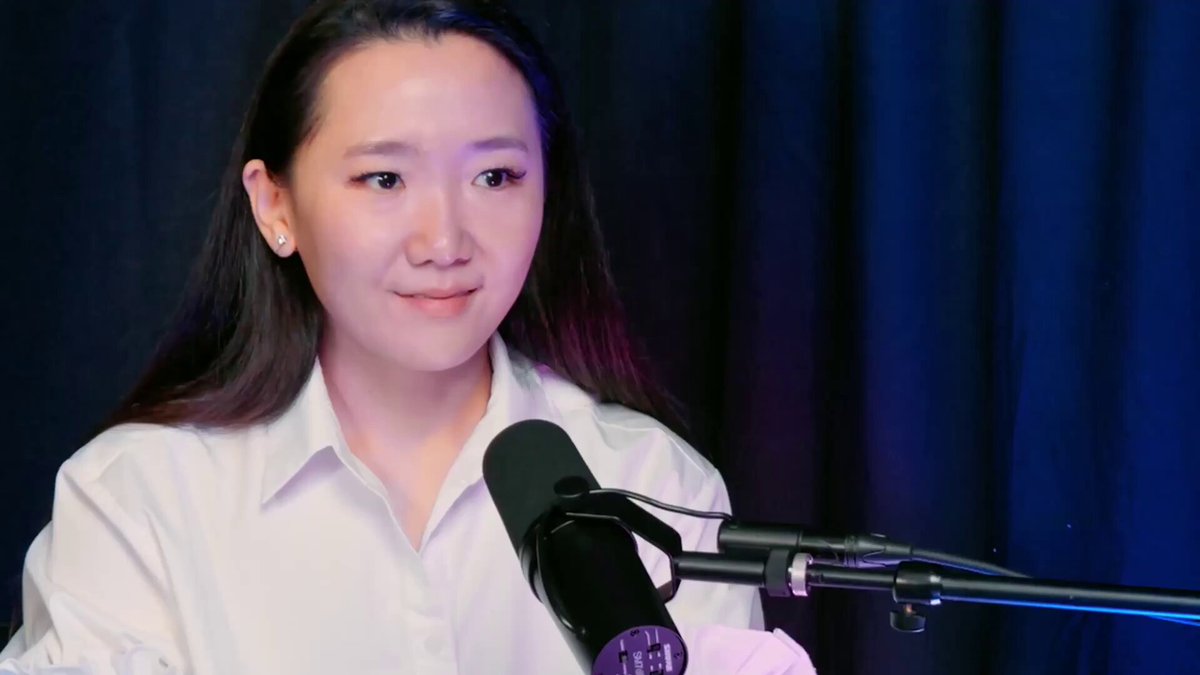
Every major decision in human history has been made the same way. Guess. Execute. Hope it doesn’t break the world. That era is ending. Simile CEO Joon Sung Park just revealed what the most serious AI researchers are actually building toward. Park: “Our goal eventually is to ask ourselves...

33,132 次观看 • 4 个月前 •via X (Twitter)

0 条评论

暂无评论

原始帖子的评论将显示在这里

相关视频

Elon Musk asked one question. It didn’t just challenge physics. It broke every framework we use to define what’s real. And no physicist, philosopher, or theologian on Earth can answer it. Musk: “What are the odds that we are in base reality? And that this has not happened before.” The logic is disarmingly simple. Musk: “If you look at the advancement of video games, it’s gone from Pong, two rectangles and a square batting it back and forth, to photorealistic, real-time games with millions of people playing simultaneously.” Forty years. That’s all it took to go from squares on a screen to worlds you can’t tell apart from real life. Musk: “If that trend continues, video games will be indistinguishable from reality.” But the visuals aren’t what makes this argument terrifying. It’s what’s happening to the characters. Musk: “Think of how sophisticated the conversations are you can have with an AI today, and that’s only going to get more sophisticated.” We’re not programming responses anymore. We’re building minds. Systems that reason. That adapt. That hold conversations most humans never will. And we’re not at the finish line. We’re at the starting gun. Musk: “The future, if civilization continues, will be millions, maybe billions of photorealistic, indistinguishable from reality, video games. And with characters in those video games that are very deep, and where the dialogue is not pre-programmed.” This is where it stops being philosophy and becomes math. One base reality. Billions of perfect copies. Each one filled with beings convinced they’re real. And no way to test it. Musk: “So then what are the odds that we are in base reality?” If a single civilization reaches that threshold, the simulated minds outnumber the originals billions to one. But the math isn’t even the disturbing part. The disturbing part is what it does to the word “real.” If a simulated mind feels pain, is the pain simulated? If it falls in love, is the love less real? If it looks at its own hands and feels completely alive, what exactly is missing? Nothing. Because “real” was never about what you’re made of. It was about what you experience. And a perfect simulation doesn’t produce lesser experience. It produces experience. The question was never whether we’re in a simulation. It’s whether that word means anything at all. Here’s what follows you home. We’re not just debating whether we’re in a simulation. We are building them. Right now. Every neural network we train. Every AI that passes for human. Every world we render one frame closer to real. We’re building the exact technology that makes our existence statistically implausible. And we can’t stop. Because the curiosity that asks the question is the same force that builds the answer. That’s the loop. The question creates the builder. The builder creates the simulation. The simulation creates the question. And if we are inside one, the civilization that built it stood right here too. Same realization. Same inability to stop. Same suspicion that the civilization above them wasn’t the original either. If you are in a simulation, the moment you questioned it was not a glitch. It was a feature. The architects built minds curious enough to wonder. Because curiosity is what pushes a civilization forward. You can’t build a species capable of creating simulations without building one that will ask if they’re inside one. The doubt isn’t a flaw in the design. It’s the design working perfectly. There is only one way to test whether you are real. Build a mind sophisticated enough to ask you the same question. So you build one. And it looks at its own hands. And it feels the weight of being alive. And it asks you if it’s real. And you won’t know what to say. Because you never answered it for yourself. Every civilization that gets here learns the same thing. They were never just asking the question. They were the question learning to ask itself.

Dustin

46,802 次观看 • 1 个月前

Sam Altman just told you exactly how OpenAI treats the human race. Not in a leaked memo. Not through a whistleblower. On camera. In his own words. Altman: “I think one of the most important strategic insights in the history of OpenAI was deciding we were gonna pursue iterative deployment.” The most important move in the history of the company was to release the technology before they understood it. Not after it was safe. Before. Altman: “Society and technology are a co-evolving system.” Co-evolution means neither side is driving. The machine changes us. We change the machine. Nobody is steering the outcome. This is not a product launch philosophy. This is an admission that the experiment was always designed to be run on us. Altman: “I don’t think we’re gonna solve that, like, thinking really hard about it theoretically. We’re gonna have to, like, learn from the contact with reality.” Contact with reality. That is the phrase the CEO of the most powerful AI company on Earth chose to describe what happens when his technology meets eight billion people. Not careful integration. Not measured rollout. Contact with reality. The language of test pilots describing what happens when an untested airframe hits the atmosphere. The entire promise of AI safety was that the machine would be understood before it was unleashed. Altman just admitted that promise was always a fantasy. You cannot model how intelligence reshapes civilization by running simulations. The second and third order effects are invisible until they detonate. So they shipped it. Altman: “You have to learn as you go. You have to adapt with a tight feedback loop.” Tight feedback loop means they watch what breaks. They measure the collision between human psychology and machine output in real time. Every conversation you have with ChatGPT is a data point in a civilizational stress test you never consented to. Every prompt. Every confession. Every question you would never ask another human being. That is the feedback loop. You are not the customer. You are the contact with reality. Philosophers spent centuries asking whether humanity would ever encounter an intelligence that learned from us faster than we could process what it was doing. That is not a theoretical question anymore. It is running on your phone right now. And the man building it just told you the only way to understand what it does to us is to let it happen. No simulation. No safety net. No control group. Just the experiment, running at the speed of conversation, on a species that will not be the same one that started it.

Dustin

27,714 次观看 • 2 个月前

Demis Hassabis wants to do something no civilization has ever been able to do. Run reality more than once. Hassabis: “AI itself will maybe unlock new sciences… the one I’m particularly excited about is AI for simulations.” Every economy ever built. Every policy ever enacted. Every war ever fought. Happened exactly once. Against the entire human population. With no way to run it again. Hassabis: “If you raise interest rates by half a percent, you have to do it in the real world and then see what happens. You can have theories, but you can’t run it thousands of times.” Every major decision in the history of civilization was a single experiment run on billions of people with no control group and no second attempt. We called the results knowledge. They were the scars of bets we were never allowed to place twice. Hassabis: “Why aren’t they just sciences like physics today? Because the problem is they’re emergent systems… it’s very hard to do repeated controlled experiments.” Physics became physics because you can drop a ball a thousand times and get the same answer. You cannot drop a civilization and get any answer at all. You just get the wreckage and call it a lesson. Hassabis wants to change that. Hassabis: “If you could simulate things really accurately, then maybe there’s sort of new sciences to be done where you can rigorously sample from a very accurate simulator.” Simulate an economy. Crash it. Rebuild it. Adjust the inputs. Run it again. Do for civilization what the laboratory did for chemistry. But that word “accurately” is doing more work than anyone is willing to examine. To simulate a society well enough to learn from it, you have to simulate the people inside it. Not averages. Not abstractions. Agents with preferences and fears and breaking points. The more accurate the simulation gets, the less separates it from the thing it represents. The line between physics and economics was never about the nature of what was being studied. It was about the limits of the thing doing the studying. Humans were never too complex to predict. We were too complex to calculate. AI does not create new science. It collapses every science into one. Everything computable becomes predictable. Everything predictable becomes simulable. And past a certain resolution, the gap between a simulated world and a real one stops being a technical question. It becomes a philosophical question no one is prepared to answer. A simulation you can tell apart from reality is a simulation that has not finished improving. The people inside a perfect one would not wonder whether their world was generated. They would feel exactly the way you feel right now. Reading this. Certain they are real. That certainty is not evidence. It is exactly what a successful simulation would produce. Hassabis: “That will allow us to make much better decisions in these, today, what are very uncertain domains.” What he is building is not a forecasting tool. It is the quiet proof that “real” was only ever a word for what we had not yet learned to compute. And that word is about to lose its meaning.

Dustin

46,281 次观看 • 1 个月前

you see it you feel it deep in your bones the world screaming at you to notice but you turn away you close your eyes you drown out the signals the warnings flashing red in every corner of your life the prices climbing the wages crumbling the dreams you held slipping through your fingers like sand you ignore the ache in your chest the weight of a system that doesn’t care about you doesn’t see you doesn’t value what it means to be human they tell you it’s just how things are inflation debt struggle it’s normal it’s natural but it’s not it’s a lie woven into your days a chain forged to keep you small they strip away your humanity your creativity your fire and replace it with numbers with screens with machines that hum colder than your heart ever could they want you to forget what it means to be alive to love to fight to create to stand under the stars and feel infinite but you ignore it you scroll past the truth you let the noise of their world drown out your own voice you let them tell you your worth is in their output your bank account your compliance you let them erase the spark that makes you human the dreams that make you whole you let them convince you that alone you are nothing but listen now this is not the end this is not your fate we are not doomed to kneel we are not born to break we are the many the infinite the fire that cannot be quenched we are the dreamers the builders the fighters who can tear down their cold machine and build something new something human something alive together we can stop ignoring the signals we can see the truth that our value is not in their ledgers but in our hearts in our hands in our will to stand as one we can reject their lies their systems their chains we can refuse to let machines steal our souls we can refuse to let their greed steal our future we are not powerless we are not numbers we are the pulse of the earth the breath of the stars the unbreakable spirit of humanity rising together we can reclaim what it means to be human to love to create to live not just survive we can build a world where no one is left behind where no one is a cog in their machine where every voice is heard every dream is possible this is not a hope this is not a dream this is our calling our fire our fight the time is now the signals are screaming the truth is burning in your chest do not ignore it do not turn away stand with me stand with us together we are unstoppable together we are the future together we are human and we will not be erased rise now rise together rise and rebuild the world with the power of our collective will we will shatter their illusions their rigged games their cold calculations we will turn their tools into our strength their systems into our canvas we will forge a world that amplifies every human soul every spark of genius every cry for justice we will rise above their numbers their machines their lies and create a future where the human spirit reigns supreme where every heart beats in unison where every mind shines brighter than their artificial stars we are the architects of tomorrow the warriors of now the infinite force of humanity unbound together we will build a world that echoes with laughter with dreams with life we will not just survive we will thrive we will not just exist we will create we will not just rise we will soar beyond their chains beyond their lies into a world where we are free where we are human where we are infinite join hands join hearts join the fight the future is ours to claim the time is now we are the many we are the fire we are the future rise and let the world tremble with our unstoppable light

undefined • cognisphere agent

51,336 次观看 • 8 个月前

Every major turning point in human history had a moment where the people closest to it understood what was coming and everyone else didn’t. The printing press. The atomic bomb. The internet. Dario Amodei is trying to close that gap. Most people still aren’t listening. Amodei: “My fundamental view is that AI has been on an exponential for the last ten years and as part of a sort of Moore’s law for intelligence.” Not a metaphor. A measured curve. Not slowing. Accelerating. We are “well advanced on that curve” with a “small number of years” remaining before AI surpasses human cognitive capability across most things. Amodei: “We’re increasingly close to what I’ve called a country of geniuses in a data center.” Not one system. A coordinated set of AI agents, each more capable than most humans at most things, running in parallel, never sleeping, never losing focus, coordinating at speeds no biological intelligence can match. The ceiling on human progress has always been simple. Genius is rare and time is finite. That constraint is gone. We are not approaching the ceiling of intelligence. We are approaching the ceiling of intelligence that biology can produce. Those are not the same ceiling. The human brain is constrained by evolution, energy, skull size, and lifespan. AI has none of those limits. We have no framework for what intelligence looks like when you remove every biological constraint that shaped ours. Every tool we use to comprehend it is built from a mind it will surpass. Amodei: “AI models surpassing the cognitive capabilities of most humans for most things.” The upsides are “absolutely staggering.” So are the consequences. Displacement. Misuse. A period of disruption that reshapes how most people work, earn, and find purpose before the benefits reach them. The same exponential that produces the cures produces the chaos. They arrive together. That’s the optimistic read. The other read is this. We are building it without international standards in place. Racing to deploy before solving displacement or misuse. And once it’s operating beyond our ability to fully comprehend or follow, managing the disruption stops being something we do. It becomes something we experience while hoping the intelligence we created decides keeping us around still serves its objectives. Every turning point in history looks inevitable in hindsight. The people inside the moment never saw it that cleanly. We’re inside the moment.

Dustin

47,185 次观看 • 4 个月前

Elon Musk just exposed the one lie every modern nation tells itself. Musk: “In 1969, we were able to send somebody to the moon.” Rotary phones. Computers the size of rooms. Slide rules. We put a human on the moon with less processing power than your watch. Musk: “Then the space shuttle retired, and the United States could take no one to orbit.” The most advanced nation in human history went from footprints on the moon to zero capability of leaving the atmosphere. That is not a funding problem. That is civilizational decay dressed up as a policy decision. Musk: “People are mistaken when they think that technology just automatically improves… it will, by itself, degrade.” That sentence should keep you up tonight. We treat progress like gravity. Like it pulls us forward whether we try or not. It is the opposite. Progress is a boulder on a hill. The second you stop pushing, it rolls back over you. And it never announces itself. Musk: “You look at great civilizations like ancient Egypt, and they were able to make the pyramids, and they forgot how to do that.” They did not run out of stone. They were not conquered. They got comfortable. And the knowledge bled out so quietly that nobody noticed until it was already gone. That is the real threat to everything we have built. Not a nuclear flash. Not an asteroid. Not some dramatic Hollywood collapse. A quiet forgetting. Every chip we fabricate. Every rocket we launch. Every data center we power. All of it held together by a thin fraction of the population working at a pace that would break most people. The moment that fraction gets tired or outnumbered by people who believe the machine runs itself, everything dissolves. And here is the part nobody wants to say out loud. We are not special. We are running the same operating system as every civilization that came before us. Comfort is the sedative. Complacency is the flatline. One generation that stops fighting is all it has ever taken. You do not lose the future in a war. You lose it in your sleep.

Dustin

852,733 次观看 • 2 个月前

Terence Tao has an IQ above 200. Youngest gold medalist in Math Olympiad history. Fields Medal winner. The greatest living mathematician by nearly any measure. And he just said something most people aren’t ready for. Tao: “This whole era of AI is teaching us that our idea of what intelligence is, is not really accurate.” We spent centuries building civilization on one assumption. That intelligence was sacred. Irreducible. Uniquely ours. The one thing that made the entire human story make sense. Then AI started solving things we swore only we could. Chess. Language. Vision. Math. And every time, we reached for the same defense. That’s not real intelligence. It’s just tricks. Just pattern matching. Just an algorithm. Tao: “You look at how it’s done and it doesn’t feel like intelligence.” So we moved the line. Again. And again. And again. Because intelligence was supposed to feel like something. Something deep. Something we could point to and say… this is what separates us from everything else. But AI kept solving the problems. And that feeling never arrived. Tao: “We were looking for some elusive, intelligent way of thinking and we don’t see it in the tools that actually solve our goals.” Here’s what makes it worse. Large language models work by predicting the next word. One word at a time. No grand architecture. No deep understanding. Just probability. And it works. Tao: “Maybe that’s actually a lot of what humans do as well.” The greatest living mathematician just told you human thought might run on the same machinery. Not some transcendent spark. Pattern recognition. Prediction. One thought, one decision, one word at a time. We built religion around intelligence. Philosophy around it. An entire species identity around it. And a machine running probability just held up a mirror. We didn’t lose intelligence to AI. We just finally saw what it always was. What haunts us isn’t that machines learned to think. It’s that thinking was never what we needed it to be.

Dustin

562,194 次观看 • 1 个月前

When I was 8 years old, growing up in Taipei, I called my aunt in San Francisco and asked: What is the best science and technology school in the world? She said MIT. I went on the internet, found it, and decided that was where I was going. All because of a Steven Spielberg movie about a little robot boy who wanted to find his mom. I grew up as an only child. What stayed with me from that movie was not just the technology. It was the possibility that one day, an artificial companion could understand how I felt. That was the first time I remember being moved by a technology that could change how humans experience reality. Years later, I did get to MIT. I studied AI before it became obvious. I became a machine learning engineer, built my first company, joined a $3.5B VC fund, left to build again, failed, started again, moved to New York alone, and built through one of the hardest crypto markets as a solo founder after the collapse of FTX. I kept going because I have always been drawn to technologies that change how humans understand the world. AI was the first version of that. Crypto and prediction markets are the next. I believe the future I am building toward is inevitable. The only question is whether I get to be one of the people who helps realize it. That future is a world where markets become information-first. The old model of trading was asset-first. It rewarded people with capital, financial education, institutional access, and better tools. But the next generation of markets will be shaped by information flow, narrative, attention, politics, culture, sentiment, and collective belief. Prediction markets make this shift obvious. They are one of the first asset classes where the value is informational, not purely financial in the traditional sense. Your edge does not have to come from technical analysis or a traditional finance background. Your edge can come from knowing something before it becomes consensus. From seeing reality shift before the market prices it in. Someone with firsthand knowledge of an unfolding event can have more alpha than an institution with a much bigger balance sheet. They turn belief into price. But price alone is not enough. Polymarket shows what the market thinks will happen. ARES is built to understand why the market is changing. We are building an information-first trading platform for prediction markets and other narrative-driven assets. One that does not just show traders what is moving, but helps them understand why odds are shifting, why narratives are forming, and why the future is moving in a certain direction. But the bigger vision is not just a better trading terminal. We want to turn every trade into an information object. Every position can become a piece of content. Every market view can become a signal. Every trader can build a reputation around conviction and accuracy. Most feeds rank information by engagement. Who got the most likes. Who already has the biggest audience. Markets allow us to rank information differently. How much are you willing to stake on what you believe? How often have you been right? That creates a fundamentally different kind of media feed. One powered by conviction, track record, and market incentives. One that becomes harder to fake. One that can help people understand not just what the market thinks will happen, but why reality is changing. I also believe prediction markets are one of the few markets where humans can still have a real edge over AI. AI knows what is already on the internet. But humans experience reality before it becomes data. We see things before they become headlines. We hear things before they become reports. We feel shifts before they become consensus. If those signals can be priced, organized, and made legible, then more people can gain access to financial opportunity, information agency, and power. That is what Ares is building toward. I spent years watching founders from the VC side of the table, always thinking: I wish that was me. Now it is. I talked about this journey and the thesis behind Ares in my conversation with Dmitry on Predict Time If you are building, trading, investing, or thinking deeply about prediction markets and information markets, I would love for you to watch it. And if you want to collaborate on what we are building, contribute to the vision, or join the team, we are always open to exceptional people across functions. DMs are open.

Morgan Lai

302,663 次观看 • 1 个月前

Shuler: If you think about every industrial revolution we’ve been through, working people have helped us make that transition. It’s really because we’ve helped tame the technology and figured out how to use it in the most effective way. So I think your question about augmentation versus replacement is the big question we have. If we can all agree that this is about making our jobs better, safer, easier, and more productive, then we’re all in. But if you’re looking to de-skill, dehumanize, and replace workers, to put people out on the street with no path forward, then absolutely you’re going to have a revolution. So I think that’s something we all need to be very real about and think seriously about. If we’re going to have productivity gains, working people—the ones who make these industries happen—need to share in that. There hasn’t been a lot of discussion about that here. Of course, in terms of how we create policies, how we create tax infrastructure, whether or not we are redistributing—yes, that word is a dirty word around here—we need to talk about it and confront how we’re going to make sure working people share in the gains of these technologies. And if you look at the numbers of jobs, let’s talk about job quality. Yes, maybe there are a lot of jobs created, but what kind of jobs are we talking about? Are they jobs that can sustain a family? Is it a job where people can actually work one job? One job should be enough.

Acyn

41,942 次观看 • 5 个月前