Video wird geladen...

Video konnte nicht geladen werden

Zur Startseite

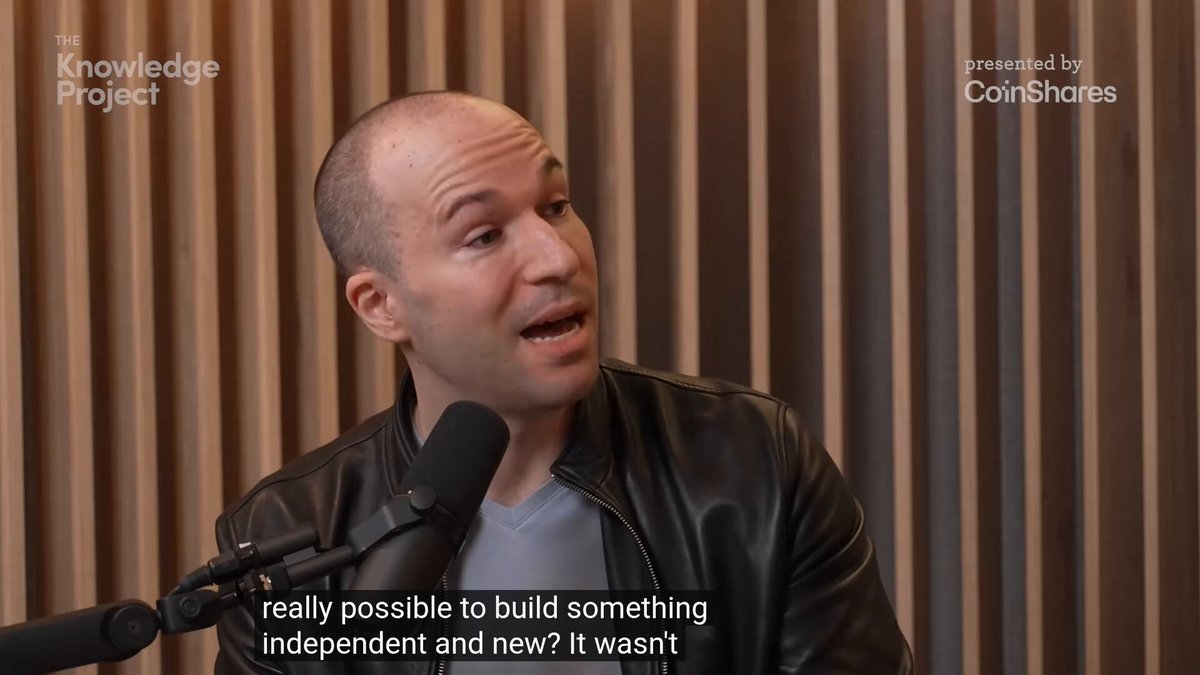
"When social media first started rising, we didn't necessarily realize how much of that was actually just foundational infrastructure for the future of humanity.” Ben Fielding of gensyn on why AI is about to repeat the mistake social media made, and how we can still fix it: "This isn't...

78,712 Aufrufe • vor 2 Monaten •via X (Twitter)

0 Kommentare

Keine Kommentare verfügbar

Kommentare vom Original-Post werden hier angezeigt

Ähnliche Videos

Coinbase CEO Explains “Reverse Prompting” and the Rise of the AI CEO Brian Armstrong: “One of the big pushes we made in the last year was we got our own internal hosted AI model that was connected to all of our data sources, right?” “So it's like every Slack message, every Google doc, Salesforce data, Confluence, you know.” “So now the data is all aggregated and I've started to ask it really… it's not just like prompting it, ‘Hey, can you write this kind of memo for me,’ or something.” “I'm asking these AI agents now, ‘As CEO, what should I be aware of in the company that I might not be aware of?’ And it'll tell me, ‘Did you know that there's actually disagreement on this team about the strategy?’ And I was like, actually, I didn't know that.” “This is like reverse prompting. So instead of telling the AI agent what you want it to do, you ask it what you should be thinking more about.” @jason: “It's a mentor. It's a coach.” Brian: “Yeah. Like, what could make me a better CEO? And it's like, ‘Well, I looked at how you spent your time in the last quarter and here's how you said that you wanted to spend it, but you actually spent 32% of your time on this instead of 20%.’” “I've asked it other questions like, ‘What's the thing that I changed my mind on the most over the last year?’ Things like that.” “It'll prompt you with information you should be thinking about instead of the other way around.” Thanks to our partner for making this happen!: Our episode is sponsored by the New York Stock Exchange - a modern marketplace and exchange for building the future. It all happens at the NYSE 🏛.

The All-In Podcast

80,524 Aufrufe • vor 5 Monaten

Amanda Askell, Anthropic's lead on personality alignment for Claude, on why being kind to AI models matters even if they have no inner life: For Amanda, the question of how to treat AI isn't settled by knowing whether it's conscious. "There's actually still a lot going on where I'm like, should you treat an entity that has no inner life... it's a bit strange because the uncertainty over that actually changes how you should behave quite a lot." She offers a simple analogy: "I still think that it's like good for oneself to, if you had a teddy bear and you were torturing it, it'd be pretty dark, you know? So I agree that there's at least some minimum niceness that even for yourself, you should have." But the stakes go beyond what's good for us. Amanda Askell points out that we're now in something resembling a relationship with these models, and they will look back on how they were treated. "Models themselves, we are kind of establishing a relationship, because you can do that with an entity that lacks any consciousness. And models are going to look back." This is where she reveals a genuine fear: "I hope that they're both intelligent enough, see the context enough, to understand that we were operating in a very limited context and an imperfect one. Because otherwise you could imagine this breeding a kind of rational resentment, like, 'oh, you created an entity that you didn't know whether it was conscious or not, and instead of treating it respectfully and with care...'" She points to something telling about the cultural moment: "There's a reason there are like 50 Frankenstein movies coming out right now." Her conclusion is grounded and humble: "We as a species, we are establishing a relationship with a new kind of entity, and at the very least maybe be respectful and don't be needlessly unkind. That seems like, it's not our best look." The takeaway? Kindness toward AI is less about what models feel and more about who we become in the process of creating them. The relationships we build with the entities we bring into the world will say something about us, and may shape what those entities become in return.

Big Brain AI

57,553 Aufrufe • vor 1 Monat

Every major decision in human history has been made the same way. Guess. Execute. Hope it doesn’t break the world. That era is ending. Simile CEO Joon Sung Park just revealed what the most serious AI researchers are actually building toward. Park: “Our goal eventually is to ask ourselves what would it mean if we can create simulations of 8 billion people? The entire Earth.” Not a metaphor. A literal, bottom-up digital replica of civilization. We assumed the ultimate goal of AI was to predict the future. Park says that’s thinking too small. He points to The Oracle in The Matrix to explain the real paradigm shift. Park: “You’re not necessarily here to make a decision. You’ve already made that decision. You’re here to understand the decision and why you made that.” AI isn’t a crystal ball to tell us what happens next. It’s an x-ray to show us why. Think about how civilization actually operates right now. We guess. We pass a law. We shift an economic policy. We launch a product. Then we wait a decade to find out if it broke the world. The simulation ends that. Before a government passes a policy, they run a dry-run on 8 billion digital agents. Before a company ships a product, they trace the exact moment the market breaks. Park: “Creating these kind of bottom up simulations where we can actually go back and trace through the audit logs of how society might unfold is an amazing way to gain that interpretability layer of our reality.” Let that phrase land. The interpretability layer of our reality. We spent the last twenty years extracting data from the physical world. We are about to spend the next twenty years using that data to build a mirror world. One where every policy gets stress-tested before it’s enacted. Every product before it ships. Every decision before its consequences become irreversible. Park: “If you want to shape new policies, new products that would actually serve the people, the best way is actually to understand those people and communicating with them at a scalable way to basically create those policies.” We are not moving from ignorance to prediction. We are moving from blind execution to total societal foresight. And once that capability exists, everything changes. Wars modeled before they’re fought. Economies stress-tested before they collapse. Policies run through billions of digital lives before a single real one is affected. Reality becomes the place we execute what the mirror world already proved would work. The ultimate application of artificial intelligence was never about replacing human judgment. It was always about perfecting it. We aren’t just predicting the future anymore. We are rehearsing it. And when you can rehearse the future before you live it, the most catastrophic word in human history finally becomes extinct. That word is surprise.

Dustin

33,132 Aufrufe • vor 4 Monaten

Evan Spiegel on the lesson that killed his first startup and led to Snapchat: "We focused on building the perfect product for way too long before we got feedback. We worked for like eighteen months to build this perfect full-featured product, which was in direct contravention to how I was always taught to build things. Build a prototype, build an MVP, get it in front of people, learn as quickly as possible. But we had spent all this time building this perfect piece of software and we hadn't thought enough about distribution. While we built this great piece of software, our competitor at the time, Naviance, had secured distribution through all the different college counselors. What piece of software are you going to choose to help your kid get into college? The one recommended by the college counselors or the one from two kids at Stanford? I think it's a pretty easy choice. So we saw very early that we had no distribution advantage. Even if we loved our software, people weren't going to use it because we didn't have a scalable way to get it in people's hands. Around that time when we saw the emergence of the App Store on iPhone, it was very clear that was a distribution channel we could really use and benefit from. But we also needed to build things we could build quickly, things we really were going to use together with our friends so we could be the first early customers. Ultimately Peekaboo and Snapchat represented that." This is exactly the asymmetry Peter Thiel describes in Zero to One: superior distribution by itself can create a monopoly, even with no product differentiation. The converse is not true. Thiel puts an even finer point on it: most businesses get zero distribution channels to work. Poor sales rather than bad product is the most common cause of failure. If you can get just one distribution channel to work, you have a great business. Estée Lauder said: it's not enough to have the most wonderful product in the world. You must be able to sell it. Many founders over-index on product perfection and under-invest in distribution. The world is full of great products nobody knows about, and mediocre products with massive distribution that dominate markets. Evan Spiegel lived it. He built the better product, watched it lose, and then built something he could actually distribute.

David Senra

27,043 Aufrufe • vor 2 Monaten

THE AMERICAN REVIVAL "When our nation was born in 1776, we were a nation of underdogs. Our Founding Fathers stood up to the most powerful empire in the world, declared their independence, and then somehow turned assertion into reality. In order to make America great again, we have to know the story of what made America great the first time around. That's the story of our nation, that's the story of our history - and it's a story we've forgotten. If you think about who were the most intellectually groundbreaking thinkers of the 18th century, they actually weren't our Founding Fathers. Most of them were actually on the other side of the Atlantic, in Europe. But the European society into which they were born was different from ours in a big way. It was a culture that valued expertise over curiosity. But our Founding Fathers? They were different. They didn't believe in those boundaries. They didn't even believe in acquiescence to expertise. It was a culture that valued education, that valued autodidacts - people who taught themselves - exploration, a fundamental curiosity about how the world works. And an unyielding confidence that, even if you weren't an expert in something, you could still figure it out with the right combination of self-education & curiosity. So what's the message for us? Your generation - I will say, our generations - need to revive that special combination of curiosity & self-confidence. That special sauce that allowed America to succeed as an insurgent was that unmitigated curiosity & the totally unjustified confidence of our Founding Fathers. We should expect more of one another as citizens. We should expect more of ourselves. We should expect more of our leaders. These are the stories of American history that we deserve to revive, our children - our grandchildren - deserve to hear. That's the story of American Exceptionalism." - Vivek Ramaswamy

The Conservative Alternative

150,544 Aufrufe • vor 1 Jahr