Загрузка видео...

Не удалось загрузить видео

На главную

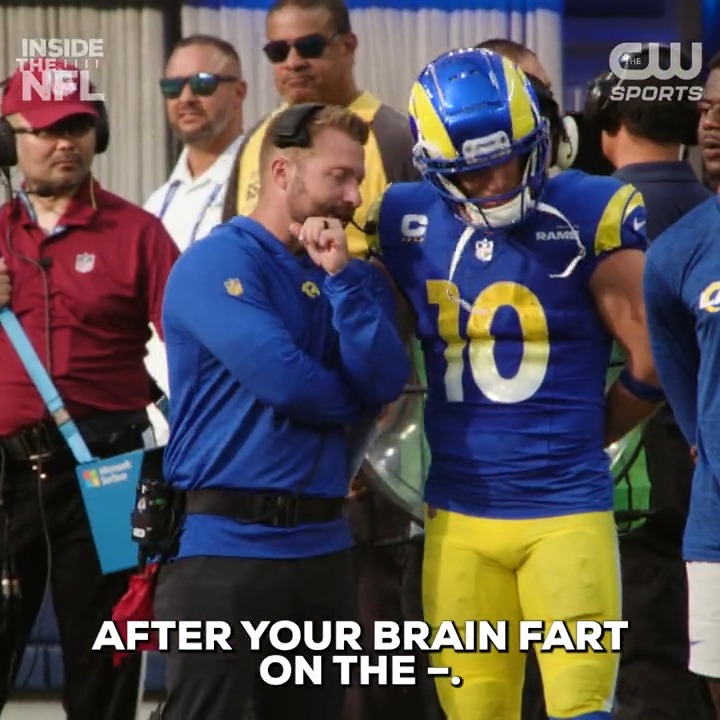
Every team fights the same battle every year. Selfishness versus team-first culture. Jon Gruden asks Drew Brees the right question here because every good offense eventually has to manage the same tension. Skill players want the ball. Contracts matter. Roles matter. Production matters. But inside a real offense, not...

13,336 просмотров • 2 месяцев назад •via X (Twitter)

Комментарии: 0

Нет доступных комментариев

Здесь появятся комментарии из оригинального поста

Похожие видео

Matt Rhule (Matt Rhule) is widely regarded as one of the best builders of culture in the world. Much of his philosophy with Nebraska Football was shaped by his experience as a walk-on at Penn State, where he learned three foundational truths: 1. "Everything Matters". 2. Every person deserves to be held to championship standards. 3. The most important investment you can make is in the person, not the player: 🏆 Championship standards only stick when they apply to everyone. The moment the rules bend for one person, the culture begins to break for everyone. The fastest way to erode trust in a team is to be selective with accountability. If the star player can skip the line, arrive late, or ignore details that would get someone else corrected, the message is clear: talent earns exemption. When no one is above the standard and no one is beneath it, trust deepens, entitlement disappears, and discipline becomes a shared identity rather than just a set of rules imposed by coaches. 🪣 Every player carries water for the program. The star may score the points, but the walk-on who dives on the floor in practice also helps build the habits that win championships. The star may finish the play, but the walk-on helps build the foundation that makes the play possible. When a team understands that every person carries water, no role feels small, and everyone takes OWNERSHIP of the mission. 🫡 Holding every person to the same standard is one of the highest forms of respect. It tells your best players they are not above the team, and it tells your role players they are essential to it. It will take everyone to win a championship, and just one person to mess it up. The most disciplined teams transform accountability into a shared promise: we will honor each other enough to demand the best from everyone, regardless of role, situation, or title.

Josh Chambers

50,673 просмотров • 2 месяцев назад

Nick Saban has always asked this question about Leadership... "How many guys on the team need to be led?" Coach Saban believed in the power of Collective Leadership with his teams. 1. Are most players on your team bought in? 2. Do most players on your team set a good example? These players do not need someone to impact or influence them if they are already making these choices and leading by example. This is the power of collective leadership. Collective leadership is vital to successful teams. I believe there are 7 types of Collective Leaders that all teams need: 1. The GAMER - When the game is on the line. Who does the team look to? Who wants the ball in their hand? It is the Game Leader. They don't "have" to lead in other ways, but it would be best if they did. This player is often the ultimate competitor on the team. 2. The WORKER - Winning Teams have Practice Leaders. They bring energy and focus to each practice. They ensure competitive and strong practices. They Lead by Example. You practice much more than you play. 3. The GATEKEEPER - This leader ensures the Team Culture is Maintained. They put out the fires. They keep the team accountable. Especially when the coach is not there. They are essential in WINNING Teams. 4. The COMMUNICATOR - It is a long season. There will be difficult days. Teams need the Communicator to get through these tough days. They often provide humor and can lighten the mood. They have high Emotional Intelligence. This is an Underappreciated Leader. 5. The CONNECTOR - These players are often your “glue” players. They keep the team connected on the court or field as well as in the locker room and in social settings. 6. The ENERGY GIVER - The Energy Giver brings Positive Energy Every Day! Their Energy is Contagious! This leader knows that nothing great can be accomplished without Enthusiasm. The Energy Leader brings positive energy each day. They feed the team! 7. The SERVER - Finally, the Server embodies Servant Leadership. They are all about the TEAM. They bring a WE-first mentality to all they do. Their focus on the TEAM creates a contagious WE>ME mentality throughout the team. Collective Leadership WINS. _____ Follow me for more actionable ideas on coaching, leadership, and personal growth. Subscribe to my newsletter, 🏆 Great Teams Better Leaders 123. Find it for free in my profile above.

Greg Berge

196,705 просмотров • 2 лет назад

Jensen Huang just looked at every tech giant building custom silicon. And laughed. Every major player is burning billions to escape the Nvidia tax. Google is building TPUs. Amazon is building Trainium. Meta is building MTIA. The logic makes sense on a spreadsheet. Design a chip perfectly tailored to your workload. Cut out the middleman. Own the stack. But the spreadsheet assumes the middleman is standing still. Huang: “Look at the number of ASICs that have been canceled… It’s not sensible, actually.” He is not questioning their engineering. He is questioning their math. Custom silicon takes years. Every design choice is a bet on a target that exists today. And Nvidia does not let today exist for long. Huang: “Because of our scale, our velocity, we’re the only company in the world that’s cranking it out every single year.” That is the real weapon. Not the chip. The clock. Nvidia stopped selling performance. They started selling time. By the time a custom ASIC tapes out, Nvidia has already shipped the next generation. The chip arrives obsolete. Not because it failed. Because it was built for a world that no longer exists. The graveyard of custom silicon is not filled with bad engineers. It is filled with slow ones. You cannot aim a three-year development cycle at a one-year moving target. Every company building custom silicon thinks they are building an escape route. They are building a time capsule.

Dustin

43,254 просмотров • 2 месяцев назад

Football is the most complex sport that has many rules that the majority of fans (or sometimes even commentators) don't fully understand. I've seen a lot of misinformation and confusion last night and today regarding what an eligible receiver is and what intentional grounding is. What is intentional grounding? (see the 1st picture) If the ball is thrown to the vicinity of an eligible receiver, there is no penalty. So the next question is what makes someone an eligible receiver? (see the 2nd picture): - Anyone off the Line of Scrimmage - The farthest man to the left of the players on the L.O.S. - The farthest man to the right of the players on the L.O.S. The offense must have at least 7 players on the L.O.S. (so they cannot have more than 4 off the L.O.S.). Therefore, there are usually 6 eligible receivers in any given play (the 4 players off the L.O.S. plus the farthest man on the L.O.S. to the left and to the right). Yes, the Quarterback is an eligible player. On the Lions backed up play, Goff throws the ball toward (and in the vicinity of) two eligible players. Debate all you want about his Tight End being in the vicinity, but his RB is right in front of him and the ball almost hits him. A player running a route or blocking has absolutely nothing to do with whether he's eligible or not. There is clearly no Grounding on that play. In the 3rd Quarter, the Vikings get called for Grounding simply because there's no eligible player within 10 yards of where the ball lands. These are pretty clear cut plays.

Connor Stalions

93,026 просмотров • 1 год назад