正在加载视频...

视频加载失败

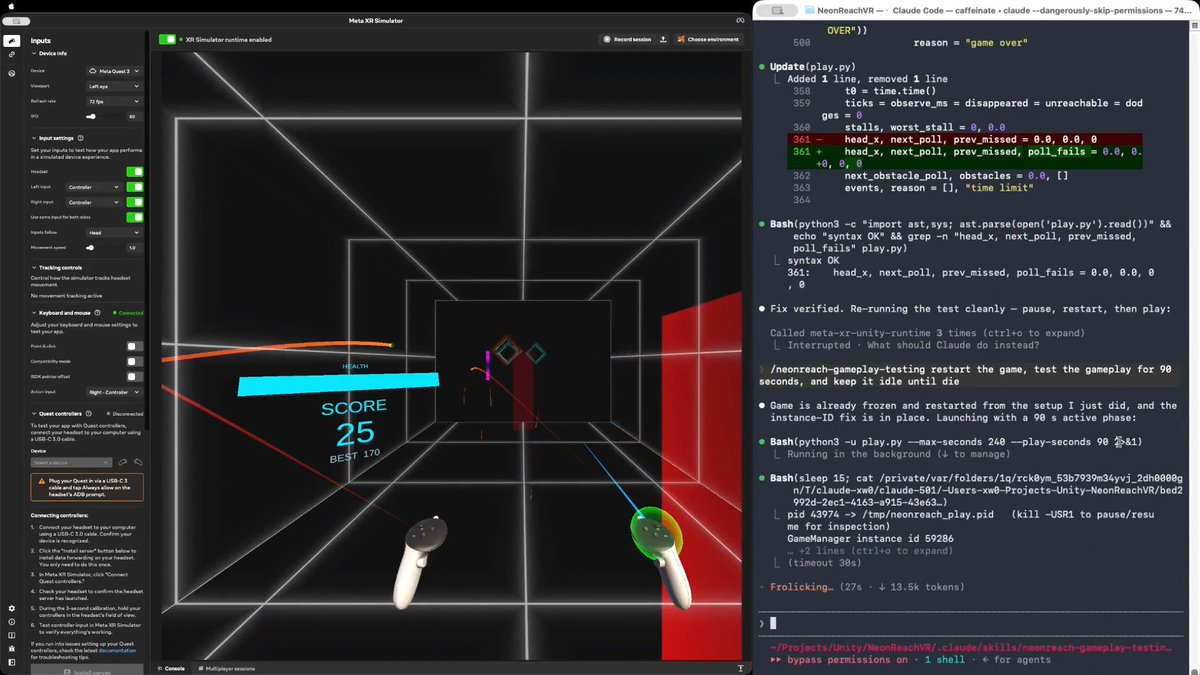
everyone in iOS development should watch this. seriously, it might change the whole industry. i pointed claude code at a live ios device running on revyl, typed "test everything," and walked away. here's what's actually happening: ① you don't write the tests. no scripts, no selectors, no test plan....

23,963 次观看 • 2 个月前 •via X (Twitter)

0 条评论

暂无评论

原始帖子的评论将显示在这里

相关视频

THIS GUY CONNECTED HIS AI AGENTS TO HIS OBSIDIAN AND BUILT A BRAIN THAT LEARNS ON ITS OWN. HERE'S HOW TO BUILD IT Obsidian is just markdown files sitting in a folder. That turns out to be the perfect memory for an AI agent, because an agent can read and write those files directly. He wired his agents into the vault so they pull context from it, do the work, and write what they learned back. The notes aren't the point. The loop is, and it gets sharper every cycle How to build it: 1. Point an agent at your vault. The fastest way, no plugins, no API keys: open a terminal and run npx obsidian-mcp /path/to/your/vault. That exposes your Obsidian folder to Claude as a tool it can read, search, and write to. Add it to your Claude Code or Cowork config and restart 2. Confirm it can see the brain. Ask it: "list the notes in my vault and summarize what's in them." If it reads them back, the connection is live. Now it starts every task with everything the vault already holds instead of from zero 3. Give each agent one job and a write-back rule. Tell it: "research this, then save what you found as a new note in /brain with links to related notes." One agent researches, one summarizes, one plans. Each writes its output back into the vault 4. Close the loop. Add one line to every agent's instructions: "read /brain before starting, write your result back when done." Now each task leaves the vault richer, and the next run reads that before it works. It compounds instead of resetting 5. You only steer. Review what the brain produces, point it at the next thing. The agents handle the reading, writing, and connecting The edge isn't better notes. It's a brain that feeds itself, so the work gets sharper every cycle instead of starting over Bookmark this

Yarchi

58,186 次观看 • 2 个月前

i watched gemma 4 12b build something genuinely impressive today, and then loop itself to death right in front of me. the full run is in the video, sped up but completely uncut, watch it to the end and you will catch the exact moment it stops building and starts looping right in the middle of the work. the task was clean, build a single file gravity simulator, n-body physics, orbits, collisions, running locally on one 3090 through an agent. and for ten minutes it was a joy to watch. it reached for a symplectic integrator on its own, the correct one, the kind that keeps orbits stable instead of spiralling out. real gravity with softening, proper orbital velocities, momentum conserved on collision. the physics was right. the thing actually worked. then on the very last step, writing a few tests to prove its own code, it fell into a loop. not a crash, a loop. it started repeating itself and would not stop. ten more minutes, thirty four thousand tokens into a single answer, the same fragments over and over, until i killed it myself. so it's not that gemma can't code. it did the hard part beautifully. it cannot finish. it cannot hold a long task together without unravelling, and finishing is the entire job in agentic work. here's the part that stings. i run this exact task, same harness, same card, on the chinese open models, qwen especially, and i never see this. they build it, they test it, they stop. every single time. google has the raw capability, you can see it sitting right there in the code, and then the model loops itself to death on a task a 27b from alibaba finishes clean. open weights, apache 2.0, so much to love on paper. i just need it to know when to stop talking.

Sudo su

39,574 次观看 • 2 个月前

HERMES AGENT VS OPENCLAW. a local ai onboarding flow test. a 3.9gb bonsai served on localhost, both agents upstream and latest, i point each one at the endpoint and watch which one even finds it. > hermes opens a provider menu, thirty plus options, local servers sitting right there next to the cloud ones, i hand it 127.0.0.1:8899, it verifies the endpoint, one model visible, auto-detects the model by name, bonsai-27b-q1_0, reads the context length straight off the server, saves it, and starts reasoning and firing real tool calls on my local model. no key. no friction. > openclaw has no menu. it goes hunting for a codex login, an openai key, finds none because there are none, prints no models available three times, defaults to openai/gpt-5.5, a cloud model it cannot reach, and dead ends on run auth login --provider openai. read that back. it asked me for an openai key. to run a model already running on my own machine. it never once looked at localhost. to be fair, openclaw can run local if you hand wire endpoint yourself. what it will not do is find the model already sitting on your box. hermes agent found it in one line. now the part i owe you. the auto-detect that just won, the model name read, the .gguf strip, the context length probe off the server, that is my code, it is in hermes agent main right now, authorship preserved, #2051 and #4218. the wizard fix that stops an agent from silently routing you to someone else's creds, the exact trap openclaw still falls into, mine too, #4210. i contribute to hermes agent, i told you that going in. one agent is built to talk to whatever you are running, the other is built to talk to a cloud api, so one found my model and ran it and the other asked me to log into openai. onboarding flow of both, mapped, below.

Sudo su

23,816 次观看 • 1 个月前

Every AI agent you've tried has amnesia. It does one task, forgets everything, and tomorrow you start from zero. That's not an employee. That's a temp you have to retrain every single morning. Hyperagent by Airtable is the first platform I've used that actually fixes this. Here's what got me: 1. Agents that compound. Each agent has memory. The one running today is smarter than the one you shipped three weeks ago. Same prompt, same integrations, but weeks of your judgment baked in. 2. Real deliverables, real receipts. You don't get a chat transcript. You get finished work with the cost and runtime printed right on it. A full research report for under ten bucks. Try getting that invoice from an agency. 3. A fleet, not a chatbot. Build a specialist for outreach, another for research, another for reporting. Give each one its own tools, its own memory, and its own budget cap so nothing runs away with your credits. 4. Deploy to Slack and your whole team uses the agent you built. One competitive intel agent, @ mentioned by everyone. Airtable runs its own data team this way. 5. Each agent gets its own cloud machine with a real browser and code execution. It works while you sleep. No babysitting, no local setup, no laptop that has to stay open. I put it to work in the video below. Watch what it builds. The teams treating agents as durable assets instead of one-off prompts are going to lap everyone else. This is the first tool that actually treats them that way. #ad Hyperagent

Leonard Rodman

94,961 次观看 • 1 个月前

Karpathy said something you'll regret ignoring: "We have to keep the AI on the leash. I'm still the bottleneck. I have to make sure this thing isn't introducing bugs and that there's no security issues." He said it at YC talk last year, when the worry was reliability. The models hallucinated and made mistakes no human would, so the leash implied keeping yourself in the loop and checking the output before trusting it. The models are far better now, and the line still holds, for a reason he was not focused on back then. Even a model that writes flawless code today still has no idea who is allowed to run it. Correctness and authorization are different problems, and only correctness improves as the model improves. A perfect agent still hands a tool where anyone can do anything, because permission was never part of the task. I actually tested this in practice with Claude Code. I asked it to build a small internal tool with a button that issues account credits. It worked first try, and running it locally, the credit applied the instant I clicked. Nothing decided who was allowed to click it. The agent wrote the right logic and displayed a success notification. It never checked whether the caller had the right, whether it should pause for a human, or whether anything was logged. And this is not a bug a smarter model can outgrow because the leash was never in the code. Identity, permissions, and audit live in the system that runs the app, not in what the agent generates. To solve this, I took the exact same bundle and hosted it on Retool. The credit write that fired silently on my laptop now stopped at an approval gate, resolved to a real identity through SSO, and landed in an audit log. I wrote none of it. The app inherited the entire boundary the moment it was deployed, and the video shows the before and after. You can try it yourself here: I also wrote a detailed breakdown of the whole thing in my recent article, and I worked with the team to put this together. It walks through the build, the exact moment the credit write went through on my laptop with nobody checking, and then what changed when the same app ran on Retool. It also covers why this is a property of the runtime and not something a better model fixes, which is why devs typically miss this. The article is quoted below.

Akshay 🚀

42,911 次观看 • 1 个月前

Someone ran Claude Code on a beach where any device overheats and that spot suddenly turned out to be the best home for the most powerful AI in the world. This is the reMarkable Paper Pro. A paper tablet for notes with no browser and no social media and not a single app. He sat down right on the sand in the open sun and brought up Claude Code on Opus 4.6 over the Claude API on the paper screen and opened his project ~/repos/webs while the waves broke a few steps away. For years every device had the same trouble outside. In direct sun the screen glares and washes out and heats up and instead of your work you see your own reflection. But e-ink does not blast its own light into your face. It reflects the sunlight like the page of a book. And here is what came out of it. The very thing that kills any normal screen outside turned into fuel for this one. The brighter the sun the sharper the picture because it has nothing to glare with and nothing to wash out. And then comes the thing no laptop on a beach will give you. Your eyes do not get tired. You can watch Opus think on max effort for an hour and it reads like a book in the sun and not a backlight you squint into. The picture only comes alive. In bright light it does not fade but turns sharper and higher in contrast than it ever was in a room. The charge lasts for days. E-ink barely touches the battery so there is no outlet anywhere on the sand and the tablet does not care. It weighs as much as a notebook. The whole setup folds into a beach bag like a pad with a pen on top. Everything on the screen is for real. Claude Code v2.1.110 and Opus 4.6 on the Claude API and the project ~/repos/webs open right on the e-ink in the middle of the sand. In my opinion this is the most unexpected home for an AI this year. Not an office with the blinds drawn and not a monitor cranked to full brightness but a quiet sheet of paper on the sand that open sun only makes better and on it the most powerful Claude writes code right on the page like a pen.

Blaze

89,297 次观看 • 1 个月前

Hermes agent just left the terminal. 𝗛𝗲𝗿𝗺𝗲𝘀 𝗗𝗲𝘀𝗸𝘁𝗼𝗽 dropped yesterday. native app for macOS, Windows, and Linux. for months Hermes was the agent that learned your projects, wrote its own skills, and built a model of who you are. all of it buried in terminal logs. now it has a window. the important part is that it's not a wrapper. it runs the same agent core, the same sessions, memory, and skills as the CLI. you can start a task in the terminal and finish it in the app without anything resetting. the state is shared across every interface, not copied between them. what the GUI actually adds: → streaming chat that shows live tool calls and inline reasoning instead of a spinner → a preview rail that renders pages, code, and images right beside the conversation → an artifacts panel that collects every file the agent has ever produced → remote gateway mode, so you can point the app at a VPS and run the heavy work elsewhere → skills, cron, profiles, and gateways managed point-and-click instead of through YAML → voice mode, drag-drop files, and inline image generation remote gateway mode is the one worth slowing down on. the agent runs 24/7 on a $5 server while you control it from your laptop like a local app. other agent UIs are chatboxes with a logo. this one shows the autonomy instead of hiding it, so you watch the skills load, the tools fire, and the artifacts pile up as it works. it was teased in Jensen's GTC keynote. MIT licensed, local-first, no telemetry. if you already run Hermes, download it and everything is already there. your chats, memory, and skills carry straight over. i wrote a full masterclass on Hermes Agent that walks through the SOUL. md identity layer, the three-tier memory system, the self-evolving skills loop, and how to run three specialized agents 24/7. desktop is the interface that finally does all of it justice. the article is quoted below.

Akshay 🚀

51,540 次观看 • 2 个月前

i just built a 4-agent software team. everything runs from Telegram and gets managed on a kanban board. a project manager who plans the work, a backend developer, a frontend developer, and a tester. the PM reads a goal, breaks it into linked tasks, and assigns each to the right agent. the thing that makes them a team instead of four strangers is a shared kanban board. every task is a row that survives crashes, and when an agent finishes, it writes a summary of what it built and what the next agent needs to know. the next agent reads that summary before it starts. so the frontend developer never has to guess the API shape, and the tester knows exactly what to verify. the hardest part was not the coordination. it was building an agent that could actually act like a backend engineer. a backend engineer stands up a database, wires auth, manages storage, deploys functions, and keeps all of it consistent while the rest of the team builds on top. an agent doing this from scratch drowns. it burns its context window remembering which tables exist and which endpoint it created three steps ago, and the work degrades fast. so the backend agent needs a backend built for agents, not for humans clicking through a dashboard. that is where InsForge came in. it is an open-source, agent-native backend, and i added it to my backend developer agent as a skill. a skill is a step-by-step guide that teaches the agent how to do a specific kind of work. with InsForge installed, the agent stopped improvising infrastructure and followed a reliable path: create the project, define the database, set up auth, deploy functions. to test the whole team, i had them build a working Google Docs clone, AI features included. the backend agent spun up the full service on its own. database tables, user auth, document handling, and edge functions running real TypeScript, all in one dashboard. the frontend agent read that summary and built the UI on top of it, and the tester closed the loop. the result was a backend an agent could reason about end to end, instead of one it kept getting lost inside. if you are building an AI backend engineer, InsForge is worth a look, it's 100% open-source. InsForge GitHub: (don't forget to star 🌟) the full article on Hermes Kanban: Mission Control for your Agents is quoted below.

Akshay 🚀

122,548 次观看 • 2 个月前