Loading video...

Video Failed to Load

Go Home

“Everything is difficult. If you’re going to do something important it’s going to take you a decade or more to have an impact. You might as well pick something you care about. Pick the really big thing. It’s always bothered me when I talked to entrepreneurs and they tell...

92,085 views • 8 months ago •via X (Twitter)

0 Comments

No comments available

Comments from the original post will appear here

Related Videos

Nick Saban says his mother taught him the mindset that eventually shaped Alabama’s dynasty, it’s not about beating the other guy, the competition is always you “Accountability was really important. If you had a job to do and you didn’t do it exactly right, you were going to do it over again. So you learned how to be accountable. One thing my parents always emphasized was it wasn’t about winning or beating the other guy. It was about, did you do it as well as you were capable of doing it?” “We won 30 games in a row when I was in high school and won a state championship, and that was never good enough. I asked my mom once, ‘Why is it never good enough?’ She said, ‘It’s not about winning the game. It’s not about beating the other guy. It’s about: did you do it as well as you’re capable of doing it?’” “So that makes you kind of a perfectionist, because the competition is always you. It’s always you.” “The other thing that instilled in me was I never had what I call relief syndrome. It’s kind of human nature that if you do something of significance, you think you’re supposed to be able to rest on your laurels.” “Players would win a big game and say, ‘Can we have Monday off practice? We get rewarded for winning this big game.’ Well, I’m thinking about how we’re going to win the next game. Did we play well enough in that game to win the next game, and what do we need to improve on?” “You can never be perfect, but you’re always trying to close the gap on perfect. I think great competitors, whether it’s Kobe Bryant, Tiger Woods, Michael Jordan, those guys could always take the next challenge. It didn’t matter how much they won or what they did.” Pasted text

Josh Chambers

61,421 views • 1 month ago

Chris Bosh explains how Kobe Bryant taught him that greatness is mostly an unglamorous routine “If you’re trying to go after something, it’s a process and you cannot cheat it. That is one thing you cannot do. You can’t cheat the process, and even then that doesn’t guarantee you anything. You have to have your stuff together because you want to win, that doesn’t guarantee a win. You just have to make sure you’re doing your process.” “I had the chance to have a conversation with Kobe. We were friendly and we tried to have dinner once a year. He always talked about loving the process of what you do. That’s important. You have to love what you do and love putting the work in because some days are going to suck. It’s always going to suck to go in the gym and shoot 10,000 free throws.” “Everybody’s like, ‘Oh, Kobe, this is amazing.’ He’s like, ‘Yeah, that’s cool, but think about my day. I get up at 4:30am, take my kids to school, I lift weights, I go to practice, I pick them up from school, then I’ve got to do treatment because I’m 35 years old in the league. Then I’ve got to do treatment, and by the time I finish all that stuff, the day’s over. I don’t do anything else. This is all I do.’” “If you take on that approach to something that you love, if you can stick with it even in those tough days, that’s where you want to be.” “You gotta love the grind, man. That’s the part I always like to think of anytime something gets hard. If I’m pursuing a goal and I want to quit, it’s going to come. It’s going to come. It’s okay.” “How many people would quit right now? That’s the first thing I think about. Then I keep going. I’m like, okay, I’m not going to let this drop me off and keep me away from what I’m doing.”

Josh Chambers

42,578 views • 3 months ago

Naval Ravikant’s checklist for starting a company “The most important thing is there are no formulas. At the end of the day, you have to do what you love, and you have to do it even though people tell you it’ll never work. But that being said, if there was a formula [for starting a company], I would put it something like this.” Naval started seven companies before AngelList and this is the checklist he recommends running through before starting a startup: 1. Pick a great cofounder. This is most important: “You can do a company on your own, but it’s like you can raise a child on your own, but you probably shouldn’t. You need someone who’s going to be there with you.” This has it’s own checklist. Your cofounder should be: a. Very high intelligence (”hopefully they make you feel dumb, or they’re not smart enough”) b. Very high energy (”They should be extremely hardworking. A founder is someone who never has to be motivated. You should not have to be telling them to do their job.”) c. Very high integrity. (”a smart, hardworking crook who’s going to cheat you is the worst kind of person to be paired up with.”) 2. Pick a very large market. “Notice I don’t talk about the idea. I think ideas are almost irrelevant… The more important thing is that you pick a large space that you’re knowledgeable and passionate about. And then you will figure out what the right thing to do within that space is.” You want to be able to say to investors: “This is a space where there’s a huge market. I’m really knowledgeable and passionate about it. Here’s the great person that I have doing it with me. And here’s the minimum viable product that we have built. That will show that we can test in the marketplace… You iterate until you get to product/market fit… And then you go and you raise money from people you trust. And you use that money to scale.”

Startup Archive

36,050 views • 1 year ago

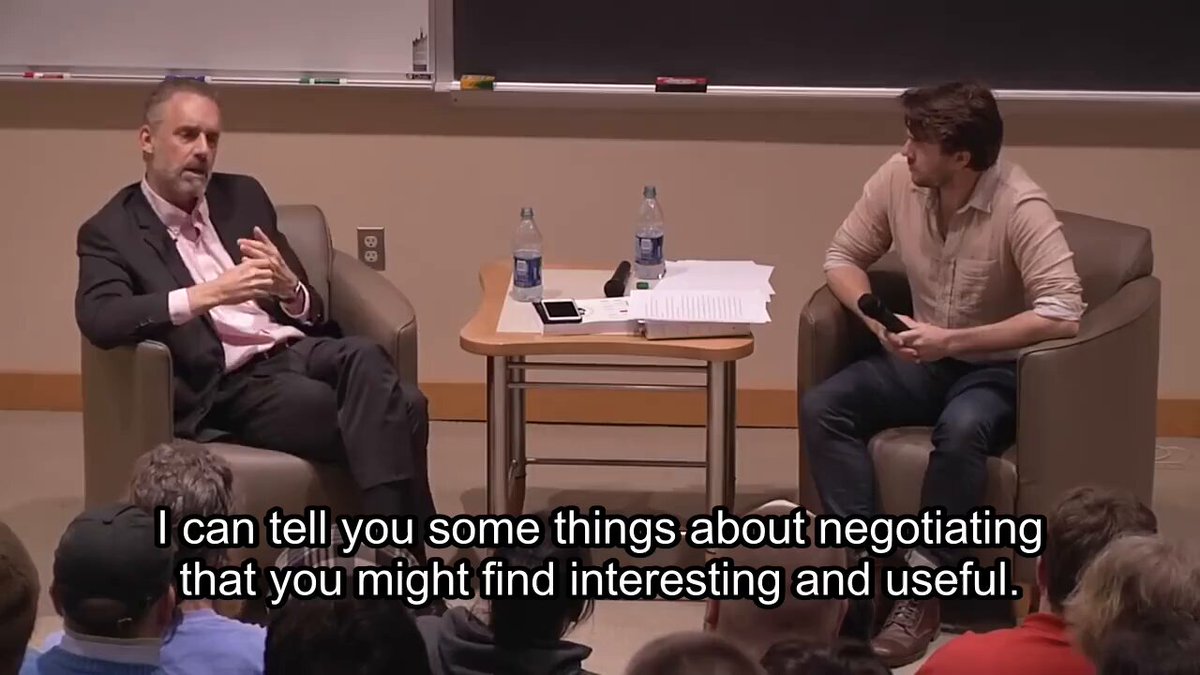
Jordan Peterson: "If you're competent and silent you will be ignored." "You might think well people should reward you because you're competent. And yes of course they should. But if you're competent and silent then you're just part of the background that's keeping everything functioning" On why you cannot negotiate from a position of weakness: "If you want to push your career forward you have to push it forward. You have to be competent and you have to be strategic" "To be strategic when you negotiate for a new position or a new salary you have to be able to say if you don't give me what I want then something you don't like will happen to you" "It's not a physical threat. It's that you have an option" "You have your CV in order. You're educated and competent and desirable to people outside of your immediate job. You're willing to instantly put yourself on the job market" "So that when you go talk to the person you're negotiating with you're credible" On the one thing most people completely miss about negotiation: "It's very seldom that you're talking to the person who's at the top of the pecking order. What you need to do is tell them a story that they can tell to their boss to make you not a problem" "A good story is look we really need this person because they're hyper competent and they have a better offer" "If you go in there with no power you're going to lose. Obviously" He concludes with the one thing every competent person needs to hear: "The first thing you need to know if you're going to negotiate is that you have to be able to say no. And what no means is that you're not going to do it"

Brad

35,334 views • 3 months ago

#TAEYONG WEVERSE LIVE 🌹: "And there is one thing I’ve realized, that now when I’m alone, I don’t want to talk about the members anymore. Because I felt this even when I was in the military. Of course, I did do it a lot, but I think I came to think that talking about someone else when they aren’t around isn’t polite, no matter how much they are team members". 🌹: "We’re close and like brothers, but still, if you hear what you want to hear directly from the people involved, it’s much more comfortable for me, and I think it would be more comfortable for you all and the person involved too. (I’m trying not to talk about even that member’s TMI anymore. Actually, I did talk about it during the last interview. There was talk about the members, but because the other members might feel uncomfortable. I said that I wouldn’t talk about it. 🌹: "I asked for your understanding. So I hope you all understand. They did that for me . I hope you all understand, too. I think I regretted those things. Talking about the members' TMI or things like that in the past. They might have wanted to talk about it too, you know". 🌹: "And rather than just finding it fun for me to talk about, the people involved need to have something to say when they come. If I tell them everything, what are they going to talk about when they turn on the live stream again? If I tell them everything, they probably won't turn on the live stream at all. They won't even talk". *Pat pat* 🌹: "You all understand, right? Thank you" * Taeyong, I respect your decision. I hope those people who always do that can understand and respect your decision as well.

🌹Nyo

134,943 views • 5 months ago

Steve Jobs on what separates the successful founders from unsuccessful ones Steve is asked what the factors of success and common pitfalls are for young entrepreneurs. He responds: “I get asked this a lot, and I have a pretty standard answer. A lot of people come to me and say, ‘I want to be an entrepreneur.’ And I go, ‘Oh, that’s great, what’s your idea?’ And they say they don’t have one yet. And I say I think you should go get a job as a busboy or something until you find something you’re really passionate about, because it’s a lot of work.” Steve continues: “I’m convinced that about half of what separates the successful entrepreneurs from the non-successful ones is pure perseverance. It is so hard. You pour so much of your life into this thing, and there are such rough moments in time that most people give up. I don’t blame them. It’s really tough, and it consumes your life. I mean, if you’ve got a family and you’re in the early days of a company, I can’t imagine how one could do it. I’m sure it’s been done, but it’s rough because it’s pretty much an 18-hour-a-day job, 7 days a week for a while. So unless you have a lot of passion about this, you’re not going to survive. You’re going to give it up.” He concludes: “You’ve got to have an idea or a problem or a wrong that you want to right that you’re passionate about. Otherwise, you’re not going to have the perseverance to stick it through. And I think that’s half the battle right there.”

Startup Archive

80,791 views • 1 year ago

Q: How will I know when it’s the right time to go full-time on a startup idea? Tony Fadell is the co-creator of the iPod, iPhone, and Nest. As he puts it in the clip below: “Great ideas chase you.” He continues: “In this world, there are so many people who have more ideas than they have time to implement… I used to be like that. But the best ideas are the ones that you can really focus on… Now I try to run away from a great idea. And then it stalks me. It hunts you down because you’re like: ‘Ah, that’s going to have this problem, I’m going to put it aside.’ And then a few days later, you’re like: ‘Actually I think I know how to solve that problem.’ At some point it just becomes this black hole that sucks you in and you can’t think about anything else but this.” Mark Zuckerberg gave similar advice in a previous Startup Archive answer: “I always think the most important thing entrepreneurs should do is pick something they care about and work on it, but don’t actually commit to turning it into a company until it’s working. If you look at the data of the very best companies, I think a tremendous percentage of them have been built that way and not from people who decided upfront that they wanted to start a company because you just get locked into a local maxima a lot of the time.” Let great ideas chase you and don’t turn it into a company until it’s working. There’s almost always a ton of work you you can do upfront to de-risk an idea before turning it into a company. And perhaps just as important: you want to make sure you’re still excited about the idea after a few months and the novelty has worn off—it should be all you can think about. Companies are almost always a 10 year project if they work and a 2-3 year project if they fail. It’s worth it to be patient before jumping in with two feet.

Michael McGuiness

62,662 views • 3 years ago

I know you just want to accept this job offer, so you don’t have to keep looking for a job. I understand that you’re worried that they will take your offer away if you ask for more money. I get it, you feel like you should just accept what they’re offering because the job market is tough. But hear me out. If you don’t negotiate before you accept you lose your leverage. In other words, you can’t get what you want if you don’t ask for it before you say yes to the job. Companies are going to try to pay you as little as possible, so they always lead with their worst offer. If you accept their first offer you’re accepting their worst offer. You are going to be locked into this compensation package for years so you might as well make sure it’s their best offer before you accept. To make sure you get the best job offer NEVER accept a job offer on the spot. NEVER! Instead when you receive a job offer always say, “Is this negotiable?” If they say, “No. This is the best we can do.” You know you got their best offer and you can sleep at night. And you have to decide if this is what you want. If they say, “We might be able to do a little better, what were you thinking?” You need to ask for what you want. Remember salary is only 70% of your compensation, you can ask for other things in addition to more money. You can negotiate: A better title A more flexible WFH/hybrid schedule More PTO Sign on bonus Tuition reimbursement Start date Good luck in your salary negotiations #jobinterview #joboffer #salarynegotiation #jobsearch #negotiationtips

Anna Papalia

983,300 views • 3 months ago