Video wird geladen...

Video konnte nicht geladen werden

Zur Startseite

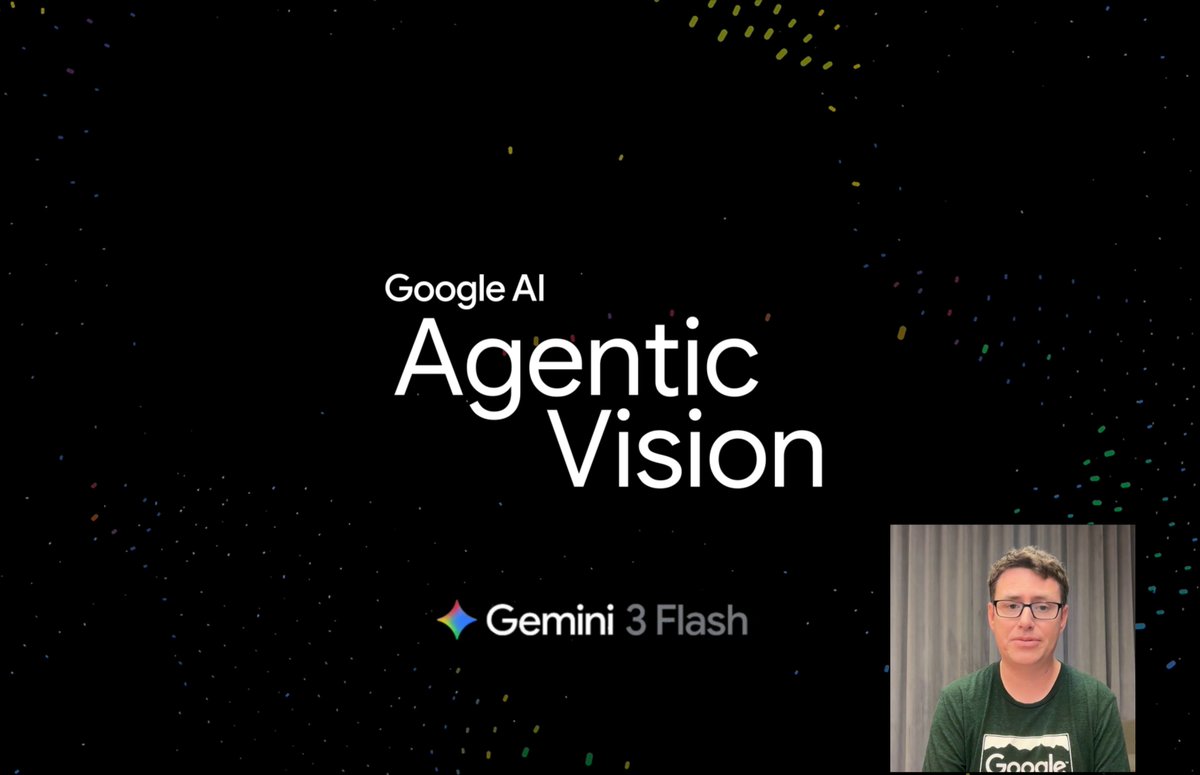
🚀Excited to share that #Gemini 3 Flash can do code execution on images to zoom, count, and annotate visual inputs! The model can choose when to write code to: 🔍 Zoom & Inspect: Detect when details are too small and zoom-in. 🧮 Compute Visually: Run multi-step calculations using code...

19,284 Aufrufe • vor 7 Monaten •via X (Twitter)

0 Kommentare

Keine Kommentare verfügbar

Kommentare vom Original-Post werden hier angezeigt
Ähnliche Videos

New short course: Building Code Agents with Hugging Face smolagents! Learn how to build code agents in this course, created in collaboration with Hugging Face, and taught by Thomas Wolf, its co-founder and CSO, and m_ric, Hugging Face’s Project Lead on Agents. Tool-calling agents use LLMs to generate multiple function calls sequentially to complete a complex sequence of tasks. They generate one function call, execute it, observe, reason, and decide what to do next. Code agents take a different approach. They consolidate all these calls into a single block of code, letting the LLM lay out an entire action plan at once, which can be executed efficiently to provide more reliable results. You’ll learn how to code agents using smolagents, a lightweight agentic framework from Hugging Face. Along the way, you’ll learn how to run LLM-generated code safely and develop an evaluation system to optimize your code agent for production. In detail, you’ll learn: - How agentic systems have evolved, gaining greater levels of agency over time—and why code agents are a next step. - How code agents write their actions in code. - When code agents outperform function-calling agents. - How to run code agents safely in your system using a constrained Python interpreter and sandboxing using E2B. - To trace, debug, and assess the code agent to optimize its behaviours for complex requests. - How to build a research multi-agent system that can find information online and organize it into an interactive report. By the end of this course, you’ll know how to build and run code agents using smolagents, and deploy them safely with a structured evaluation system in your projects. Please sign up here!

Andrew Ng

127,724 Aufrufe • vor 1 Jahr

👀 I used OpenAI's Code Interpreter to make Flappy Bird 🐦in 7 minutes: Code Interpreter/GPT-4 for code generation. Pre-existing or AI-generated assets for graphics. --- Here's how to make the game in only 6 steps: (1): Enter the following prompt: "write p5.js code for Flappy Bird where you control a yellow bird continuously flying between a series of green pipes. The bird flaps every time you left click the mouse. If the bird falls to the ground or hits a pipe, you lose. This game goes on infinitely until you lose and you get points the further you go". (2): Use generative AI or existing game assets and spirits. I searched "flappy bird assets" on Google and used the first link, a GitHub repo with pngs from the original Flappy Bird. (3): Use this prompt to link assets to the code: "Please generate the entire file again based on the fact I'm using a unique background, spirits for the bird, and pipes. Here is the list of assets I'm using: [list of file names]." Code Interpreter should modify the code accordingly to include the list of file names. (4) Make an account OpenProcessing -> create a sketch -> paste in the code generated by Code Interpreter -> upload in-game assets from step (2). (5) (Optional) Ask ChatGPT to make changes to improve the in-game experience e.g., adding a high score, restarting the game when the bird dies, etc. Copy the new code into your OpenProcessing sketch and reload the game. (6) If something doesn't work, ask GPT4 to fix it. Copy and paste the error message and ask it to regenerate the code. --- Bonus Tips: - Iteratively test code. Each time you make a change using Code Interpreter, test the updated code by playing the game so you catch new bugs early. - Learn programming by asking questions: "Act as a senior programmer very good at explaining concepts to a beginner. Tell me how gravity works in this game and how you used code to make this happen."Code Interpreter/GPT4 for code generation. Download Pre-existing assets or generate new images for graphics. Excited to see what you make!

Alex Ker 🔭

739,874 Aufrufe • vor 3 Jahren

I built an agent that answers machine-learning questions. It's autonomous, and the best part is that I built the whole thing without writing a single line of Python code. Here is what I did and how I did it: Over a year ago, a friend and I built a site that publishes multi-choice questions. You get a new one every day. I decided to have GPT-3.5 answer questions. Here is what I needed to build: 1. Connect to the site's API to retrieve today's question 2. Extract the question and the potential choices 3. Connect to OpenAI's API and ask GPT-3.5 to answer the question 4. Parse the answer from the model 5. Submit the answer back to the API to get the score Not difficult. Likely several hours of work. But I didn't have to write any code. I built the whole thing by dragging and dropping components using Vellum is a YC-backed platform for developers to build LLM applications. They are the only ones I've seen offering this functionality. They sponsored this post, and their team helped me with all my questions while I built this. I created a workflow. The platform supports several node types to build whatever you have in mind. I show how I put the whole thing together in the attached video. The only code I had to write was a few lines of Jinja to parse and transform the API and the LLM results. There are three lessons I want to share from this experience: First, the best possible code is the one you didn't write. I'm a big fan of no-code tools because they help me materialize my ideas fast. They help product people, designers, and no coders collaborate on the solution. Second, Large Language Models are sensitive to how you prompt them. Small changes to prompts can make a big difference in results. This is more pronounced when you are building a multi-step workflow. Third, automated testing and evaluation for prompts is critical. There aren't many companies thinking about this. They'll have a hard time moving from a demo phase. The attached video will show you what I did.

Santiago

309,825 Aufrufe • vor 2 Jahren