Video wird geladen...

Video konnte nicht geladen werden

Zur Startseite

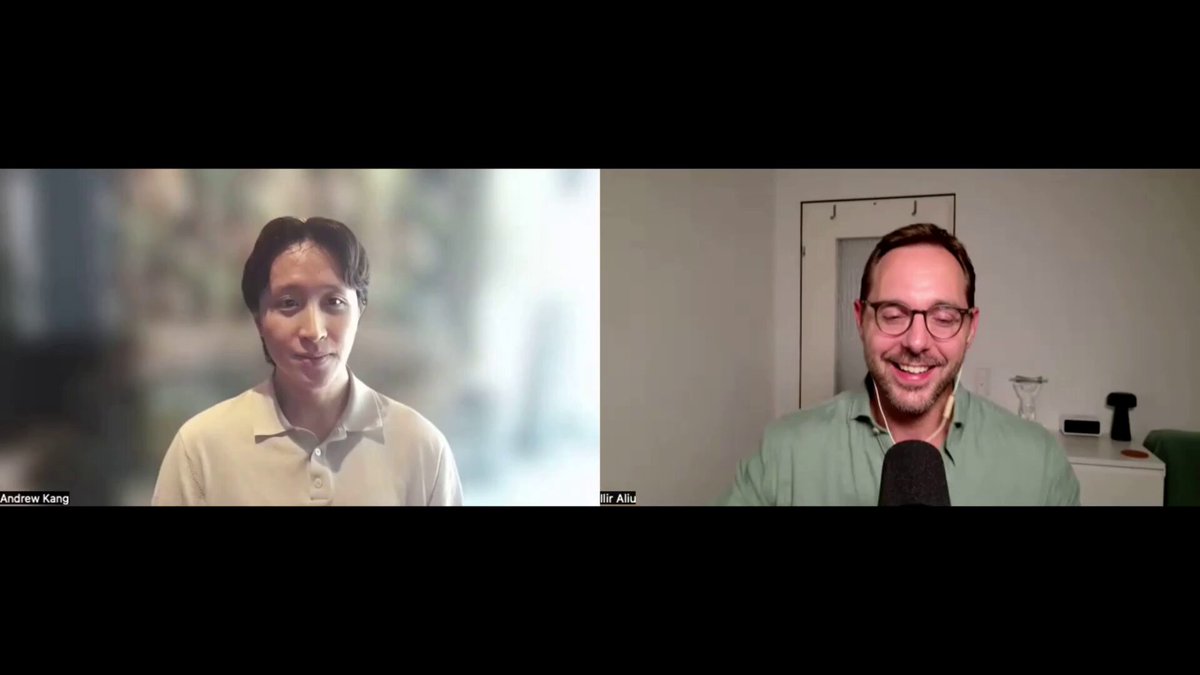
EXCLUSIVE INTERVIEW WITH CHRIS CAMILLO AND AMIT KUKREJA We sat down with Chris Camillo and amit for a full length conversation on the state of humanoid robotics, the timeline, the supply chain, and where the investable opportunities actually are. Here is the full video with timestamps: 0:47 The current...

26,207 Aufrufe • vor 1 Monat •via X (Twitter)

0 Kommentare

Keine Kommentare verfügbar

Kommentare vom Original-Post werden hier angezeigt

Ähnliche Videos

Sergey Levine (Sergey Levine) is one of the world's top robotics researchers and co-founder of Physical Intelligence. We talked about where humanoid robotics is today, thoughts on the Chinese robotics ecosystem, and his predictions for future timelines. In this episode: • Current state of robotics and surprising capabilities so far • Chinese robotics compared to US ecosystem • If OpenAI and Anthropic got into robotics • His top robotics research paper recommendation • Predictions for when humanoid robotics will land Where to watch: • YouTube - • Spotify - • Apple Podcasts - • Transcript - Thank you to the sponsor of this episode for supporting my work: • WorkOS: makes your app Enterprise Ready with easy to use APIs to add SSO, SCIM, RBAC, and more in just a few lines of code, check them out at Chapters: 00:00 Intro 00:37 Where are we today 04:20 Most surprising capabilities so far 07:03 The most inspiring real world robotics 08:36 If OpenAI or Anthropic got into robotics 10:22 Chinese robotics 13:15 Will one lab breakout from the rest 16:59 Thoughts on a concrete roadmap 21:03 Generalization and demonstrating it 26:04 Types of data and which is best for robotics 34:34 Why humanoid robotics differs from Waymo 37:10 If humanoid robotics failed here is why 39:55 Are there hot take modeling architectures in robotics 42:05 Thoughts on AI safety in robotics 46:44 Top robotics research paper recommendation 49:35 Why is Boston Dynamics less top of mind 53:47 Advice for his younger self 56:42 Outro

Ryan Peterman

70,752 Aufrufe • vor 1 Monat

My conversation with Sergey Levine (Sergey Levine). Sergey is the co-founder of Physical Intelligence -- a company building foundation models that can control any robot to do any task in any environment. The company's thesis is that generality is more scalable than specialization, meaning that a model trained across many different robots and tasks will ultimately outperform any system built to do one thing well (eg, just wash dishes). Sergey is a researcher by background, but I think you will appreciate how practical and commercially grounded this conversation is. We discuss: - Why changing a diaper will be the last task a robot masters - The simulation v. real-world data debate - How multimodal LLMs give robots common sense - Moravec's Paradox + Robot Olympics - Why robots can do long-horizon tasks now - A realistic timeline for robots in our homes I should note that I am an investor in Physical Intelligence -- I made the investment because I believe it is one of the most important companies tackling the problem of robotics. Enjoy! Timestamps: 0:00 Intro 2:39 Defining Physical Intelligence 5:19 The Challenge of Building General Models 6:34 The Stakes and Future of General Purpose Robotics 8:15 Pros and Cons of Humanoid Robots 10:12 Historical Milestones in Robotics Research 15:31 Combining Generative AI and Deep RL 21:24 Moravec's Paradox 25:33 Kitchen Robots 29:30 Simulation vs. Real-World Data 30:48 The Robot Olympics 36:31 The Physiological Reality of Embodiment 38:56 Controversies in the Robotics Community 44:18 What Makes a Great Researcher 48:27 How Businesses Should Prepare for Robotics 54:09 Tracking Progress Through Research Papers 57:02 The Next Step: Mid-Level Reasoning 1:02:00 The Kindest Thing

Patrick OShaughnessy

134,397 Aufrufe • vor 6 Monaten

I spoke with Andrew Kang, Co-Founder and CEO of RoboStrategy. RoboStrategy already holds concentrated positions in industry-defining companies including Figure, Apptronik, Standard Bots, and Dyna Robotics. It is the first publicly listed vehicle purpose-built to give investors liquid exposure to private robotics and physical AI giants, applying the MicroStrategy capital-markets playbook to automation. The first episode of the third season! Full interview now live: Ep 101 | Investing $19M in Humanoids with Zero Robotics Experience 📽️ YouTube: 🎧 Spotify: And thanks for making this happen, intern & Humanoid Scott, Jack 🤖! Timestamps 0:00 Why we built a public fund for private robotics 0:35 Building the MicroStrategy for robotics 1:22 Escaping the tiger parent trap 2:11 Video games are elite training for game theory and critical thinking 6:30 Learning arbitrage in RuneScape and Neopets 7:59 Don't believe experts just because of their titles 10:24 Why investing is just a video game with real money 12:40 Harvard nutrition professors don't know what they're talking about 18:48 Recreating global finance from first principles 19:57 Why robotics is the early days of crypto all over again 21:50 Realizing humanoids are no longer sci-fi 22:58 Why I wrote a $19M check when every VC told me not to 27:24 How SPVs are democratizing venture investing 30:55 Bet on the founder and their execution speed, not the pitch deck 36:39 The math behind a $50 trillion physical labor market 41:44 Applying the MicroStrategy playbook to private markets 45:48 Humanoids are the GPUs of physical labor 47:48 Building a new SoftBank for the robotics era 50:51 Why robotics startups need engineers for attention 54:35 Don't be satisfied with surface level answers

Ilir Aliu

16,683 Aufrufe • vor 2 Monaten

🦔Workers in India are wearing head-mounted cameras for 12 cents an hour to collect training data for humanoid robots. The footage of them doing everyday tasks like cooking, cleaning, sorting, and walking through public spaces gets sold to robotics companies building the models meant to replace those same kinds of jobs in higher-wage countries. The arrangement has been running for roughly two years. Workers do not own the data, do not get residuals, and in many cases are not told what their footage is being used to train. My Take The workers wearing the cameras live in a country where robotics automation will hit decades later, so they are training their own future replacements at a delay that hides the consequence from them personally. The companies buying the data are mostly US and Chinese, building humanoid robots aimed at warehouses, retail, and service jobs in countries paying $15 to $25 an hour rather than 12 cents. Robotics companies need motion data that mimics how humans actually move through real environments, and synthetic data has not been good enough yet. Paying 12 cents an hour in Bengaluru is cheaper than running motion capture studios in Boston, and it works at scale because the worker absorbs the cost of the camera, the discomfort of wearing it, and the long-term loss of any rights to their own movement data. The robotics labor market that eventually emerges from this footage will displace far more wages than the data collection cost to gather. That is the trade investors funding humanoid robotics startups are betting will pay off, and the workers in the videos are the ones paying the tab up front. Hedgie🤗

Hedgie

162,060 Aufrufe • vor 4 Monaten

Elon just dropped a MAJOR nugget on how Tesla is going to be training Optimus to do real world tasks. They are building an Optimus Academy, which is a large scale, dedicated real-world training facility to accelerate the development of Optimus. The Academy will deploy thousands of Optimus units, potentially 10,000 to 30,000 robots, in a controlled realistic environment where they perform self-play, experiment with tasks, iterate on behaviors, and continuously generate training data through trial and error. The Tesla bots will also run millions of simulations in Tesla’s high-fidelity physics-accurate engine, allowing Optimus to close the “sim-to-real gap” by using these real-world observations to refine and validate the simulations! “You’re actually highlighting an important limitation and difference from cars. We’ll soon have 10 million cars on the road. It’s hard to duplicate that massive training flywheel. For the robot, what we’re going to need to do is build a lot of robots and put them in kind of an Optimus Academy so they can do self-play in reality. We’re actually building that out. We can have at least 10,000 Optimus robots, maybe 20-30,000, that are doing self-play and testing different tasks. Tesla has quite a good reality generator, a physics-accurate reality generator, that we made for the cars. We’ll do the same thing for the robots. We actually have done that for the robots. So you have a few tens of thousands of humanoid robots doing different tasks. You can do millions of simulated robots in the simulated world. You use the tens of thousands of robots in the real world to close the simulation to reality gap. Close the sim-to-real gap.”

Teslaconomics

42,563 Aufrufe • vor 8 Monaten