Video wird geladen...

Video konnte nicht geladen werden

Zur Startseite

EXPLORE PRIMLAND. NOW. 🌲🍃🍂🍁 12.000 acres. 4 scenes. Multiple seasons. Trees. Clouds. Birds. Shadows. Masks. Postprocessing. A custom pipeline. The Blue Ridge Mountains, modeled and rebuilt in Three.js & #WebGL. Not a website—an explorable landscape. Explore it ↓↓

367,167 Aufrufe • vor 7 Monaten •via X (Twitter)

0 Kommentare

Keine Kommentare verfügbar

Kommentare vom Original-Post werden hier angezeigt

Ähnliche Videos

Your our history shouldn’t be taught in a boring way 🫠 I’ve always loved history, but I could never imagine what life actually looked like back then. So I built Empire Atlas, a 3D interactive explorer of 8 historical empires using Three.js and Kimi.ai K3 🔥 It lets you explore how people lived, what their homes looked like, their maps, daily life, interiors, and more. Properly researched. But the craziest part is that this was near one shot vibe coded with Kimi K3 🤯 When I previously built a 3D anatomy app with GPT 5.6 sol, I had to iterate on performance and optimization. With Kimi, the moment I handed over the 3D assets (generated using Tripo), prompt and design (by GPT Image 2.0), it created an 11 step engineering plan to build the entire thing. The very first step it did was optimizing the assets. It took nearly 500MB of 3D assets and brought them down to just 17.8MB using mesh simplification, Draco compression, and 1024px WebP textures. Absolutely nuts. It also generated 56 historical images across the 8 empires showing daily life, maps, interiors, and more using its image plugin with batch processing. Those were converted to WebP too, bringing the total image size to around 10MB. That’s a huge reason the experience loads so fast on website. It's engineering workflow or intelligence has really impressed me so far. The only downside is that it took more than 5 hours, though 😅 Anyway, back to history. In Empire Atlas, you can explore 8 different empires and see how people and our ancestors lived at that time. I really love those textures I was able to create using Tripo. You can explore their homes in 3D, and there’s so much more we could do with this. We could extend these houses into fully explorable interiors and create increasingly realistic reconstructions of what life actually looked like. And maybe create fun education games too. I genuinely think this can make history education so much more immersive. Much more than showing black and white images in boring textbooks. Go explore your history now 👇 Live: Code:

The Bugged Dev

119,175 Aufrufe • vor 23 Tagen

Apple's product pages have that scroll effect. The camera flies through a 3D world. Products float. Scenes transition. No cuts. One continuous flight driven by your scroll wheel. Here is what one costs to build in 2026. Big storytelling agencies (Noomo, WithLore, Utsubo): $15,000 to $100,000. Three to six months. A team of designers, 3D artists, and WebGL developers. Awwwards-tier flagship from a senior freelancer: $8,000 minimum. Three.js multi-scene site with GSAP scroll: $3,500 to $8,000. That is if you can find a Three.js specialist. They charge $75 to $150 an hour. There are fewer of them than there are brands that want the site. Now meet scroll-world. A free, open-source agent skill for Claude Code and Codex that generates the entire thing from a prompt. Describe your brand. Describe the scenes. "A coffee brand. Start outside the farm. Fly into the roasting facility. Pass through the packaging. Land in the cafe." It generates the isometric stills. It generates the camera flights. It generates the connector clips between scenes from the actual boundary frames of both neighbors, so every seam is pixel-identical. No flicker. No cut. One continuous flight. Then it wires the chain into a portable vanilla JS scroll engine that drops into plain HTML, Next.js, or Vue. One prompt. Hours. Not months. 6,096 stars on GitHub in 25 days. 724 forks. MIT license. Built by cyw, founder and CTO of Hermai AI, out of San Francisco. Here is what scroll-world does: - Interviews you on brand, scenes, art direction, and budget before spending a cent - Generates the isometric stills through GPT Image 2 - Generates the camera flights through Seedance on Monid - Renders a native 9:16 portrait chain for mobile, not a crop - Ships a vanilla JS scrub engine with blob-seek, lazy load, and seam crossfade - Installs into Claude Code as a plugin or Codex through the Vercel skills CLI - Framework-agnostic Here is what scroll-world costs to install: Zero. Forever. Generation burns credits. A 6-scene 1080p chain on Monid pay-per-clip lands around $27, printed before the run starts. Big storytelling agency: $15,000 to $100,000. scroll-world: $27. Awwwards WebGL flagship: $8,000. scroll-world: $27. Three.js contractor for a month: $12,000. scroll-world: this afternoon. Your brand. Your world. Your scroll. 100% Open Source. (Link in the comments)

Nav Toor

353,967 Aufrufe • vor 1 Monat

Tu B’Shvat is a holiday which is deeply tied to the land of Israel. It’s a reminder that Judaism is an indigenous faith rooted in the seasons and the fruits of this land. The seven species mentioned in the Bible, wheat, barley, grapes, figs, pomegranates, olives, and dates, aren’t just symbolic. They represent a tangible connection to an ancient agricultural heritage and the physical land that shaped Jewish identity. In the Middle Ages, the custom developed to celebrate Tu B’Shvat with a feast of fruits. And in the 16th century, the Kabbalist rabbi, Yitzchak Luria, instituted a Tu B’Shvat seder, which is similar to the Passover seder, in which Jews all over the diaspora were able to reconnect to the land of Israel through eating her indigenous fruits. According to Kabbalah, when you eat fruits from the trees, it helps a human soul evolve. And Judaism is about being present to every single thing that you do and everything that you eat as well. Tu B’Shvat reminds us that Judaism and the land of Israel are inseparable. The roots of the Jewish people are right here. And to celebrate Tu B’Shvat is to celebrate Zionism, not as a modern political movement, but as a profound acknowledgement of a people’s enduring bond with the land of their ancestors. The land of Israel isn’t just a backdrop to Jewish history. It’s part of the story itself. And every seed sown, every tree planted, and every fruit harvested and eaten is a continuation of that story. Chag Tu B’Shvat Sameach, everyone. 🍃

Noa Tishby

31,797 Aufrufe • vor 7 Monaten

A forgotten kingdom waiting above the sky. Used Script to video skill on FlovaAI FlovaAI_Japan prompt Title: "The Castle Above the Clouds" Duration: 45 seconds Style: Grounded naturalistic photoreal cinematic adventure drama, live-action feature film quality, anamorphic 35mm film look, realistic medieval atmosphere, emotional performances, natural sound design, shallow depth of field, atmospheric lighting, epic scale, realistic geology, no fantasy exaggeration. Main Characters: ELIAN (32) — A medieval historian and explorer, calm and observant, wearing a weathered dark leather coat, linen shirt, travel boots, carrying an old leather journal. MARA (29) — A skilled mountain guide, intelligent and fearless, wearing a practical wool cloak, leather gloves, climbing gear, carrying a small lantern and ancient map. Scene 1 — The Fortress Above the World (0–10 seconds) EXTREME HIGH VANTAGE POINT — CASTLE BATTLEMENT TERRACE — MORNING A sweeping aerial establishing shot reveals a massive medieval castle standing on a sheer alpine cliff nearly 1000 meters above the valley floor. The camera slowly moves across the open stone battlement terrace. No people are visible at first. Foreground: Weathered pale sandstone parapets dominate the frame. Ancient crenellations line the edge. The stone is covered with realistic cracks, worn mortar, chipped corners, patches of moss and lichen. A castle tower rises on the left side of the frame with narrow arched windows glowing in warm sunlight. The camera slowly approaches the cliff edge. Beyond the parapet: A terrifying vertical drop disappears into clouds. Far below, the valley appears miniature: A turquoise river winds through green farmland. Tiny villages with red rooftops sit beside the water. A medieval town with walls and towers rests on a distant ridge. The enormous mountain range fills the horizon, glaciers glowing under sunlight. Clouds drift BELOW the castle terrace. Sound Design: Strong mountain wind. Distant bells from the valley. Soft orchestral strings begin. Scene 2 — The Forgotten Map (10–20 seconds) EXT. CASTLE COURTYARD — MORNING The camera moves through an ancient stone courtyard. Empty armor stands beside old wooden doors. Sunlight enters through towering arches. Elian walks slowly through the courtyard, studying carvings on the castle walls. Mara follows behind carrying an old rolled map. She opens it on a stone table. The map shows the surrounding mountains and a hidden route marked through the peaks. MARA "This path hasn't been walked in three hundred years." Elian touches the faded markings. ELIAN "Then why was it hidden instead of destroyed?" Mara looks toward the towering mountains outside. MARA "Because some places are forgotten for a reason." A strong wind blows through the courtyard. The castle bells ring once. Scene 3 — The Edge of the Unknown (20–32 seconds) EXT. CASTLE BATTLEMENT — AFTERNOON Elian and Mara stand on the highest terrace overlooking the impossible landscape. The camera circles them slowly. They look incredibly small against the mountains. The valley below glows with golden sunlight. Clouds move between the castle and the world below. Mara points toward a distant mountain ridge. MARA "Beyond those peaks is the old fortress of Aurelian." Elian looks through a small telescope. Far away, barely visible on a rocky summit, sits another ancient castle. ELIAN "No one could build there." Mara smiles slightly. MARA "Someone did." The camera pushes toward the distant fortress. Snow-covered peaks rise behind it. Thunder rolls softly in the distance. Scene 4 — The Storm Approaches (32–40 seconds) EXT. MOUNTAIN PATH BELOW THE CASTLE — LATE AFTERNOON Elian and Mara descend along a narrow stone path carved into the cliff. The castle towers above them. A dramatic weather shift begins. Massive clouds gather around the mountain peaks. Wind increases. Loose dust moves across the ancient path. Mara stops and looks upward. MARA "The mountain is changing." Elian looks back toward the castle. ELIAN "Then we move faster." The camera rises high above them. They become tiny figures against the massive landscape. Scene 5 — The Final View (40–45 seconds) EXT. ALPINE RIDGE — SUNSET A final cinematic wide shot. The camera rises above the mountains. The medieval castle stands alone on its cliff, surrounded by glowing clouds. The valley below reflects the orange sunset. The river shines like a ribbon of gold. Elian's voice echoes softly. ELIAN (V.O.) "Some kingdoms are remembered because they conquered the world..." A pause. The camera moves toward the endless mountains. ELIAN (V.O.) "Others are remembered because they dared to reach beyond it." Cut to black. END. Visual Notes: Realistic medieval architecture inspired by Alpine castles and mountain fortresses No magic, no fantasy creatures, no exaggerated landscapes True scale: humans remain tiny compared to nature Cinematic 35mm grain, anamorphic lens flares, realistic atmospheric depth Natural mountain wind, distant bells, footsteps on stone, subtle orchestral score. #Flovaai #Flovacpp

Sharon Riley

604,606 Aufrufe • vor 1 Monat

This is insane. An AI agent can run every boring job in outbound. We spent the last 6 months building ours. Here are my 8 favorite agents to build: Replies get sorted before we open the inbox. Campaigns go live from one command. Weak inboxes pull themselves out before they hurt a domain. Here are the agents behind it: 1. Reply Agent Reads every reply and drafts the response. A human reviews, edits, and sends. 2. Mailbox Health Agent Watches inbox and domain health. It predicts when you need new mailboxes, then buys and warms them. 3. Campaign Optimizer Agent Checks every live campaign every 6 hours. If 500+ leads were emailed and replies are under 4%, it tests new copy, replaces inboxes replying under 1%, and shifts sending to better hours. 4. Lead Qualification Agent Scores each lead by company size, industry, and tech stack. It enriches the record, updates your CRM, and only loads qualified leads into campaigns. High-priority prospect? You get a Slack ping. 5. Meeting Booking Agent Finds meeting requests inside replies. It books the slot, writes prep notes using the lead's background, sends reminders, and logs the outcome. 6. Pipeline Progression Agent Tracks opens, clicks, and website visits. It moves the CRM stage, triggers the next sequence, and creates a task when a lead shows real intent. 7. Copywriting Agent Writes cold emails and follow-ups in the campaign's voice. 8. Analytics Agent Watches campaign metrics in real time and explains what to fix in plain language. We built ours with custom code. Smartlead's SmartAgents let you build agents like these from a plain-English prompt, inside the platform where your campaigns already run. If you repeat an outbound task more than twice a week, that is an agent you have not built yet. Which one would you build first?

Hosun Chung

156,625 Aufrufe • vor 1 Monat

In the past few weeks, I deep dived into an exploration revolving around the use of physical interfaces to feed and interact with a real-time img2img diffusion pipeline using Stream Diffusion and SDXL Turbo. What really captivated me is to use my hands, objects, art supplies, tools, and light to create images and scenes. 𝗣𝗵𝘆𝘀𝗶𝗰𝗮𝗹 𝗠𝗲𝗱𝗶𝗮 + 𝗧𝗼𝗼𝗹𝘀 I experimented with clay, manipulating different types and colors along with a selection of prompts. I used a magnifying glass, tracked in real-time, to focus the diffusion process on specific areas. Combining these tools created a dynamic and inspiring experience. Using magic clay to layer shapes and colors as a base for revealing landscapes and hidden worlds, and the magnifying glass to focus and reveal these details, was particularly effective. 𝗣𝗵𝘆𝘀𝗶𝗰𝗮𝗹 𝗟𝗶𝗴𝗵𝘁 I used light as my method of interaction with the img2img diffusion. This approach felt special right away. There was something magical about holding a physical light source and seeing it influence the generated visuals. I iterated on this technique with themes like Rococo architecture, flowers, Brutalist architecture, hidden worlds, and origami landscapes. 𝗜𝗻𝗸 + 𝗛𝘆𝗯𝗿𝗶𝗱 𝗙𝗼𝗿𝗺𝗮𝘁𝘀 I also used ink in milk as a means of physical interaction with the diffusion pipeline. As I drop ink into milk, shapes come alive instantly. By learning to manipulate the combination of physical and digital elements, I steered the generated output toward my areas of interest. These iterations extended beyond ink in milk to include the format in which these elements are contained: a circular plate or a triptych of small stainless steel trays. These formats provide a structured yet flexible framework to explore themes and narratives across multiple visual spaces. It's magical. Some of that last iteration has been captured in this insightful article by Fast Company: #stablediffusion #realtime #ai

Hugues Bruyère

86,381 Aufrufe • vor 2 Jahren

On this day, 52 years ago, John Cassavetes' "The Ki!!ing of a Chinese Bookie" (1974) was released in the USA. John Cassavetes explaining why he made the movie: "'A Woman Under the Influence' (1974) was the first picture I’ve had anything to do with that wasn’t made out of plain, simple feeling, but rather out of a real desire to do something in my profession. It was extremely frightening for me not to come to work out of enthusiasm and instead put myself up as something of a craftsman. Earlier films such as 'Shadows' (1958) and 'Husbands' (1970) grew out of personal experiences reaching all the way back to my childhood days. They were expressions of my innermost feelings, and now that I’ve dealt with all that, I feel obligated to view life in other terms. I want to explore other areas of human and artistic experience. I made 'The Ki!!ing of a Chinese Bookie' (1976) as an intellectual experiment– not because I am in love with it. I enjoy a more intellectual and less emotionally demanding view than in my previous work. If I can make, out of certain intellectual ideas, films that are complex in their nature, then I’m entering into new ground. And that is certainly something I look forward to. It is a film that has little to do with me and with how I feel about life. It’s interesting to me to see how other people live in our society, to look at them and ask myself, ‘Why do they do it? And how do they do it?’ Without trying to explain. The fun and challenge of the film was to imagine a self-contained world different from the one I live in: to move into it and live in it." ("Cassavetes on Cassavetes", edited by Ray Carney, 2001)

DepressedBergman

86,531 Aufrufe • vor 6 Monaten

🚨 SIGGRAPH Asia 2025 Paper Alert 🚨 ➡️Paper Title: WorldExplorer: Towards Generating Fully Navigable 3D Scenes 🌟Few pointers from the paper 🎯Generating 3D worlds from text is a highly anticipated goal in computer vision. Existing works are limited by the degree of exploration they allow inside of a scene, i.e., produce stretched-out and noisy artifacts when moving beyond central or panoramic perspectives. 🎯 To this end, authors of this paper proposed “WorldExplorer”, a novel method based on autoregressive video trajectory generation, which builds fully navigable 3D scenes with consistent visual quality across a wide range of viewpoints. 🎯They initialize their scenes by creating multi-view consistent images corresponding to a 360 degree panorama. 🎯Then, they expanded it by leveraging video diffusion models in an iterative scene generation pipeline. 🎯Concretely, they generated multiple videos along short, pre-defined trajectories, that explore the scene in depth, including motion around objects. 🎯Their novel scene memory conditions each video on the most relevant prior views, while a collision-detection mechanism prevents degenerate results, like moving into objects. 🎯Finally,they fuse all generated views into a unified 3D representation via 3D Gaussian Splatting optimization. 🎯Compared to prior approaches, WorldExplorer produces high-quality scenes that remain stable under large camera motion, enabling for the first time realistic and unrestricted exploration. 🎯They believe this marks a significant step toward generating immersive and truly explorable virtual 3D environments. 🏢Organization: TU München 🧙Paper Authors: Manuel-Andreas Schneider, Lukas Höllein , Matthias Niessner 📝 Read the Full Paper here: 🗂️ Project Page: 🧑‍💻 Code: 🎥 Be sure to watch the attached Technical Summary Video - Sound on 🔊🔊 Find this Valuable 💎 ? ♻️QT and teach your network something new Follow me 👣, naveen manwani , for the latest updates on Tech and AI-related news, insightful research papers, and exciting announcements. #SIGGRAPHAsia2025

naveen manwani

10,578 Aufrufe • vor 11 Monaten

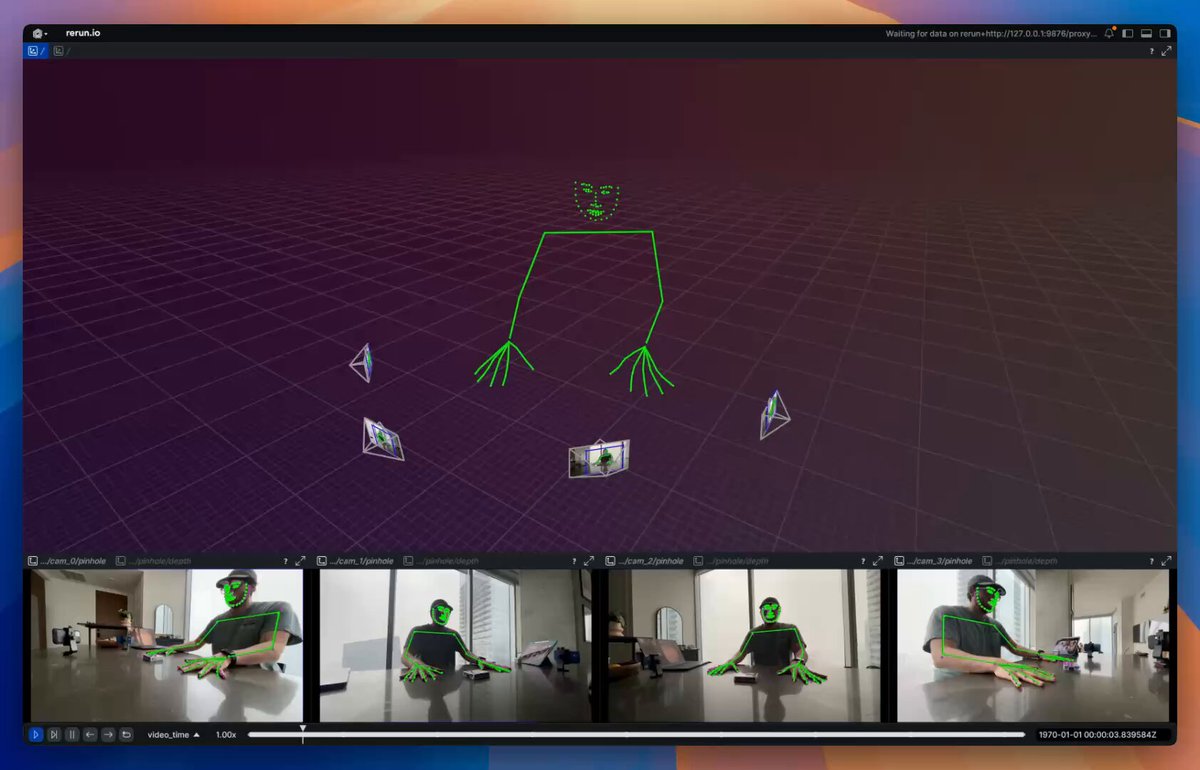
MVP of Multiview Video → Camera parameters + 3D keypoints. Visualized with Rerun The basic pipeline as of right now looks like this: 1. Capture 🔴 – Using 4 iPhones and an Insta360 Go. iPhone videos are captured via Final Cut Pro Multicam for easy sync and the exocentric view; the Insta360 Go is used for the egocentric view. 2. Sync 🕒 – Custom Gradio app using two Rerun viewers and callbacks for easily aligning frame timestamps so the ego and exo views are aligned. 3. Calibrate 🎯 – Use VGGT from Jianyuan and AI at Meta to get intrinsics/extrinsics for sparse cameras. 4. Estimate 3D 🕺 – Use RTMLib whole‑body keypoint estimator on each frame, then triangulate in 3D. What's missing? 1. No temporal coherence: I’m estimating keypoints one frame at a time and one camera at a time. This leads to a lot of jittering. For now, I plan on adding a One Euro Filter to help with jittering. Long term, I'd want to train a multiview keypoint estimator 2. Kinematic fitting is still missing; this is my next goal. The output will be joint angles, as explored in my previous posts. 3. Missing dense point cloud: VGGT seems to fail for me here. I’m looking to explore using MP‑SFM as a method for generating dense multiview depth maps + normals (plus it has a friendlier license compared to VGGT). 4. Eventually, creation of 4D Gaussian splatting using something akin to DN‑splatter—my long‑term goal is a data engine that provides poses/depths/splats/keypoints/etc.

Pablo Vela

42,785 Aufrufe • vor 1 Jahr

Pylon's 𝗺𝗼𝘀𝘁 𝗵𝗮𝘁𝗲𝗱 𝗳𝗲𝗮𝘁𝘂𝗿𝗲 is our Analytics. That ends today. We've completely rebuilt our Analytics from scratch. Here's what we tried, what we screwed up, and what's coming. 𝗩𝗲𝗿𝘀𝗶𝗼𝗻 𝟭, The Basics (Nov 2023) Our first attempt at analytics was quite loved by customers. At the time our customers were mostly small startups with simple needs. We built an out-of-the-box set of dashboards that covered the common use cases of support analytics (SLA-tracking, CSAT, TTFR, TTR, basic filtering...). As we moved upmarket... 1/ Everyone was requesting custom metrics 2/ Queries were becoming inefficient and slow We needed an upgrade. 𝗩𝗲𝗿𝘀𝗶𝗼𝗻 𝟮, Advanced Reporting (June 2024) We knew custom reporting was going to be blackhole of work that long-term led to fully customer-customizable dashboards. We had four choices: 1/ Do nothing for now 2/ Do custom work per customer 3/ Build full custom reporting in-house 4/ Use an embeddable analytics vendor At the time Pylon was under 10 people total and we had no capacity to do the frontend work so we chose Option 4 (use a vendor). This was the first time we chose to not build a core feature like this in-house as we ultimately want full control of the end-user experience. We built out the new reporting with the chosen vendor over ~3 weeks. On the surface the new reporting looked really good (not visually, but in terms of functionality). You could add custom charts of any type, create custom formulas, label the Y and X axis, and effectively build most of what you would want. It was really great for demos. But in practice it was incredibly hard to use, lacked core capabilities (like the ability to filter off of dynamic custom fields), and visually looked not stylized to the rest of the product. We started to discover some of these issues during the implementation, but it still felt like there was more upside than downside so we released it. Feedback was not great but we hoped our vendor would fix changes quickly. Unfortunately they weren't fast enough and we lost confidence that they would be a good long-term solution. As a stop-gap we also built out a data warehouse integration so customers could export their data back to Snowflake or BigQuery to use with their own BI tools. Finally, a few months ago the vendor told us they were being acquired. That was the final straw. We needed to move off ASAP. 𝗩𝗲𝗿𝘀𝗶𝗼𝗻 𝟯, New Reporting (Today) Today's release is back to being built entirely in-house. It's been rolled out in beta to all customers with an option to flip back to old analytics until we plug some custom reporting gaps. This time we have the capacity to do it right between Wendy (prev product design at Amplitude), Matt, and Tom. We've managed to greatly improve: 1/ Desired filter options (custom field support) 2/ Performance 3/ Setup UX 4/ Style (looks native) Early feedback has been really positive so far and as we bring it out of beta we're thinking about how to make the best natively-offered reporting of any support platform. 𝗩𝗲𝗿𝘀𝗶𝗼𝗻 𝟰 (What's coming soon) To get to first-class reporting, we need to study not only our learnings, but also what the incumbents have screwed up as well. Funny enough, Zendesk's analytics have similar complaints to our v2, and for the exact same reason as we did: they integrated an external tool. In 2015 they bought a company called BIME Analytics which they became Zendesk Explore. The complaints they have to this day are similar to our v2: 1/ Steep learning curve 2/ Advanced, yet still not enough flexibility 3/ Random feature gaps 4/ Data accuracy and reliability concerns 5/ Performance issues 6/ Complicated UX v4 will follow three core principals: Offer a simple default setup. We want to continue being startup friendly and we'll feature gate custom reporting and data exports by tier in the product. Offer maximal configuration, with AI-assisted setup. As we go upmarket, customers will want to Explore (pun intended) data in every single direction. We need to allow them to do that. For those more complicated use cases we think AI will be the Ultimate (also pun intended) way to reduce setup friction. Build it all in-house. Although using a 3rd party embedded analytics provider didn't work for us, we don't think that is the case for everyone. It's just in customer support, reporting is REALLY important. They are probably some of the highest-complexity reporting of most SaaS vendors (maybe second to marketing products). So... we have to do it right. And since this is end-user facing, we have to own every detail of it. If you got this far, thank you for reading. See our new Analytics at

Marty Kausas

115,123 Aufrufe • vor 1 Jahr