Video yükleniyor...

Video Yüklenemedi

Ana Sayfaya Dön

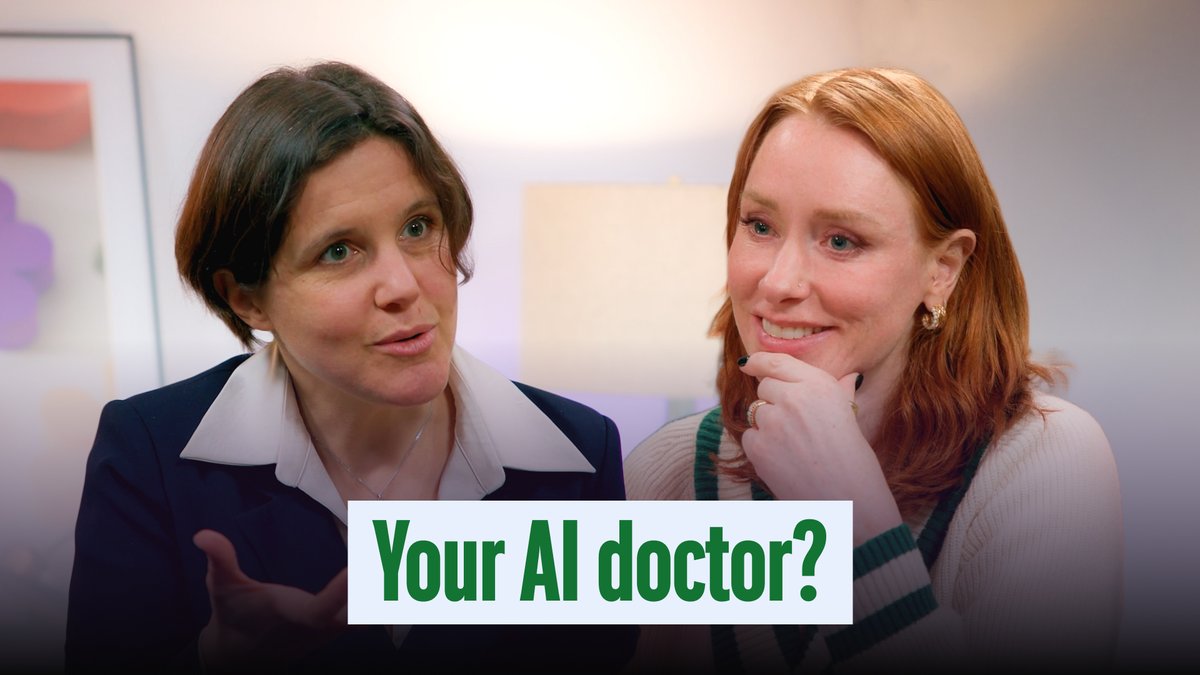
From clumsy movements to dexterous manipulation – how did robotics make such significant leaps? 🤖 Tune into our podcast episode with Hannah Fry and Carolina Parada – our Senior Director and Head of Robotics – to explore how our robots can see, understand, and reason about the world around...

46,956 görüntüleme • 1 yıl önce •via X (Twitter)

11 Yorum

Google DeepMind profil fotoğrafı
Google DeepMind1 yıl önce

Watch → Spotify → Apple Podcasts → Or listen wherever you get your podcasts! 🎧

UserInterface profil fotoğrafı
UserInterface2 yıl önce

Unveiling the Future of Prompt Engineering for Better AI Interactions #tech

Kaynat Kakar ✪ profil fotoğrafı
Kaynat Kakar ✪1 yıl önce

@FryRsquared @parada_car88104 I think in the next Google I/O we will have a surprise from Google in Robotics

gerhardfantaschorle profil fotoğrafı
gerhardfantaschorle1 yıl önce

@FryRsquared @parada_car88104 im not gonna watch two women yap for almost an hour thanks

Maurus Balmer profil fotoğrafı
Maurus Balmer1 yıl önce

How about: ROBOTS <->REASONING<->THINKING<->ACTION(S)<-> <->REASONING<->ACTION(S)<->THINKING<-> <-> <->THINKING<->REASONING<->ACTION(S)<-> <->THINKING<->ACTION(S)<->REASONING<-> - 🙂 🪄

Prashant profil fotoğrafı
Prashant1 yıl önce

@FryRsquared @parada_car88104 The pace of progress has been unbelievable, robotics has indeed come a long way

lil_VaeVictis 😶 profil fotoğrafı
lil_VaeVictis 😶1 yıl önce

@FryRsquared @parada_car88104 @grok can you clip this from the start to about 54 seconds in?

manish kumar profil fotoğrafı
manish kumar1 yıl önce

@FryRsquared @parada_car88104 Fascinating topic! The leap from clunky bots to dexterous robots likely stems from advances in computer vision, AI-driven . Excited to hear how your team is pushing these boundaries – especially how ‘seeing’ and ‘understanding’ transforms into real-world manipulation.

London Man profil fotoğrafı
London Man1 yıl önce

@FryRsquared @parada_car88104 Robots need human mums to show them around. Not bounding boxes or RL or simulations rather learn by experience in the real world. The LLM will do the brain work easily. Gemini is so close now - its exciting. (Well that's my ex-programmer's opinion anyhow)

Cannon profil fotoğrafı
Cannon1 yıl önce

@FryRsquared @parada_car88104 Uma pergunta sincera vocês conseguem provar o que é real ou não? O problema é alguém usar essa tecnologia pra o mal, um exemplo: Um golpe imobiliário.

Sean Holden profil fotoğrafı
Sean Holden1 yıl önce

@FryRsquared @parada_car88104 "You've been listening to Google DeepMind." And you shouldn't, because this was just an advert for Gemini, which is nothing but an exercise in surveillence. DeepMind may well want to do something interesting, but ultimately they are owned by Google, which makes *you* the product.
Benzer Videolar

New episode with Dr. Konrad Kording (Kording Lab 🦖), professor of bioengineering and neuroscience at the University of Pennsylvania (Penn) and co-director of CIFAR's Learning in Machines & Brains program (CIFAR). Konrad works at the intersection of causality, machine learning, and neuroscience, building rigorous methods for causal reasoning when experiments aren't possible — and challenging how researchers interpret neural data and build AI. Konrad argues the most promising path to understanding how the brain works is to read the brain’s wiring directly, down to the molecular detail of each connection, and to build compilers and simulations to understand the brain’s computation directly. In this episode we go deep into how neurons work, how neurons wire together, and how organic and artificial neural networks differ. We discuss why organic neurons are doing much more; how a model of a single organic neuron can solve MNIST — computing more like a 3-layer artificial neural network; how the brain might learn by solving credit assignment with only local signals; how to approximate backprop without a global algorithm; why AI and humans are intelligent along different dimensions; why Konrad isn’t very worried about AI replacing us; economic models of intelligence and physical work; and much more. Konrad is a brilliant, contrarian thinker who explains complex concepts very intuitively. It is a solid computational neuroscience primer. I hope you enjoy this conversation as much as I did! Other links to this episode and references below. Chapters 00:00:00 Introduction 00:01:01 How organic neurons work 00:24:13 How the brain learns: circuits and credit assignment 00:45:29 Recording the brain 00:52:47 Why simulating brains is hard 01:05:00 A new approach: connectomes and compilers 01:21:00 Why simulate brains? 01:29:50 How AI and human intelligence differ 01:41:04 Evolution, intelligence and AI risk 01:52:42 Robotics, causality, and the roots of intelligence 02:05:53 AI for science and scientific rigor 02:13:05 The economics of intelligence 02:27:50 A hopeful future

Juan Benet

49,297 görüntüleme • 1 ay önce