Video wird geladen...

Video konnte nicht geladen werden

Zur Startseite

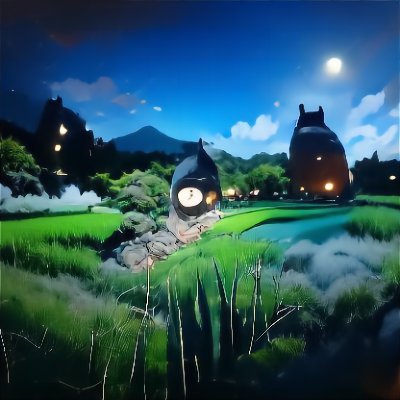
Google presents Still-Moving Customized Video Generation without Customized Video Data Customizing text-to-image (T2I) models has seen tremendous progress recently, particularly in areas such as personalization, stylization, and conditional generation. However, expanding this progress to video generation is still in its infancy, primarily due to the lack of customized video...

40,485 Aufrufe • vor 2 Jahren •via X (Twitter)

5 Kommentare

Profilbild von AK
AKvor 2 Jahren

paper page:

Profilbild von AK
AKvor 2 Jahren

daily papers:

Profilbild von Itamar Zimerman
Itamar Zimermanvor 2 Jahren

Wow. The video examples on the project page look🤯

Profilbild von Hila Chefer
Hila Chefervor 1 Jahr

Thanks for sharing @_akhaliq! 🤩 Check out the thread for more details ☺️

Profilbild von Chansoo Byeon
Chansoo Byeonvor 2 Jahren

@elonmusk this for memes please

Ähnliche Videos

Tencent presents GameGen-O Open-world Video Game Generation We introduce GameGen-O, the first diffusion transformer model tailored for the generation of open-world video games. This model facilitates high-quality, open-domain generation by simulating a wide array of game engine features, such as innovative characters, dynamic environments, complex actions, and diverse events. Additionally, it provides interactive controllability, thus allowing for the gameplay simulation. The development of GameGen-O involves a comprehensive data collection and processing effort from scratch. We collect and build the first Open-World Video Game Dataset (OGameData), amassed extensive data from over a hundred of next-generation open-world games, employing a proprietary data pipeline for efficient sorting, scoring, filtering, and decoupled captioning. This robust and extensive OGameData forms the foundation of our model's training process. GameGen-O undergoes a two-stage training process, consisting of foundation model pretraining and instruction tuning. In the first phase, the model is pre-trained on the OGameData via the text-to-video and video continuation, endowing GameGen-O with the capability for open-domain video game generation. In the second phase, the pre-trained model is frozen, and we fine-tuned using a trainable InstructNet, which enables the production of subsequent frames based on multimodal structural instructions. This whole training process imparts the model with the ability to generate and interactively control content. In summary, GameGen-O represents a notable initial step forward in the realm of open-world video game generation via generative models. It underscores the potential of generative models to serve as an alternative to rendering techniques, which can efficiently combine creative generation with interactive capabilities.

AK

367,200 Aufrufe • vor 2 Jahren