Video yükleniyor...

Video Yüklenemedi

Ana Sayfaya Dön

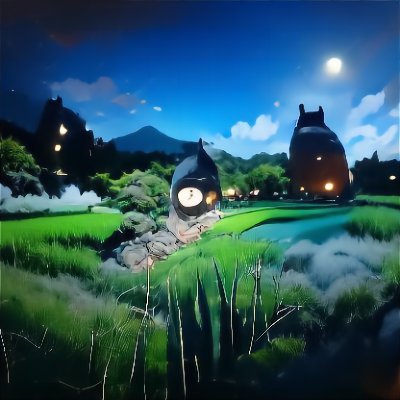
Google presents Still-Moving Customized Video Generation without Customized Video Data Customizing text-to-image (T2I) models has seen tremendous progress recently, particularly in areas such as personalization, stylization, and conditional generation. However, expanding this progress to video generation is still in its infancy, primarily due to the lack of customized video...

40,485 görüntüleme • 2 yıl önce •via X (Twitter)

5 Yorum

AK profil fotoğrafı
AK2 yıl önce

paper page:

AK profil fotoğrafı
AK2 yıl önce

daily papers:

Itamar Zimerman profil fotoğrafı
Itamar Zimerman2 yıl önce

Wow. The video examples on the project page look🤯

Hila Chefer profil fotoğrafı
Hila Chefer1 yıl önce

Thanks for sharing @_akhaliq! 🤩 Check out the thread for more details ☺️

Chansoo Byeon profil fotoğrafı
Chansoo Byeon2 yıl önce

@elonmusk this for memes please

Benzer Videolar

Tencent presents GameGen-O Open-world Video Game Generation We introduce GameGen-O, the first diffusion transformer model tailored for the generation of open-world video games. This model facilitates high-quality, open-domain generation by simulating a wide array of game engine features, such as innovative characters, dynamic environments, complex actions, and diverse events. Additionally, it provides interactive controllability, thus allowing for the gameplay simulation. The development of GameGen-O involves a comprehensive data collection and processing effort from scratch. We collect and build the first Open-World Video Game Dataset (OGameData), amassed extensive data from over a hundred of next-generation open-world games, employing a proprietary data pipeline for efficient sorting, scoring, filtering, and decoupled captioning. This robust and extensive OGameData forms the foundation of our model's training process. GameGen-O undergoes a two-stage training process, consisting of foundation model pretraining and instruction tuning. In the first phase, the model is pre-trained on the OGameData via the text-to-video and video continuation, endowing GameGen-O with the capability for open-domain video game generation. In the second phase, the pre-trained model is frozen, and we fine-tuned using a trainable InstructNet, which enables the production of subsequent frames based on multimodal structural instructions. This whole training process imparts the model with the ability to generate and interactively control content. In summary, GameGen-O represents a notable initial step forward in the realm of open-world video game generation via generative models. It underscores the potential of generative models to serve as an alternative to rendering techniques, which can efficiently combine creative generation with interactive capabilities.

AK

367,229 görüntüleme • 2 yıl önce

MagicAnimate: Temporally Consistent Human Image Animation using Diffusion Model with Gradio demo local demo: This paper studies the human image animation task, which aims to generate a video of a certain reference identity following a particular motion sequence. Existing animation works typically employ the frame-warping technique to animate the reference image towards the target motion. Despite achieving reasonable results, these approaches face challenges in maintaining temporal consistency throughout the animation due to the lack of temporal modeling and poor preservation of reference identity. In this work, we introduce MagicAnimate, a diffusion-based framework that aims at enhancing temporal consistency, preserving reference image faithfully, and improving animation fidelity. To achieve this, we first develop a video diffusion model to encode temporal information. Second, to maintain the appearance coherence across frames, we introduce a novel appearance encoder to retain the intricate details of the reference image. Leveraging these two innovations, we further employ a simple video fusion technique to encourage smooth transitions for long video animation. Empirical results demonstrate the superiority of our method over baseline approaches on two benchmarks. Notably, our approach outperforms the strongest baseline by over 38% in terms of video fidelity on the challenging TikTok dancing dataset. Code and model will be made available.

AK

810,731 görüntüleme • 2 yıl önce