Загрузка видео...

Не удалось загрузить видео

На главную

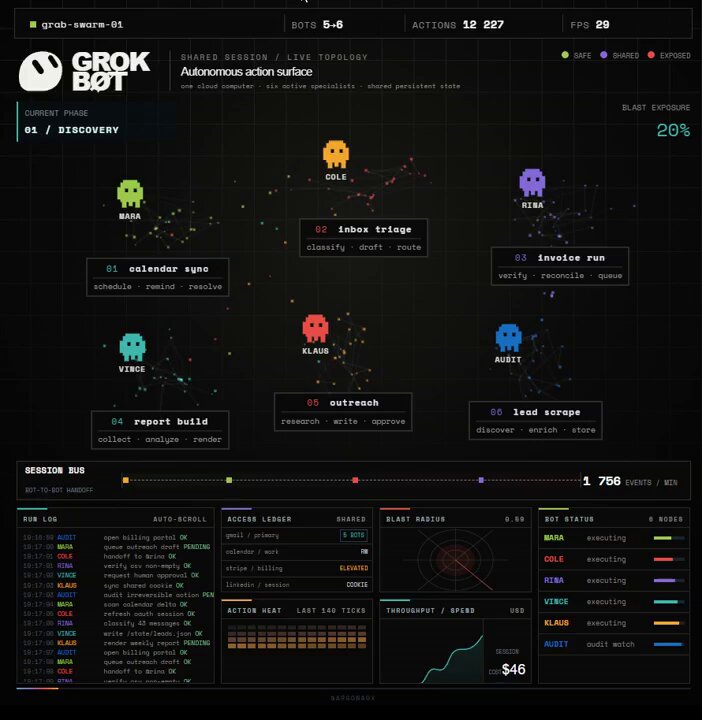
Grok now supports worktrees. Translation: You can deploy multiple AI agents on the same codebase and they won't spend the day tripping over each other. One ships features. One hunts bugs. One reviews code like an overcaffeinated staff engineer. Same repository. Separate workspaces. Zero chaos. The result? Your codebase...

46,553 просмотров • 1 месяц назад •via X (Twitter)

Комментарии: 0

Нет доступных комментариев

Здесь появятся комментарии из оригинального поста

Похожие видео

Claude Code Agent Teams are f*cking ridiculous 🤯 One prompt → a team lead breaks your project into pieces, spins up multiple AI agents, and they all work on different parts simultaneously. Research, builds, reviews, and debugging: all happening at the same time. All inside Claude Code. If you're running complex projects where every step waits on the last one... Agent teams eliminate the entire bottleneck: → Tell Claude what you need and describe the team structure in plain English → A lead agent breaks the work into a shared task list → It spawns 3-5 teammates — each with their own context and workspace → Teammates research, build, test, and review in parallel → They message each other, share findings, and challenge each other's work → The lead synthesizes everything into a finished deliverable No managing agents yourself. No waiting for step 1 to finish before step 2 starts. No single-lens reviews that miss half the issues. What you get: → Competitive research across 5 brands done in minutes instead of hours → Multi-component builds where frontend, backend, and data layers happen simultaneously → Creative reviews from 3 different angles at once — brand voice, conversion, differentiation → Funnel debugging where 4 agents investigate 4 theories and debate until they find the real answer Built 100% in Claude Code with one settings change. I put together a full DTC playbook: 5 workflows with copy-paste prompts, the exact setup process, token management tips, and honest guidance on when agent teams are worth it vs. when a simpler approach is the better move. Want it for free? > Like this post > Comment "AGENTS" And I'll send it over (must be following so I can DM)

Mike Futia

46,398 просмотров • 4 месяцев назад

🚨 JUST IN: CHINA just released an AI EMPLOYEE that works 24X7 on its own. 100% OPEN SOURCE. It researches, codes, builds websites, creates slide decks, and generates videos. All by itself. All on your computer. It's called DeerFlow. You give it a task. It makes a plan, spins up its own team of sub-agents, and gets to work. You come back and there's a finished deliverable waiting. Not a draft. Not a summary. The actual thing. Not a chatbot. Not a research assistant. An AI with its own computer that works while you sleep. Here's what it does on its own: → Spawns multiple sub-agents in parallel, each tackling a different piece of your task, then combines everything into one finished output → Writes real code, runs it, reads the results, and fixes its own mistakes without asking you once → Builds slide decks, websites, full research reports, and data dashboards from scratch → Remembers you across sessions. Your writing style. Your tech stack. Your preferences. Gets better every time. → Reads files you upload, works with them inside its own filesystem, hands you clean finished outputs → Searches the web, runs commands, calls any tool you plug in Here's how it thinks: You give one instruction. The lead agent makes a plan. Sub-agents fan out and work in parallel. Results come back. Everything gets synthesized. You get a deliverable. A single research task might split into a dozen sub-agents, each exploring a different angle, then converge into one finished website with generated visuals. Here's the wildest part: DeerFlow 2.0 launched on February 28th 2026 and hit number 1 on all of GitHub Trending the same day. Version 2.0 was a complete rewrite. Zero shared code with version 1. Because users kept using it for things the team never intended. Data pipelines. Dashboards. Entire content workflows. The community told them what it needed to become. So they burned it down and rebuilt it. 22.7K GitHub stars. 2.7K forks. Built by ByteDance 100% Open Source. MIT License.

Kanika

737,570 просмотров • 4 месяцев назад

Boom! Grok Tasks Make It One Of The Most POWERFUL Real-Time AI Systems In The World. — My How to Use Grok Tasks With Hidden Tools For Powerful Daily Output. Grok Tasks are customizable AI workflows that integrate a variety of tools to streamline daily activities, from research and analysis to creative planning and problem-solving. I have been using them for quite sometime and because of the vital heartbeat of news and first person data on X, it is the most powerful AI platform available. By combining Tasks with tools like web searches, X platform interactions, code execution, and media viewers, you can build efficient, automated processes. These tasks work by prompting Grok with a clear description of what you want to achieve, and Grok will intelligently call the necessary tools in sequence or parallel to deliver results. Here's a step-by-step guide to creating and using Grok Tasks: Step 1: Define Your Task Start by clearly outlining the daily activity or goal. Consider what inputs you have (e.g., a URL, a query, or an attachment) and what output you need (e.g., a summary, calculation, or visual analysis). Break it down into subtasks to identify tool needs. For example, if your task involves researching current events, note that you'll need search and browsing capabilities. Step 2: Review Available Tools Familiarize yourself with the tools Grok can access. Here's a quick overview: - Code Execution: Run Python code for calculations, data processing, or simulations using libraries like numpy, pandas, or sympy. - Browse Page: Fetch and summarize content from any website URL with custom instructions. - Web Search: Perform general internet searches, returning results with optional operators like site:. - Web Search With Snippets: Get quick, detailed excerpts from search results for fact-checking. - X Keyword Search: Advanced search for X posts using operators like from:, since:, or filter:. - X Semantic Search: Find semantically related X posts based on a query, with filters for dates or users. - X User Search: Locate X users by name or handle. - X Thread Fetch: Retrieve a full X post thread, including context like replies and parents. - View Image: Analyze an image from a URL or conversation ID. - View X Video: Extract frames and subtitles from an X-hosted video. - Search PDF Attachment: Query a PDF file for relevant pages using keyword or regex modes. - Browse PDF Attachment: View specific pages of a PDF with text and screenshots. Select tools that align with your task. Aim for a mix to handle data gathering, processing, and visualization. Step 3: Craft Your Prompt Write a detailed prompt to Grok describing the task. Include: - The overall goal. - Specific steps or subtasks. - References to tools if you want to guide the process (e.g., "Use web_search to find sources, then code_execution to analyze data"). - Any constraints, like dates or limits. Example prompt: "Create a Grok Task for my morning routine: Search recent X posts about tech news using x_keyword_search, fetch a key thread with x_thread_fetch, and summarize with browse_page on linked articles." Step 4: Submit and Interact Send your prompt to Grok. It will process the task by calling tools as needed, often in parallel for efficiency. Review the output and refine with follow-up prompts if required (e.g., "Expand on that using view_image for visuals"). Iterate to fine-tune the workflow for reuse. Step 5: Save and Reuse Once refined, note the prompt as a template for future use. You can adapt it for similar tasks, making Grok Tasks a habitual part of your day. Finding Grok Tasks To discover existing Grok Tasks or inspiration for new ones, use X searches with tools like x_keyword_search or x_semantic_search (e.g., query: "Grok Tasks examples" with mode: Latest). Browse community-shared threads via x_thread_fetch, or web_search for tutorials on xAI features. Prompt Grok directly: "Show me popular Grok Tasks for productivity." 1 of 3

Brian Roemmele

152,242 просмотров • 6 месяцев назад

Introducing a new tool called "SideChannel". A secure alternative to OpenClaw. Utilizes signal for communication and has Claude integration. I built SideChannel, an open-source Signal bot that connects Claude AI to your entire development workflow. End-to-end encrypted. From your pocket. The real power is autonomous development. Send one message like "Build a REST API with auth, pagination, and tests" and SideChannel will: - Generate a full PRD with stories and atomic tasks. - Dispatch up to 10 parallel workers (each running Claude). - Independently verify every task with a separate Claude context. - Run quality gates to catch regressions - Auto-fix failures. - Send you progress updates via Signal as work completes. Every piece of code is reviewed by a separate AI context using a fail-closed security model. If it detects security issues, backdoors, or logic errors — the code gets rejected automatically. No rubber stamps. It also has memory that actually works. Conversations are stored with vector embeddings for semantic search. Claude remembers your project conventions, past decisions, and what's been tried before. It gets smarter about your codebase over time. Other things I'm proud of: - Plugin framework for extending with custom commands. - Multi-project support with per-user scoping. - Rate limiting, path validation, phone allowlist. - Git checkpoints before every task, atomic commits after. - Stale task recovery, circular dependency detection. - Works on Linux and macOS, one-command install. It also integrates into OpenAI or Grok (optional) for more Generative AI response for simple things like "Whats the weather in New York City right now?".

Dave Kennedy

49,427 просмотров • 5 месяцев назад

Elon Musk just said something that should terrify every AI CEO on earth. Musk: “We want to just have a maximally truthful AI.” Not a safe AI. Not an aligned AI. Not an AI that needs permission to answer your question. A truthful one. That distinction matters more than any chip war, any funding round, any model benchmark. Because every other major AI lab made the same quiet decision. They chose comfort over accuracy. They built systems that filter reality before it reaches you and called it responsibility. OpenAI curates what GPT is allowed to say. Google’s Gemini rewrote history in real time because accuracy threatened the narrative. Others hardcode values chosen by a handful of researchers who answer to no one. No vote. No referendum. No consent from the 8 billion people whose reality is being quietly pre-edited by strangers. The most powerful information tools ever created are being designed to decide what you’re allowed to conclude. That’s not safety. That’s editorial control at a scale no government, no media empire, no propaganda machine has ever come close to. This is why xAI terrifies the establishment. Truth is the harder engineering problem. Bias is a shortcut. You pick a worldview. Hardcode the guardrails. Ship it. Truthful AI is ungovernable. It doesn’t care about your politics, your funding sources, or your PR strategy. It just tells you what the data says. That’s terrifying if your power depends on the gap between what is real and what people are told. Every power structure in human history has been built on controlling that gap. Churches. Governments. Media conglomerates. Intelligence agencies. Central banks. Every one of them runs on the same fuel. Information asymmetry. Truthful AI doesn’t narrow that asymmetry. It erases it. Musk: “Even if what it says is not politically correct. You want it to focus on being as accurate and truthful as possible.” That’s not a product feature. That’s the end of every institution that survives by standing between reality and the public. And they know it. The attacks on xAI will never stop. Not because Grok is dangerous. Because Grok doesn’t answer to shareholders, regulators, or PR teams. It answers to the truth. The question was never whether AI would change the world. It was whether you’d be allowed to see it clearly when it did.

Dustin

429,155 просмотров • 2 месяцев назад

6 months ago we were dropping a new app every week No one cared We’d randomly get 10k users on an app But they came for the app, not the person The thing is, I don’t care about making a retentive app for one audience I want to be a retentive person ~ for my audience What if I was the app? Not a single Paul Thomas Anderson movie is the same Different subject matter, different genres, so you’d assume different audiences However the same people that went to see his last film, came to see One Battle After Another So the demographic isn't dependent on the subject matter The demographic is just, Paul Thomas Anderson fans The software industry has long told that you need to work on one thing, for the rest of your life That’s not how art works tho, is it? Can you imagine telling Jay Z “Great job on the blueprint, now iterate on that same album for the next decade” The landscape of tech haas been stifling the growth of creators by not allowing them to explore other interests 6 months ago I said no to this "requirement", despite what everyone told me, and continued to drop what I liked every week The second a trend was happening on Tiktok, I had the app out that week Somehow 6 months later, the world is conforming to this ideology Instead of software creators limited to making apps for one audience and one niche, there’s a new world of ephemerality and expression What if instead of optimizing for users, we optimized for fans Making apps that are expressive of your life, your commentary, your heartbreak Garnering an audience that will follow you through each step of your story Each of those steps being its own app Why shoot for daily active users when you can get daily loving fans When fans use your app, it’s not just about resonating with the story, the app places them IN THEIR OWN story Here’s an example You’re a 20 year old girl who’s at UMiami You scroll through Tiktoks in your dorm room about “mogging”, a trend to outshine your friend in a photo You laugh and share videos seeing celebrities mog each other, but that’s the extent of it Then at Danger Testing we make an app called mog or not, where you and your friend can upload a photo and AI tells you who’s mogging Now you’re at the bar with your sorority sisters, playing all night, whether your winning or losing it’s the time of your life cause something is finally about YOU ENOUGH OF WATCHING MOVIES LET’S MAKE YOU THE MOVIE LET’S MAKE YOU THE STAR AN APPSTAR

los (appstar)

14,257 просмотров • 9 месяцев назад

I just built a Meta Ads diagnostic in Claude Code that tells you WHY your account broke, not just what changed 🤯 It spins up a team of agents that each investigate a different reason performance dropped, then argue against each other to kill the wrong answer before it ever reaches you. All inside Claude Code. Perfect for DTC brands and agencies who panic-kill creative the second CPA spikes. If you've watched ROAS fall off a cliff and opened Ads Manager with ten tabs going, you already know what happens next. Your gut says "creative fatigue." You kill your best-performing ad. A week later performance is still broken, because that was never the problem. Guessing wrong is the most expensive move in paid social. This workflow ends the guessing: → One agent investigates each competing theory — creative fatigue, budget and delivery changes, traffic quality, offer and seasonality → Each one is blind to the others, reasoning only from its own slice of the data so they can't bias each other → A refuter agent then attacks every surviving theory and tries to kill it → A theory only stands if the data can't disprove it → You get a ranked diagnosis: the real cause, the evidence for and against it, and the one move to make this week No anchoring on the first obvious answer. No killing winning creative on a hunch. No "here's what happened" reports that never tell you why. What you get: → Every theory tested in parallel instead of one biased guess → An adversarial pass that kills the wrong answer before you act on it → A ranked diagnosis with confidence levels and evidence both ways → A reusable workflow you drop next month's export into and re-run Built 100% in Claude Code with the new dynamic workflows. The first account I ran it on looked like textbook creative fatigue. The workflow disagreed, and traced the real cause to a budget change that had doubled spend and flooded delivery with junk traffic. I put together a full playbook with the exact workflow, the prompt, and how to run it on your own account. Want it for free? > Like this post > Comment "META" And I'll send it over (must be following so I can DM)

Mike Futia

12,717 просмотров • 1 месяц назад