Загрузка видео...

Не удалось загрузить видео

На главную

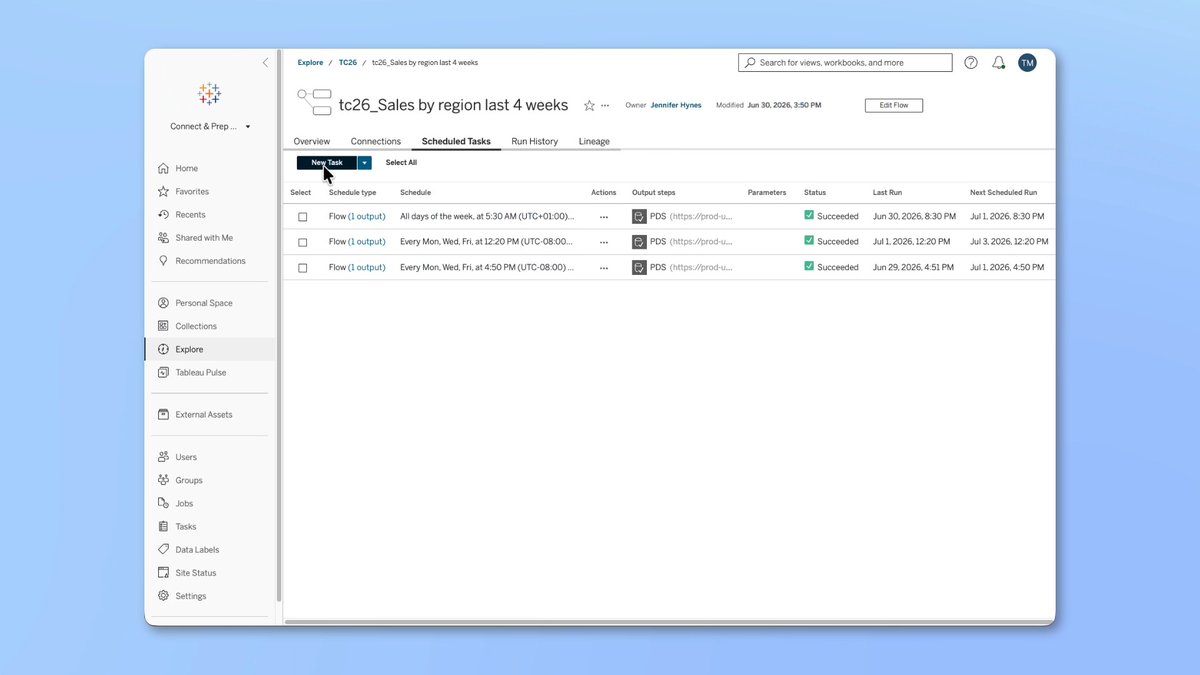
Here's how I would learn data engineering basics in 2025: - Find a data source you care about (examples: gaming APIs, stock market, web scraping, etc) - Use Python to interact and ingest your source. Initially just write the data to a CSV. - Setup an account with Snowflake...

20,363 просмотров • 11 месяцев назад •via X (Twitter)

Комментарии: 5

Фото профиля Nina Taft
Nina Taft11 месяцев назад

Great advise, I would also encourage folks who just started and setting up own infra to setup billing alerts to a)don’t get unexpected bills b)get a legit biz sense in the price of data manipulation

Фото профиля Mobile Scanner
Mobile Scanner11 месяцев назад

Scan any documents, convert images into text, PDF files, etc. 👍

Фото профиля prodigal son
prodigal son11 месяцев назад

Going to incorporate this with my cloud dev studies to add some level of functionality to my pipelines

Фото профиля Row Skilli-Vitzky
Row Skilli-Vitzky11 месяцев назад

What of doing all this with Airbyte , Snowflake and dbtFusion for Ingestion, Storage and Orchestration respectively I’ve been curious to know your thoughts on the future of loading data with python especially as these tools get cheaper

Фото профиля Fran
Fran11 месяцев назад

Gonna try this

Похожие видео

We just launched a major new Data Engineering Professional Certificate on Coursera! Data underlies all modern AI systems, and engineers who know how to build systems to store and serve it are in high demand. If you're interested in learning this skill, please check out this 4-course sequence, which is designed to make you job-ready to be a Data Engineer. This is a new specialization taught by Joe Reis, the co-author of the best-selling book “Fundamentals of Data Engineering," in collaboration with AWS. (Disclosure, I serve on Amazon's board.) For many AI systems, data engineering is 80% of the work, and modeling is 20%. But people’s attention on these two topics is often flipped. This makes the job of the data engineer particularly important. In this professional certificate, you'll learn foundational data engineering skills while implementing modern data architectures using open-source tools: - Learn the key steps of the data lifecycle, to generate, ingest, store, transform, and serve data. - Learn to align with organizational goals to design the data pipeline right for your business' needs. - Understand how to make necessary trade-offs between speed, scalability, security, and cost. Joe has distilled into this specialization decades of experience helping startups and large companies with data infrastructure. He is also joined by 17 other industry leaders in the data field, who will help you learn in-demand skills for the growing field of data engineering. Please sign up here:

Andrew Ng

118,937 просмотров • 1 год назад

Your agents can't keep up with real-time data. Especially when it's scattered across dozens of sources. Most teams waste weeks building custom connectors for every database, API, and data warehouse. Then they build ETL pipelines to sync everything. By the time your agent retrieves the data, it's already outdated. Picture this: Your Postgres database updated 5 minutes ago. Your MongoDB collection changed 2 minutes ago. Your agent is still pulling from yesterday's snapshot. This is why most production RAG systems fail. There's a better approach: MindsDB is an open-source AI platform with a federated data engine that lets you query multiple data sources in real-time using SQL - without moving any data. Here's what makes it different: ↳ Your data stays in place. No ETL pipelines or data duplication ↳ Query Postgres, MongoDB, REST APIs, and more using consistent SQL ↳ JOIN across different sources in real-time with a unified interface ↳ Works with both structured and un-structured data And here's the best part: You don't even need to write SQL. Just describe what you want in plain English, and MindsDB converts it to SQL automatically. The system does all the heavy lifting. The breakthrough for AI agents is simple: When data updates at the source, your agent gets fresh results immediately. No sync delays. No stale embeddings. No custom code for each integration. You can literally write a SQL query that joins a Postgres table with a MongoDB collection and gets live results. This is what production AI applications need but rarely get. In this video, I give you a complete walkthrough of what we just discussed and how to actually do it. Make sure you watch this till the end. I've shared the link to MindsDB's GitHub repo in the next tweet!

Akshay 🚀

65,672 просмотров • 6 месяцев назад