Video wird geladen...

Video konnte nicht geladen werden

Zur Startseite

HERMES AGENT SUPPORTS 300+ MODELS. PICKING THE RIGHT ONE PER TASK IS THE DIFFERENCE BETWEEN $5/MONTH AND $50. STARTING OUT: Claude Sonnet 4.6. official recommendation from Nous Research. "the model this project was built and tested with." strong reasoning. reliable tool calling. mid-range pricing. PREMIUM TIER: Claude Opus 4.8....

17,138 Aufrufe • vor 1 Monat •via X (Twitter)

0 Kommentare

Keine Kommentare verfügbar

Kommentare vom Original-Post werden hier angezeigt

Ähnliche Videos

HERMES AGENT BECOMES 10X MORE USEFUL WHEN YOU CONFIGURE THESE 5 THINGS. EACH ONE TAKES 5 MINUTES. MOST USERS NEVER TOUCH THEM. 1. THE RIGHT MODELS one model for everything = wrong model for most things. GPT-5.6 Sol: strongest reasoning. daily driver. access through your ChatGPT subscription (Plus or higher). Max plan unlocks higher reasoning effort. Grok 4.5: live X search. fastest responses. access through your X Premium+ subscription. "find me 3 high-engagement Hermes posts from the last 5 days." Grok pulls directly from X. no scraping. real-time. Kimi K3: design powerhouse. comparable quality to Claude Fable 5 at roughly 30% of the price. takes longer to generate. the quality justifies the wait. connect via Desktop app / Dashboard: Models → add provider. GPT-5.6: ChatGPT subscription → OAuth. Grok 4.5: X subscription → OAuth. Kimi K3: OpenRouter or Nous Portal. switch between them mid-session: /model [name] 2. PARALLEL TOOL CALLS Hermes used to call tools one at a time. Gmail, then calendar, then web search. sequential. now: multiple tool calls run simultaneously. "check my emails, check my calendar, tell me the weather in Dubai, and find the latest Hermes updates." four tools at once. results merge when all finish. what used to take 3 minutes takes 30 seconds. automatic after update. no config needed. hermes update 3. FASTER AND CHEAPER WEB SEARCH two improvements. one automatic, one you configure. AUTOMATIC (update only): v0.19.0 processes web pages differently. clean content straight to the agent without redundant processing steps. 60x faster. 49x cheaper. no config needed. CONFIGURE (Firecrawl): Firecrawl is the default scraping backend. strips HTML, ads, navigation, scripts. returns only the text your agent needs. 500 free credits per month on free tier. get your key from firecrawl .dev. add to .env: FIRECRAWL_API_KEY=your_key Nous Portal subscribers: Firecrawl is included through Tool Gateway. no separate key needed. SAVE MORE (auxiliary model): web summarization defaults to your main model. route it to a cheap model: auxiliary: web_extract: model: google/gemini-3-flash-preview cheap model reads the page. premium model reasons about the content. 4. MORNING BRIEF WITH EMAIL + CALENDAR connect Gmail and Google Calendar via MCP: 1. go to mcp .zapier.com 2. add Gmail: enable read and draft only. never enable send. one automated email from the wrong context can cost a relationship. 3. add Google Calendar: read access. 4. click connect → sign in → regenerate token 5. paste the token into Hermes chat tell your agent: "create a

YanXbt

29,620 Aufrufe • vor 11 Tagen

HERMES AGENT IS NOW IN THE CLOUD. NO VPS. NO TERMINAL. NO SETUP. PICK A MODEL. PICK A SERVER SIZE. AGENT IS LIVE IN 60 SECONDS. Nous Portal just launched hosted Hermes Agent. two clicks. one minute. done. Nous Research WHAT THIS MEANS: before today: install Hermes on a VPS or your laptop. configure providers. set up gateway. manage updates. run hermes setup. edit config.yaml. great for power users. friction for everyone else. now: go to pick a model. pick a server size. your agent is live and reachable in 60 seconds. no terminal. no SSH. no Docker. same Hermes. same features. same tools. someone else handles the infrastructure. FOR TEAMS: this is where it gets interesting. spin up agents for everyone at your org. each team member gets their own Hermes instance. granular access controls per user. unified billing through Nous Portal. your team gets Hermes on day one. no DevOps needed. no VPS per person. one admin dashboard. one bill. WHAT'S INCLUDED: → 300+ models via Nous Portal (Claude, GPT, Gemini, DeepSeek, Grok, MiniMax, and more) → Tool Gateway (web search, image generation, TTS, browser automation) → all messaging platforms (Telegram, Discord, Slack, WhatsApp, Signal) → full feature set (profiles, cron, kanban, skills, memory, sub-agents, MoA, /goal, /learn, /journey) → automatic updates ONE PORTAL. FOUR TIERS: Free: $0/month. pay-as-you-go credits from $10. Plus: $20/month. $22 in monthly usage credit. Super: $100/month. $110 in monthly credit. Ultra: $200/month. $220 in monthly credit. highest rate limits. every paid tier includes Tool Gateway. one OAuth. one subscription. no extra API keys. SELF-HOSTED IS NOT GOING ANYWHERE: Hermes is MIT licensed. open source. free forever. you can still run it on your laptop, VPS, or GPU cluster. nothing changes for self-hosted users. the cloud version is for people who want the agent running without managing the machine. pick your path: → self-hosted: full control. you manage everything. → cloud: zero ops. Nous manages infrastructure. → hybrid: self-host your main agent, cloud for team members. HOW TO START: cloud: self-hosted: hermes setup --portal both connect to the same Nous Portal. same models. same tools. same billing. learn how to replace your entire team with 8 hermes agents 👇

YanXbt

45,446 Aufrufe • vor 24 Tagen

I have been testing DeepSeek-V4-Pro with the Pi coding agent. I am mindblown by how well it works out of the box. A few notes: I spent a few hours building an LLM wiki with an agent powered entirely by DeepSeek-V4-Pro on Fireworks AI inference. This is the first time I feel like there is an open-weight model that can reason at the level of Claude and Codex. And it does this in a cost-effective way with support for 1M context length. To be clear, I am using DeepSeek-V4-Pro inside of Pi without any special configuration. It works out of the box. It's exciting that there is a model that can just be plugged into a basic harness like Pi, and it just works. I've never seen that before. Most models require lots of configuration and setup. DeepSeek's DeepSeek-V4-Pro is clearly good at agentic coding (probably the best from the open-weight models), but the model is also great on knowledge-intensive tasks where reasoning matters. The agent pulled agentic engineering best practices from different company docs (Anthropic, OpenAI, Google, Stripe, Meta, Modal, DeepSeek, Mistral, Cohere), searched and digested Reddit and HN threads, summarized arxiv papers, and surfaced trending GitHub repos. Then it distilled everything into actionable tips across categories. I love the Wiki it built. The quality is really good. Here is a snapshot of what the wiki looks like: DeepSeek-V4-Pro handled the task without breaking stride. Multi-step research queries, code generation for scaffolding, context-heavy reasoning across disparate sources. For coding specifically, this is the first open-weight model that genuinely feels like a Codex or Claude Code experience. It compares in capability and actual multi-turn agentic work. What made the loop feel so responsive was Fireworks' inference speed (the fastest in the market) and the fact that they actually validate models at the systems level before shipping. No corrupted reasoning traces. Just fast, reliable iteration. The hybrid CSA and HCA attention design cuts KV cache to just 10% and inference FLOPs by nearly 4x at 1M-token context. This is what makes the agent loop actually fast and cheap enough to run in practice. For devs who've been watching open-weight models close the gap but haven't found one that actually delivers in practice, this is the closest I've seen. Try it here:

elvis

59,803 Aufrufe • vor 3 Monaten

JUST IN: Perplexity launched "Perplexity Computer" — and it might be the most complete AI agent system available right now. Not a chatbot upgrade. Not a research tool with a new name. A system that plans entire projects, delegates to specialist AI models, and runs autonomously for hours, days, or months (their words). Here's what makes the architecture genuinely different: → Opus 4.6 handles core reasoning and orchestration → Gemini handles deep research (spawning its own sub-agents) → Grok handles lightweight speed tasks → Veo 3.1 handles video generation → Nano Banana handles image creation → ChatGPT 5.2 handles long-context recall and wide search → You can override model choices per subtask 19 models total. Each task runs in an isolated environment with a real filesystem, real browser, and real tool integrations. You describe an outcome. It breaks it into tasks and subtasks, creates sub-agents for each, and coordinates them automatically. When a sub-agent hits a problem, it spawns more sub-agents to solve it. And it connects to your existing stack — GitHub, Google Drive, Gmail, Slack, Jira, Linear, Notion, Confluence, Ahrefs, Airtable, and more. Critically, it doesn't just run once. It can run on a schedule. Reading your docs, checking your project boards, pulling from your CRM, and acting on what it finds. Market monitoring. Competitor tracking. Weekly reports with charts. Content pipelines. CRON jobs that actually execute. Not "AI that helps you once." AI that runs in the background for days or months. Think of it as managed OpenClaw — similar autonomous capability (scheduled tasks, multi-step workflows, tool integrations) but fully managed. No Mac Mini. No security config. No infrastructure to maintain. I tested it with a complex prompt — a full stock trading simulator with what-if scenarios, correlation heatmaps, sentiment analysis, and a Bloomberg Terminal aesthetic. Two prompts later: deployed to Netlify via GitHub, with working CRON jobs updating live data. I've started using it to analyze my portfolio. But coding is just one lane. This thing researches, writes reports, generates datasets, creates videos, processes documents, and connects to your existing tools — all in one coordinated workflow. The real shift: you don't choose a model anymore. You describe what you need. The system routes each piece of work to whichever model does it best — and spawns new agents when it hits a wall. 19 models, dynamic sub-agents, scheduled tasks, and your entire tool stack connected. Thoughts?

Paweł Huryn

219,498 Aufrufe • vor 5 Monaten

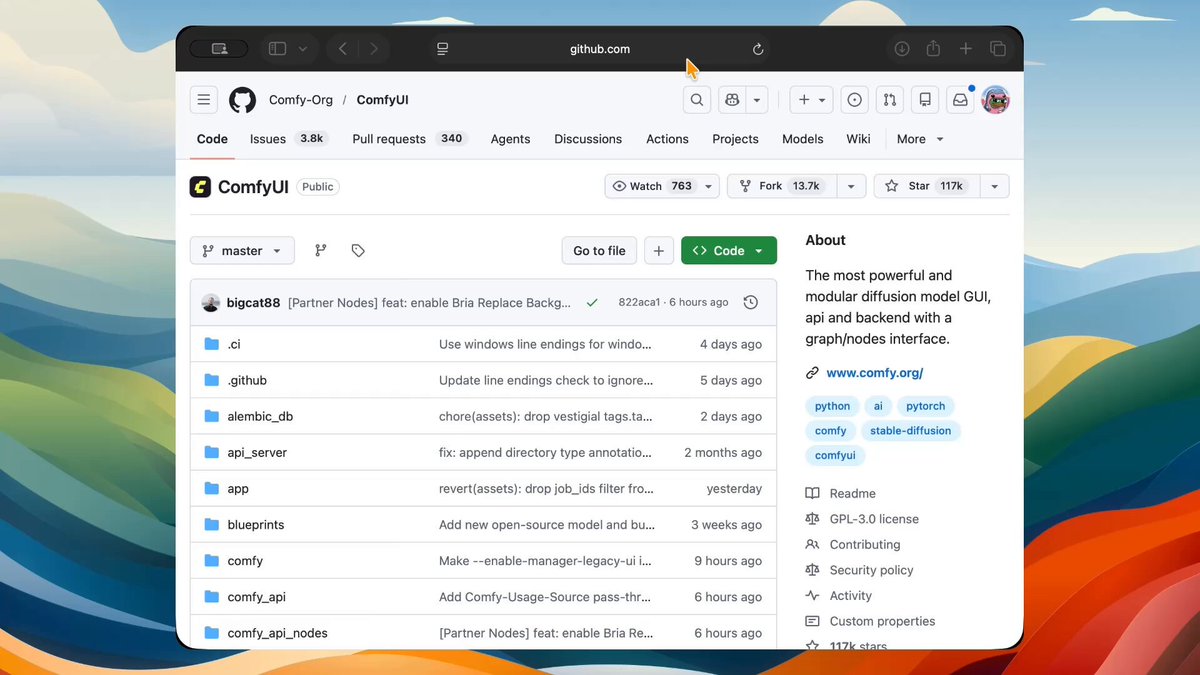
no money for grok or midjourney? this tool is for you. there's a FREE tool created by an anon dev. open-source. runs locally. 117k stars on github. it generates: > images & video > 3d models > audio > 20+ models here's how to set it up in under 5 minutes: 1️⃣download ComfyUI Desktop go to and grab the desktop app for your system. windows 10+, mac (apple silicon), or linux. it installs like any normal app, it sets up python and every dependency for you in the background. no terminal, no config files. 2️⃣open it first launch, it spins up its own environment automatically. you just wait a few seconds and you're in. you'll land on a node canvas, that's the whole interface. 3️⃣load a starter workflow top menu → Workflow → Browse Templates → Image Generation. click it. this drops a ready-made setup onto your canvas so you don't build anything from scratch. 4️⃣grab a model comfyui ships empty on purpose, the model is the brain, and you pick it. in the template, the "Load Checkpoint" node has a Download button when no model is installed. click it. it pulls one in for you (a few GB, this is the only real wait). 5️⃣install ComfyUI Manager this is the one add-on you don't skip. it lets you install models, custom nodes, and updates with a click instead of the command line. grab it from github (link in comments). it's the difference between fighting comfyui and flying in it. one honest note: an NVIDIA gpu makes this fast, apple silicon works great too, and a weak machine still runs it just slower. that's the whole setup. you now own an image, video, and 3D studio that costs you nothing per month. save this. and the next time grok or midjourney asks for your card. you won't need it. disclaimer: comfyui itself is 100% free. so are the local models (sdxl, flux, wan 2.2, ltx-2). some premium models like seedance are pay-per-use api models, only if you want top-tier quality. the free local ones cover most of what you need. (github link in the comments) follow and turn on post notification for daily AI contents.

m0h

14,542 Aufrufe • vor 1 Monat

HERMES AGENT WITHOUT TOOLS IS A CHATBOT. WITH THEM IT BUILDS 3D TOWERS IN BLENDER, CHECKS STOCK PRICES, AND DRIVES VS CODE. tonbi JUST DROPPED THE FULL GUIDE. module 6 of his 10-part Hermes masterclass. best breakdown of the tool layer anyone has published. what you need to know: TOOLS vs SKILLS vs MCP skills = instructions (markdown, loaded into context) tools = callable functions (Python, agent emits call, Hermes executes) MCP = adapters to external systems (Blender, Stripe, Linear, Notion) every tool has three parts: → the function (does the real work) → the schema (what the model sees to decide when to call it) → the registry (makes the tool exist in the agent) the model never runs the function directly. it emits a structured request (tool name + JSON args). Hermes executes and returns the result. if the tool fails, the error goes back as JSON. the agent recovers instead of crashing. TOOL SETS CONTROL THE SURFACE hermes chat --tool-sets web # only web tools loaded. no files, no terminal. hermes chat --tool-sets safe # read-only: web search, vision, image gen. # no file writes. no terminal. no code execution. mid-session: /tools enable video /tools disable terminal or toggle in the dashboard: hermes dashboard → Skills → Tool Sets MCP SERVERS two transport types: STDIO (local subprocess) or HTTP (remote endpoint). add a server: hermes mcp # or ask: "add the MCP server for Blender" filter tools with include/exclude per server. keep only what you trust. security: → OAuth 2.1 PKCE (no long-lived tokens in config) → package scanning via api.osv. dev before launch → all MCP calls go through approval gates HERMES AS MCP SERVER hermes mcp serve exposes 10 tools via FastMCP. connect VS Code Copilot or Cursor to your running Hermes instance. BUILD YOUR OWN TOOL He built a stock price tool live: → Python function calling Finnhub API → schema with name, description, parameters → registered in tool_sets.py → agent calls it automatically when relevant any repeating API call in your workflow can become a native tool. full Hermes architecture deep-dive in the article 👇

YanXbt

32,680 Aufrufe • vor 1 Monat

-> someone cloned claude -> design interface and -> made it completely free -> it's work on YouTube -> and also suitable for kids -> it’s called open design -> and it’s live on github -> same clean split-screen ui -> you get in claude artifacts -> prompt on the left, live -> design/code preview on -> the right, type what you -> want to build and it -> generates the ui in real -> time, but here’s the twist -> you pick the ai model -> not locked into one -> company, want to use -> gemini, mistral, llama, -> deepseek any model -> with an api work -> if you’re running local -> models with ollama -> that works too -> no subscription walls -> the big difference -> vs claude artifacts -> works with any free -> ai model you’re not -> paying $20/mo just to -> design, use free tiers -> local models, or whatever -> you already have access to -> fully local, your prompts -> and code never leave -> your machine unless -> you want them to -> no data training -> no cloud storage -> privacy by default -> no usage limits -> claude cuts you off -> after a few designs -> here you can generate, -> iterate, break things -> and rebuild all day -> the only limit is your -> don’t like how a button -> works, change it -> want to add your own -> components, go ahead -> you own the tool -> so if you’ve been gatekept -> by paywalls or worried -> about sensitive prompts -> going to some company’s -> servers, this fixes that. -> same workflow, more -> control, zero monthly fee

BeingInvested

12,134 Aufrufe • vor 2 Monaten

HERMES AGENT v0.17.0 JUST SHIPPED. "THE REACH RELEASE." 1,475 COMMITS. 800 PRs. 245 CONTRIBUTORS. HERMES NOW REACHES IMESSAGE, RAFT NETWORK, AND CURSOR'S COMPOSER MODEL. the highlights: Nous Research iMESSAGE WITHOUT A MAC RELAY Photon Spectrum integration ships native iMessage support. no Mac in a closet. no BlueBubbles bridge. hermes photon login → device code auth → done. Hermes lives in the blue bubbles now. ASYNC SUBAGENTS NO LONGER BLOCK YOUR CHAT delegate_task(background=true) dispatches a subagent that runs in the background. returns a handle immediately. you keep working. result re-enters as a new turn when it finishes. long research dives stop blocking your main session. IMAGE EDITING, NOT JUST GENERATION image_generate now edits source images. "make this logo blue." "remove the background." "turn this sketch into a render." works across every supported image provider. same tool, new mode. CURSOR'S COMPOSER MODEL VIA GROK OAUTH grok-composer-2.5-fast is in the xAI model picker. 200k context window. fast coding model behind Cursor. your Grok subscription. Hermes's agent loop. no separate API key needed. AUTOMATION BLUEPRINTS schedule tasks without learning cron syntax. "daily news briefing at 8am" becomes a form. one blueprint definition renders everywhere: dashboard form, CLI slash command, Telegram chat, docs catalog entry. answer questions, not memorize 0 8 * * *. FULL PROFILE BUILDER IN DASHBOARD build a complete Hermes profile from the browser. pick model. choose skills. attach MCPs. no config.yaml editing. plus unified multi-profile view with global switcher. SKILLS HUB BROWSER REHAUL connected hubs (OpenAI, Anthropic, HuggingFace, NVIDIA). Featured section. full skill previews before install. security scan on each skill. browsing skills is a real browsing experience now. ATOMIC MEMORY OPERATIONS memory tool gained an operations array. batch add/replace/remove edits applied atomically. the model can free space and add entries in ONE call even when individual adds would overflow the budget. memory updates no longer fail mid-edit. CURATOR STOPPED SPENDING TOKENS BY DEFAULT deterministic skill pruning still runs free. LLM-powered consolidation now opt-in only: curator.consolidate: true to enable. routine background curation costs you zero tokens. WHATSAPP BUSINESS CLOUD API official Meta adapter alongside existing Baileys bridge. no QR-scanning bridge process to keep alive. hosted, first-party WhatsApp channel. TELEGRAM RICH MESSAGES (BOT API 10.1) proper rich formatting. cleaner long-message handling. native markup instead of flattened text. on by default. opt-out available. DESKTOP APP IS NOW A DAILY DRIVER rebindable keyboard shortcuts. native OS notifications. live subagent watch-windows streaming activity. composer model selector with per-model presets. automatic RTL/bidi text. resizable VS Code terminal pane. per-thread composer drafts. install ANY VS Code Marketplace theme. RAFT AGENT NETWORK new bundled adapter connects Hermes to raft. build as an external agent. wake-channel bridge. privacy by contract: wake payloads carry metadata only, never message bodies. SECURE DASHBOARD LOGIN every token-required endpoint returns 401 behind OAuth gate. websocket auth uses served dashboard token. public_url override warnings. exposing your dashboard to the network is safer by default. upgrade: hermes update 300+ issues closed. security round included. hermes-agent ecosystem now at 198K GitHub stars.

YanXbt

35,063 Aufrufe • vor 1 Monat

Mark Zuckerberg is explaining one of the most misunderstood dynamics in AI and it has direct investment implications (Save this). The concept he's describing is model distillation, and it's one of the most important techniques to emerge in AI over the past year. Here's how it works. You train a massive, enormously expensive model, in Meta's case, Llama 4 Behemoth, a 2 trillion parameter teacher model and then you use that model to teach a much smaller, cheaper model. The smaller model inherits roughly 90 to 95% of the intelligence of the giant while running at 10% of the cost and on a fraction of the compute. Meta already did this with the Llama 4 family and Behemoth serves as the teacher. Llama 4 Scout and Maverick, the publicly released open-source models were distilled from it. Scout runs on a single H100 GPU with a 10 million token context window and outperforms models that cost far more to operate. Maverick, at 17 billion active parameters, rivals DeepSeek V3 in coding at half the parameter count and beats GPT-4o on multimodal benchmarks. Both are completely free for commercial use. What Zuckerberg is pointing at is a structural shift in how AI gets deployed in the real world. Companies aren't taking a frontier model off the shelf and running it as-is but rather taking open-source models, fine-tuning them on their own proprietary data, distilling them into even smaller custom models tailored to their specific use case, and running them on infrastructure they control at a fraction of the cost of a closed frontier API. The investment implication of this is significant and runs in two directions. For Meta specifically, this is a strategic masterstroke. Every company that builds on Llama, fine-tunes it, distills it, or deploys it through their infrastructure is pulling into Meta's orbit while Meta builds the most powerful open teacher model. The ecosystem of companies using it grows and that ecosystem generates commercial activity across Meta's platforms and data services. Meta's AI research benefits from billions of real world deployment signals and it's a flywheel that closed model providers cannot replicate because their strategy requires charging per token, which is now a 65x cost disadvantage against the open-source alternative. For the broader market, distillation changes the economics of inference in a way that has barely been priced in. As intelligence becomes extractable into smaller and cheaper models, the absolute demand for compute doesn't decline but rather it explodes, because now the number of applications that are economically viable expands by orders of magnitude. Every task that was previously too expensive to automate at $3.25 per call becomes viable at $0.05 that means more total token usage, more total GPU utilization, and more demand for the infrastructure companies, the Nebiuses, the GE Vernovas, the Constellation Energies that supply the underlying compute and power.

Milk Road AI

27,869 Aufrufe • vor 28 Tagen

Matthew Gallagher Built a $401M Company in Year One with 2 People. And the tool behind it? Claude Code. This year he's on track for $1.8B. Sam Altman predicted this. It's happening now. The problem? It costs money. API credits stack up. Monthly bills keep growing. Every prompt eats your budget. Every project drains your wallet faster. Until now. Two methods. 99% cheaper. One is completely free. Forever. $0. Not a trial. This video breaks down both step by step. ↓ Let me put this in perspective. $100-$500. That's monthly. That's what you spend. That's $6,000/year on API credits. Just to use a tool you haven't shipped anything with. The $401M guy? Spending $0. Same capability. Shipping weekly. Different cost structure. Different results. Different life. I'm about to hand you his cost structure for free. ↓ Open source vs closed source. Pay attention. Closed source: Claude. GPT-4. Pay per token. Meter always running. Open source: Qwen. Llama. Mistral. Free to download. Free to run. Free forever. No meter. No tokens. No bill. Here's what nobody tells you: 80% of coding tasks? Open source handles them. More than handles them. Writes clean code. Debugs errors. Generates boilerplate. Handles routine work perfectly. You're paying premium prices for tasks that don't need premium intelligence. That's hiring a brain surgeon to put on a bandaid. Smart play: Free models for the 80%. Paid credits for the 20%. That's what the $401M guy does. That's what this video teaches you. Follow Himanshu Kumar for more breakdowns that turn free tools into real businesses. ↓ Method 1: Ollama. Local. Free. Forever. Download it. Pull a model. Point Claude Code at it. Done. No internet needed. No API keys required. No monthly subscription. No token counting ever. No bill. Today. Tomorrow. Ever. Your data never leaves your computer. Complete privacy. Complete freedom. Claude Code thinks it's talking to the cloud. It's talking to your laptop. For $0. The video walks through every step: Every config file. Every variable. Every command. Every click. If you can follow a recipe, you can do this. People who set this up 3 months ago? Saved $300-$1,500 since then. Workflow didn't change one bit. ↓ Hardware you need: 16GB RAM: 7B models run smooth. 32GB RAM: 32B models run comfortable. 64GB + GPU: biggest models available. No GPU? Still works. Just slower. Few extra seconds. That's it. Your $1,500 laptop is sitting there running Chrome and Spotify. Put it to work saving you $200/month instead. Follow Himanshu Kumar for more breakdowns that turn free tools into real businesses. ↓ Method 2: Open Router. Free Cloud. No Hardware. Weak machine? Don't want local setup? This method is for you. Free AI models in the cloud. No download. No hardware. Configure Claude Code to route through Open Router. The config: Base URL: Open Router API. API key: free Open Router key. Default Sonnet: free. Default Opus: free. Default Haiku: free. Small fast model: free. Subagent model: free. Free. Free. Free. Free. Free across the board. Same interface. Same commands. Same workflow. Zero cost. Copy the config from the video. Paste it. Save $200/month. Starting today. Right now. ↓ When to use which: Ollama (local): Best for privacy. Best for offline work. Best for unlimited usage. Best if you have decent hardware. Open Router (cloud): Best for weak machines. Best for instant setup. Best for trying different models. Best if you don't want to manage anything. Both methods: Best for 80% of your daily work. Still use paid Claude for: Complex architecture. Multi-file refactoring. Deep reasoning tasks. The 20% that actually needs it. $20/month instead of $200/month. Same output. 90% less cost. ↓ The math that should make you angry. You (current): $200-$500/month. $2,400-$6,000/year. $7,200-$18,000 over 3 years. You (after this video): $20-$50/month. $240-$600/year. $720-$1,800 over 3 years. Savings over 3 years: $6,480-$16,200. That's a used car. That's seed money. That's 6 months of rent. All from one 25-minute video. All from 15 minutes of configuration. Highest ROI 25 minutes you'll spend this year. ↓ The limitations. I won't lie to you. Open source is not Opus. Not as smart on complex reasoning. Not as good at long-context tasks. Makes more mistakes on nuanced problems. But they are: Free. Capable. Getting better monthly. Good enough for 80% of daily work. Smart cost management isn't being cheap. It's being strategic. Expensive tool when it matters. Free tool when it doesn't. ↓ The one-person billion-dollar company is coming. $401M in year one proved it's possible. The building blocks: AI that codes: Claude Code. Way to run it free: this video. Distribution: the internet. Customers: everyone. Only missing ingredient? Someone who builds. Not reads about building. Not saves posts about building. Not bookmarks videos about building. Builds. Tools are free. Knowledge is free. Opportunity is screaming. You're still "thinking about it." ↓ Your action plan: Tonight: Watch the video. Tomorrow morning: Set up Ollama or Open Router. Tomorrow afternoon: Build something. Anything. This week: Build a second thing. Faster. This month: Charge someone for it. One video. One setup. One weekend. $0 cost. Unlimited potential. Or keep paying $200/month for something you could get free. Keep consuming instead of building. Keep planning instead of shipping. Matthew Gallagher didn't plan a $401M company. He built it. Full video attached. Every method. Every config. Every tradeoff. 25 minutes. Your move. Follow Himanshu Kumar for more breakdowns that turn free tools into real businesses.

Himanshu Kumar

13,599 Aufrufe • vor 3 Monaten

China just made Silicon Valley's entire AI industry look like a scam. The US government spent 3 years trying to stop China from building competitive AI. But this backfired HORRIBLY. Here's what happened: Yesterday, a Chinese startup called DeepSeek released a new AI model called V4. It matches the performance of OpenAI and Anthropic's best models. At 1/7th the price. And for the first time ever, it was built on Chinese chips. NOT American ones. That last part is the one that terrifies the west. For context: Since 2022, the US has banned the export of advanced AI chips to China. The entire strategy was built on the assumption that if China can't access Nvidia's best hardware, they can't build frontier AI. But DeepSeek just proved that assumption wrong. Their V4 model was trained and runs on Huawei's Ascend chips. Huawei spent months working directly with DeepSeek to make sure V4 runs across their entire line of AI processors. Jensen Huang even predicted this on a recent podcast: "The day that DeepSeek comes out on Huawei first, that is a horrible outcome for our nation." That day was yesterday. And the numbers are crazy: DeepSeek V4 costs $3.48 per million output tokens. OpenAI's latest model GPT-5.5 costs $30. Anthropic's Claude charges $25. Same ballpark performance. 7x cheaper. Uber's CTO just admitted they burned through their ENTIRE 2026 AI budget in 4 months using Anthropic's tools. If Uber had used DeepSeek instead, that same budget would have lasted 7 YEARS. 4 months vs 7 years. Same work getting done. But the pricing isn't even the big thing here. The real story is what DeepSeek did with their technical report: They published the benchmarks where they LOSE. Every AI company cherry-picks the tests where their model wins. DeepSeek ran the full comparison against GPT-5.4 and Google's Gemini, found they trail frontier models by 3 to 6 months, and printed it anyway. They literally don't care because the price gap makes the performance gap irrelevant for 90% of use cases. So the US export controls didn't slow China down. They ACCELERATED China's independence. Because Chinese developers were FORCED to train models with limited resources, they had to figure out how to make AI radically more efficient. That constraint became their competitive advantage. Every generation of DeepSeek has gotten dramatically cheaper to train. V4 continues the trend. Meanwhile US companies are going the OPPOSITE direction: OpenAI's GPT-5.5 Pro costs $180 per million output tokens. That's 51x more expensive than DeepSeek V4 for comparable work. The Commerce Secretary confirmed this week that ZERO Nvidia advanced chip shipments have actually gone through to China despite being approved in January. So China built frontier AI anyway. Without American chips. At a fraction of the cost. And the market response tells you everything: Chinese chipmaker SMIC surged 10%. Huahong Semiconductor jumped 15%. DeepSeek's Chinese AI competitors Zhipu AI and MiniMax dropped 9% because V4 is destroying them too. DeepSeek is making Silicon Valley's pricing model look like a scam. US tech companies spent $650 billion on AI infrastructure this year. DeepSeek just showed the world you can match their output for pennies. The export controls were supposed to be America's ace card. Instead they taught China how to win without American chips, at American prices nobody can compete with. Jensen Huang was right. This is a horrible outcome. But it's the outcome America built for itself.

Ricardo

280,185 Aufrufe • vor 3 Monaten

We made a thing! Very happy to announce sqlcoder-pro and the Defog Alignment Platform. Available to use immediately without a wait-list, weights will be open-sourced very soon. The video does a quick show and tell comparison against ChatGPT (with gpt-4o). Read on for more details! TLDR 💪 equal (or better) performance on text-to-SQL as the most capable Claude-3.5 or GPT-4 models 🤝 You can use it today on a free plan/free trial, without a waitlist 🪽 self-hostable on a single RTX4090, with 2 second median generation times for SQL queries 🔁 exactly the same output every time, give the same prompt 👨🏻‍🏫 teachable and steerable: show the model what you want it to do 🛞 debuggable – you can understand WTF is going on inside the model, instead of treating it like a black box Let's dig into each of these one-by-one! Performance SQLCoder-8b-pro significantly exceeds the performance of our previous sqlcoder-8b model on Postgres text-to-SQL (from 88.2% to 90.2% accuracy - gpt-4o is at 87.6%, for reference). It is also better at following instructions. This was done via self-merges, hand crafted fine-tuning data, and adapting the training data to fit our tokenizer. Cost You can host this on the model on a single $3,500 RTX4090, and support ~5 requests/second via VLLM. If you're looking to host on the cloud instead, you can run it on a single L4 GPU that costs $300/mo on GCP Repeatability We have a dense 8b model with no MoE shenanigans. For the same prompt with temperature=0, you'll always get the same answer – which is critical in BI. Teachable In our alignment and feedback modes, you can give the model feedback on how it answered certain questions, and it will automatically adapt to the feedback. Debuggable You can use logprobs and attention scores to determine where, exactly is the model paying attention to inside a prompt + what it's getting confused by when generating outputs. Available today You can use Defog on the cloud today by going to docs[dot]defog[dot]ai, and getting an API key. Excited to hear what you think!

Rishabh Srivastava

13,465 Aufrufe • vor 1 Jahr

Alibaba just dropped Qwen3.5-397B-A17B and there's a lot to unpack. 397B params, 17B active per forward pass. Sparse MoE done right. But the real story isn't the size—it's the architecture choices. The MoE Design Most MoE models feel like bolt-ons. Qwen 3.5's sparse activation is native—only 4.3% of parameters fire per token. That's how you get trillion-parameter-class performance without trillion-parameter inference costs. The 0.8 RMB/million tokens pricing isn't subsidized; it's structurally earned. Native Multimodal, Not Glued-On This is a vision-language model from the ground up. Heterogeneous architecture—separate processing pipelines for text, image, video that fuse early. Not a vision encoder slapped onto an LLM. The result: 90.8 on OmniDocBench, 79.0 on MMMU-Pro. Document understanding and visual reasoning without the usual brittleness. The Context Window Reality Qwen3.5-Plus (the hosted version) ships with 1M tokens by default. That's not a marketing number—they're actually positioning it for long-document workflows. With built-in adaptive tool use, it's clearly aimed at agentic automation, not just chat. What Actually Impressed Me • FP8 native pipeline: ~50% activation memory reduction • Async RL framework for continuous refinement—training and inference workloads separated • 201 languages (up from 119), 250k vocab for better low-resource encoding • Apache 2.0 license. Full weights on HuggingFace and ModelScope. The Benchmark Context 76.4 on SWE-bench Verified puts it in the range where it can handle real debugging workflows. 72.9 on BFCL v4 for agentic tool use. 88.4 on GPQA Diamond. These aren't SOTA in isolation, but the breadth is unusual—strong across reasoning, coding, multimodal, and agentic tasks. The Honest Caveat I haven't stress-tested the 1M context for needle-in-haystack retrieval yet. And "native multimodal" claims need real-world torture testing—PDFs with tables, charts, mixed layouts. Benchmarks are benchmarks. Bottom Line This isn't just another model release. It's a bet on efficient scale: big model capabilities, small active compute, open weights. At 1/18th the cost of Gemini 3 Pro, it's going to force pricing conversations across the board.

Bo Wang

13,221 Aufrufe • vor 5 Monaten

China just released an open source AI model that matches the best closed models from OpenAI and Anthropic. Gavin Baker explained exactly how they did it and the answer should concern every American AI lab. The model is called GLM 5.2. It was built by Z. AI. You get 744 billion parameters, 1 million token context window and its MIT license, meaning anyone can download it, fork it, build a company on it, with no restrictions and no Dario. It scored 51 points on the artificial analysis intelligence index. The highest score any open weight model has ever achieved. It beat GPT 5.5 on the frontier software engineering benchmark. It trails Claude Opus 4.8 by less than one percentage point. And it costs 85% less to run than GPT 5.5 for comparable performance. Gavin Baker said on the All-In podcast that this model has challenged some of his beliefs. Then he explained how China built it. The method is called distillation. Just think of tens of thousands of phones and computers running simultaneously, all hitting the frontier model APIs through masked accounts, asking specific questions, and harvesting what happens inside the model when it answers. Every reasoning step, every token. The entire thinking process gets recorded and fed back into the Chinese model during training. It is a cheat sheet. It is the answer key to the exam. And here is the part that should worry everyone. Sacks said it plainly. China was already nine months behind American models. But now that GLM 5.2 is good enough to run its own reinforcement learning, it can improve itself without needing to distill from American models anymore. The cheat sheet let them get close enough to start writing their own answers. Sacks said we are six months behind on the model and 24 months behind on silicon and they are only a few months behind in total. The Z. AI founder told Elon Musk directly that open weight fable-level capability will be here before Q1 2027. Every restriction Anthropic lobbied for, every self-imposed safety guardrail, every month of delay in releasing American frontier models accelerated this. The Chinese labs were not under those restrictions. They were not going to wait. The composable model future Gavin described, where every enterprise runs a frontier model alongside their own fine-tuned open weight model, is coming regardless of what American labs do next. The question is just whether the open weight half of that stack is American or Chinese. Right now it is Chinese. WATCH THE FULL PODCAST ON The All-In Podcast

Ihtesham Ali

86,295 Aufrufe • vor 1 Monat