Video yükleniyor...

Video Yüklenemedi

Ana Sayfaya Dön

Highly-maneuverable, extremely photogenic. Take a look at what our LEO Express 2 Mira saw while closing in on the LEO Express 1 Mira – on our fully autonomous RPO mission with Starfish Space Starfish’s software enabled Mira to perform close-proximity maneuvers, with a single camera and closed-loop GNC software...

35,227 görüntüleme • 6 ay önce •via X (Twitter)

0 Yorum

Yorum bulunmuyor

Orijinal gönderinin yorumları burada görünecek

Benzer Videolar

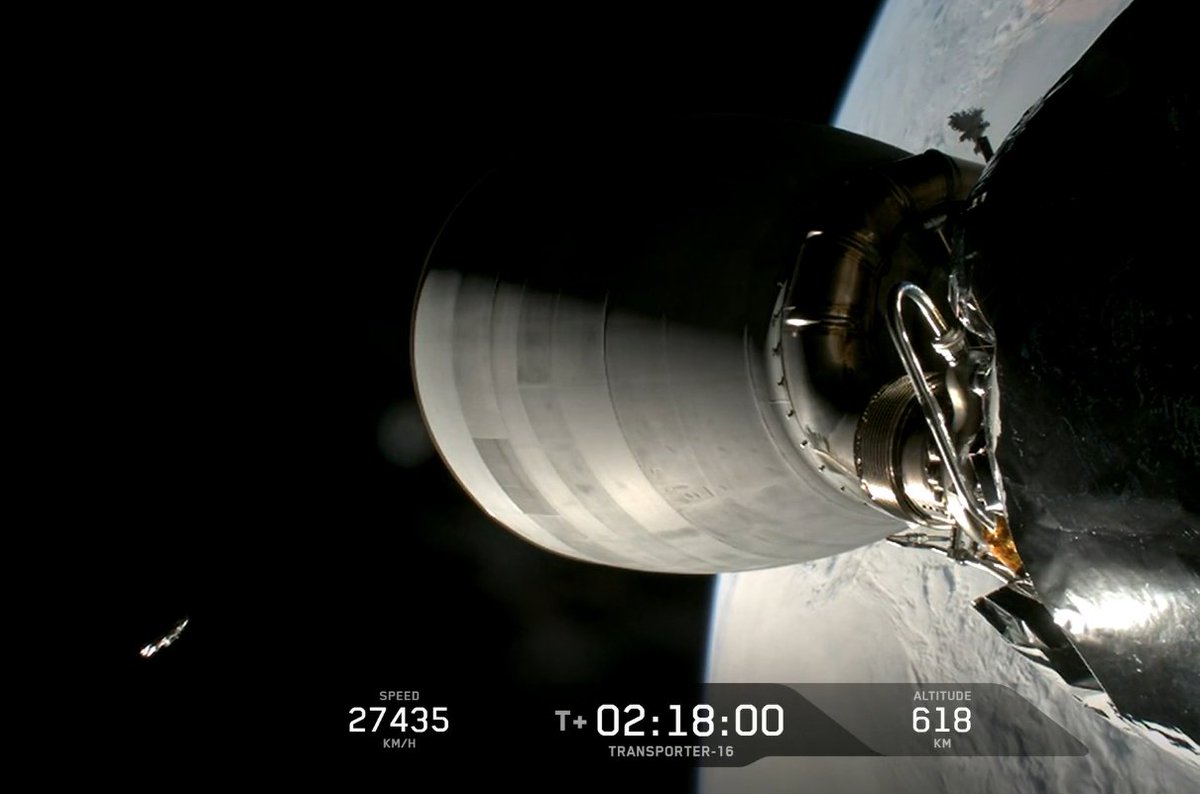
I'm excited to announce we have achieved our Tier 1 mission success criteria and have begun gathering a tremendous amount of data on how this brand new spacecraft performs. On March 30th, 13:17:08Z, the Gravitas spacecraft separated from the SpaceX Transporter-16 stack to begin its mission as one of the highest power free-flying satellites ever launched. Immediately after separation, the spacecraft autonomously: - Executed detumbling maneuvers - Established two-way communications with the ground (on our very first ground station pass) - Deployed its 20kW solar arrays - Slewed to a safe and stable attitude to await further ground commands These actions alone are a testament to the incredible work of our in-house engineering, software, and GNC teams to build a robust spacecraft. Since then, our operations team completed all initial system activations and checkouts, confirming the vehicle is in a power positive and thermally stable state with no major anomalies observed at this time. We completed this phase of the mission ahead of schedule. Next up we will be powering up and downlinking data for all payloads aboard the Gravitas spacecraft in support of our customers and partners while continuing to put the spacecraft through its paces. As we noted ahead of launch: The goal of this mission is to experiment and push our systems to the limit to inform future missions. I look forward to sharing more on our successes and challenges as the mission proceeds. Video of our satellite below; link to full T-16 webcast:

Neel Kunjur

89,923 görüntüleme • 4 ay önce

Today, we unveil Project Shadow — Apex's on-orbit Space-Based Interceptor (SBI) technology demonstration, launching NET June 2026. At Apex, we often launch self-funded missions to advance our technology and demonstrate our capabilities in space. Over 1.5 years ago, we launched our first Aries satellite, which continues to serve as an on-orbit software testbed for our team and customers. Project Shadow is our next step internally funded mission (with more to come in the future). Launching on our Nova satellite bus platform, Shadow integrates and demonstrates key SBI technologies in a single, end-to-end mission. Here’s an inside look at Shadow: 1. Apex’s Nova platform will be outfitted with the “Orbital Magazine” configuration package, providing environmental management for the demonstration interceptors, a Link-182–compatible radio, and Missile Warning/Tracking sensors. 2. The Orbital Magazine will carry two scaled-down demonstration interceptors, each equipped with a solid rocket motor (SRM) and a suite of data-collection sensors. 3. The Orbital Magazine will launch NET June 2026, and after LEOPS and commissioning, Apex will issue a fire control command. 4. The Orbital Magazine will deploy the first interceptor and establish an inter-satellite link. The interceptor will be tasked to fire its SRM while oriented in the inverse velocity direction, avoiding other in-space objects, and safely deorbiting after the burn. 5. During the burn, the Missile Warning/Tracking payloads on the Orbital Magazine will gather critical data on on-orbit SRM performance, determine tracks, and more. 6. The second interceptor will be deployed shortly after, establish a crosslink, and receive a command to fire its SRM, following a similar trajectory to the first demonstration interceptor and safely deorbiting. Project Shadow is self-funded by Apex. We believe that supporting America, our allies, and democracy requires direct investment in the development and maturation of key defense technologies — including SBIs. Learn more about next year’s mission from SpaceNews with the link below.

Apex - Satellite Platforms 🛰

1,118,977 görüntüleme • 9 ay önce

Here is one of our experimental 3D printed Hadfield liquid rocket engines going through some thrust vector control (TVC) profiles! As we scale to our first light-lift orbital launch vehicle, Tundra, and then our medium-lift reusable launch vehicle, Titan, precise control of the rocket at every phase of flight is critical to mission success. Guiding a rocket to orbit, and eventually back to Earth, demands close coordination across every sub-team. Some of the key challenges we’re tackling: ➡️ Reliable & repeatable TVC actuation: ensuring the engine gimbal responds consistently across every test and flight ➡️ High-frequency control loops: real-time systems that keep the vehicle stable from liftoff to orbital insertion ➡️ Propellant sloshing: accounting for the movement of fluids in tanks and its effect on vehicle dynamics ➡️ Wind shear compensation: countering atmospheric disturbances during ascent ➡️ Structural bending & flex modes: managing how the vehicle’s primary structure responds to aerodynamic and thrust loads ➡️ Precision payload delivery: hitting the exact target orbit, every time Our team at NordSpace has been advancing our propulsion systems on many fronts, as we work to unveil our orbital-scale, pump-fed Hadfield and Garneau rocket engines in the near future — the engines that will carry Canada to orbit for the first time, and unlock sovereign access to space. Check out some of our rocket hardware, meet our engineers, join over 400 attendees and over 40 speakers at the Canadian Space Launch Conference, taking place this May 5th in Ottawa. National Defence Defence Research and Development Canada Canadian Space Agency NSERC / CRSNG

NordSpace 🇨🇦

48,970 görüntüleme • 5 ay önce

Autonomous driving through extremely-tight-dynamic environments with complex, stochastic, and adversarial traffic-dynamics, or simply through an absolute chaos, on sub-urban unstructured roads in India. This kind of traffic and environment has never been attempted in the history of #autonomousdriving. There were no traffic-rules to abide by on this road, other than to perform a left-sided avoidance, if the other obstacles follow the same, else the vehicle will have to change its plan in a stochastic manner, in several of the adversarial multi-agent negotiation settings encountered throughout the autonomous navigation. This demos tested our motion planning and decision making framework to its limits, showcasing its robustness in negotiating such traffic-dynamics with ease. This demo was done on mostly a very narrow road, suited mostly for one-way navigation, but as is customary in India, bidirectional traffic is active on such narrow roads. It can be seen throughout navigation that the incoming vehicles didn't allow any gaps for our #AutonomousVehicles, forcing it to negotiate passively-aggressively its own path through the chaos. Furthermore, obstacles overtaking us didn't follow any rules either, and zig-zagged and moved in crisscross fashion, challenging our motion and behaviour planning software, which negotiated all such scenarios with ease. There were only two points where our vehicle came to halt, when two girls on a two-wheeler didn't stop and just kept on navigating, despite our vehicle being closer to the narrow passage and it having the right of way, and despite a bike being parked over there by someone, making it a very challenging scenario both for the humans and for the decision making autonomous agent(s). This demo was done in the Awadhpuri area, on the Durga Mata road. This framework was last shown in relatively much sparser traffic in our Kankali Kali Mata demo last month. It is being scaled further with deep unsupervised and #reinforcementlearning , and in the coming weeks, it will play a critical role in our endeavour to solving the Level-4 autonomy problem by the end of the year. This kind of traffic negotiation has never been attempted by any autonomous driving company ever. While a 90-degree turn is usually discussed as a corner case in the West, our autonomous vehicle negotiated a blind 90-degree corner, with traffic, with ease. #deeplearning #MachineLearning Swaayatt Robots

Sanjeev Sharma

125,305 görüntüleme • 2 yıl önce