Loading video...

Video Failed to Load

Go Home

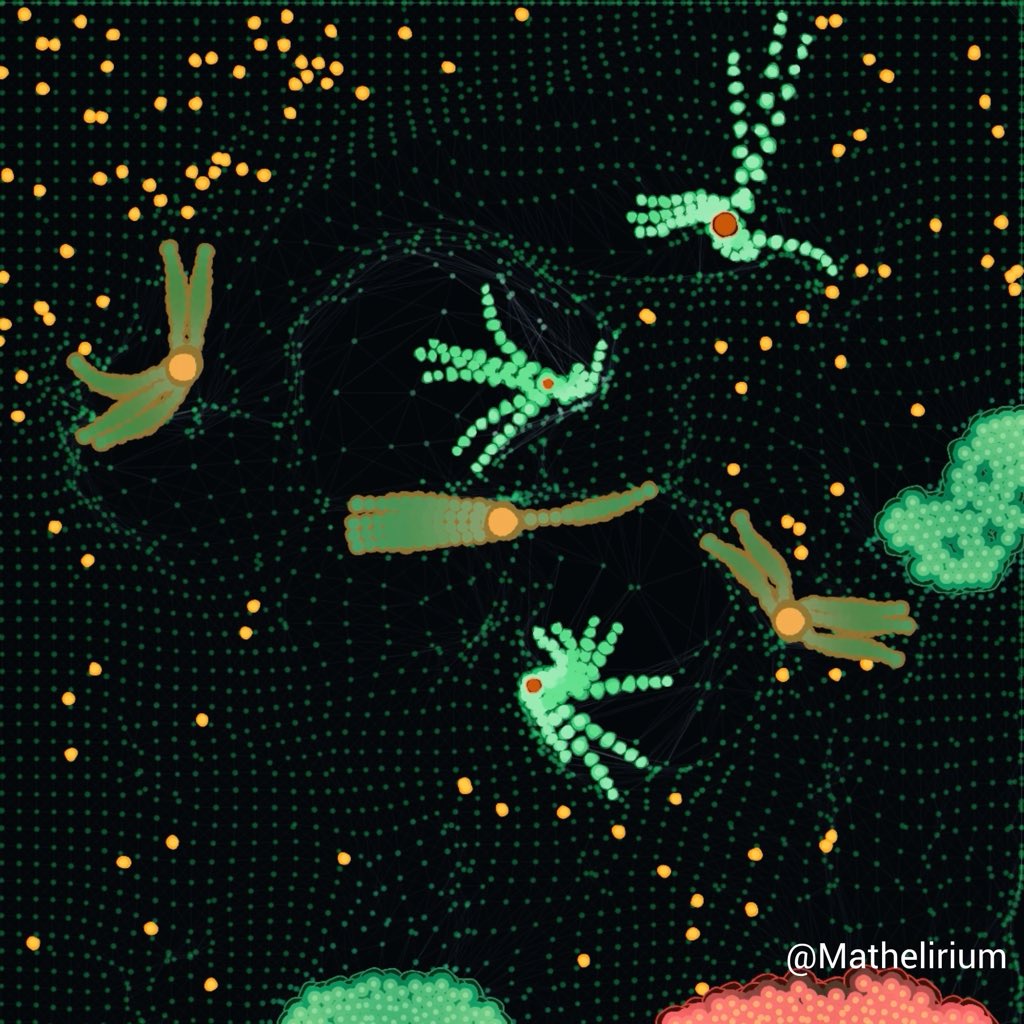
How can something as abstract as a graph, consisting of nodes, edges, and a few dynamical rules, end up looking so alive? It's one of the strangest strengths of Mathematics.

11,052 views • 15 days ago •via X (Twitter)

18 Comments

Màxkw’tët (Bear) 🐻 🪶's profile picture
Màxkw’tët (Bear) 🐻 🪶15 days ago

That’s because adjacency isn’t just representational but ontological. Which all of graph theory and spectral graph theory is derivable from A. So both theories are just downstream consequences of adjacency.

AHQ⁵'s profile picture
AHQ⁵15 days ago

It’s made of smaller parts that are staying close, supporting, and reinforcing eachothers structure. That’s what makes that feeling.

N8's profile picture
N815 days ago

Geometry births structure, it’s clear. But what creates the geometry?

Mugur Marculescu's profile picture
Mugur Marculescu15 days ago

This is something I think about a lot:

Nikolina Tesla ⚡ aka Queen's profile picture
Nikolina Tesla ⚡ aka Queen15 days ago

It's all about golden ratio. The most strongest force in the universe.

Tom Nicholson's profile picture
Tom Nicholson15 days ago

With the right graph and traversal algorithm you can do pretty much anything

Talk to Your Money's profile picture
Talk to Your Money15 days ago

Because it jiggles and only alive things jiggle

🪓 🦋's profile picture
🪓 🦋15 days ago

Very Chemtool.

Vivek's profile picture
Vivek15 days ago

Kind of like automata that stephen wolfram keeps talking about

Felix Woitzel's profile picture
Felix Woitzel14 days ago

may I suggest, that today is a a once in a while day and this

Ben Moore's profile picture
Ben Moore15 days ago

🤯

I⁰ AM⁰¹ Perceptioⁿ ⁿoticing-being⁰¹ human³⁵⁸, Now🪬's profile picture
I⁰ AM⁰¹ Perceptioⁿ ⁿoticing-being⁰¹ human³⁵⁸, Now🪬14 days ago

Because the shimmering surface is the "accretion disc horizon visible" of the unseen event that the nonlocal zero point motion oscillation is 🤫

Lésbos's profile picture
Lésbos15 days ago

Maybe because its animated to move like a living cell? Why is it bouncing around so much? Street maps dont bounce. Why is the graphic?

steven Kirkland's profile picture
steven Kirkland15 days ago

Amazing visual. Very helpful. Thanks math.

TrueNorth's profile picture
TrueNorth15 days ago

Go more discrete where nodes are in Planck scale topological contact.

Scythe's profile picture
Scythe15 days ago

You've made a graph wiggle, so what

Shayla Tezcatlipoca's profile picture
Shayla Tezcatlipoca15 days ago

Life was using Math, long before Humans existed... So perhaps it is more that human + ai math, is now finally able to model the complexity in such magnificent dynamic detail - we are wonder struck.... Maybe life and emergence of intelligence - was math, and not random chance ? but a bit of both, as is going on in that sim ?

soft radius's profile picture
soft radius15 days ago

Because life is an illusion 🤣

Related Videos

The Trap in Every Mathematics Lecture If you’ve taken a lot of math courses, you start to recognize a pattern. There’s a moment where the lecturer is warming up with the obvious stuff...add matrices entrywise, scale by α, do the row-column product...and you’re thinking, alright… where is this going? Then you relax. You stop resisting. And right there, they slip in one line that changes how you see the whole subject. When Benedict Gross says "matrices represent linear operators,"he’s telling you to stop treating a matrix as a rectangle of numbers and start treating it as an action. A linear operator is a function T: Rⁿ → Rⁿ that respects two rules: T(u+v)=T(u)+T(v) and T(αu)=αT(u). Once you pick a basis, T is completely determined by where it sends the basis vectors e₁,…,eₙ. Put T(e₁),…,T(eₙ) into columns and you get a matrix A. That is what "A represents T" means...A is the coordinate portrait of the transformation. Now the punchline that makes matrix multiplication feel inevitable. If B represents S and A represents T, then doing S first and then T is the composition T∘S. In coordinates that becomes A(Bx)=(AB)x. So multiplying matrices is really composing transformations. That’s why multiplication is usually not commutative: T∘S is generally not the same transformation as S∘T, and the matrices inherit that noncommutativity. This explains half of Linear Algebra because it tells you what the course is really about...functions that move vectors around, not grids of numbers. A matrix is just the written form of that function once you choose coordinates. Then the rules stop feeling random Multiplying matrices means doing one move and then another, an inverse means you can undo the move, eigenvectors are directions that don’t get turned, and changing basis is just describing the same move in a different language. That one idea makes a lot of linear algebra click. #LinearAlgebra #Matrices #GroupTheory #GLn #MathLectures #Mathematics

Mathelirium

66,892 views • 8 months ago

I was watching a lecture on YouTube by David Tse from Stanford (see link below), and he quoted his advisor Bob Gallager: "Good theory should prune rather than grow the knowledge tree." To demonstrate what Gallager meant, we takes one idea… "how do you move mass from one shape to another as cheaply as possible?" and watch 200 years of mathematics cut that idea down to its clean geometric core. Monge (1781, "Mémoire sur la théorie des déblais et des remblais") A mound on the left, a trench on the right, and every grain of earth has to choose one destination and stick to it. In the animation that’s strict one-to-one matching: each point marches to a single partner, no splitting, no sharing. It’s beautiful but rigid and hard to work with. Kantorovich (1942, "On the Translocation of Masses"; 1948, "On a Problem of Monge") Kantorovich relaxes the rules. Instead of forcing each point to pick exactly one target, he allows mass to split: part of it can go here, part of it can go there. On screen you see packets of mass spraying from one source cell to several targets along smooth arcs. The problem becomes a clean convex optimisation problem. Brenier (1991, "Polar factorization and monotone rearrangement of vector-valued functions"); McCann (1995, "Existence and uniqueness of monotone measure-preserving maps"; 1997, "A convexity principle for interacting gases") Bernier then shows that, in the most natural cost setting, the best way to move mass always comes from a hidden height function whose slopes tell you where to send things. McCann shows that many natural energy functionals behave nicely along the paths generated this way. In the animation you see contour lines of that hidden landscape, with particles gliding along the most economical path between the two shapes. Jordan-Kinderlehrer-Otto (1998, "The variational formulation of the Fokker-Planck equation") JKO change the question from "what is the best single shuffle?" to "how does a whole cloud evolve in time?". They show that a familiar diffusion-with-drift equation can be reinterpreted as steepest descent of a free energy in the space of probability distributions. In the scene, a blob both smooths out and gets pulled toward the embankment while a free-energy counter steadily drops. Ambrosio-Gagli-Savaré (2005, "Gradient flows in metric spaces and in the spaces of probability measures") Ambrosio-Gigli-Savaré take that idea and generalise it far beyond this one setting. They build a theory of gradient flows on abstract metric spaces: you only need a notion of distance and an energy, and you can talk about curves of maximal slope. Wasserstein spaces become one important example among many. In the final scene the probability field evolves in the top panel while its energy traces a clean descending curve below.

Mathelirium

65,705 views • 9 months ago