Video yükleniyor...

Video Yüklenemedi

Ana Sayfaya Dön

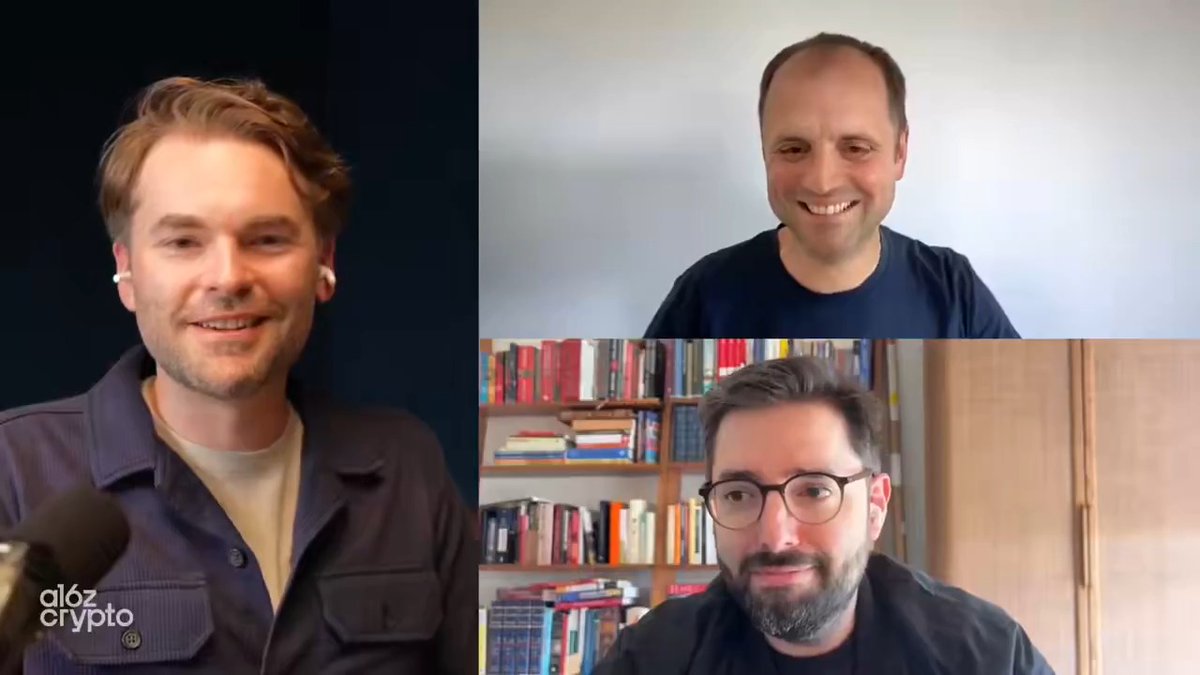
How do you actually formally verify the code underpinning Ethereum's future? In this episode (the finale of the lean Ethereum miniseries), Nico sits down with Alex Hicks (Alexander Hicks), lead of Protocol Snarkification at the Ethereum Foundation, to break down formal verification from first principles. They cover: – What...

15,143 görüntüleme • 3 ay önce •via X (Twitter)

0 Yorum

Yorum bulunmuyor

Orijinal gönderinin yorumları burada görünecek

Benzer Videolar

Ethereum is starting from the endgame. Episode 4 of TheCoordinate is a deep dive into Lean Ethereum: a clean-slate rethink of consensus, execution, and data availability. I sat down with Justin Drake from Ethereum Foundation to unpack: > need for the rewrite, > rewrite items: post-quantum security + fast finality, > endgame finality (3-slot -> 2-slot -> maybe 1-slot), > slot anatomy, networking constraints, and the "SOL slots" meme, > real-time ZK proving changing the execution roadmap, > censorship resistance with FOSSIL, > role of L2s in the world of Lean Ethereum, > incentives across proposer, builder, prover, includer, attester. If you’re building on Ethereum or trying to understand where the base layer is headed, this one is for you. This is Episode 4 of TheCoordinate. Hope you enjoy it! ------------------------------- Timestamps: 0:00 Intro: digital intelligence needs digital institutions 0:30 The big questions: Lean Ethereum, consensus/execution, post-quantum 1:25 Why Ethereum needs an endgame mindset (and a clean-slate approach) 3:30 The two “rewrite-class” items: post-quantum security + fast finality 5:52 Beamchain → Lean Consensus → Lean Ethereum (expands beyond consensus) 6:34 ZK EVM + real-time proving within a slot → “10,000 TPS” target 10:10 “SOL slots”: pushing slot duration toward speed-of-light constraints 11:09 3-slot finality (3SF) → endgame finality (2-slot / 1-slot paths) 18:19 eFP2P: erasure-coded gossip, bandwidth efficiency, scaling blobs 26:21 FOSSIL today: inclusion lists + opening includers beyond validators 39:09 Lean VM: minimal ZKVM 51:04 XMSS explained: Merkle signatures, 2^32 leaves, statefulness tradeoff 1:00:36 Rollups: 99.9% throughput on L2s + “native rollups” 1:06:53 Economics: roles (builder/prover/includer/attester), proving costs, stake capping

Soubhik Deb

86,471 görüntüleme • 4 ay önce

Mistral AI Releases Leanstral 1.5: An Apache-2.0 Lean 4 Code Agent Model Solving 587 of 672 PutnamBench Problems Most AI theorem proving is a language model generating a proof in one shot, with a verifier bolted on at the end to check it. That's autocomplete with a grader — and Mistral just drew a clear line between that and an actual proof agent. They released Leanstral 1.5 — a 119B MoE with 6.5B active parameters, trained as a code agent that lives inside the Lean 4 compiler loop: propose a proof, read the compiler's goals and errors, refine, repeat until it compiles or the budget runs out. Verification isn't the eval here. It's the training signal. Here's what's actually interesting: → Test-time scaling behaves like a dial: PutnamBench Pass@8 climbs 44 → 244 → 493 → 587 solved as the per-attempt token budget moves 50k → 200k → 1M → 4M → 587/672 on PutnamBench at ~$4 per problem, versus an estimated $300+ for Seed-Prover 1.5 high (a 10 H20-days-per-problem budget) → Saturates miniF2F: 100% on both validation and test sets → Two RL environments in training — a multiturn prover, and a raw-filesystem code agent that edits files, runs bash, and queries the Lean language server for live goals and types → Not just math: an Aeneas (Rust → Lean) pipeline flagged 11 genuine bugs across 57 repos, 5 previously unreported — including an integer overflow in datrs/varinteger when (value + 1) hits Std.U64.MAX Apache 2.0 weights, free API endpoint Full analysis: Model weights: Project: Technical Details: Mistral AI Mistral AI for Developers Sophia Yang, Ph.D.

Marktechpost AI

56,461 görüntüleme • 4 gün önce

It's finally here - the Official Lean AI Company Playbook 1000+ founders, investors and execs have been flooding my DMs about. Ever since I created the Official Lean AI Leaderboard after exiting my $150M annual revenue startup, founders from across the globe have asked me this one question: "How are these lean AI companies generating millions with tiny teams?" So I spent the last 3 months obsessively tracking and collaborating with 30+ lean AI-native founders, researching the answer. Here's what I discovered: They've built operational systems that multiply human capability. Instead of scaling headcount, they've created AI-powered processes that let small teams operate at unprecedented scale. And their secret goes far beyond the specific AI tools they use. It lies in redesigning their entire company operations around a fundamentally different approach to growth and execution. After countless conversations, interviews, and behind-the-scenes exclusive access, I finally documented the exact playbook with complete systems. This comprehensive playbook includes: • A complete breakdown of the tech stack and operational workflows • The organizational design principles that enable tiny teams to do massive work • Critical inflection points where things break (and how to navigate them) • A detailed 6-month implementation plan for starting your own lean AI company (with weekly actions) • Implementation best practices from dozens of successful lean AI-native companies Want the ultimate Lean AI Playbook or help transforming your Lean AI operations? 👇 • Like and Share this post • Comment "Lean AI Playbook" • Follow me (so I can DM you) --------------- PS: Separately, I'm opening a limited number of high-impact advising slots for serious founders and operators who want to work directly with me—beyond just consuming my content. If you're ready to transform how your company operates using AI, DM me. (Please note: these are paid spots due to limited availability and time atm)

Henry Shi

121,510 görüntüleme • 1 yıl önce