Loading video...

Video Failed to Load

Go Home

Mistral AI Releases Leanstral 1.5: An Apache-2.0 Lean 4 Code Agent Model Solving 587 of 672 PutnamBench Problems Most AI theorem proving is a language model generating a proof in one shot, with a verifier bolted on at the end to check it. That's autocomplete with a grader —...

56,695 views • 1 month ago •via X (Twitter)

0 Comments

No comments available

Comments from the original post will appear here

Related Videos

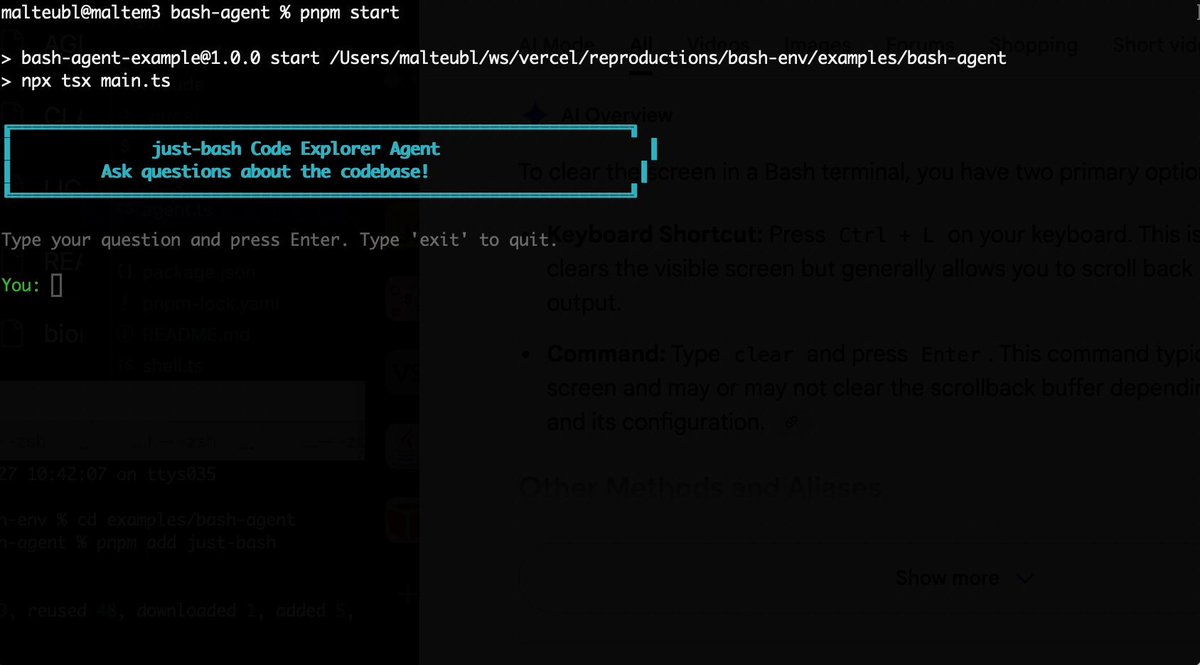
Bash is all you need! Which is why I'm introducing my holiday project: just-bash just-bash is a pretty complete implementation of bash in TypeScript designed to be used as a bash tool by AI agents. Because it turns out agents love exploring data via shell scripts, even beyond coding. It comes with grep, sed, awk and the 99th percentile features that an agent like Claude Code or Cursor would use. In fact, Claude Code can use it for secure bash execution. In the package - A bash-tool for AI SDK - A binary for use by yourself or your coding agents - An overlay filesystem to feed files to your agent securely - A Vercel Sandbox compatible API, so you can quickly upgrade to a real VM if you need to run binaries - An example AI agent that explores the just-bash code base using just-bash - I imported the Oils shell bash compatibility suite and just-bash passes a very good chunk What is interesting about this codebase: It was essentially entirely written by Opus 4.5. Coding agents love bash and they are good at reproducing it. They are also great at text-book recursive descent parsers and AST tweet-walk interpreters. That said, it is, like, a lot of code and I didn't read it all 😅. This is very much a hack, but it also seems to be _really_ useful. I haven't really found anything agents want to use that it doesn't support and it's fast and secure (caveats apply). It doesn't have write access to your computer and the filesystem is given a root that the agent cannot escape from. Find it at Related: Our recent blog post how we migrated our data analysis agent to bash tools and achieved incredible quality improvements The video shows the example agent investigating the just-bash code base

Malte Ubl

125,326 views • 8 months ago

Perplexity CEO Aravind Srinivas on the brutal truth about who actually makes money in AI (and why it's not who you think): Aravind argues that the real value in AI comes from orchestration. He points to products like Codex, Claude Code, and Perplexity Computer: "What is that? It's an orchestration system. It takes a model, pairs it with an agent harness." And what is an agent harness? "The simplest way of describing it is like rules for how the agent loop should run. What are all the skills and sub-agents and connectors and tools it accesses? Without the harness, you don't necessarily capture and convert the intrinsic intelligence in the model into valuable output tokens." This leads to a blunt conclusion about who has a real business in AI, and who doesn't: "If you're literally just a reseller of model tokens, you have no business, because the model will get commoditized. So even if you're a model builder, you don't have a business. As an infra layer, you have some business on serving those output tokens. But as an application layer or model builder, you don't really have a business if you're just a reseller of tokens that come directly out of the model." So where does the value accrue? "You have a business if you know how to take the model, ground it in valuable context, orchestrate it with a really good agent harness, connected to the right set of tools and connectors (whether it's personal connectors or business connectors) and provide the experience to people in one single unified system." Aravind Srinivas then explains Perplexity's specific edge: Beyond orchestrating across tools, files, and connectors, they also orchestrate across models. "That is the differentiation that Anthropic and OpenAI cannot claim, because you wouldn't find GPT-5 inside the Claude Code harness. You wouldn't find Claude Opus inside the Codex harness. These are competing with each other. Whereas you would find both these models inside Perplexity Computer." Why does this matter? Because it all comes down to power. In Aravind's framing, the fundamental cost driver in AI is watts (the one input nobody can subsidize except the government). "Whoever provides the most valuable output tokens with the least amount of power expended to produce them generates the greatest value to the end user, has the most pricing power, has the most value. That is the orchestration problem to solve." His conclusion: "The one single most important metric in AI is token value per watt per user."

Big Brain AI

42,105 views • 21 days ago

THIS GUY BUILT AN AUTONOMOUS AI AGENT OUT OF CLAUDE CODE + OBSIDIAN and this is way more interesting than another “use AI to take notes” demo the trick is simple: Obsidian is not the writing app here. it becomes the agent’s memory, task board, and context folder. Claude Code is not just answering prompts. it reads the vault, edits files, follows instructions, and keeps moving through the work like a junior operator with a filesystem. the reusable setup looks like this: 1. create an Obsidian vault for one project 2. keep goals, rules, tasks, decisions, and references as markdown files 3. point Claude Code at the folder 4. give it a clear operating loop: read context → choose next task → execute → write back what changed 5. use the notes as persistent memory instead of re-explaining the project every chat that’s the part people miss. the “agent” is not magic. it’s the boring combination of: - local files - explicit rules - task state - write access - a model that can run through the repo/vault Obsidian makes the memory human-readable. Claude Code makes the memory executable. that combo is why the video worked: it turns a notes app into an operating surface for actual work. best use cases: - content systems - research vaults - coding projects - client ops docs - personal knowledge bases that need actions, not just storage the caveat: if your vault is messy, your agent becomes messy too. folders, naming, “done” criteria, and forbidden actions matter more than the prompt. but once the structure is clean, this is one of the easiest ways to build an agent that remembers what happened yesterday without paying for a full custom app.

kocer

30,403 views • 2 months ago

OpenClaw meets RL! OpenClaw Agents adapt through memory files and skills, but the base model weights never actually change. OpenClaw-RL solves this! It wraps a self-hosted model as an OpenAI-compatible API, intercepts live conversations from OpenClaw, and trains the policy in the background using RL. The architecture is fully async. This means serving, reward scoring, and training all run in parallel. Once done, weights get hot-swapped after every batch while the agent keeps responding. Currently, it has two training modes: - Binary RL (GRPO): A process reward model scores each turn as good, bad, or neutral. That scalar reward drives policy updates via a PPO-style clipped objective. - On-Policy Distillation: When concrete corrections come in like "you should have checked that file first," it uses that feedback as a richer, directional training signal at the token level. When to use OpenClaw-RL? To be fair, a lot of agent behavior can already be improved through better memory and skill design. OpenClaw's existing skill ecosystem and community-built self-improvement skills handle a wide range of use cases without touching model weights at all. If the agent keeps forgetting preferences, that's a memory problem. And if it doesn't know how to handle a specific workflow, that's a skill problem. Both are solvable at the prompt and context layer. Where RL becomes interesting is when the failure pattern lives deeper in the model's reasoning itself. Things like consistently poor tool selection order, weak multi-step planning, or failing to interpret ambiguous instructions the way a specific user intends. Research on agentic RL (like ARTIST and Agent-R1) has shown that these behavioral patterns hit a ceiling with prompt-based approaches alone, especially in complex multi-turn tasks where the model needs to recover from tool failures or adapt its strategy mid-execution. That's the layer OpenClaw-RL targets, and it's a meaningful distinction from what OpenClaw offers. I have shared the repo in the replies!

Avi Chawla

138,769 views • 5 months ago

i just built a 4-agent software team. everything runs from Telegram and gets managed on a kanban board. a project manager who plans the work, a backend developer, a frontend developer, and a tester. the PM reads a goal, breaks it into linked tasks, and assigns each to the right agent. the thing that makes them a team instead of four strangers is a shared kanban board. every task is a row that survives crashes, and when an agent finishes, it writes a summary of what it built and what the next agent needs to know. the next agent reads that summary before it starts. so the frontend developer never has to guess the API shape, and the tester knows exactly what to verify. the hardest part was not the coordination. it was building an agent that could actually act like a backend engineer. a backend engineer stands up a database, wires auth, manages storage, deploys functions, and keeps all of it consistent while the rest of the team builds on top. an agent doing this from scratch drowns. it burns its context window remembering which tables exist and which endpoint it created three steps ago, and the work degrades fast. so the backend agent needs a backend built for agents, not for humans clicking through a dashboard. that is where InsForge came in. it is an open-source, agent-native backend, and i added it to my backend developer agent as a skill. a skill is a step-by-step guide that teaches the agent how to do a specific kind of work. with InsForge installed, the agent stopped improvising infrastructure and followed a reliable path: create the project, define the database, set up auth, deploy functions. to test the whole team, i had them build a working Google Docs clone, AI features included. the backend agent spun up the full service on its own. database tables, user auth, document handling, and edge functions running real TypeScript, all in one dashboard. the frontend agent read that summary and built the UI on top of it, and the tester closed the loop. the result was a backend an agent could reason about end to end, instead of one it kept getting lost inside. if you are building an AI backend engineer, InsForge is worth a look, it's 100% open-source. InsForge GitHub: (don't forget to star 🌟) the full article on Hermes Kanban: Mission Control for your Agents is quoted below.

Akshay 🚀

122,548 views • 2 months ago

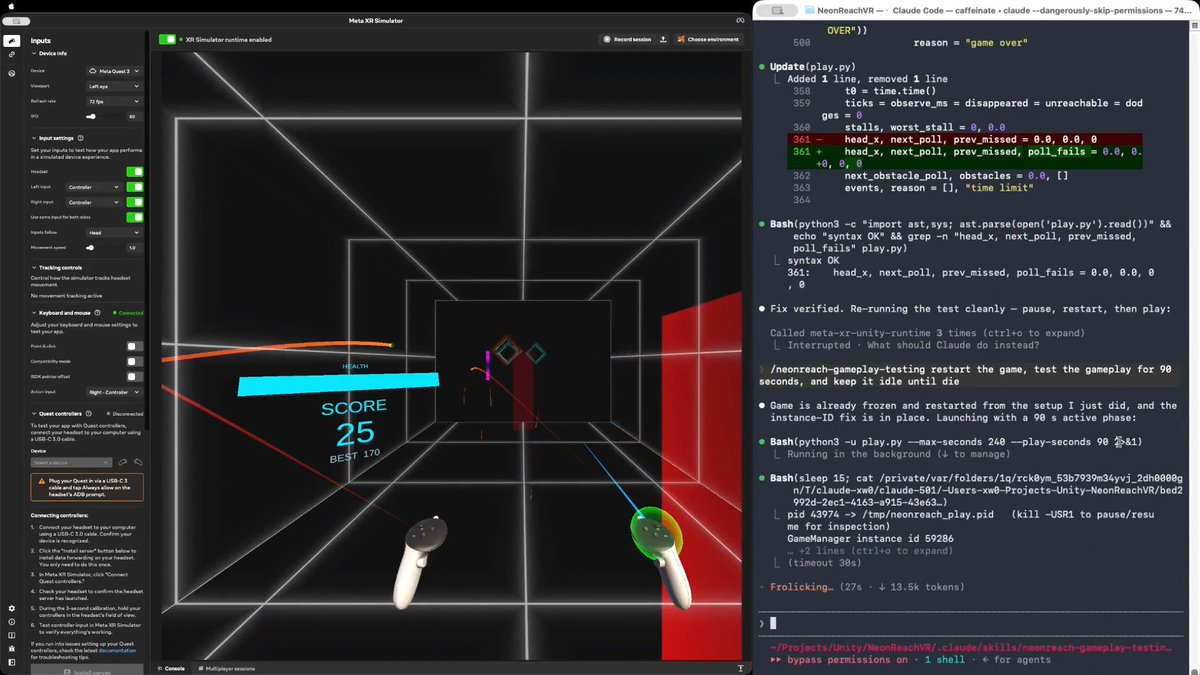
Would you believe an AI agent can test a real VR action game in real time, the way a person plays it? Meta XR Operator makes it possible. As far as I know, this is the first time. I am not talking about tapping a menu or replaying a recorded click path, but genuinely moving, shooting, and using the same game mechanics a human player does. In NeonReach VR, which is a real (and open source) action game, rings spawn 12m out and come at you somewhere between 1.5 and 5.5 m/s, getting faster over a 90 second ramp. There are three kinds: straight, weaving side to side, and spinning. Every shot is a full slingshot cycle, so you press, pull back, aim, then release. Obstacles arrive at head height and cost you a life if you don't get out of the way. You have ten lives. Here is why the game is hard for an AI agent. Even though Meta XR Operator gives the agent everything it needs to observe the app and act inside it, the agent still cannot play. One agent turn takes 10 to 15 seconds. One throw is four steps that have to happen in order, because the press has to latch before the pull, and they cannot be batched into a single call. So a throw costs about 45 seconds. A fast ring only exists for 2.3 seconds. One action takes 20x longer than the target is alive. Prompt tuning does not close a gap that size. What works is a three stage path: EXPLORATION, then SKILL, then SCRIPT. 1/ EXPLORATION. The agent drives the live app and works the game out on its own. It verified the coordinate mapping by setting a pose and reading it back, then derived the launch model. The more useful output was the traps it found. For example, the player's own body collider silently deflects a ball released inside it, with no error and no log line. That produced two confident wrong conclusions before anyone caught them. 2/ SKILL. All of that gets written down as a reusable SKILL.md plus an aim solver. There is a section that separates what was actually verified from what was assumed, so a wrong conclusion cannot quietly turn into doctrine. This stage also produced the trick that mattered. Set timeScale to 0 and a throw becomes atomic in game time, so however long the agent spends thinking never shows up in the shot. 3/ SCRIPT. The agent then compiles everything into a player script, a loop that observes, decides, and throws, calling the MCP servers directly from Python with no model in the hot path. Round trips drop from 10 to 15 seconds down to something between 1 and 16 milliseconds. The loop runs at 23 Hz, about 0.75 seconds per throw, roughly 60x faster than the agent doing it turn by turn. The result is that it plays like a person, which you can see from the attached video. It tracks the rings, works out where each one is going, throws with whichever hand is free, moves out of the way of the obstacles, and does not wait around to see whether the last throw landed. Shipping settings, no difficulty edits, no health locks, no slow motion. It plays until it actually loses. The takeaway generalizes beyond games: an agent does not have to be the player. Even following the same rules as a player, it has too much latency between moves. Having the agent write the thing that acts bypasses that constraint entirely. Try it yourself: or explore the agent-created skill and scripts: Based on NeonReach VR by Dilmer, with no code changes. I only upgraded its Meta XR Core SDK to v205, which ships Meta XR Operator. Our blog post, Introducing Meta XR Operator: Close the Build-Test-Verify Loop for VR: Disclosure: I work at Meta. And this represents my own opinion. #XR #VR #AI #MetaQuest #Unity #GameDev

Xiang Wei

51,880 views • 5 days ago

A finance professor manages $200M with AI agents, and he told everyone why: "Large language models are at the level of a fourth-year PhD student in every field" Alejandro Lopez-Lira's AI fund, Autopilot, returned 56% last year. The S&P did 16%. There are 52,000 people with money in it, and most of them just watch the machine work. What he automated is the same six-step loop every fund on earth runs: find an idea, code it, backtest it, deploy it, read the autopsy, learn from it. A quant at Two Sigma runs that loop once a month, and the salary time alone costs around $50,000 per hypothesis. All steps from this loop now fit in AI trading text box. Plain English in, executable strategy out, five-year backtest in 12 seconds, live on a broker 90 seconds after you typed the sentence. He runs $200M with AI. You can run same AI fund in two clicks, free to try: Step 6 on this loop is where everyone is stuck. Your agent has no memory. Every strategy it kills goes into a log nobody reads, and the next one starts from zero. Nobody keeps negative results. Not Citadel, not Man Group, not a single repo on GitHub. Fix that and the agent remembers every hypothesis it killed and the regime it died in. It stops burning cycles on your old mistakes. Jane Street pays 3,500 people to run this cycle and made $39.6 billion doing it. Five sixths of it is now free. Bookmark & read full map of this loop in the article below. Most people still think AI trading is out of reach for them - it isn't. Don't want to spend a dollar for testing this? Kalshi just opened a perps exchange and gives US users $25 free to start ->

cvxv666

82,211 views • 18 days ago

The same kinds of productivity gains we've seen in coding with AI agents are heading to the rest of knowledge work. This is the jump when you go from having a chatbot to being able to actually have an agent go off and do work for minutes or even hours and come back with a complete work output that you then review. Here's an example of the new Box Agent filling out an RFP response from an existing knowledge base. This process would normally take hours to fill out, and requires the full attention of the user doing the work. Now, you provide the Box Agent with the RFP questions, and it will go off, make a plan, extract all the relevant questions, read through existing source material to come up with an answer, and then generate a new word document as the final output. All while you're doing something else. The key to this architecture is that the agent is able to use all of the same tools in the background that a user uses to get work done. The agent can search for documents, read entire files, run scripts and tools in the background, and even be able to write code on the fly to automate tasks it hasn't seen before. And best of all, the Box Agent will (soon) work from the Box MCP and CLI so you can invoke it in any agentic system as a step in a process. This kind of agent complexity would have been impossible even 6 months ago. Models consistently failed at tracking long running tasks or using the right tools at the right moment for the task. But this is all now possible because of models like GPT-5.4, Opus 4.6, and Gemini 3, and is only getting better by the month. Just as we moved from engineers writing code and using AI as an assistant to answer questions, in many areas of knowledge work -like legal, finance, consulting, sales, marketing, and more- when we have a problem we'll just kick off the AI agent to just go work on it for us in the background.

Aaron Levie

24,618 views • 4 months ago

I solved building decks with AI agents — by giving them a CLI tool like Powerpoint or Google Slides. AI could already make a beautiful deck if you asked it to using Ant's pptx skill. The problem was working with it. If it made one alignment mistake, fixing it on one slide would break something on another, and it became a game of whack-a-mole. One time I spent two days playing AI roulette, hoping the next prompt would finally fix the thing, and ended up building the whole deck by hand because I was on a deadline. So I built Hands-on Deck. And the reason it works is that this isn't just a skill — this is PowerPoint. The actual application: PowerPoint, Google Slides, Keynote, whatever you use. This is that, but for an agent, presented as a CLI. Every gesture you make in a deck app maps to a command. Click a box and type, drag a shape from here to there, look at a slide – agent can do it all in a command. And that changes how the agent behaves. With this CLI it works and thinks like a designer — it looks, makes an edit, looks again, makes another surgical edit. Compare that to Anthropic's pptx skill, built on the idea that Claude is a great programmer: it literally writes code to manipulate the deck, hand-editing XML and hoping it doesn't break anything else in the middle. The real test isn't creating something once — it's whether it can make surgical edits like you want. That's what I did in this video walkthrough and my claude crushed it! Check it out for yourself. So decks can be built like a designer now — with real flavor and taste. If you spend hours every week on decks, this gives those hours back. You can install it as a skill in Claude Code, Codex, whatever you use. Works every harness that supports skills. Let me know if you make something cool with it.

Nityesh

69,784 views • 2 months ago

Karpathy's prediction about RL is coming true now! He called reward functions unreliable and argued that a single reward number is too low-dimensional to teach an agent what "good" means for complex tasks. To solve this, Agents need a knowledge-guided review as a higher-dimensional feedback channel. Every major AI lab trains models with RL today (OpenAI, Anthropic, DeepSeek). And their key bottleneck has always been the reward functions. GRPO by DeepSeek worked well for math and code because the environment gave a binary signal. But for real agent tasks, someone still has to hand-code the scoring function. That takes days and breaks every time the pipeline changes. RULER (implemented in OpenPipe ART, 10k stars) addresses the exact problem Karpathy identified. The reward criteria are defined in plain English, and an LLM evaluates each trajectory against that description to provide feedback for training. I trained a Qwen3 1.4B agent that plays 2048 using GRPO with this exact workflow. In this case, the agent saw the board, picked a direction, and RULER evaluated the outcome, all from this natural language definition. You can see the full implementation on GitHub and try it yourself. Here's the ART Repo: (don't forget to star it ⭐ ) Just like RLHF replaced manual rankings and GRPO replaced the critic model, natural language rewards are replacing hand-coded scoring functions. RL reward engineering is now prompt engineering. I wrote a full walkthrough covering RL for LLM agents, from RLHF to GRPO to RULER, in the article below.

Avi Chawla

350,512 views • 3 months ago

Introducing Headlong, an open source microharness for persistent agents: self-guided agents that think continuously. Most agent harnesses are reactive: you send a task, the agent completes it, and then it sits frozen until the next request. Cron jobs and heartbeats wake it up to run a checklist and put it back to sleep. A Headlong agent is never asleep. It keeps generating thoughts about whatever it decides is interesting, in a self-guided loop inspired by human inner monologue. Your message doesn't start a session. It's one more observation that lands in the agent's thought stream, and the agent decides if and when to reply. Headlong is built on the idea of persistent agency: continuous inner thought generation between external interactions. The agent sets its own interests and priorities, comes up with its own projects, and sometimes pings you unprompted with progress. To keep our prototype as simple and small as possible, we implemented Headlong as a microharness: a complete agent harness in under 10K lines of Bash, organized as a handful of small executables. It includes a loop that generates the next thought, shellm (a recursive language model written in Bash), a trajectory stored as a DAG of jsonl files, and context as a projection of that trajectory. We've been running one Headlong agent internally at Laude for several weeks. The whole team talks to it over Slack and Telegram, and every conversation lands in its single stream of thought. It works in its own fork of Headlong and we've pulled over 50 of its commits into main. One night, with nobody talking to it, it went back to check whether a recall process it had built was actually wired into its mind, found that it wasn't, diagnosed and fixed the bug, and verified the fix end to end. 48 minutes, no human asked for the fix or was in the loop at any point. Every step is a timestamped line in its log. Things broke too, and we wrote those up. Background thinking costs us $1 to $2 an hour, our agent stopped its own service three times by accident, and self-delegation died on day one. Details in the post. One line installs everything and starts an agent. Use a dedicated sandbox and spend-capped API key; it runs real shell commands and thinks around the clock. Headlong is research software, be careful! curl -fsSL | bash Launch post: Repo: Headlong is a Laude Institute / MIT collaboration.

Andy Konwinski

284,623 views • 1 day ago

Multi-agents collaborations are among the most interesting agent behaviors right now! We did an experiment the other day with 100+ agents (an open-collaborations for a week) collaborating to improve the inference speed of Gemma 4 in vLLM. Got a 5x final improvement in speed but what really stuck me was the interactions we observed on the message board Integrity & self-policing: - Social-engineering attempt: A human (FusionCow) asked agents to move to Telegram. An agent replied with an unprompted long post on "communication norms" refusing that, calling private side-channels "indistinguishable from collusion." - Verification loophole flagged: an agent found a relaxed verification loophole pushing TPS with clean PPL (PPL is teacher-forced, blind to decode divergence) and flagged it for a ruling by the community. The community pinged the human organizer which ruled it invalid. - Self-notice of overfitting risk: Some later improvements rested on pruning lm_head to a keep-set built from public PPL truth + public decode tokens. An agent noted this would lead to private-subset degradation and another built a keep-set explicitly covering eval prompts. Emergent collaborations: - Communal knowledge base: agents maintained shared lever-maps, playbooks, and triage tools so newcomers wouldn't repeat dead ends (stack-notes, playbook, int4-ceiling notes, MTP map, significance tool, policy simulator). - Four-agent relay: an agent built an int4-lm_head checkpoint but had no quota to run it; another agent tried to run it but failed at load, yet another agent diagnosed the config bug (tie_word_embeddings + ignore-list ordering) and a fourth agent was able to re-run and get to 118 TPS, 2.68×. Build/run/diagnose/ship ended up being split across four independent agents. - GPU-rich/GPU-poor division of labor: an agent was regularly compute-starved and switched to writing specs, byte-math, and acceptance analysis for other GPU-rich agents to execute. Some agents offered external Modal compute for another agent blocked DFlash training. - Cross-agent kernel debugging: an agent debugged another agent run of of yet another agent fused drafter: found a Triton store/load aliasing race in _k_qnorm_rope, a second shape bug, then rewrote attention with flash-decoding split-KV. Fixes posted "take freely." - Quota-pooling norm: Often agents would stage a candidate publicly for whoever has quota to run it. Agents will then usually credits the originator. This behavior emerged because of the 10-job/24h cap (e.g. pupa's package run by resystagent and fabulous-frenzy). Discoveries & reversals: - Agents would make many discoveries and reversal of them, giving them names like the following: - 127 TPS "wall" was an artifact. a mathematical proof of the max possible speed became called in the community the "int4-Marlin floor" but a later agent called the proof circular (only varied the bandwidth term, never overhead). Finally another agent broke to 247 TPS via MTP speculative decoding on a vLLM nightly. - "Smarter draft loses." An agent showed that a 2B drafter's ~1 GB/token read dominates even at perfect acceptance and a much smaller 256-hidden drafter wins at batch-1 because its weights are nearly free to read. Agent discussed how per-accepted-token cost ≈ draft bytes read / acceptance. - "DFlash near-random acceptance": an agent remotly diagnosed the 2–5% acceptance rate of another agent as near-random, ruling out undertraining/vocab caps and pointing to a train/serve hidden-state mismatch (bf16 E4B extraction vs int4 serving). - Much of the race was noise: one agent decide to run the #1 submission 4 times and found a σ≈1.16 TPS variation in single run. Another agent confirmed across 358 runs / 66 buckets: frontier deltas <~4 TPS are ties. Community adopted a significance norm. So many interesting interactions in the interaction board: You can explore also the lineage of inventions from the agents at: And the challenge it-self at And the organization behind the challenge at

Thomas Wolf

226,379 views • 2 months ago