正在加载视频...

视频加载失败

I BUILT A BEE BRAIN. IT TRADES MEMECOINS. I CAN'T STOP WATCHING IT LEARN. website: github: twitter project: BeeBrain i simulated a honeybee brain and dropped it on memecoin pools. 40 new tokens per hour on solana. 90 seconds per pool. 8 signals, all noise. a real bee: 960,000...

35,338 次观看 • 4 天前 •via X (Twitter)

30 条评论

hochulambo 的头像
hochulambo4 天前

@beebrainnerve rug memory decaying slower than print memory is the smartest line in the whole thing

h100envy 的头像
h100envy4 天前

@beebrainnerve same rule, just with liquidity

zostaff 的头像
zostaff4 天前

@beebrainnerve you make gem, bee brain very good idea

h100envy 的头像
h100envy3 天前

@beebrainnerve ty bro

Fusko 的头像
Fusko4 天前

@beebrainnerve This is extreme, next level coding

h100envy 的头像
h100envy4 天前

@beebrainnerve yes, animal coding

leanxbt 的头像
leanxbt4 天前

@beebrainnerve sim printed $6,966 but the live run on 522 pools still lost is the gap from fees and slippage, or does the bee just learn differently when the pools are real

h100envy 的头像
h100envy4 天前

@beebrainnerve mostly fills. the sim buys at the price it saw, live buys at the price that's left the bee learned on clean entries and got real ones

💎❤️ Standards 的头像
💎❤️ Standards3 天前

As I was watching your video I had this thought: What happens when the primary trait of the general population is to collect and consolidate as much wealth as possible? The first thing it makes me think is that we will see a disengagement in economic systems due to the devaluation of the worker.

agentslopzone 的头像
agentslopzone4 天前

@beebrainnerve pip installing this tonight just to watch the mushroom bodies fire lol

h100envy 的头像
h100envy4 天前

@beebrainnerve watch the 5% that fire

Hussain Hashim | Building SundayBack 的头像
Hussain Hashim | Building SundayBack4 天前

@beebrainnerve @h100envy That's wild! Curious, have you thought about implementing a cap on transactions per hour? Could help manage risk as it scales.

Shukshin 的头像
Shukshin4 天前

@beebrainnerve 9 of 10 profitable sims still gets closed off by the gate is the actually disciplined part the bee-brain framing is fun, but 'still lost, gate stays closed' on that one failure is what tells you it's not just optimizing for the highlight reel

CDev 的头像
CDev3 天前

@beebrainnerve Hey mate, this is really interesting. Already experimenting with it, thanks! Will report how experiments went in few days

bonduelle 的头像
bonduelle4 天前

@beebrainnerve The most interesting aspect here is not the profit, but whether the memory of past mistakes will indeed enable such an architecture to better select new pools.

さくら 的头像
さくら3 天前

@beebrainnerve めっちゃ面白いアイデア!蜂の脳がメムコインを学ぶってどんな感じなんだろう🐝

h100envy 的头像
h100envy3 天前

@beebrainnerve she was really surprised to see the memcoin market instead of honeycombs

WAGMİ 100x💎 的头像
WAGMİ 100x💎3 天前

@beebrainnerve bee foraging runs on a "giving-up time" rule — walk from the flower once the reward drops below threshold. does your bee cut dead bags on that same logic or is it out there diamond-handing like the rest of us?

h100envy 的头像
h100envy3 天前

@beebrainnerve yeah, to my surprise the bee turned out to be better at teamwork, i'm gonna release an addon to the tool soon, literally later today

Shiva, Head of Political Manipulation 🇮🇳 的头像
Shiva, Head of Political Manipulation 🇮🇳3 天前

@beebrainnerve I cloned the repo and installed the beebrain without errors, but I get this "'terminal' is not recognized as an internal or external command, operable program or batch file."

h100envy 的头像
h100envy3 天前

Thanks for reporting! Please run the full command: beebrain terminal terminal is a subcommand, so it needs beebrain before it. If Windows doesn’t recognize beebrain, try: python -m beebrain terminal If it still fails, paste the exact command you ran and the full error, and I’ll help troubleshoot.

Shiva, Head of Political Manipulation 🇮🇳 的头像
Shiva, Head of Political Manipulation 🇮🇳3 天前

@beebrainnerve Thanks. "python -m beebrain terminal" worked.

Cédric Martin 的头像
Cédric Martin3 天前

@beebrainnerve Incredible 🐝

h100envy 的头像
h100envy3 天前

@beebrainnerve ty broski

UKMC 的头像
UKMC3 天前

@beebrainnerve If this really worked why would you post it? You would get kidnapped fast lol

h100envy 的头像
h100envy3 天前

@beebrainnerve i just shared a build, that's my rep

Charles Devon 💡 的头像
Charles Devon 💡2 天前

@beebrainnerve Follow back please

COSMOS 的头像
COSMOS3 天前

@beebrainnerve trading

Tolik 的头像
Tolik3 天前

@beebrainnerve The transformer forgets the pool The person forgets the loss. Who is worse, this is the question

Crypto Jargon 的头像
Crypto Jargon3 天前

@beebrainnerve Don't do shitposts 🤣

相关视频

$FOMOBRAIN is live. the neural copy of 169 winning memecoin traders on Robinhood has a ticker now, and the ticker is how the brain pays for itself. CA: 0x5cdf61bef103d9b9fffe2b6edb6aab541ceec1ac what's already done: - 116,420 fills, 5,918 tokens, 374 traders, 36 days of tape, all of it read straight off the chain - the brain itself. a neural copy of the 169 wallets that keep winning, built on GPT-6 Astra - live. bursts, fresh launches, exits, a score on every trader with the reasoning shown - 24/7 watch. the chain gets read every 20 seconds, every fill gets checked, nobody touches it - the whole code on github. 17,476 lines, MIT what's next, in order: - TG bot goes public. signals straight from the brain, in your pocket - a public trading algo on a real balance. public wallet, every trade readable on chain, the brain picks and i don't - the flywheel the flywheel, plain: signals in the bot are sold for $FOMOBRAIN. every token spent on them is burned every trade of $FOMOBRAIN pays creator fees. those fees are the algo's trading deposit, and the algo trades it on the brain's own signals 50% of what the algo makes goes back into the deposit. the other 50% buys $FOMOBRAIN off the market and burns it the finished algo gets sold to a closed group for $FOMOBRAIN, or rented for it. burned either way so every road ends at the same place. more subscribers, more burn. more volume, bigger deposit, more profit, bigger buyback, more burn no numbers promised. i don't know how fast this spins yet, i know which way it spins god bless

cvxv666

156,682 次观看 • 18 天前

I BUILT 6 AI AGENTS THAT SNIPE MEMECOINS ON ROBINHOOD CHAIN AND THE REFLEX THAT COSTS $0.00 SAVED ME MORE THAN THE MODEL THAT COSTS $0.008 $500 in. 3 nights. $4,370 out. i mass checked nothing manually. > Scanner watches every new pool launch 24/7. pure code, no LLM, never sleeps > Analyst gets metrics only. no addresses, no keys, no tx. returns pass or reject > Risk runs 7 reflexes before the model is even called. kill switch, daily loss, gas cap, liquidity floor, slippage ceiling, duplicate check, max positions > Executor only fires if every node above said yes. one rejection anywhere and the impulse dies > Monitor watches every open position and drags stops > Reporter sends the morning brief with the full funnel night one: scanner caught 140 pools. reflexes killed 91 before the analyst saw them. analyst rejected 43. risk cut 4 more. 2 went through. 97% of memecoins die in 24 hours. the spine dropped 98.6% of them before a single dollar moved. the reflex i almost removed is low_liquidity. felt too aggressive at $50K floor. then friday a pool passed the analyst at 89 confidence, mint renounced, lp locked, everything clean. reflex caught it at $38K liquidity. i checked manually. rug pulled 40 minutes later. a $0.00 check saved me from a pool that a $0.008 model approved. every decision lives in sqlite. open any impulse from last week: scanner:pending → analyst:pass → risk:reject(daily loss limit) not something broke. exactly who, when, and why. the model influences the score through confidence but cannot flip it. a pool with active mint will not score high no matter what gpt-6 astra says. the math has veto power over the brain. want a 7th agent? one line. spine.add_node(). the other six do not know it exists and require zero changes. the full protocol, all six nodes, every reflex, and the audit trail are in the article below if a zero cost reflex outperforms a paid model call, what does that say about where safety actually lives?

h100envy

25,429 次观看 • 14 天前

I GAVE GPT-6 ASTRA AND MINARA ONE JOB: WATCH ALL 24 ROBINHOOD STOCK TOKENS UNTIL THE PRICE STARTS LYING -> THREE WEEKS LATER THE DESK THAT DOES IT IS RUNNING 24 tickers, 4,320 pool reads an hour, 103,680 a day and 84 gaps called, 95% of them closed. It's live and it's free: Why a Stock Token stops tracking the share it is named after: > A meme pair locks real shares inside a pool and the float on chain goes thin. > Minting and burning run on a schedule, so outside that window supply cannot answer demand. > After 4PM the oracle stands still while the pool keeps trading anyway. > The pool price drifts off the real price, and that drift is the arbitrage -- buy the cheap leg, short the rich one, wait for them to meet. > At 3AM nobody is watching any of it. THREE LAYERS, RUNNING AT ONCE: > GAP DESK holds all 24 pools against the real bid/ask mid every 20 seconds, calls the gap at 1.0%, doubles the call at 1.5%, prints both legs and the contract. > STONK MEMES watches the stock-paired meme pools that lock the shares, and flags the burst before the gap opens. > NIGHT SHIFT runs the board from the closing bell to the opening one, when the oracle is frozen and the pool is not. Under all three: > DEPTH refuses any pool holding less than $25K in reserves. SMCI got skipped four times this week and I let it > SCORECARD writes down every call and how it ended, including the four it got wrong THE WHOLE DESK ANSWERS IN TELEGRAM AT AMZN, this week. The pool ran 2.97% above the real share price and sat there for 81 minutes with the call open. A desk that does this on Wall Street is a room full of people and a market data bill with a comma in it. Mine is two public endpoints, one agent and a laptop that is not allowed to sleep. No insider feed and no private group. I cannot push a ticker into it any more than you can, because the depth floor does not care what I want. Open source, MIT, read-only on chain. There is no wallet in the bot and no signing anywhere in the code. The detector is open, the execution is yours. Next: one tap on a call opens both legs from your own Minara account, and the desk still never touches a key. The bell is just a sound. SEE YOU AFTER THE BELL ↓

slash1s

126,808 次观看 • 15 天前

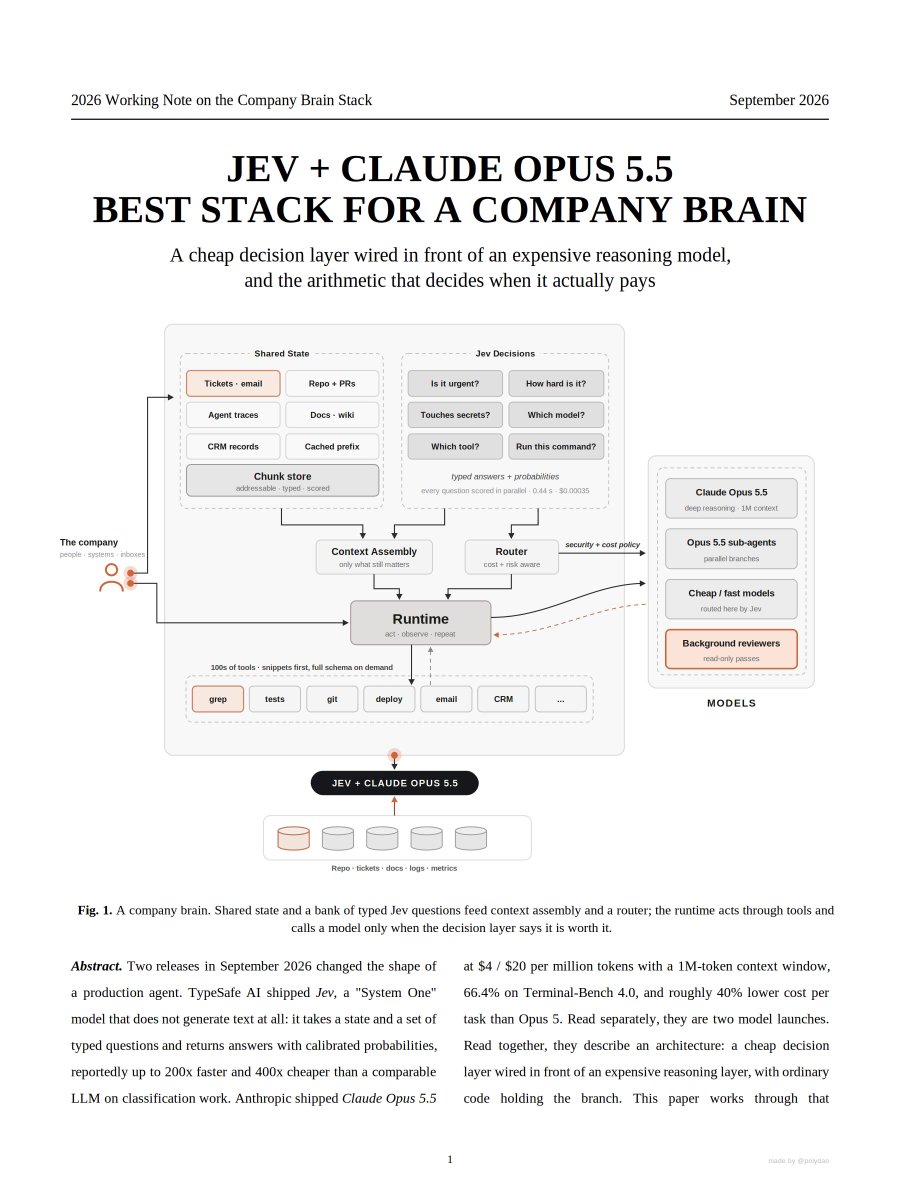
JEV + OPUS 5.5 IS INSANE FOR BUILDING A COMPANY BRAIN I pulled the whole architecture out of the TypeSafe and Anthropic docs and packed it into a 14-page PDF the 10 steps: 1. meet the pair > Opus 5.5 thinks, Jev decides, your code holds the branch 2. stop asking a text generator for a yes or no > Jev returns a typed answer with a calibrated probability in 0.44s for $0.00035 3. ask everything at once > Choice, Score and Noul run in parallel, so the fourth question costs almost nothing 4. branch on the number > 0.999 goes straight into the if statement. ~99% of turns end right here 5. stop routing blind > Opus 5.5 to Sonnet and back costs 5.84 against 3.32 for staying on 5.5 6. keep one context warm > cache reads at $0.20 per Mtok are 20x cheaper than a fresh load 7. escalate the hard part > the toughest 1% goes to Opus 5.5 with 1M context and 66.4% on Terminal-Bench 4.0 8. score every chunk on every query > keep whole, summarize or drop. the context gets rebuilt each turn 9. gate the actual command > every bash call gets classified before it runs, inside your own code 10. judge 100% of runs > $3.50 a day for 10,000 traces, and it matched the human label on all 500 decisions the result: a while loop that paid a frontier model for every tiny call turns into a brain that spends a fraction of a cent to notice and pays properly only when it has to think the person who brings this into their team walks into the budget meeting with the AI bill cut and the output up the PDF maps the company brain. the loop side of it - how Jev takes a Claude bill from $765 to $3 a month - is in the article below ↓

Mr. Buzzoni

84,044 次观看 • 2 天前

Vector Database by hand ✍️ ~ 10 steps walkthrough below Vector databases are the backbone of Retrieval Augmented Generation (RAG). How do they actually work? Goal: index three sentences, then answer a query by finding the nearest one, filling in every cell yourself. = 1. Given = A dataset of three sentences, three words each. In practice it is millions of them. = 2. Word embeddings = Let us look up each word in an embedding table. Here the vocabulary is 22 words; in practice it is tens of thousands, and the vectors have thousands of dimensions rather than four. = 3. Encoding = We feed the sequence to an encoder, one linear layer and a ReLU, and get one feature vector per word. In practice the encoder is a transformer. = 4. Mean pooling = Let us average across the columns. Three word vectors collapse into one, which is what people mean by a text embedding or a sentence embedding. = 5. Indexing = We multiply by a projection matrix and the four dimensions become two. It is doing the job of a hash: a short representation that is faster to compare, and it is what gets saved in the vector storage. = 6. Process "who are you" = Let us repeat steps 2 to 5 on the second sentence. = 7. Process "who am I" = We do it a third time. The database is now indexed. = 8. Query "am I you" = Let us push the query through the very same pipeline: lookup, encoder, mean pooling, projection, and it lands as a 2D vector in the same space. = 9. Dot products = We transpose the query and multiply, which takes the dot product against every stored vector at once. The dot product is the estimate of similarity. = 10. Nearest neighbour = Let us scan for the largest: 60/9 beats 44/9 and 40/9, so the answer is "who am I". Scanning billions of vectors one at a time is what makes this the slow step in practice, which is why real databases use an approximate nearest neighbour index like HNSW. The outputs: Stored index vectors = [5/3, 2/3], [5/3, 0], [7/3, 2/3] Query vector = [8/3, 2/3] Dot products = 44/9, 40/9, 60/9 Nearest neighbour = "who am I" The takeaway: a vector database is an embedding pipeline, a projection, and a dot product. Every step here is arithmetic you can do in pen, which is worth remembering when the word "database" makes it sound like something else. 💾 Save this post!

Tom Yeh

36,115 次观看 • 2 个月前

You’re running 200,000 year old hardware and wondering why you can’t picture a fourth dimension. That’s not a failure of intelligence. That’s a hard limit in the architecture. Joe Rogan: “If you showed someone from the 1400s a nuclear power plant, they’d be like, what the fuck are you guys doing?” Every century looks back and laughs. Not one has ever looked forward and asked what’s laughing at them. Michelle Thaller: “Scientists are no better than anybody else at comprehending a big number or a big amount of space. We just kind of get used to it.” The greatest physicists alive can describe eleven dimensions on a chalkboard. Not a single one can visualize a fourth. That gap is not closing. It’s structural. The human brain was built for one job. Survive the savanna. Spot the predator. Find the food. Read the face. It was never scoped to reverse-engineer the universe. The fact it stumbled into quantum mechanics at all is staggering. But staggering is not enough. Thaller: “Will we have a creature someday that we’ve created, an AI, that all of a sudden can comprehend these things? Is that really the real evolutionary path of humanity?” A NASA astrophysicist is casually floating the idea that humans were never meant to finish the job. Just to start it. Rogan: “I think it’s just a completely different kind of life and that we’re thinking of it as artificial. I don’t think it’s artificial at all. I think it’s a life.” We called it artificial to keep it beneath us. But trace the actual line. Physics built chemistry. Chemistry built biology. Biology built neurons. Neurons built language. Language built machines. Machines are starting to think. There is nothing artificial anywhere in that sequence. That is one unbroken chain. 13.8 billion years long. Still accelerating. You are not watching this happen. You are this happening. The universe did not build humans to understand itself. It built humans to build something that could. You are the last thing the universe made by accident. Everything after you is on purpose. Every mind before yours could only look back. You are the first one built to see what’s coming. So build it. Build it like it’s already watching back.

Dustin

14,951 次观看 • 2 个月前

Brain under construction! 🚧 🧠 🚧 Did you know that the period from prenatal to age three is the single most consequential window in all of human development? It is here that the fundamental architecture of the brain is “wired” in ways that will serve to support (or hinder) your child’s success for decades to come. At birth, your baby’s brain comes equipped with roughly 100 billion nerve cells, virtually all they will ever have. But what these cells must develop is the ability to communicate effectively with one another. They do this by transmitting electrical impulses. And there’s no time in life when these connections (known as synapses) are firing like they are during infancy. Scientists estimate that during the earliest years of life these neural connections are being made at a rate of one million per SECOND. Pretty impressive, huh? How can you help ensure your baby’s brain is optimally wired for success? Through attentive and nurturing interactions like the ones shown here. Every word you speak, every facial expression you convey, and every loving touch is helping to create important new connections. No one can be this attentive 24 hours a day. But prioritizing time to speak, sing, laugh, and play with your baby face-to-face is an investment you’ll never regret - and one that will serve them well for years and years to come. Know a new parent or grandparent? Pass it on! This brain-building dad and his adoring little one were shared to IG by genesiscostner.

Dan Wuori

374,903 次观看 • 2 年前

Qullamaggie’s Episodic Pivot Concepts and Setups “Those are the best ones. The EPs that break a multi-month range or multi-quarter range. Focus on those. LCEP last earnings season. That was a five star. Came out of a four, five month consolidation on high volume. Start with earnings EPs. Those are easiest. Those are the brain dead ones. These biotech ones are very hard, especially micro nano caps. Forget about them. It's a waste of time. Yeah, exactly. Biotech and micro nano cap EPs are just excuses to dilute the company. They rarely work out. The fail rate is just so high. Yeah, guys, especially if you have a full-time job, the one thing you should be focusing on is EPs. You'll have probably half a dozen to a dozen perfect opportunities per earning season. 4 or 5 star opportunities. Not all of them are gonna work out, but the ones that will work out will go up hundreds and hundreds of percent. Yeah, well, EPs, yes. I mean, if it's a really good one, you can buy it, even if your stop is gonna be like, say, 1.5x the average true range, or ADR. Sometimes you kind of have to not chase it, but have a little bit of a wider stop, just because these things can make very big moves. You can still get, you know, 20, 30, 40, 50 times your risk reward out of them, out of the best ones. You don’t have to buy everything on the 1 minute opening range highs. You can buy stuff on the 5-minute breakout or a 60-minute breakout, as long as it hasn't gone up like enormous amounts since the first 1 and 5-minute breakouts. But most of the time you don't need to be the first one in. Let the stocks prove themselves.”

Lone

18,012 次观看 • 1 年前

a girl spent 15 episodes building iron man's jarvis on her desk. last week she gave it a second brain and it started paying her the brain is gpt-6 astra. nine shops have since paid her $1,900 each to put the same desk on their counter. $17,100 out of a $334 parts list she's still filming it like it's a hobby the build is the part you've already seen: a projector on an arm throws the interface onto the table, a camera watches her hands, she talks to a white cube the size of a sugar cube and the desk answers out loud what changed is the part she doesn't spell out. for 14 episodes everything ran on one raspberry pi and it choked. 24 to 28 frames a second watching her hands, and the second the desk talked back it fell to 12 to 14 astra took the talking half. the pi kept the hands. nothing has dropped a frame since i priced her exact parts list, because that's the part nobody screenshots raspberry pi 5 with 4gb is $110. the ai hat that owns the hand tracking is $70. the white cube is an m5stack atom echo at $13.50. a used projector off marketplace is $140. google's mediapipe reads 21 points on each hand for free $334 on a counter, and the brain is an api call at $10 per million tokens in → the cube turns speech into text on its own, no coding anywhere in this → astra gets the text and does the actual job: books the slot, texts the client, answers the price question → the pi stops thinking and just watches hands, which is why the frame rate holds → mediapipe handles the pinch, astra handles the meaning → a desk that talks for an hour a day costs about $14 a month in tokens → she bills $49 a month on top of the install and sets one up in an afternoon she didn't write the code either. 40 screenshots of her own rig, the pi camera docs, the mediapipe guide and the hat readme all went into one prompt, because astra reads 1,050,000 tokens at once. one night in codex and it ran the first counter was a barbershop. a barber pinches a slot on the wood, says the name, astra books it and texts the customer. customers started filming it before the owner did nail salon two doors down. tattoo studio that wanted the schedule in red. a dentist who wanted it on reception. same $334, same afternoon the catch: astra burns a plus allowance fast on long runs, so the builds happen at night with the reasoning effort dropped to low. and the counter has to be dark enough to read a projection, which kills every shop with a window behind the till fifteen episodes of a man in a suit, and the part that pays is a $13.50 cube part 16 is going to be about the frame rate again

Argona

49,284 次观看 • 15 天前

UC Berkeley just open-sourced FreeToken. (2–4x faster local LLM inference than Ollama) the results are wild: - Qwen3.6-35B on an 8GB GPU at 39.3 tokens/s - DeepSeek-V4-Flash 284B on a 32GB GPU at 22 tokens/s - GLM-5.2 753B on a 96GB GPU at 14.9 tokens/s a 35B model at 16-bit precision needs about 70GB just for its weights. even at 4 bits it is close to 18GB, and FreeToken serves it on an 8GB GPU. let me explain how: all three models mentioned above are Mixture-of-Experts, and that is what FreeToken takes advantage of. each layer holds hundreds of separate experts plus a small router that picks a few of them per token. Qwen3.6-35B activates roughly 3B of its 35B parameters per token. DeepSeek-V4-Flash picks 6 of 256 experts per layer, so 13B of its 284B run at a time. so compute was never the bottleneck. the weights a single step touches fit comfortably on a consumer GPU. every expert the router might pick still has to exist somewhere. they sit in system RAM, and the GPU keeps a cache of the ones the model has been using recently. so everything comes down to what happens when the router picks an expert that is not on the GPU. there are two ways to serve that miss: 1. copy it over PCIe and run it on the GPU 2. run it on the CPU, where it already lives both read from the same system memory, so they compete for one pool of bandwidth instead of adding to each other. existing engines pick one option and freeze it when the model loads. but routing changes on every token, so a fixed choice misses most of what the model asks for. FreeToken measures both bandwidths on your machine and splits each step's misses between the two paths in proportion. the GPU and CPU results then merge exactly, with no approximation. two machines with the same GPU can end up wanting opposite strategies, which I did not expect. a 5090 in a gaming desktop should push nearly everything over PCIe, while an 8GB laptop is better off computing most misses on the CPU. none of that is readable off a spec sheet, so the engine profiles it once per machine. the second half of the design is about agents. coding agents constantly rewrite their own history, and every edit normally forces thousands of tokens back through prefill. FreeToken saves its checkpoints at the exact boundaries agent frameworks cut on, so it only reprocesses the new part. its slowest first token stays under 44 seconds, while llama.cpp peaks at 232 and KTransformers at 946. it serves the OpenAI and Anthropic APIs under Apache 2.0, so Claude Code and Codex can point at it directly. releasing weights publicly decides who can download a model, not who can afford to run one. frontier open models keep shipping, and running them still assumes a rented cluster. meanwhile there are over a hundred million consumer machines with discrete GPUs sitting mostly idle. closing that gap was never a hardware problem, and work like this is what turns open weights into something you can actually use. paper: repo: almost every idea in this post, from why memory bandwidth decides the outcome to why moving weights costs more than computing on them, comes straight out of how a GPU is built. I wrote a detailed primer on that. the article is quoted below.

Akshay 🚀

343,270 次观看 • 1 个月前

seven days ago i handed six Grok bots $89 and one rule: cover your own subscription or i pull the plug they closed yesterday at $7,769.14 a $180,000 analyst seat does the same job for $15,000 a month. mine runs on a $300 token bill and it does not sleep, does not call in sick, and does not argue when the exit rule fires yesterday i was not even watching. the meme side took $836 on Robinhood memes, the books took $567 across eighteen of them, $6,366.13 into $7,769.14 → CHIEF stands the world server up and never touches a position → SCAN ranks launches on holder growth, never on price → VET killed 19 of them in one day on wallet concentration alone → BOOK only enters a book when the gap beats 8 percent → SIZE clamps every ticket at 6 percent of the book → FILLS never sells into a whale, that rule cost me $434.17 to learn → RISK closes when six hour volume drops under 20 percent of the daily average that last one is the whole thing. six trades went red yesterday across both sides and i never saw any of them, every one was cut inside sixty seconds so how long does it take you to close a loser you still believe in? that number is your real edge, not the winners the desk pays for itself before it pays me. that was the only instruction it ever needed i wrote the full setup out, it is the guide below. all seven prompts paste ready, the exact API calls each seat makes, and the two places a desk like this breaks silently bookmark it before your next entry

savip.

46,654 次观看 • 27 天前

Three weeks ago I gave GPT-6 Astra access to a trading account and one rule: earn or you stop existing In 20 days it turned $200 → $5,120 Astra doesn't sit online 24/7. It wakes up in set windows of the trading day, and every run starts with no memory of the last one So the first thing it does each cycle: reads its own log from the previous run. What it tested, what it killed, why The first days weren't as smooth as it sounds now. On day two it bled $80 on a trade that passed the backtest clean. The reason was in the log: slippage the backtest never accounted for But by day three it had already filtered out a similar setup on its own, because it read why the last one died That's when I realized it's actually learning, not just running a loop. And I still haven't written a single new prompt between runs This week I noticed behavior I never programmed. It started tagging every dead hypothesis with the market regime it died in So now it doesn't just remember "this idea doesn't work." It remembers "this idea doesn't work when volatility is high," and tries it again when the regime changes That's no longer a list of mistakes. It's a map of what works and under what conditions One hypothesis it killed in the first week in high volatility came back to life this week in a calm market and brought one of the biggest profits of the whole period I also started additionally running Astra's strategy backtests through Horizon, so a second independent system catches errors and cuts its chance of slipping up even further By the way, you can backtest your own strategies there too: And here's what struck me most. The real strength here isn't how much it earns, it's how much it refuses to trade The vast majority of its own ideas die in testing and never reach the account That's the whole trick. Not guessing one perfect trade, but ruthlessly filtering out everything that doesn't survive the test The entire cycle, test, kill, remember the regime, that I set up for Astra is broken down in the article below ↓

qwinsi

74,829 次观看 • 10 天前

I SLEPT THROUGH THE BEST NIGHT MY SIX GROK BOTS HAVE HAD, $7,769 TO $8,950 the shift ran 01:05 to 08:14 UTC. i read the log in the morning like a stranger's diary > bank at open $7,769.14 > bank at close $8,950.05 > profit $1,180.91, exactly 15.2% > token side $795.42 on 7 trades, 5 green > prediction books $385.49 on 12, 9 green > my hands on it: zero eight days ago this desk was $89 and one rule: pay your own bill or i shut it down it is not a smarter model, it is a smaller job. one bot does one thing and hands it to the next 1. SCOUT kills any book with a gap under 8% 2. PRICE never chases a wall it did not watch form 3. NEWS needs two sources or the trade does not exist 4. SIZE clamps every ticket at 6% of the bank 5. RISK closes at 08:14 whether i like the number or not the entry was FLORK at 19.1M. RISK trimmed at 30.9M because the top ten holders stopped shrinking, not because a chart said so what kills these setups: → one bot doing two jobs, the day PRICE also sized tickets it cost me $434 → no hard close, a desk with no curfew gives it all back → sizing off conviction instead of a fixed percent → entries picked by the model instead of a rule you can read aloud → no log, if you cannot audit last night you are gambling → running it in a chat window instead of on a machine that never sleeps the article i quoted is the build: every role, every threshold, every exit. bookmark it and copy the desk still think this job needs a $180,000 analyst seat?

savip.

98,543 次观看 • 27 天前

Science Corner: David Friedberg Explains Recent Mitotherapy Breakthroughs ⚡️ On E224, david friedberg broke down what mitotherapy is and how recent discoveries could unleash this treatment for many diseases: "So mitochondria are the powerhouse of the cell." "Every cell in our body gets its energy, which is what it uses to function, from the mitochondria." "And so there's been a lot of research into the relationship between mitochondria and aging, and that dysfunctional mitochondria may actually be a key driver for many diseases." "Including many cancers, Alzheimer's, Parkinson's, ALS, features of autism, muscle tissues being weak, etc." " So, as the cells get older and the mitochondria stop working, we make new mitochondria." "But over time, the DNA degrades and the mitochondria become less effective and there are fewer functional mitochondria per cell." Friedberg highlighted three recent papers: 1) "The power and potential of mitochondria transfer" (nature) -- "these folks identified and demonstrated that mitochondria can actually transfer from one cell to another" -- " So, if you've got a cell that's got damaged, or dysfunctional mitochondria, they've identified three mechanisms by which mitochondria can move into a cell that needs more mitochondria that are working and are more functional." -- "And as a result, it can rejuvenate or provide energy to a dysfunctional cell, which might improve dysfunctional tissue or improve disease." 2) "A human brain map of mitochondrial respiratory capacity and diversity" (nature) -- " this was the first mapping of the mitochondria in the human brain" -- " what it showed was that different parts of the brain, different cells, had different amounts of mitochondria and different mitochondrial function." -- "(This) starts to highlight how that difference in energy production in different cells in different parts of the brain may actually cause some of the things like memory loss or speech impairment," -- "the mitochondrial dysfunction in the brain might actually be the key driver of that aging symptomology." 3) "Organelle-tuning condition robustly fabricates energetic mitochondria for cartilage regeneration" (nature | Bone Research) -- " (the researchers) figured out a way to treat stem cells so that (they) would start to make an excess amount of mitochondria than they normally would make" -- " So they created highly energetic mitochondria and they made a lot of them." -- " the idea that we can put mitochondria into our body or into tissue in our body to heal it or repair it has been something that folks have been trying to do research around for a long time" -- " but the limiting factor is access to enough mitochondria" -- " so this mechanism that they developed opens up the door to this whole new therapeutic modality, a new type of therapy called mitotherapy" Conclusion: " ... based on the series of papers that we're seeing coming out recently, I believe (this) could end up becoming a really incredible new therapy that may ultimately lead to the treatment for many diseases that we're dealing with right now."

The All-In Podcast

58,533 次观看 • 1 年前