Loading video...

Video Failed to Load

Go Home

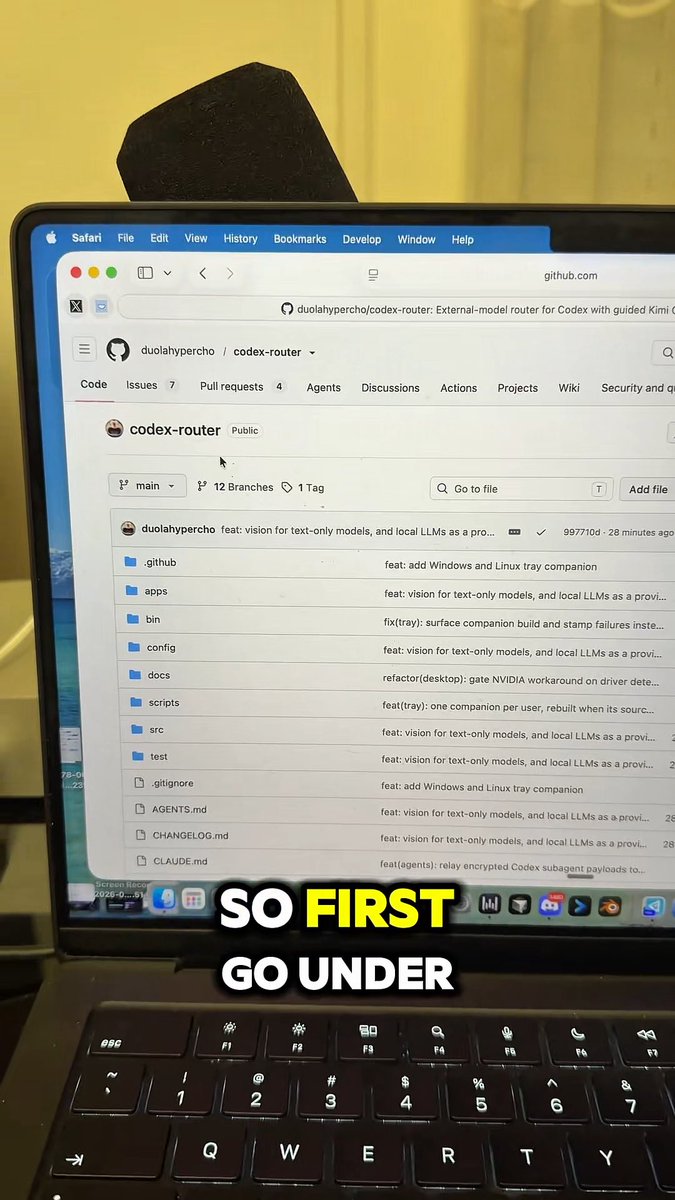
I replaced my $200/mo chatgpt with this $10/mo setup the setup: opencode go ($10/mo) + deepseek harness ($0/mo) deepseek harness just crossed 106,000+ stars in just 45 hours so this guy mapped the entire deepseek-v4 agentic workflows into 9 diagrams → the council, the assembly line, the skeleton crew,...

50,291 views • 2 days ago •via X (Twitter)

0 Comments

No comments available

Comments from the original post will appear here

Related Videos

I have been testing DeepSeek-V4-Pro with the Pi coding agent. I am mindblown by how well it works out of the box. A few notes: I spent a few hours building an LLM wiki with an agent powered entirely by DeepSeek-V4-Pro on Fireworks inference. This is the first time I feel like there is an open-weight model that can reason at the level of Claude and Codex. And it does this in a cost-effective way with support for 1M context length. To be clear, I am using DeepSeek-V4-Pro inside of Pi without any special configuration. It works out of the box. It's exciting that there is a model that can just be plugged into a basic harness like Pi, and it just works. I've never seen that before. Most models require lots of configuration and setup. DeepSeek's DeepSeek-V4-Pro is clearly good at agentic coding (probably the best from the open-weight models), but the model is also great on knowledge-intensive tasks where reasoning matters. The agent pulled agentic engineering best practices from different company docs (Anthropic, OpenAI, Google, Stripe, Meta, Modal, DeepSeek, Mistral, Cohere), searched and digested Reddit and HN threads, summarized arxiv papers, and surfaced trending GitHub repos. Then it distilled everything into actionable tips across categories. I love the Wiki it built. The quality is really good. Here is a snapshot of what the wiki looks like: DeepSeek-V4-Pro handled the task without breaking stride. Multi-step research queries, code generation for scaffolding, context-heavy reasoning across disparate sources. For coding specifically, this is the first open-weight model that genuinely feels like a Codex or Claude Code experience. It compares in capability and actual multi-turn agentic work. What made the loop feel so responsive was Fireworks' inference speed (the fastest in the market) and the fact that they actually validate models at the systems level before shipping. No corrupted reasoning traces. Just fast, reliable iteration. The hybrid CSA and HCA attention design cuts KV cache to just 10% and inference FLOPs by nearly 4x at 1M-token context. This is what makes the agent loop actually fast and cheap enough to run in practice. For devs who've been watching open-weight models close the gap but haven't found one that actually delivers in practice, this is the closest I've seen. Try it here:

elvis

60,091 views • 3 months ago

What's the Big Deal with DeepSeek in AI? Here's why DeepSeek is making everyone take notice: 1. Super Smart on a Budget: DeepSeek showed you can make awesome AI without breaking the bank. Their latest model, DeepSeek-V3, was trained for only about $10 million, which is a lot less than the usual big bucks spent on AI, like the rumored $78 million for some of OpenAI's models. They did this in just two months with fewer fancy computers. 2. Open for Everyone: DeepSeek isn't keeping their tech a secret. They've made it open-source, meaning anyone can use, tweak, and learn from it. It's like they're saying, "Come join the party!" 3. Beating the Big Names: DeepSeek-V3 has done better than some top dogs from companies like OpenAI and Google in solving puzzles, math, and coding. This proves you can get great AI results without spending a fortune. 4. Challenging NVIDIA: NVIDIA's chips are usually the choice for AI because they're really powerful. But since DeepSeek did so well with less expensive chips, it might make people think twice about always going for NVIDIA's priciest options. 5. The DeepSeek Crew: The team at DeepSeek is young and smart, mostly from top Chinese schools, with brains in physics, math, and computer science. They learned AI in about six months by themselves! They use first principle thinking, which means they break down problems to the basics and build from there. This has helped them come up with cool new ways to do AI. 6. Changing AI for Good: DeepSeek is showing that AI can be cheaper and more open to everyone. They're changing how we think AI should be made and shared, which could shake up the whole AI world. So, as we watch DeepSeek, it's clear they're not just another player; they're changing the rules of the game. I predicted that this would be a make or break year for all the massive investments made in AI by American VC's. A few weeks later, DeepSeek happens! Watch the rest of my predictions in my 2025 outlook video . Link in replies #AIInnovation #DeepSeek #NVIDIA #OpenAI #TechDisruption

Dr Ola Brown

83,460 views • 1 year ago

Mo Gawdat believes up to 30% of jobs in certain sectors could disappear by 2028. That stopped me in my tracks. Mo was one of the first people to come on this podcast and warn me about AI, long before most of the world was talking about it. At the time, it felt early. Now, it feels like the world is catching up to what he was seeing. I’m still trying to understand what AI actually means for our lives. Not just whether it can write emails, create images or make us more productive. I mean what it does to jobs. What it does to power. What it does to education. What it does to human connection… That’s why I wanted to have this discussion with Mo again. What makes Mo worth listening to is that he saw these systems inside Google years before most of us had even heard the term AI. His book *Scary Smart* now feels like it was written for this exact moment. Let me explain why this discussion matters. Mo believes we’re not just entering an AI revolution. We’re entering a period where AI, robotics, economics, surveillance, digital currencies and global instability are all colliding at the same time. That’s a lot for any of us to process. We spoke about: - The jobs Mo believes are most at risk from AI. - Why he believes that AI is actually underhyped! - The mistake almost everyone is making with ChatGPT. - The prediction that changed even his own view of the future. The part that stayed with me was this idea that human connection may become the real currency. Because if AI can produce the information, write the report, analyse the data, then what is left? I don’t think this conversation gives neat answers. That’s probably why it’s worth watching. It helped me think more honestly about what’s coming.

Steven Bartlett

27,882 views • 2 months ago