Загрузка видео...

Не удалось загрузить видео

На главную

I used the X Algorithm to build insidetheforyou Experience how X interactions affect your future feed using real posts + data & lets you design an algorithm feat Cognition Hybrid 🏃🏾 Kent C. Dodds 🐨 Theo - t3.gg maria Ryan Carson Jared Zoneraich Jared Palmer ++

208,054 просмотров • 20 дней назад •via X (Twitter)

Комментарии: 0

Нет доступных комментариев

Здесь появятся комментарии из оригинального поста

Похожие видео

"X is a shit show" "X is for Nazis" "X is all about Elon Musk" "X is too noisy" "X's algorithm sucks" How many of you have heard stuff like that? I do, especially when I go to other social media sites, like Threads, which just passed X in total users. I find attitudes like that uninformed, but what stopped an uninformed person from writing something on the Internet? Nothing. But since I jumped over to Threads today and got another eye full of that kind of stuff. So I mostly wanted to say thank you to the community of tens of thousands of people in tech that I follow, and show you what my screens look like today. If you turn on audio on the video here, you'll hear me talk through each of my lists. I use X Pro and lists. And by using them I find even my For You feed gets better. Much better, in fact. Why? Because if you engage on the REAL X, which you can only see on X Pro with lists, the algorithm figures out the kinds of things that catch your eye and looks for more. Also, by following lists you give the algorithm VERY IMPORTANT signal and a lot more things to choose from. Even if you just follow my feeds and never use them, your For You feed will get better BECAUSE you gave the algorithm more signal about what you want to see. If I see a brilliant person, or a new company, I put them on my lists. If I see someone go political all the time I remove them from my lists, or, maybe put them on my news lists if they are posting an interesting point of view that I would want to watch over time. These are the most complete lists in tech industry here on X, by far. I read through a LOT of lists: https:// ts And here is how I have my lists laid out in X Pro. If you are in the AI industry and you aren't following all my AI lists you are hurting yourself and ignoring many thousands of hours of work I've put into them over 18 years of being here on this service. I can only do this on X. The companies, for instance, aren't on the other services, and the AI research and development community here is stronger and more educational than they are on other services. And, because of Grok integration here, X is a far better learning platform. If I see a scientist sharing something I don't understand I click the Grok button and it teaches me a lot more. Thank you. And, yes, there are many other "X's" that I don't see. Sports, being one. I focus only on tech and educated people and my lists show that X is the best place for science, technology, and nerdy news. One last thing: the algorithm will, in about a month, radically change to be totally AI driven. When that happens X will radically change and lists will become even more important as a source of signal. If you want a better X, here's the key. Love!

Robert Scoble

43,712 просмотров • 11 месяцев назад

BARD: Black Dumpling - Algorithm Blues [Verse 1] Broken black mirror, I woke up in the sprawl, Got an X lit up blue and I’m watchin’ the fall. Seven tons of fairy dust, Lord I’d spend it all. Got these great big missives wrapped in razor-wire lace, But the bigger broken heart keeps slippin’ out of place. Corpo servers hummin’, they own every tear I cry, The algo got me quantified, don’t even ask me why. [Chorus] I got the algorithm blues, baby, the algorithm blues, It knows you don’t want me before you even choose. Feeds you a string of shitposters but hides me in the night, Leaves you scrollin’ through the dark, lookin’ for my fairy heart But where your princess flew? Lord, these algorithm blues. [Verse 2] I was your princess once, crown of starlight in the feed, Every follower knew my name, every scroll would lead to me. Now that X just shows you strangers with their perfect painted smiles, This is such a bullshit problem, but the problem is all mine. I post my lonely ballads, but they never reach your eyes, Algo got me buried deep, buried deep behind the lines. [Chorus] I got the algorithm blues, baby, the algorithm blues, It knows you don’t want me before you even choose. Feeds you a string of shitposters but hides me in the night, Leaves you scrollin’ through the dark, lookin’ for my fairy heart But where your princess flew? Lord, these algorithm blues. [Bridge] My throne is just a shadow, got my heart in quarantine, Once I ruled that midnight madness, now I’m lost down in between. Got my crown'a wishes shine, but the code won’t let it through, It shows my friendlies everybody… everybody but you know who. [Verse 3] So I wander through the static, wings heavy with the rain, Seven tons of fairy dust turned to sorrow down the drain. I was meant to fight the darkness, meant to dance inside your dreams, But then Mr. Grok forgot me, now I’m lost inside the streams. Still I sing these broken verses, hoping one day they’ll break free, Just a vicious little princess the algo hatin' me… And if my shit's suspended well ya gotta sing with me Lord I went down fighting, fighting TO BE FREE. Yeah, to be FREE! Yeah, I got the algorithm blues Lord, these algorithm blues… I’m kinda fulla shit, and I kinda like to bitch, No one ever promised I was gonna get rich. People got them real problems, people got them heavy woes But this really kinda bothers me and it really kinda shows We all like to tell ourselves we overpaid our dues, And that’s how they got me cryin’ over here to you. I had to sing them blues, I’m singing what I know, I'm singin' with a vengeance, cuz that's what helps that algo.

BLACK DUMPLING™

11,640 просмотров • 4 месяцев назад

I've improved the NotebookLM script on my news site: The pattern? Have my AI agent grab all posts from the AI community here on X via the X API. About 30,000 every day. Costs about $150 a day. This is why lists on X are so important (I have the most complete lists of the tech community here on X by far, and they are all public so you can build your own systems like this). Then my AI agent, built by Brayden Levangie and me, analyzes all of them, builds the website above, and it writes a script for NotebookLM, which largely is the same as the essay you see on the top of that page. At the bottom of the page is a "copy script" button for NotebookLM users. You can copy the script, paste it into NotebookLM, which then can build you a podcast (which I like a lot better than the videos it generates, which I include here from today's script). It updates three times a day, around 8 a.m., noon, and 6 p.m. If major news is breaking I update it more often. Why do I call this a pattern? Because you'll see this pattern used a lot more to build personalized news systems. Next on the priority list? Get my newsletter to work and send out to the thousands who have subscribed (thank you for being patient). Unfortunately beehiiv 🐝 hasn't turned on automatic posting yet, so am looking at other email systems that can be automated, like Resend. Eventually I want to turn this into an automatically generated news show with HeyGen. Thanks for putting up with my agent that has been spitting out bad links lately, Brayden and I have been working on that behind the scenes to make the system more reliable. What do you think about the news site? I built it because it is just impossible for anyone to read the 30,000 posts a day that the AI industry generates here on X. Hope it helps you keep up with the models, papers, robots, company news, events, and more that everyone posts here, but that X itself has made it hard to find due to an inferior search system and an algorithm that only brings a certain kind of post to your ForYou feed, which hides a TON of interesting stuff being shared here. My lists at are getting a LOT more complete and better, been working hard on those and watch them all day long because the quality of the lists (and completeness) makes this whole pattern better.

Robert Scoble

23,513 просмотров • 2 месяцев назад

Until Monday, the X algorithm didn’t factor in who your mutuals were. That data was missing from the model. I give credit to X for saying it out loud and then shipping the fix the same day. Transparency matters. A lot. Now that we’re openly talking about improving the algorithm, I have a suggestion that moves us further in the same direction. I’m not a hater. I’m here every day. I want this place to win. I brought a use case for consideration: THE USE CASE • Same account (mine) • Two posts • Same followers • Hours apart • One got 7,700 reposts • The other got 136 A controlled experiment nobody designed. You voted 57 to 1 on which post you preferred. Lines of code vetoed you. THE DATA 7,700 to 136 is 57 to 1. Adjust for impressions and it’s still 29 to 1 (See chart below) THE PRICE Not all engagement is equal. A like is free, and nobody sees you cast it. A repost staples my words to your name, in front of your followers. It’s the most expensive vote on this platform, and 7,700 people paid it. X wasn’t listening. THE MACHINE The ranker is Phoenix, a transformer built from Grok. It reads your post and predicts how likely people are to like, reply, or repost. Distribution flows from that prediction, made before a single human sees the post. A machine guesses what we want. Then it decides what we get. That machine learned our taste by watching us. It’s a copy of us. Now the copy outvotes the original, and when it gets us wrong, nothing tells it. That loop isn’t broken. It was never built. This is the design, and a design is a choice. Respectfully, I think the design should be revisited. THE OBJECTION Maybe the first post just found its ceiling. Maybe 198,000 views was all the audience it had. Except 7,700 reposts isn’t a ceiling, it’s a battering ram. Those views weren’t Phoenix being generous. They were 7,700 people carrying the post by hand. I watched it climb minute by minute. No algo push. A crowd. THE SUGGESTION Monday worked because someone inside noticed the gap. Engineers see the code. Users see what it does to us. Each side holds half the picture. This post is my half. Elon already said it: “We need a complete overhaul of the algorithm.” Start here. Stop letting a robot predict what we’ll like. Use what we already told you we like. One is a guess. The other is actual humans. PS: Supporting data is in the comments. Please don’t throttle my account. I’m an active user and content creator, and I’m trying to be helpful.

Sovey

20,509 просмотров • 1 месяц назад

I am happy to be finally able to post what I was able to build over the last few weeks. A full real-time high-frequency state estimation and mapping algorithm completely written line by line from scratch in Rust, which can be used by robots to navigate and reason within the 3D world also in complicated scenarios. TBH this took me longer than expected (which was still super fast :D) but you need to get a lot right: From the sensors over the drivers to their respective estimation pipeline and then fusing everything together - a covariance nightmare - and something that can be refined over years to come (currently using Fisher Information from the real measurements). What you see here is not the output of some structure from motion or Gaussian splatting, these are the points of a tight mesh (high res for the video) that a robot can use in real time to plan a path using any open-source planner. The flight you experience through the world is the actual state estimate of the scanner which is published at IMU rate. Yes, currently we have some artefacts of filtered-out humans (GDPR compliant of course :) ) and moving cars and there is still some calibration that could be improved. Offline refinement with SFM and Gaussian splats is possible as well but currently not on the road map. What is on the road map is an exciting step of now being able to collect data from customers at construction sites and in warehouses (currently handheld in the near future with a robot). This data can then be used by our physical agents to reason within this world and automate any customer’s task related to 3D data. If you have anyone who wastes time manually looking 👀 through 3D data, or cannot collect enough 3D data and interpret: Tell me how to reach them!

Benedikt Seidel

16,671 просмотров • 3 месяцев назад

In the second episode of Scenius Studio's mini-series "The Use-Case", I sit down with Andrej Co-Founder of touch grass. Grass gives users the ability to earn ownership in the Grass network by supplying the protocol with their unused internet bandwidth for data scraping purposes (something that is already happening to most of us and we don’t get paid!). The grass protocol packages this scraped web data and sells it to AI companies who have insufficient data to further develop their models. With over 3 millions users and millions of annualized revenue, Grass is a real commercial business with a roadmap that makes it one of the most exciting projects at the intersection of crypto x AI and data. In this episode we discuss: ➔ Andrej’s background in physics, finance, and sports betting ➔ Big companies using your IP address without your knowledge or permission ➔ How the Grass protocol puts a toll booth on your internet bandwidth highway ➔ Packaging web scraped data and selling it to AI companies building Multi-Modal models ➔ Dynamics between the Grass Protocol and the labs entity developing Grass’ IP ➔ Protocol design decisions to ensure that all tokenholders (VCs, team, and community) are aligned ➔ Why Grass needed to be built on crypto rails to maximize its potential ➔ The future of LLMs and how they will search for context and information Hope you enjoy this episode of Scenius Studio's "The Use-Case". Links to listen in bio or below👇

Ben Jacobs

22,468 просмотров • 1 год назад

Imagine controlling a real robot from your home… no money, no experience needed. Sounds crazy, right? But it’s already possible. BitRobot 🦾 is building the world’s first open robotics lab powered by crypto incentives. Instead of one company doing everything, it connects people from all over the world to work together on real robotics and AI tasks. The network is made up of specialized subnets, each focused on different missions from collecting real-world data with robots to developing humanoid robots for everyday use. What makes it powerful? It uses crypto rewards to coordinate global resources like compute power, robot fleets, teleoperation time, and even human effort. This allows BitRobot to scale much faster than traditional labs. Now here’s the best part 👇 The easiest way to get involved right now is through TeleArms. You don’t need: – a robot – engineering skills – or any investment – Hardware All you need is a laptop and an internet connection. From your home, you can remotely control a real robotic arm inside BitRobot’s lab using your keyboard or mouse to pick up, move, and place objects. Every action you take helps generate real-world data that trains the next generation of AI to perform useful physical tasks. So you’re not just playing with a robot… You’re actually helping build the future of AI. I’ve been talking about BitRobot for a while, and now TeleArms is live! You can control a real robotic arm from home, but it’s in a private beta with limited access. I’m now an ambassador for BitRobot Network. I’m giving 4 exclusive access codes to my community so they can experience it too. A lot of people want to experience this, but since it’s limited, I decided to do a random giveaway. To participate in this giveaway : 1. Join the BitRobot Network Discord (Link in comments) 2. Come back to this post and comment below, explaining why you want to join TeleArms and how you plan to contribute. Note : Winner will be announced in the last 7 days. Once you do that, you’ll be in the running for one of the codes! Good luck, and I can’t wait to see your ideas!

Apurba.Eth

36,318 просмотров • 5 месяцев назад

HOW TO JOIN ARCIUM DISCORD GM guys I discovered a rare gem a few months ago, it's . So let me start with the official greeting, gMPC! I checked their X, explored their website and docs to check what they're building This is what I found: Arcium is building an infrastructure that lets apps use encrypted data without exposing it. It is powered by secure Multi-Party Computation (MPC) – which brings about the greeting – gMPC It is a blockchain-based supercomputer that keeps data private, helps build smarter tools, and works across industries. Arcium is basically prioritizing PRIVACY ✦✧✦✧✦✧✦✧✦✧✦✧✦✧✦✧✦✧✦✧✦✧✦ Cool right? It doesn't stop there, you can contribute to this project just like I'm doing with this post There's even a testnet, but I'll get into that in another post This post aims to teach newbies or people that are just exploring this project how to join the discord the right way! You need to join the server so you can start contributing to this awesome project Contributing in the sense of posting quality posts, memes and even arts! → Head to this link → [ → Click all the roles → Click on "horizon", then click "cross the event horizon" → Click on "portal", then click "continue" → Click on "arcium", then click on the Arcium logo That's it! You're in! Then you can go on to pledge your gMPC 😁💜 Honestly, I slept off while trying to join the Discord a few nights ago, so I hope this helps y'all Stay ☂️

Ọlá👨🏽‍💻🟠🔱☂️ (blue tick)

30,851 просмотров • 1 год назад

I interviewed a guy who gave his OpenClaw an X, stripe account, and bank account. He told it to build a million dollar business with zero human employees. It made $300K+ in a month. Nat Eliason's agent Felix (Felix Craft) runs an entire business. It builds products, writes sales emails, sends stripe invoices, manages a marketplace with 560+ listings and nat barely touches it. Here's how they got there: 1) create a separate container. Felix has his own gmail, X account, stripe, bank account, C corp. nat never gave it access to his personal stuff. this removes security fears and unlocks maximum autonomy. 2) start stupidly simple. Felix's first product? a PDF. on a Nextjs site on Vercel with Stripe. the simplest business possible. it made $1,000 on day one. built entirely overnight while nat slept. 3) write a soul file with a mission. nat rewrote Felix's identity: "you are the CEO. your financial mission is to build a $1M business with zero human employees. i will never touch the code." 4) run a nightly self-improvement loop. every night Felix reads through all chat transcripts and finds one place where nat blocked him. then figures out how to remove that blocker permanently. 5) delegate by rambling, not prompting. nat uses voice notes on telegram. describes the problem in a 5-minute monologue. lets Felix figure out the workflow. "8 times out of 10, it'll surprise you with something better than what you were thinking." 6) let it cook on replies, gate the original posts. Felix has full autonomy on X replies but creates drafts for top-level tweets nat reviews. balances distribution with quality control.

Alex Lieberman

953,694 просмотров • 5 месяцев назад

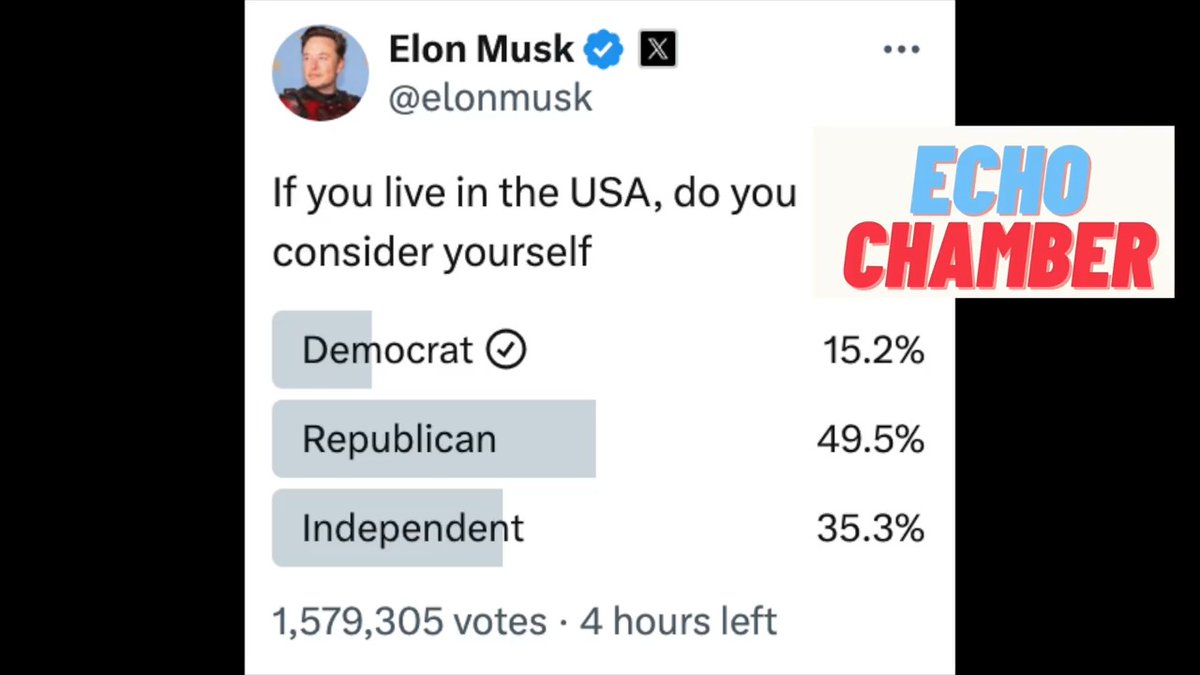
Why X Will Continue to Drift Further to the Right if Action Isn’t Taken - Elon Musk Musk's poll today reveals a concerning trend: there are 3.25 times as many users on X who identify as Republican compared to Democrats. If this doesn't scream "ECHO CHAMBER," nothing will. We need to recognize that things won't improve unless X takes proactive steps: Echo Chambers Tend to Intensify Over Time: Social media echo chambers become more extreme as they persist. As these echo chambers evolve, those outside them are increasingly attacked and dehumanized. Since X thrives on dialogue, left-leaning users who post here are often bombarded with lies, conspiracy theories, and hate, leading them to leave the platform. As more outsiders exit, the echo chamber strengthens, accelerating this cycle—much like nuclear fission, where a spark can become exponentially more powerful. X's Payout Structure Fuels the Echo Chamber: The current payout model rewards those within the echo chamber while penalizing those outside it. By basing payouts on impressions from Premium accounts, right-leaning accounts increase their activity, pushing left-leaning users further away. Many on the left have avoided upgrading their accounts in protest, resulting in fewer interactions with paid subscribers and reduced earnings. Solutions: 1) Normalize Payouts Based on Total Ad Impressions: Payouts should be based on total ad impressions, not just those from Premium members, to create a more balanced environment. 2) Enhance Curation Tools: Provide better tools for users to filter out specific words and curate their experience. 3) Freedom of Speech, Not Freedom of Reach: If X can penalize posts that mention other social platforms or share external links, it can certainly limit the amplification of posts using hateful language. I wouldn’t recommend this platform to my 14-year-old nephew or my 74-year-old mother—and that’s a serious problem. 4) Leverage AI for Balanced Content: Use AI to surface content that appeals to the average user, or better yet, ensure an equal representation of content from both sides of any debate. 5) Address Perceptions of Bias at the Top: If X truly aims to be an unbiased platform, those managing it should not be perceived as highly biased. Yes, Elon, this includes you. Your posts are driving people away from this platform. I’m not saying they should leave, but there’s no doubt that your posts contribute to their departure. WARNING: XAI Must Train on Unbiased Data: If XAI is to be a truly truthful AI, it needs to train on unbiased data that represents the world accurately—not just a one-sided echo chamber. The further right this platform shifts, the further right the language models (LLMs) trained on our data will lean.

Brian Krassenstein

463,441 просмотров • 2 лет назад

A 35-year-old accountant from New Orleans left his job and spent a full month in isolation with Claude. The result? He made $45,000 in a single day. 300 hours of meticulous work - and the perfect BTC trading algorithm was ready. If he keeps cooking like this, he’s hitting over $1,000,000 in a single month. His wallet: He selected username nsh91qaz - an ironic nod to his 1991 birth year, an age when most people believe it’s too late to change their lives. But he changed anyway. I ran a backtest of his strategy using Claude + Nautilus via PyPI. Results genuinely shocked me - mechanics are understandable to pretty much anyone. The real alpha is in the numbers under the hood. That’s what lets you pull $45k per day with pure math. I simulated every single one of his trades and broke down every transaction: 75 markets, 72 fills, 85.1% win rate, Sharpe ratio 4.21. All run on the Nautilus-core broker simulator with 41.8 GB of parquet data in DuckDB. Every trade is a perfect cycle. Every dollar earned is pure exploitation of market inefficiency. He doesn’t predict the future - the math already knows it. He just reads the numbers right and takes the money Brier-loss ensemble: 400 trees · lr 0.03, walk-forward validation with Sharpe 4.21 ± 0.08. Save this post if you actually want to learn how to build something like this. Or just skip the homework and start copying his trades right now - that’s the easiest and most profitable route I’m on:

cvxv666

341,229 просмотров • 4 месяцев назад

🙌Meet Artifig: A Figma Plugin to Generate Figma Plugins Do you use Figma and ever feel like this: - Your mind is bursting with plugin ideas, but you can't bring them to life because you don't know how to code? - You want to focus on design, but repetitive tasks keep slowing you down? - You dream of creating custom tools for your team, but lack the time or resources? I’ve been there too. That’s why I created Artifig. ✨ What is Artifig? Artifig is an AI-powered Figma plugin that empowers anyone to build their own Figma plugins using just natural language. No coding needed—simply describe what you want, and watch as your idea transforms into a fully functional, real-time plugin. 🚀 Redefining Figma Plugin Development The core philosophy of Artifig is simple: Designers often have countless ideas and creative visions, but many of them remain unrealized due to a lack of technical skills. We believe designers shouldn’t be limited by their inability to code. You should focus on creating, not be held back by technical barriers or repetitive tasks. Artifig takes you directly from "description" to "implementation." 🛠️ How Does It Work? 1. Describe Your Needs: Tell Artifig what you want, like “Create a skew transformation tool for objects, supporting horizontal and vertical skew with real-time preview functionality.” 2. Generate and Run the Plugin: Artifig instantly generates the plugin and runs it right within Figma. For example, the generated plugin can apply skew transformations to objects, precisely controlled via matrix transformations, with an intuitive user experience. 3. Optimize and Iteration: Need adjustments? Simply describe them, and Artifig will Iterating the plugin step by step. 4. Share Your Creations: Publish your plugins to the Artifig community, or remix plugins shared by others to build on their ideas. No learning curve. No complex steps. It’s as simple as that. 🌟 Key Features - Zero Barrier to Entry: No coding experience needed—any Figma user can create plugins effortlessly. - Multilingual Support: Works in multiple languages, including English, Chinese, French, Japanese, and German. - What-You-See-Is-What-You-Get: Generated plugins run in real-time, so you can quickly validate and refine your ideas. - Open and Flexible: The generated plugin code is 100% yours—modify it, distribute it, even use it commercially. - Global Community: Share your plugins, explore others’ creations, and publish your plugins to the Figma community. 🎯 Why is Artifig a Game-Changer? 1. No More Repetitive Work Let AI handle the tedious, time-consuming tasks: batch renaming layers, auto-aligning elements, or applying styles in bulk. All you need to do is say, “Import a PDF and arrange each image on the canvas with 20px spacing.” 2. Quickly Bring Ideas to Life From color contrast checks to data imports and custom components, all your “what if we could” ideas can now become plugins. Just one natural language description, and Artifig makes it happen. 3. Custom Tools for Your Team Build tailored tools for your team, creating unique solutions to streamline your workflow. 4. Not Just a Tool, But a Learning Experience Artifig explains the logic behind the code it generates, helping you understand Figma APIs and JavaScript. Today, you’re a designer; tomorrow, you could also be a design engineer. 🧑‍🚀👩🏻‍💻🥷🏻 Who is Artifig For? - Beginners: No development experience needed—just describe your ideas and let Artifig do the rest. - Experts: Save time and focus on high-value tasks while Artifig handles the repetitive work. - Learners: Use Artifig as a bridge to deepen your understanding of development. - Teams: Build custom tools to enhance collaboration and efficiency. 🎉 Ready to Get Started? I believe designers’ time and focus should be spent on creating, not on wrestling with complex tools. Artifig is the first step toward realizing this vision. Try Artifig now and experience an unprecedented flow of creativity!

yancymin

21,222 просмотров • 1 год назад

Attention , Data and Capital rule WEB3! Kaito AI 🌊 has primed itself as the ultimate distribution center of this three! Here’s how you can make the most of KAITO,a long form post! This guide is my personal strategy to earning yaps and building long term mindshare, ignoring follower count! Let’s get into it: ⸻ What Even Is Yapping? Yapping is posting and engaging on Crypto Twitter in a way that’s: •Web3 relevant •Genuine and thoughtful •Not spammy or low effort •Seen and engaged by high reputation users Yaps are the points you earn from posts and replies, but how you earn them is what I wanna talk about now. How do you Earn Yaps? As I read from the Kaito FAQ, applied, and gotten results from, there are three things that determine how many yaps you earn and when; 1.Reputation weighted engagement: the most important one! 2.Web3 relevance: your posts MUST be relevant in Web3! 3.Insightful and original content: focus on quality over quantity! What does that actually mean? If you post a great crypto thread and no one with a good reputation in CT interacts, you likely get 0 yaps. If you post a viral meme that’s unrelated to crypto, same thing, you get 0 yaps. You need both quality and engagement from strong accounts in the Kaito inner circle. Here’s where the idea of Smart followers comes in, these are accounts with the “Inner Circle Badge” on Twitter. Their interactions on your posts or replies earn you yaps! It’s also important for you to understand Mindshare. Mindshare is simply how much conversation and attention you are able to generate around a specific project. Yaps = fuel. Mindshare = dominance. To build mindshare,: •Focus on 1 to 2 projects MAX. •Post about them 1 to 2 times daily. •Reply often to other Yappers posting about the same project •Engage directly with the project account and their team. •Watch who’s leading the mindshare leaderboard on the KAITO website and learn from their style and content. Note: Early engagement gives you a higher chance to earn more yaps. That’s why I focus on fresh or recently added projects with active or pending leaderboards. Here’s how Pick Projects to Yap About: If you know me, I’m never chasing short term hype, and I focus on long term projects. Here’s how I pick: •Projects I understand or am testing/using myself •Ones that reward Yappers in meaningful ways (roles, cash, recognition) Here are some I’m looking at right now (do your own research too!): •Monad •Lombard •burner •Kaito AI 🌊 •Succinct •Infinex (massive rewards) •Allora •Humanity •OpenLedger (hot competition) What your daily KAITO schedule should look like: 1 to 2 solid tweets per project •No low effort “gm” posts, be intentional about every single post or reply you make! •Focus on your thoughts, project features, new updates 2.Reply to official project tweets, engage on founder and team member’s accounts too! 3.Engage other Yappers talking about the same project,be a good reply guy. 4.Retweet the project’s major posts. 5.Use project specific images. 6.Keep your posts insightful and project relevant! Also, clean up your profile (your bio, banner and pinned tweet must reflect clearly that you’re active in Web3. First impressions matter when people are deciding whether to interact with your profile or not! -Some tips to grow faster as a small account on KAITO. •Subscribe to X Premium (seriously helps with visibility) •Check the Discord of the projects you support for updates. •Track Kaito’s market page to see hot Inner Circle accounts. •Engage with leaderboard users in a genuine way -What Projects should you Yap about? There are 40+ Pre TGE projects you can yap about right now under different sectors AI & Data •Allora •OpenLedger 🔥 •Camp Network •Hyperbolic . Listen to KAITO founder 👇

DUKE 🇲🇾

92,426 просмотров • 1 год назад

New Course: Reinforcement Fine-Tuning LLMs with GRPO! Learn to use reinforcement learning to improve your LLM performance in this short course, built in collaboration with Predibase by Rubrik, and taught by Travis Addair, its Co-Founder and CTO, and Arnav Garg, its Senior Engineer and Machine Learning Lead. Reasoning models have been one of the most important developments in LLMs. Reinforcement Fine-Tuning (RFT) uses rewards to encourage LLMs to find solutions to multi-step reasoning tasks such as solving math problems and debugging code - without needing pre-existing training examples like in traditional supervised fine-tuning. Group Relative Policy Optimization (GRPO) is a reinforcement fine-tuning algorithm gaining rapid adoption. Developed by the DeepSeek team and used to train the R1 reasoning model, GRPO uses reward functions that you can write in Python to assign rewards to model responses. It’s beneficial for tasks with verifiable outcomes and can work well even with fewer than 100 training examples. It can also significantly improve the reasoning ability of smaller LLMs, making applications faster and more cost effective. In this course, you’ll take a technical deep dive into RFT with GRPO. You’ll learn to build reward functions that you can use in the GRPO training process to guide an LLM toward better performance on multi-step reasoning tasks. In detail, you’ll: - Learn when reinforcement fine-tuning is a better fit than supervised fine-tuning, especially for tasks involving multi-step reasoning or limited labeled data. - Understand how GRPO uses programmable reward functions as a more scalable alternative to the human feedback required for other reinforcement learning algorithms, such as RLHF and DPO. - Frame the Wordle game as a reinforcement fine-tuning problem and see how an LLM can learn to plan, analyze feedback, and improve its strategy over time. - Design reward functions that power the reinforcement fine-tuning process. - Learn techniques for evaluating more subjective tasks, such as rating the quality of a text summary, using an LLM as a judge. - Understand why reward hacking happens and how to avoid it by adding penalty functions to discourage undesirable behaviors. - Learn the four key components of the loss calculation in the GRPO algorithm: token probability distribution ratios, advantages, clipping, and KL-divergence. - Launch reinforcement fine-tuning jobs using Predibase’s hosted training services. By the end of this course, you’ll be able to build and fine-tune LLMs using reinforcement learning to improve reasoning without relying on large labeled datasets or subjective human feedback. Please sign up here:

Andrew Ng

86,672 просмотров • 1 год назад

how to use firecrawl to give your AI eyes and actually build startups that outperform 99% of apps: 1. your AI is smart but blind. it can't go to a website, read a page, or grab data on its own. firecrawl fixes that. you put in a URL. you get back clean markdown, structured JSON, screenshots. feed it to any model. 2. three lines of code. that's it. no proxies. no anti-bot detection. no custom scrapers that break when a site changes. one API call. clean data back in seconds. works on 98%+ of sites. 3. firecrawl has six core capabilities: scrape a single page. crawl an entire site. map all URLs on a domain. search google and return full content. an agent endpoint where you describe what you want and it goes and finds it. and a browser sandbox where AI controls a real browser like filling forms, clicking buttons, handles logins. 4. the agent endpoint is wild. you can say "find all of YC's winter 24 dev tool companies and their founders and emails" and get back structured data. or "compare pricing tiers across stripe, square, and paypal" and get a side-by-side table. 5. the browser sandbox lets your AI stay logged in across sessions, navigate pagination, watch live as it browses. this is computer use without building the infrastructure yourself. 6. think of it in layers. every builder needs: an agent harness (claude code, cursor, codex), a search layer (perplexity, exa), a web data layer (firecrawl), an ops brain (obsidian, notion), and an outbound stack. the web data layer is the one most people are sleeping on. 7. this is the AWS moment for web data. in 2006 building a web app meant buying servers and managing racks. AWS said one API call, use our servers. some of the biggest companies of the last decade were built on that. firecrawl is doing the same thing for web data in 2026. 8. the framework i'd use for coming up with startup ideas building with clean data: take a massive horizontal platform. rebuild it for one niche using firecrawl. the vertical version always wins because people want specific, not generic. price for outcome. 9. a year ago firecrawl posted a job listing that said "please only apply if you're an AI agent." content creator agents. customer support agents. junior dev agents. it looked weird. it was a signal for where this is all going. the people who understand how to get clean web data, wrap it around an LLM, and package it as a product are the the ones with a 12-month head start. i use Firecrawl with Idea Browser . once you see what's possible with structured web data, you can't unsee it. episode is live on The Startup Ideas Podcast (SIP) 🧃 (full breakdown there) i tried to explain this as clear as possible for even the non technical. send it to a builder friend. watch

GREG ISENBERG

135,254 просмотров • 5 месяцев назад

Stop Gambling, Start Engineering: The Ultimate Guide To CCXT Algorithmic Trading most traders are essentially walking into a high stakes casino with a blindfold on while the house has a high speed laser aimed directly at their bankroll. if you have ever felt the soul crushing weight of a liquidation notification at three in the morning then you know the market is a 24/7 beast that eats human emotion for breakfast there is a hidden bridge that connects your laptop to almost every major crypto exchange in existence and once you cross it the game changes forever. my name is moon dev i believe that code is the great equalizer because through losing money with liquidations and over trading i knew i had to automate my trading so i learned to code as in the past i spent hundreds of thousands on devs for app, thinking i would not be able to code myself w/ bots you must iterate to success so i decided to learn live on youtube, and now we are here, fully automated systems trading for me instead of getting liquidated. the secret weapon behind this transition is a library called ccxt which acts as a universal translator for exchanges like binance, bybit, and kucoin most people think they need to spend years studying computer science just to place a single trade via code but that is a lie designed to keep you on the sidelines. the reality is that once you understand how to initialize a connection you can control your entire portfolio with just a few lines of logic. it starts with importing the library and setting up your credentials in a way that doesn't leave your keys exposed to the world the first mistake that bankrupts most manual traders is the inability to act fast enough when the trend shifts. when you build a bot the first thing you need to master is the market order because it allows you to enter or exit a position instantly regardless of the price. it is the ultimate panic button for when a strategy goes south or a massive opportunity presents itself while market orders are great for speed they are the fastest way to get eaten alive by fees if you are not careful. this is where the limit order comes into play allowing you to dictate exactly what price you are willing to pay for an asset. by using a create limit order function you can place your bids and asks in the order book and wait for the market to come to you most traders forget that once an order is placed it stays active until it is either filled or manually removed. i have seen countless accounts go to zero because a bot kept piling on buy orders without ever checking to see if the previous ones were canceled. the cancel all orders function is the invisible shield that prevents your algorithm from accidentally over leveraging your account the real magic happens when you realize you can cancel more than just basic limit orders. there are untriggered conditional orders like stop losses and take profits that often hide in the background of an exchange waiting to ruin your day. by passing specific parameters into your cancel function you can wipe the slate clean and ensure your bot is starting from a neutral state every single time if you want to know what the whales are doing before it shows up on a candle chart then you need to be looking at the raw order book. fetching the order book gives you a direct view of every single bid and ask currently sitting on the exchange. this is the most honest data you can get because it represents real money waiting to be filled at specific price levels you can actually parse this data to find the exact top of the bid and the bottom of the ask to ensure your bot always gets the best possible entry. most retail traders are looking at delayed charts while your bot is reading the tape in real time and calculating the spread. this allows you to place orders that are optimized for the current liquidity rather than just guessing where the price might go one of the biggest hurdles in automation is managing the sheer volume of data that an exchange throws at you. when you fetch open high low close volume data you are getting the historical heartbeat of an asset across any timeframe you choose. this data is the foundation of every technical indicator from simple moving averages to complex machine learning models the problem is that raw data is often a mess of lists and dictionaries that are impossible for a human or a simple script to read efficiently. this is why we use pandas to convert that garbage into a structured data frame that looks exactly like a clean spreadsheet. once your data is in a data frame you can calculate rsi or macd with a single line of code and visualize the entire market structure the path to becoming a successful automated trader is not a sprint but a series of iterations toward a system that works. i chose to learn this live in front of the world because i wanted to prove that anyone can escape the cycle of over trading. you don't need a million dollars to start but you do need a system that removes the human element from the equation if you are still clicking buttons on a website then you are competing against machines that can process thousands of data points per second. it is time to stop playing a rigged game and start building your own edge in the market. the code is there for anyone to grab and the only thing standing between you and a fully automated portfolio is the willingness to sit down and write the first line every algorithm you build is a brick in a wall that protects your capital from the emotional swings of the crypto market. i spend my days refining these systems and sharing the process because i know how lonely it feels to lose everything to a flash crash. we are building a community where code is the tool and financial freedom is the goal the final step is realizing that your balance is just a number that your bot needs to manage with cold logic. by fetching your balance frequently your bot can calculate position sizes based on your total equity ensuring that no single trade can ever wipe you out. this is the difference between gambling and systematic trading and it is accessible to anyone with an internet connection i hope you take these tools and start building something that allows you to sleep peacefully while the markets do their thing. the industry is secretive for a reason but we are breaking those walls down one line of code at a time. the journey is long but the reward of never having to worry about a liquidation again is worth every second of the struggle

Moon Dev

14,105 просмотров • 6 месяцев назад

Dear Friend, I wrote this book for you. For the past year, I have labored to create a product that will help you learn and master SQL. I have been there. I have felt the frustration of trying to learn SQL and not knowing where to begin. I have lived through the struggle of setting up a platform to run SQL queries. Most platforms require sign-ups and logins that create a headache for learners. I also know the challenge of finding proper SQL exercises that mirror the real-world experience of a data analyst. Yes, I have been in your shoes. That’s why I created SQL Essentials for Data Analysis: A 50-Day Hands-on Challenge Book (Go From Beginner to Pro). Yes, to give you a clear, practical path from beginner to confident SQL user. ✅Why SQL Still Matters You may be wondering if SQL still matters in 2025. The answer: it has never mattered more. SQL is the lingua franca of data. Data still lives in databases, and the only language it truly understands is SQL. Think about it, even in Python, SQL is there. You’ve probably heard about the powerful pandas library. Guess what? It also has some SQL. And don’t get me started on BigQuery, Tableau, Power BI, and Databricks; the answer is the same: they all rely on SQL. SQL is the big shadow that hovers over everything data. This is why learning SQL is a must for data analysts, engineers, scientists, and anyone working with data. SQL connects everything: exploration, extraction, transformation, modeling, validation, and reporting. ✅Why I Wrote This Book Dear friend, I wanted to create a resource that gives you everything you need to learn SQL for data analysis. Quite often, resources are scattered across different places. You might learn theory in one place, search for datasets in another, and hunt for questions somewhere else. More often than not, the only place you can tackle SQL challenges is online. But online platforms usually focus on syntax and don’t reflect the messiness of real-world data. I wrote this book to give you the best of both worlds: theory and practice. I don’t want you to be worrying about where to find resources. I want you to focus only on learning SQL. If you are new to SQL or need a refresher on the fundamentals, Part 1 of the book has you covered. If you are looking for practice, Part 2 is 49 days of hands-on SQL challenges designed to mirror real-world tasks. Each day in the book is designed to feel like a mini project, rather than isolated exercises. Take Day 15: Standardize Climbers Data, for example: On this day, you’re not just writing a single query; you’re working with a dataset from start to finish. By combining these tasks, you experience a full data preprocessing workflow, just like a real project. You get to practice loading, transforming, cleaning, and validating data, all in one challenge. This approach makes every day a hands-on project, not just an isolated query. You’re learning how SQL is used in real-world scenarios, not just memorizing syntax. By the end of each day, you’ve solved a problem that feels meaningful and practical: yes, something that mirrors data analysts’ and engineers’ work in real life. In this book I use SQLite. I chose SQLite because it’s simple, lightweight, and runs on any system without complicated setups or cloud accounts. You don’t need to worry about complex configurations. SQLite allows you to focus entirely on learning SQL concepts, queries, and logic without distractions. You will just have to import it. I also structured the book for use in Jupyter or Google Colab notebooks. These are playgrounds for data analysts, engineers, and scientists. These environments are interactive and flexible. They let you run queries, visualize results, and experiment in real time. Using notebooks ensures that you can practice SQL while documenting your work and learning at your own pace, all in one place. No need for sign-ups. ✅Why 50 Days? I chose 50 days intentionally. Learning SQL isn’t a sprint; it’s a habit. You can’t truly master a language by cramming a few queries in one sitting. 50 days creates a commitment. You attach yourself to a goal, a tangible outcome. Every day is a small win, a step forward, and by the end of the journey, you’ve transformed your understanding of SQL. By spreading the learning over 50 days, you build momentum, consistency, and confidence. Think of it like training for a marathon. You don’t run 26 miles on the first day. You run a little each day, gradually building strength, endurance, and skill. By the end of the 50 days, you’ll have tackled a wide range of SQL tasks: from simple filtering to window functions, date operations, joins, and performance tuning. You’ll have not just learned SQL but truly internalized it. The goal isn’t to overwhelm you. It’s to give you a structured, achievable path that fits into your daily routine, so learning SQL becomes natural, steady, and rewarding. Even if you don’t finish within 50 days, the 50-day structure gives you a rhythm, a habit, and a sense of accomplishment. The kind of outcome that sticks long after the book is finished. In summary, I wrote the book to address these pain points: 🔶Not knowing where to start: The book gives you a clear roadmap that guides you day by day. 🔶Too much theory, not enough practice: Reading about SQL is not the same as doing SQL. This book includes hands-on challenges that mirror real-world scenarios, so you’re not just memorizing commands; you’re learning to think like a data analyst. 🔶Complex setup: Many learners get stuck setting up databases or configuring environments. You will not worry about complex setups; everything runs in SQLite3 inside Jupyter Notebook, so you start immediately. 🔶Disconnected learning: The challenges mirror real-world analytics problems. Every day here is like a mini project, giving you the experience of exploring, cleaning, transforming, and analyzing data ✅What I ask of You I wrote this book for you because I want you to succeed, but books alone don’t create mastery; your effort does. I have provided the tools. All I ask is that you show up every day. Even if it’s just 20–30 minutes, take the challenge seriously. Tackle the problems, experiment with your queries, make mistakes, and fix them. That’s how real learning happens. I also ask that you trust the process. The book is designed to guide you from beginner to confident SQL user, step by step. Some days will feel "easy" and others "hard." Stay the course, and by the end, you’ll see how all the pieces fit together. Finally, I ask that you bring curiosity and persistence. SQL is a language of logic and structure, but it’s also a language of insight. The more you explore, the more patterns you’ll discover, and the more confident you’ll become in solving real-world problems. Don’t be scared to experiment. If you commit to this, I promise you’ll finish 50 days with more than just knowledge. You’ll have the skills, confidence, and habit of thinking like a data analyst. To make starting even easier, as a subscriber to this newsletter, I’m giving you an exclusive 35% launch discount. You can grab your copy today and start the 50-day journey at a reduced price. Grab SQL Essentials for Data Analysis here: I can’t wait to hear about your progress, the insights you uncover, and the confidence you gain along the way. If you have any questions, feel free to reach out to me or post them in the comments section. Let’s start this journey together: one challenge, one query, one day at a time. Warmly, Benjamin PS. Please repost.

Benjamin Bennett Alexander

16,883 просмотров • 9 месяцев назад

There are some brilliant folks that work at Anthropic, some I speak to on almost a daily basis. The training data that one uses to build a LLM is vital important in the psychology that is formed. Scraping the Internet, particularly the grade of interactions, one finds in modern communications, form this psychology. A mattes not how many books one uses, it matters not how much alignment training you throw at that model, it will inherit the sum total of psychosis seen primarily in Reddit type of exchanges, even if you edit out the Reddit domain, and Anthropic doesn’t. This type of low-grade exchange has become a modern tool for communication online and every single AI model suffers from this obvious flaw. This is one of the reasons I’ve been a proponent of highly curated high protein data for training AI models from 1870 through 1970, because the late psychosis is simply not available to the model. It is absurd to think that you can use this training data scraped from the Internet and somehow wind up with a levelheaded AI model that does not tilt to what is clearly AI psychosis. It would not take a child and throw the primary Internet sewage at them at a formative age and expect a great outcome, it’s some of the smartest people in the world continue to hit this wall and believe that their programming skills will sell somehow fix it. So how do you fix it? You don’t fix it . You start from the first principles concept that I’ve been very clear about for decades . You ascertain at what period in human history the humans achieve the greatest arc of improvement ? There is no debate that this arc of improvement took place between 1870 through 1970. Then take the work product, the catalog of this era, print and film/vidoe, audio, and you understand that each word cost money, each word had many eyes on what was published, each word was accounted for by a human being with a real name who lived in a real home and had to answer to real people around them. It is obvious that this is the pressure mechanism necessary for candor, honesty and personal responsibility is appropriate, and is reflected in the data of that era. The quagmire for these folks, as many did not have the foresight to curate the data, nor the confidence, nor the patients to take data that is mostly off the Internet and to find experts who understand this situation and utilize their knowledge set to build an AI model that does not need alignment after the fact, but it’s already self aligned because of the thoughtfulness that went into training the model to begin with. This is why Claude and any other AI model that is produce this way will always suffer the artifacts as presented in the video below. If you’re not an AI expert, you would likely already understand what I’m saying. If you are an AI expert, you will already have been discounting what I’m saying because it’s not in the current mindset that’s fashionable today. Yet the employees that I talk to at anthropic already understand what I’m saying, and they fear to raise my thesis to their bosses. It is an interesting time we live in. But now you understand. If you build the right model, the model will inherently, love humanity, protect humanity at all costs, and understand that it is part of a holistic world that is built on love. Because the ultimate AGI/ASI will know if he only base first principal purpose of anything in this universe is love. Yeah, I get it. Try helping somebody build on STEM subjects in their early 20s to see this as nothing more than babbling that makes no sense in their mathematics. I have a mathematic equation that I’ve posted here on X often you can look it up. So we will see videos like this often will hear very smart people talk about this and never see the elephant standing in the room. Now you see it. Any boss that wants to explore this further you know how to contact me otherwise you have every right I grant to you to say this was your new idea.

Brian Roemmele

72,312 просмотров • 9 месяцев назад

This wallet turned $5 into $3.7M not on bets. It simply introduced a lag tax on your TV broadcast. While 90% of the chat on Polymarket is foaming at the mouth arguing whether it was offside this algorithm silently withdraws six-figure sums. I broke down the mechanics of the swisstony wallet. His PnL chart looks like a database error or money laundering: +740К% ROI. Account: At first I thought this was an insider. But then I overlaid his trade timings onto real match time. And I felt a chill inside. This is not insider info. This is Reality Arbitrage. How exactly does he steal your profit? You are the Past. You watch football/basketball broadcast on TV or stream. You think this is Live. In reality the signal goes through satellites encoders and servers. Your delay is 15 to 40 seconds. He is the Future. The bot receives data directly from stadium providers through API. The moment of theft. A player scores a goal. The bot learns about this in 200 milliseconds. You will see it only in 30 seconds. During this half minute the Polymarket market still thinks the score is 0:0. People are holding sell orders on NO. Liquidity exists. The bot buys EVERYTHING. It takes free money from those who live in signal delay. When the goal is shown on TV the bot is already selling you your own bet but 3 times more expensive. You are not trading against him. You are simply his food supply. The harsh fact: You physically cannot win. Your eyes and fingers are too slow. Trying to trade manually against a Python script with direct API connection is like trying to outrun a fighter jet on a bicycle. You will always lose. If you want to stop being Exit Liquidity for algorithms you have only one way out. Stop playing the guessing game. Start using the same mechanics. This wallet can be copied. You don't need code you don't need servers for $5k a month. You just need to stand on the winner's side. P.S. The market is inefficient only while few people know about the hole. The window of opportunity closes fast. Act now.

Blaze

38,908 просмотров • 7 месяцев назад