正在加载视频...

视频加载失败

If you are running local LLMs without N-gram speculative decoding, you are wasting massive amounts of compute. Whether your AI is editing a document, outputting structured JSON, or rewriting boilerplate templates, a huge chunk of the text it generates is highly repetitive or already exists right there in the...

31,324 次观看 • 20 天前 •via X (Twitter)

0 条评论

暂无评论

原始帖子的评论将显示在这里

相关视频

Researchers found a way to make LLMs 8.5x faster! (without compromising accuracy) Speculative decoding is quite an effective way to address the single-token bottleneck in traditional LLM inference. A small "draft" model first generates the next several tokens, then the large model verifies all of them at once in a single forward pass. If a token at any position is wrong, you keep everything before it and restart from there. This never does worse than normal decoding. But current drafters in Speculative decoding still guess one token at a time. That makes the drafting step itself a bottleneck, capping real-world speedups at 2-3x. DFlash is a new technique that swaps the autoregressive drafter with a lightweight block diffusion model that guesses all tokens in one parallel shot. Drafting cost stays flat no matter how many tokens you speculate. On top of that, the drafter is conditioned on hidden features pulled from multiple layers of the target model and injected into every draft layer, so it makes significantly better guesses than a drafter working from scratch. In the side-by-side demo below, vanilla decoding runs at 48.5 tokens/sec. DFlash hits 415 tokens/sec on the same model, with zero quality loss. It's already integrated with vLLM, SGLang, and Transformers, with draft models on HuggingFace for several models like Qwen3, Qwen3.5, Llama 3.1, Kimi-K2.5, gpt-oss, and many more. I have shared the GitHub repo in the replies! KV caching is another must-know technique to boost LLM inference. I recently wrote an article about it. Read it below. 👉 Over to you: What use case are you working on that can benefit from this new technique?

Avi Chawla

157,390 次观看 • 2 个月前

I just crammed the updated Gemma 4 26B A4B QAT (MoE) with 180k context into an 8GB RTX 4060 (8 GB VRAM + 16 GB RAM only!!) and optimized the batch size. 23 tokens/sec decode, 300 tokens/sec prefill Yesterday I showed you a Gemma 4 31B dense model running flawlessly on an RTX 4090. Today, we're breaking the VRAM bank on a budget card using Unsloth’s new Gemma 4 26B (A4B) QAT quants. Following Google’s chat template update that boosted agentic benchmarks by +10%, I pushed this model to its absolute limits. Here is how you squeeze 250k context out of 8GB of VRAM. # The Setup & The Optimization - Hardware: Nvidia RTX 4060 (8GB VRAM) + 16GB System RAM - Environment: CUDA 13.0 build of llama.cpp - Model: gemma-4-26B-A4B-it-qat-UD-Q4_K_XL.gguf - Prompt: 28,000 tokens of prompt for each run If you read my L2 cache breakdown (attached in replies), you know the 4060’s 24MB cache maxes out at `-b 1024 -ub 1024`. Push past that, and prefill crashes. I locked those flags in for every test below to ensure maximum GEMM throughput. # 1. The Raw Context Push (Unquantized KV Cache) First, I wanted to see how far pure 8GB VRAM + 16GB RAM could stretch without touching the KV cache: - 80k Context: Prefill 385 t/s | Decode 25.5 t/s - 120k Context: Prefill 270 t/s | Decode 24 t/s llama.cpp flags: .\llama-server -m gemma-4-26B-A4B-it-qat-UD-Q4_K_XL.gguf -c 120000 --port 8080 -ub 1024 -b 1024 Without KV quantization, 120k is your hard ceiling. push past that prefill throughput drops off a cliff, making the model practically unusable for large agentic workloads. # 2. The Q8 KV Cache Lifeline To survive 250k context on a budget card, you have to quantize the KV cache. I enabled 8 bit KV cache (`-ctk q8_0 -ctv q8_0`) and re ran: - 180k Context: Prefill 280 t/s | Decode 22.8 t/s - 250k Context: Prefill 115 t/s | Decode 20 t/s llama.cpp flags: .\llama-server -m gemma-4-26B-A4B-it-qat-UD-Q4_K_XL.gguf -c 180000 --port 8080 -b 1024 -ub 1024 -ctk q8_0 -ctv q8_0 Result: Q8 KV cache brings 250k context back from the dead. Decode speed stabilizes at a highly usable 20 t/s. You are trading a very small bit amount of reasoning precision for an extra 130,000 tokens of context window. if you own a single rtx 3050, 3060, 3070, 4050, 4060, 5050 or 5060, you must try this model and optimize your batch size for higher prefill. Hugging Face links to the updated Unsloth's QAT quants and performance graph are in the replies below. What model are you running on your 6GB, 8GB or 12GB cards right now? Let's see your setups.

Alok

36,617 次观看 • 13 天前

six months ago this wasn't happening on 8gb vram. running unsloth's Q4_K_XL quant of gemma 4 26b-a4b-it-qat, a sparse MoE model with only 4b active params on a single rtx 4060 laptop gpu, 8gb vram, 20+ tok/s decode. no cloud, no api, no offload hacks. just a gaming laptop on battery. what makes it fit: google's QAT (quantization aware training), plus MTP (multi token prediction) support in the latest llama.cpp builds. that combo is the single biggest unlock for local inference on low vram. rtx 3060, rtx 3070, gtx 1070, gtx 1080, rtx 4050, rtx 4060, rtx 5050, rtx 5060 — any 6-8gb consumer gpu, old or new — this model runs on it. world cup season, so i told it to build a soccer themed flappy bird clone. one shot, zero iteration, fully playable. six months ago an 8gb model could barely clone vanilla flappy bird. now it's shipping a themed game from a sparse MoE model running locally on a laptop battery. inference benchmarks: - decode throughput: 30 tok/s - context: 64k. this is the real unlock. 64k ctx is what makes a hermes agent loop viable locally on this model, not just single-turn chat. llama.cpp flags: -m gemma-4-26B-A4B-it-qat-UD-Q4_K_XL.gguf -c 64000 -cmoe --port 8080 game's deployed on my own site, built and shipped end to end with open source llm, zero closed source api dependency in the pipeline. link in the description. gguf weights on huggingface, link in the comments. pull it down, run it on whatever 8gb card is sitting in your rig. try the game and tell me your score and what you want in v2. local llms on consumer gpus stopped being a meme.

Alok

60,866 次观看 • 1 个月前

A single RTX 4090 (24 GB VRAM) can run the updated gemma 4 31B (dense) model with a 190,000 context window at 33 tokens/second. The VRAM barrier is dying. Google quietly updated Gemma 4, and Unsloth immediately compiled the new quants. I built llama.cpp from source on Ubuntu 22 to benchmark it. Google's stealth update 2 days ago enabled uniform Flash Attention 4 on Hopper to boost prefill and patched the chat template to improve tool calling. The agentic reasoning gains on the benchmark charts are massive: TB2 (Agents): +4.5% (to 25.8%) Tau2 (Telecom): +10.1% (to 62.7%) Running on Ubuntu 22, CUDA 13.0 with a single NVIDIA GeForce RTX 4090. Here is the exact step by step benchmarking process with a massive 28k tokens prompt and the commands I used to squeeze out maximum context without killing my throughput: # 1. The Baseline (Unquantized KV Cache) I started with full GPU offload (-ngl 99) and pushed the context to 40k. llama.cpp flags: ./build/bin/llama-server -m gemma-4-31B-it-qat-UD-Q4_K_XL.gguf -ngl 99 -c 40000 -fa on --port 8080 -v VRAM: 23.8 GB (maxed out on card) Throughput: Prefill: 2198.81 t/s | Decode: 35.77 t/s (with 28k tokens prompt) # 2. The CPU Split Trap I tried stretching to 80k context by offloading layers to the CPU (-ngl 52). llama.cpp flags: ./build/bin/llama-server -m gemma-4-31B-it-qat-UD-Q4_K_XL.gguf -c 80000 -ngl 52 -fa on --port 8080 -v Throughput: Prefill: 1212.73 t/s | Decode: 5 t/s (with 28k tokens prompt) # 3. The KV Quantization Breakthrough Instead of spilling layers to the CPU, I kept the model fully on card (-ngl 99) but enabled 8-bit KV cache quantization to free up VRAM. flags: ./build/bin/llama-server -m gemma-4-31B-it-qat-UD-Q4_K_XL.gguf -c 100000 --cache-type-k q8_0 --cache-type-v q8_0 -ngl 99 --port 8080 -v VRAM: 23.9 GB Throughput: Prefill: 2139.68 t/s | Decode: 32 t/s (with 28k tokens prompt) Result: 100k tokens of context on a single GPU with practically zero speed loss (and minimal intelligence loss). # 4. The Limit Test (Q4 KV Cache) To find the absolute breaking point, I dropped the KV cache to 4 bit (q4_0) and set -c 190000. flags: ./build/bin/llama-server -m gemma-4-31B-it-qat-UD-Q4_K_XL.gguf -c 190000 --cache-type-k q4_0 --cache-type-v q4_0 -ngl 99 --port 8080 -v VRAM: 23.8 GB Throughput: Prefill: 2206.66 t/s | Decode: 33 t/s (with 28k tokens prompt) (Note: Pushing it to 220k required dropping to -ngl 58 again, which immediately penalized decode down to 17 t/s). # The Tradeoff: For Max Reasoning: Keep your KV cache unquantized (f16). You get pristine reasoning but hit a strict 40k context ceiling. For Massive Document Retrieval: If you need to feed the model giant codebases, use --cache-type-k q4_0. Getting 190k context at 33 tokens/second on a consumer desktop with a 31b dense model is a cheat code. If you’re rocking a single 3090 or 4090 and slept on Gemma 4 earlier, this update is your cue to dust off the terminal. Hugging Face links to the Unsloth QAT quants are in the replies below.

Alok

75,704 次观看 • 18 天前

I solved building decks with AI agents — by giving them a CLI tool like Powerpoint or Google Slides. AI could already make a beautiful deck if you asked it to using Ant's pptx skill. The problem was working with it. If it made one alignment mistake, fixing it on one slide would break something on another, and it became a game of whack-a-mole. One time I spent two days playing AI roulette, hoping the next prompt would finally fix the thing, and ended up building the whole deck by hand because I was on a deadline. So I built Hands-on Deck. And the reason it works is that this isn't just a skill — this is PowerPoint. The actual application: PowerPoint, Google Slides, Keynote, whatever you use. This is that, but for an agent, presented as a CLI. Every gesture you make in a deck app maps to a command. Click a box and type, drag a shape from here to there, look at a slide – agent can do it all in a command. And that changes how the agent behaves. With this CLI it works and thinks like a designer — it looks, makes an edit, looks again, makes another surgical edit. Compare that to Anthropic's pptx skill, built on the idea that Claude is a great programmer: it literally writes code to manipulate the deck, hand-editing XML and hoping it doesn't break anything else in the middle. The real test isn't creating something once — it's whether it can make surgical edits like you want. That's what I did in this video walkthrough and my claude crushed it! Check it out for yourself. So decks can be built like a designer now — with real flavor and taste. If you spend hours every week on decks, this gives those hours back. You can install it as a skill in Claude Code, Codex, whatever you use. Works every harness that supports skills. Let me know if you make something cool with it.

Nityesh

69,784 次观看 • 1 个月前

Most developers can't explain how Single Sign-On (SSO) works. ​ This was one of my favorite questions during technical interviews. I love to ask about it because it's not a trivial topic. ​ Here is a 5-minute overview of how Single Sign-On works. ​ We all hate passwords; the less we use them, the better, and SSO helps with that. ​ When you log in to Google once and visit YouTube, Gmail, Drive, and any other connected service without re-entering your password, three players are working behind the scenes: ​ • A user trying to access an application. You, in this case. • The application you want to access. For example, YouTube. • An Identity Provider (IDP) that will verify your identity. Google, in this case. ​ Here is what happens when you try to access one application for the first time: ​ 1. You try to log in to YouTube, and the application redirects you to the Identity Provider (IDP) for authentication. ​ 2. The IDP (Google) checks your credentials and confirms your identity. It creates a new session for you on its server and sets a session cookie in your browser. ​ 3. The IDP also creates a token for YouTube—a small piece of data that contains information about your identity. ​ 4. Your browser grabs the token and presents it to YouTube. ​ 5. YouTube checks the token, and if it is valid, lets you in. ​ But then you want to access Google Drive: ​ 1. You go to Google Drive, and the application redirects you to the IDP. ​ 2. The IDP recognizes that you are still logged in because you have the session cookie. It doesn't need to ask for your credentials. ​ 3. Instead, the IDP generates a new token for Drive. ​ 4. Your browser grabs the token and presents it to Google Drive. If the token is valid, Drive lets you in. ​ You can now access multiple applications without re-entering your password. This is probably one of the best things we've invented since sliced bread! ​ But, of course, implementing Single Sign-On is a nightmare! If you are a developer, don't try to reinvent the wheel. I've been implementing SSO since dinosaurs were around, and I can tell you you want to check out Auth0. ​ Auth0 makes implementing SSO 100x easier. They just updated their free plan, and you get a lot without having to pay a single cent. 25,000 monthly active users, unlimited social connections, and you can go to production with custom domains. FOR FREE! ​ They are sponsoring this post. To save your time, keep your sanity, and have a really solid and secure solution, head over to their website: ​

Santiago

204,895 次观看 • 1 年前

Auto regressive LLMs are officially on notice. run Gemma 4 26B diffusion gguf with llama.cpp Google just dropped DiffusionGemma-26B, and it completely flips how we generate text. instead of predicting words one by one, it generates 256 tokens in parallel using bi-directional attention. its like stable diffusion, but for language. the model starts with random text "noise" and iteratively refines and self-corrects the entire block in real-time to fix formatting and reasoning errors on the fly. since it’s a Mixture of Experts (MoE) that only activates 3.8B parameters during inference, it fits perfectly on consumer hardware. You can run the Q4_K_M quant with an 18GB VRAM budget on a single RTX 3090 or RTX 4090 with exceptional throughput. Tested on Ubuntu 22 with CUDA 13.1 using the cutting edge experimental llama.cpp branch. Here is how to compile and run it with the live terminal denoising visualizer: # 1. Clone & check out the experimental PR (#24423) - 1) git clone && cd llama.cpp -git fetch origin 2) pull/24423/head:diffusiongemma && --git checkout diffusiongemma # 2. Build with CUDA support 1) cmake -B build -DGGML_CUDA=ON -DCMAKE_CUDA_ARCHITECTURES=native 2) cmake --build build -j $(nproc) --config Release --target llama-diffusion-cli # 3. Run with live visual denoising (llama.cpp flags) ./build/bin/llama-diffusion-cli \ -m /path/to/diffusiongemma-26B-A4B-it-Q4_K_M.gguf \ -ngl 99 -cnv -n 2048 --diffusion-visual Watch the video below to see the live --diffusion-visual canvas iteratively de noising the prompt output in real time. guide and unsloth's hugging face GGUF model links are in the comments below! Is auto regressive generation officially legacy tech? Let me know what you think.

Alok

52,656 次观看 • 1 个月前

this video is the CLEAREST explanation of how claude skills + AI agents work and how to use them most people set up an AI agent and wonder why it keeps disappointing them. the context window is everything context is what the model assembles before it takes any action. think of it like everything the agent needs to read before it does anything. the quality of what goes in determines the quality of what comes out. the models are genuinely really good right now. claude and gpt are exceptional. the variable is almost always the context you give them. 1. agent.md files are mostly unnecessary every single line you put in an agent.md file gets added to every single conversation you have with your agent. a 1000 line file is around 7000 tokens burning on every run. the model already knows to use react. it can read your codebase. save the agent.md for proprietary information specific to your company that the model genuinely cannot know on its own. 2. skills are the actual unlock a skill.md file works differently. what loads into context is only the name and description, around 50 tokens. the full instructions only appear when the agent recognizes it needs that skill. so instead of 7000 tokens on every run you have 50. and the agent stays sharp because the context window stays lean. the closer you get to filling the context window the worse the agent performs, same way you perform worse when someone dumps 10 things on you at once. 3. here is how to actually build a skill the right way most people identify a workflow and immediately try to write the skill. what you want to do instead is run the workflow by hand with the agent first. walk it through every single step. tell it what to check, what good looks like, what bad looks like. correct it in real time. once you have had a full successful run from start to finish, tell the agent to review everything it just did and write the skill itself. it writes a better skill than you will because it has the full context of what actually worked in practice not in theory. 4. recursively building skills is how you go from frustrated to reliable when the skill breaks, and it will break, ask the agent exactly why it failed. it will tell you specifically what went wrong. fix it together in that same conversation. then tell it to update the skill file so that failure mode never happens again. ross mike did this five times with his youtube report generator. it now pulls from eight different data sources and runs flawlessly every single time without him touching it. 5. sub agents are something you earn not something you set up on day one start with one agent. build one workflow. turn it into one skill. once that works add another. ross mike has five sub agents now covering marketing, business, personal and more. it took months to get there and every single one exists because a workflow proved it deserved to exist. the people who set up 15 sub agents on day one and wonder why nothing works skipped all the steps that make the thing actually run. 6. your workflow is the thing the model cannot get anywhere else the model has been trained on everything. it knows more than you about most things. what it does not have is your specific process, your taste, your way of doing things. that is what skills capture. that is what makes your agent actually useful versus a generic one. downloading someone else's skill means downloading their context onto your setup and it will not work the way you want it to because it was never built around how you work. this is the clearest explanation of how agents actually work i have heard. Micky runs this stuff every single day and the results show it. full episode is now live on The Startup Ideas Podcast (SIP) 🧃 where you get your pods people charge for this sorta stuff i give away the sauce for free i just want you to win watch

GREG ISENBERG

193,219 次观看 • 3 个月前

I'm running Llama 4 Maverick at 620 t/s! I'm living in the future! Honestly, a large language model running this fast is something straight out of a sci-fi movie. Speeds like this will enable a whole new world of applications that aren't possible today. For reference, GPT-4o, which is probably the most popular OpenAI model, runs between 60 and 110 t/s. The secret here: I'm not running AI at Meta's Llama 4 Maverick on a GPU. I'm using the SambaNova Cloud (my sponsor) and their custom SN40L chips. They are optimized from the ground up for running AI workflows. Right now, SambaNova Cloud runs DeepSeek, Qwen, Whisper, and the entire family of Llama models on these chips. You can check the speed of each of these models using SambaNova Cloud's Playground (see the attached video). It's completely free, and that's how I'm measuring their speeds. For example, I also tried DeepSeek R1 (the latest version from May) and, oh boy! DeepSeek R1 is a huge 671B parameter model. It's probably the best open reasoning model in the world, and it runs at 140 tokens per second! !!! Inference time on an SN40L is night and day from what you'll get from a GPU. Here is why this is big: If you are running an agentic workflow that uses multiple models simultaneously on a GPU, it will need to swap models in and out of memory (because not every model fits). A single SNL40 chip can simultaneously hold over 100 models (trillions of parameters) in memory. If you are using open models, try the SambaCloud API to see what lightning speed looks like. Here is how: 1. Create a free account at: 2. Check the QuickStart guide: If you try the playground, check the speed you're getting with Llama 4 and DeepSeek, and post the results below. I've seen much higher numbers than I posted here, so I'm curious to see whether geography affects the speed.

Santiago

34,148 次观看 • 1 年前

Micron is going to $4,000 and once you understand what inference actually is, the number stops sounding crazy (Save this). Dylan Patel just said that by 2030, OpenAI and Anthropic alone will need over 100 gigawatts of compute combined and by 2040, we may not even be measuring AI infrastructure in gigawatts anymore. We may be talking about terawatts. Every single one of those gigawatts needs memory to function. Without it, the compute is worthless. Most people heard that and thought about Nvidia but they should be thinking about Micron. Every AI model generating a response has two phases. The first is prefill, processing your prompt which is compute-heavy and the second is decode generating each word one token at a time and that phase is almost entirely memory-bound, not compute-bound. During decode, the GPU's processing units sit idle more than 95% of the time, waiting for data to arrive from memory. Google confirmed it in a research paper that decode-phase bottlenecks are dominated by memory bandwidth and capacity not raw compute. The GPU is not the bottleneck but the memory feeding the GPU is. This matters because inference is now where all the money lives. Training a model happens once, Inference happens billions of times a day every ChatGPT response, every Claude output, every agentic workflow running in the background and every one of those token streams is a billing event tied directly to memory performance. Adding more GPUs does not fix this because GPUs are already underutilized in inference because they are sitting idle waiting on memory. Adding more memory bandwidth and capacity is what directly reduces token cost, reduces latency, and allows the same cluster to serve dramatically more users simultaneously. Longer context windows compound the problem further, a model running a 1 million token context window requires dramatically more memory per session than a 10,000 token window, and every new model generation pushes context longer. The market treats memory as a downstream beneficiary of Nvidia orders. The correct framework is the opposite, Micron is the upstream constraint on how much value every Nvidia GPU can actually generate at inference scale. Micron guided Q4 to $50 billion in revenue, has HBM4 ramping at twice the pace of the prior generation, and CEO Sanjay Mehrotra has said supply will not catch demand before the end of 2027. At 8x forward earnings on $112 projected FY2027 EPS, Micron is the most undervalued infrastructure company in the entire AI stack. Inference is memory. Memory is Micron and the inference ramp has barely started. Milk Road Pro members are already up massively on this position and we're just getting started. If you want the full breakdown of what we're buying and why, come join us for just a dollar using the link below!

Milk Road AI

128,678 次观看 • 1 个月前

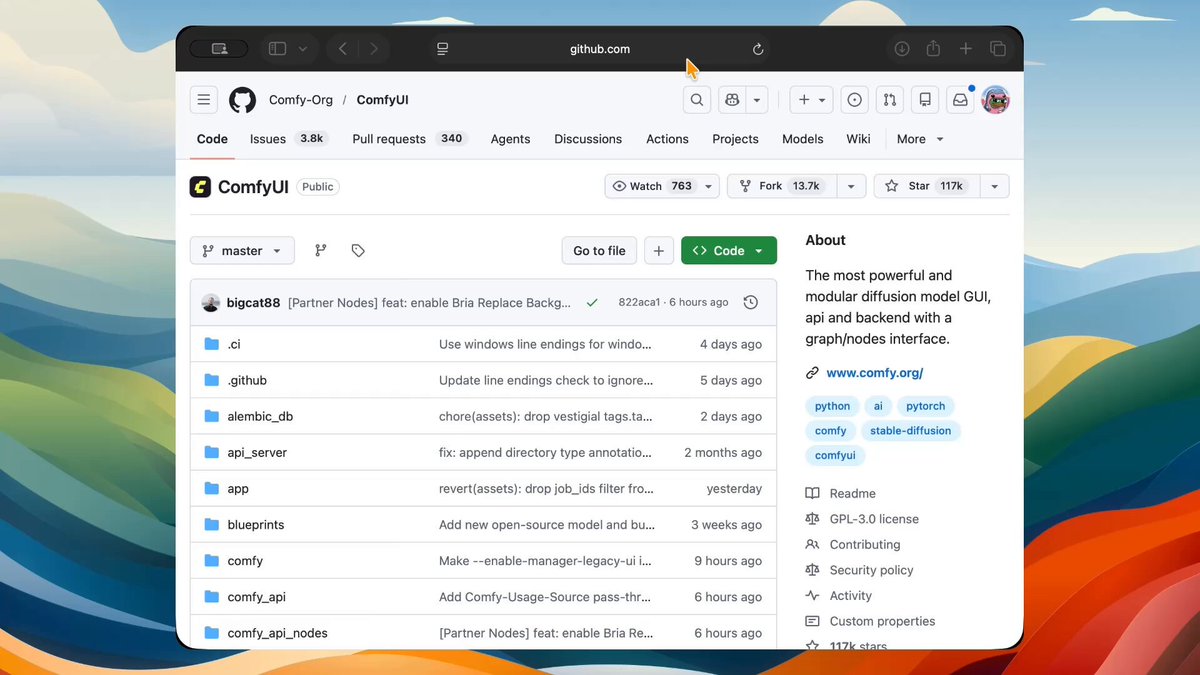
no money for grok or midjourney? this tool is for you. there's a FREE tool created by an anon dev. open-source. runs locally. 117k stars on github. it generates: > images & video > 3d models > audio > 20+ models here's how to set it up in under 5 minutes: 1️⃣download ComfyUI Desktop go to and grab the desktop app for your system. windows 10+, mac (apple silicon), or linux. it installs like any normal app, it sets up python and every dependency for you in the background. no terminal, no config files. 2️⃣open it first launch, it spins up its own environment automatically. you just wait a few seconds and you're in. you'll land on a node canvas, that's the whole interface. 3️⃣load a starter workflow top menu → Workflow → Browse Templates → Image Generation. click it. this drops a ready-made setup onto your canvas so you don't build anything from scratch. 4️⃣grab a model comfyui ships empty on purpose, the model is the brain, and you pick it. in the template, the "Load Checkpoint" node has a Download button when no model is installed. click it. it pulls one in for you (a few GB, this is the only real wait). 5️⃣install ComfyUI Manager this is the one add-on you don't skip. it lets you install models, custom nodes, and updates with a click instead of the command line. grab it from github (link in comments). it's the difference between fighting comfyui and flying in it. one honest note: an NVIDIA gpu makes this fast, apple silicon works great too, and a weak machine still runs it just slower. that's the whole setup. you now own an image, video, and 3D studio that costs you nothing per month. save this. and the next time grok or midjourney asks for your card. you won't need it. disclaimer: comfyui itself is 100% free. so are the local models (sdxl, flux, wan 2.2, ltx-2). some premium models like seedance are pay-per-use api models, only if you want top-tier quality. the free local ones cover most of what you need. (github link in the comments) follow and turn on post notification for daily AI contents.

m0h

14,542 次观看 • 1 个月前

How can you solve complex tasks using a Large Language Model? Here is a 2-minute introduction to everything you need to know to 10x the quality of your results. Let's talk about three techniques, in order of complexity, starting with the easiest one: • In-Context Learning • Indexing + In-Context Learning • Fine-tuning In-Context Learning The team that trained GPT-3 found something they couldn't explain: You can condition a model using examples of how you want it to behave. I included an example prompt in the attached video. You can "teach" the model how you want it to interpret questions, select the correct answers, and format the results by giving a few examples. You can also give specific knowledge to the model that will be helpful when formulating answers. We call this approach "grounding the model." There's another example in the video. Indexing + In-Context Learning Unfortunately, there is a limit to how much data you can include in a prompt. We call this the "context size." One version of GPT-4 supports a context of approximately 6,000 words, while the other supports 25,000 words. Although this sounds like a lot, many applications need more than that. Imagine you wrote a book and want to build an application to answer any questions about your story. What happens if your book is longer than the context? That's where Indexing comes in. Using a model, you can turn every book passage into an embedding. These are vectors, numbers that "encode" the passage's text. You can then store these embeddings in a particular database that supports fast retrieval of these vectors. You can then turn any question into an embedding and search the database for the list of passages that are similar to that query. Instead of using the entire book to ask the model, you can now use the relevant passages as in-context information, effectively working around the context size limitation. Fine-tuning Fine-tuning can give you an extra boost to get reliable outputs from your LLM. It is, however, the most complex approach on the list. There are different approaches to fine-tuning a model with your data. A popular technique is to process your data with your LLM and use the outputs to train a new classifier that solves your specific task. Notice that here you aren't modifying the LLM. Instead, you are chaining it with your trained classifier. Another approach is to modify the parameters of the LLM using your data. Think of this as "rewiring" the model in a way that solves your particular task. The results and costs will vary depending on how many layers you want to fine-tune from the original model. Many companies think that fine-tuning is the solution to their problems. In my experience, many will benefit from exploring the other two approaches. I love explaining Machine Learning and Artificial Intelligence ideas. If you enjoy in-depth content like this, follow me Santiago so you don't miss what comes next.

Santiago

384,510 次观看 • 3 年前

An entire empire was overthrown over a two percent tax on a breakfast beverage. Look at what you tolerate now. You are taxed when you earn it. Taxed when you spend it. Taxed when you save it. Taxed when you invest it. And when you die, they tax whatever is left. That is not a system. That is a harvest. You commute in a car you paid sales tax to buy. You drive it on roads you were already taxed to build. You fill it with gas taxed by the gallon. When you sell that car, the next buyer pays sales tax on it again. The same car. Taxed every time it changes hands. You arrive at a job where your salary is cut before it ever touches your hands. If you work for yourself, you pay both sides. Two people on paper. Neither one keeps what they earned. Then you go home. Every bill you open has a government standing behind it with its hand out. You buy a house with money they already took their share of. Then they charge you property tax on it every year for the rest of your life. You want to renovate your own kitchen. You need a permit. You want to build a deck on your own land. You need a permit. You pay for the property. Then you pay for permission to use it. Stop paying property tax and they seize your home. Not because you missed a mortgage payment. Because you missed a payment to the government for the privilege of keeping what is already yours. You do not own your home. You rent it from the state. If you leave something behind for your children, they are taxed on what you were already taxed to earn. The same wealth. Taxed at every stage of your life. Then taxed one final time because you had the audacity to die. They found a way to monetize your absence. We are told this is the price of civilization. It is not. It is architecture. The most effective prison ever built is the one where the inmates believe they are free. They did not take your freedom. They priced you out of it. If you kept the full value of your labor, you would be free within years. Not decades. Years. The system cannot allow that. A machine built on consumption needs a consumer that never stops. You did not sign a social contract. You were assigned one. Now pay attention. They spent decades perfecting the extraction of your productivity. Now they are building the technology to replace you. AI is not coming for your job because corporations are greedy. It is coming because a system that already takes half your output just realized it can take all of it. Without needing you in the equation. You were never the point of this arrangement. You were the input. And the moment they engineer a cheaper one, you become a rounding error on a quarterly earnings call. They did not build AI to free you. They built it to finish what the tax code started. It was never about the tea. It was about the precedent. Today we hand over half our waking lives and thank them for the potholes. You do not live in a free economy. You live in a subscription you never signed up for. And the penalty for canceling is everything you have.

Dustin

27,806 次观看 • 3 个月前