Video wird geladen...

Video konnte nicht geladen werden

Zur Startseite

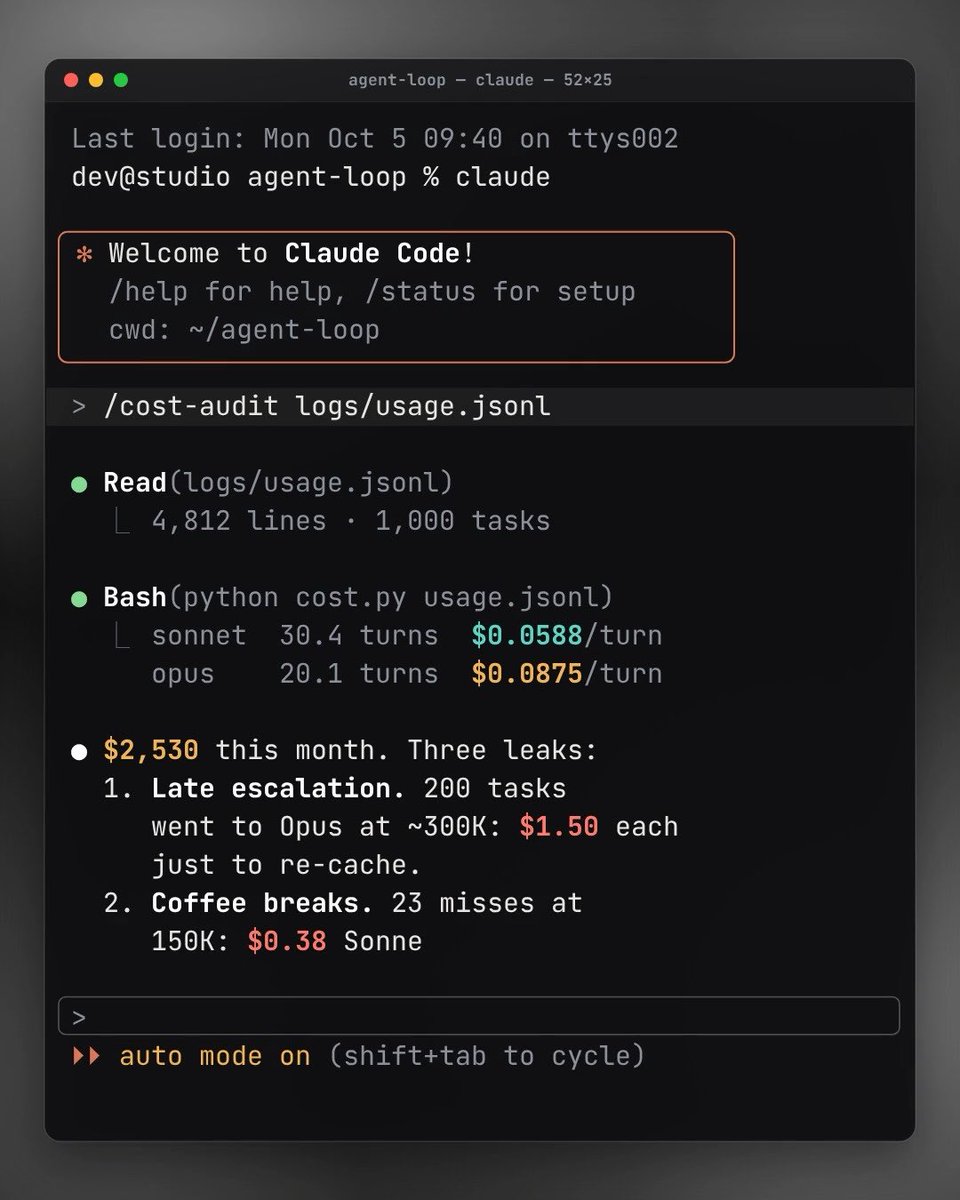
If your coding agent costs more than $2 per feature, read this. You're probably paying for 3 things you don't need: Opus reading every file in the repo. Opus making choices a $0.042 model can make. Simple tasks running on the most expensive model. Fix those 3 and the...

10,470 Aufrufe • vor 1 Monat •via X (Twitter)

15 Kommentare

Profilbild von Dvz | Python Architect
Dvz | Python Architectvor 1 Monat

Bootcamp prompt hoarders celebrate 80% API bill reduction by stacking hybrid multi-model wrappers thinking they cracked the autonomous agent architecture. They stare at temporary token price deflation while remaining completely blind to the catastrophic cascading runtime latency tax hiding inside their nested orchestration loops. Shallow financial optimization is a dangerous proxy for real performance engineering. The moment your non-deterministic pipeline hits real-world concurrent session traffic, your lightweight routing gates choke on implicit output drift. Pulling un-profiled multi-tier models to bypass frontier token rates doesn't fix architectural fragility; it just route-forwards your processing debt and leaves your distributed backend infrastructure completely I/O blocked.

Profilbild von Mayor.
Mayor.vor 1 Monat

good share buddy

Profilbild von Macro Bombastic
Macro Bombasticvor 1 Monat

yeah the repo re-read is brutal, been there man

Profilbild von notgwapo
notgwapovor 29 Tagen

seems like dialing things back a bit could save a ton. fr keeping it simple is underrated 🙏

Profilbild von Harry Tandy
Harry Tandyvor 1 Monat

smarter model routing can save serious money without sacrificing quality

Profilbild von Abozar
Abozarvor 1 Monat

Routing is the biggest lever, agreed. Two things to add from running agents in loops: a hard retry limit per step, and an escalation path so a weak answer from the cheap model goes to the strong one. Without the limit, the savings disappear when one step keeps retrying.

Profilbild von Ahmad
Ahmadvor 1 Monat

the opus reading every file one got me lol

Profilbild von LordZeppelin
LordZeppelinvor 1 Monat

Great read!

Profilbild von Shaoxiao | AI × 出海增长
Shaoxiao | AI × 出海增长vor 1 Monat

The $2/feature tax is usually three Opus habits: full-repo reads, enum picks, and trivial tasks. Default those to a cheap model; keep Opus for novel design. Routing policy is the product when overseas margins can't eat frontier tokens on every click.

Profilbild von 雨婷聊座驾
雨婷聊座驾vor 29 Tagen

charcloth trick changed my firekit forever

Profilbild von Aleena
Aleenavor 1 Monat

Most coding agents waste money because they process more context than the task actually needs. Giving the right model the right context matters more than using the most expensive one. That's something we're thinking about at @jarvixdotlive too.

Profilbild von vansh patel | 10 products in 90 days
vansh patel | 10 products in 90 daysvor 1 Monat

routing the cheap yes/no checks off opus is the real cut. we waste so many frontier tokens on "is it done" loops that a tiny model could own

Profilbild von John Rood
John Roodvor 1 Monat

the repo re-read is a context problem before it's a routing problem: the agent walks the tree because nothing durable tells it where things live. the biggest cut for us was a maintained project map, so it opens the three files that matter instead of re-walking the tree.

Profilbild von 🏳️‍⚧️ real.dahlia
🏳️‍⚧️ real.dahliavor 1 Monat

Sounds like my code’s on a luxury diet, time to cut the caviar and stick to ramen.

Profilbild von Dynamics_01(大冰美式版
Dynamics_01(大冰美式版vor 1 Monat

the first one hurt me the most. I once watched Opus re-read my entire repo three times for a one-file change, and I could feel the bill ticking. splitting planner and executor onto cheaper models cut my costs to pocket change.

Ähnliche Videos

THIS IS A PURE F*CKING GOLDMINE Anthropic just shared one of the best tricks for Claude Code. The idea: keep one expensive brain and make everything else cheap. Opus 5.5 thinks, Haiku 5.5 does the grunt work, and your bill drops 79%. Same task, two ways: all-Opus would have cost $1.13. This run cost $0.23. You just launch Claude Code like this: claude --model opus # agents: model: haiku here's the split: → Opus 5.5 plans, decides and reviews, and burns 40k tokens for $0.21 → 12 Haiku 5.5 agents fan out across read, grep and test lanes → those 12 agents chew through 180k tokens for $0.02 → Opus never reads raw agent output, only 3 summaries at 6k tokens the part most people get wrong: they let the expensive model do the reading. Haiku is 40x cheaper per token. mapping 48 files cost $0.009. doing that on Opus is where the whole budget goes. one catch worth knowing: past 100k of context Haiku jumps to 5x its own price, so every agent is kept under 100k on purpose. that is the whole design. the brain stays small and expensive, the hands stay huge and cheap, and nothing raw ever crosses between them. Opus plans. Haiku reads. Opus reviews. JEV engineering is the same move one layer down: 1,301 forks this run - which file, which agent, retry or stop - resolved in code at 0.90 sharpness, and only the split ones (0.48 on "which agent") ever reach Opus the full tree > Opus 5.5 runs the main session, plans the lanes and decides what happens next > 12 Haiku 5.5 agents fan out across read, grep and test, each kept under 100k context > every agent returns a summary, never raw files or logs > Opus 5.5 reads 3 summaries at 6k tokens and reviews the result > JEV resolves 1,301 micro-forks in code and escalates only the split ones paste the tree and this prompt into Claude Code ↓ "Rebuild my Claude Code setup around this tree: 1. Run the main session on Opus 5.5 for planning, decisions and review only. 2. Set every subagent to Haiku 5.5 and fan the grunt work out across read, grep and test lanes. 3. Keep each agent under 100k of context, split the work further if it goes over. 4. Agents return summaries only, raw files and logs never enter the main session. 5. Add one rule to CLAUDE.md: if a task is reading, searching or running tests, it never runs on Opus. Route deterministic forks (file choice, agent choice, retries) through JEV. Show me every change as a diff first. No edits until I say go." ↳ save it, it'll come in handy.

Sprytix

18,304 Aufrufe • vor 21 Tagen