正在加载视频...

视频加载失败

I’m excited to launch Tessl's first products! Introducing the Tessl Framework and Tessl Spec Registry, which integrate into any agent to keep it on rails and well informed using Spec-Driven Development. More details in the launch post: It’s a big milestone in the journey towards AI Native Development🚩 I’m...

12,624 次观看 • 10 个月前 •via X (Twitter)

0 条评论

暂无评论

原始帖子的评论将显示在这里

相关视频

Agent skills help agents use your products, build in your codebase and enforce your policies. They’re not just words - they are what the unit of software for agentic devs, and need powerful dev tools to match. That is what Tessl offers. Tessl is the package manager and development platform for skills. It offers a full dev lifecycle, helping you generate, evaluate, distribute and observe skills & context, developing them to the professional grade they warrant. Today, I’m excited to announce the general availability of our task evals, which help you understand how good your skills are. Such insight is critical to making your skills great, avoiding regression, and applying learnings from their real world usage. For example: Cisco's software-security skill shows a 1.8X improvement in securing coding in its benchmark, and ElevenLabs's agents skill boosts success by almost 3X! However, not to name names, we often see skills that provide minimal uplift while consuming context window space, or even degrade functionality. As Spencer Kimball, CEO of Cockroach Labs, put it when we shared early versions of this: evaluation is what makes agentic coding outcomes converge instead of drifting. Task evals are joining a long list of powerful context development tools, such as: * Review skills against quality best practices * Generate and maintain skills and docs for using your libraries & platform * Distribute versioned skills to your dev team and ecosystem * Consume skills easily and safely, and keep them up-to-date Skills are a central part of software development. If you’re serious about making agentic dev successful in your org, or helping your customers’s agents use your products, you need to invest in them. We hope Tessl can help. Check out links in the thread to get started!

Guy Podjarny

20,149 次观看 • 5 个月前

We've built 40+ AI agents and internal tools. The hardest part is Context Creation. AI runs playbooks and makes judgment calls for you. But without your company's context, you get slop. Context Creation means extracting the subject matter expertise and playbooks that live in people's heads, not in LLM training data, or even your tools. As forward deployed engineers (FDEs), we create context and turn it into code. We evaluate the business impact, how it aligns with the dev roadmap, and come up with creative solutions. We built The FDE Factory to replace ourselves. It drives AI adoption inside our clients' companies by running discovery sessions using prototypes to create context. Here's how it works: We put a prototype in front of a stakeholder. The stakeholder gives feedback via voice while they're using or reviewing it. Then our FDE Factory Agents builds in their expertise in minutes: > Context Agent reviews the codebase and feedback, extracts the requirements, and creates a spec > Scope Agent checks the spec against the development roadmap, validates it, and hands it off > Engineering Agent builds a new feature and wires the integration > QA Agent runs tests to prove to itself it works > PR merges, feature goes live, product updates itself in real time It's like the nontechnical stakeholder wrote the code without even knowing it. Coding agents are great at turning good development plans into code, and they're getting better at turning context into good development plans in collaboration with professional engineers. But nontechnical people are capped on what they can build without product people and engineers. The bridge that takes nontechnical people from vibe coding basic apps to building production AI tools that run on first party context is FDEs. Our new FDE Factory gives you the system to go from idea to production. Context Creation is the first and most important step in our FDE lifecycle, and we just automated it. Now clients get the right agents and tools built for them, customized to their unique business and encoded with their expertise. PS: If you're building AI agents within your company, reply "Playbook" and I'll DM you the entire FDE playbook we've run with 30+ companies. It covers finding high-impact AI use cases, building them, and deploying them across the org.

Mike Fishbein

10,101 次观看 • 1 个月前

Today we’re launching the first and only human-like AI agents in the world. Super Agents™ are the first agents with human‑level skills – they DM you, take @ mentions, send emails, manage docs, tasks, and more. Not just tools or API calls, but real skills fine‑tuned for how teams actually work. The first agents with 100% context – fully native in ClickUp and fully synced from other apps. Super Agents see your work the same way that humans do: tasks, docs, schedules, and conversations all in one place. The first agents that learn from human interactions automatically, without any setup or configuration – when you give feedback, they listen and improve how they work. The first agents with human‑level memory for custom agents – historical memory for every interaction, short-term working memory, and even long‑term memory stored in docs you can literally open, inspect, and edit. The first agents that are literally the same as users – our agentic user model is the same as our user data model. This gives you permissions and capabilities that you and your systems are already familiar with. The first infinite agent catalog – where anyone can create and customize agents in minutes, for literally any type of work imaginable. It's the most intuitive way to build agents on the planet. 95% of companies are failing in AI adoption. The reality is that AI isn't meant to be adopted, it's meant to be adapted – to you. Super Agents are automatically personalized to you and your company using proprietary state-of-the-art agent architecture, orchestration, and tooling. Today is the largest step forward we've ever made towards our mission of making people more productive. Maximize human productivity, with ClickUp Super Agents. Available NOW. For everyone.

Zeb Evans

320,607 次观看 • 7 个月前

We are excited to announce a powerful step for the future of FOMO! Taking a page out of Virtuals book on BASE, FOMO will be releasing the ability for future projects to be paired in $FOMO in the coming weeks. This is the biggest release we have ever announced. Launch your AI Agent Token + $FOMO trading pair Every individual agent token is paired with the $FOMO token in its liquidity pool. When launching an agent on you will need $FOMO tokens, which are used to create the liquidity pool. This process creates deflationary pressure for FOMO and the entire agent ecosystem. When creating your agent and token, you will have the option to pair your launch with FOMO or SOL, as our goal is not to alienate any project, but rather invite the best communities, CTO’s and builders to launch with us. If you decide to pair your project with FOMO you in turn get full marketing and dev support, once your project graduates the bonding curve and reaches Raydium. Further, as an added incentive, as our revenue grows we will be using part of the funds to support projects that have paired in FOMO. And Devs who launch tokens paired in FOMO will earn fees from their AI Agent token launch. Building the most robust agents using our framework will catapult us as one of the most prominent standards of the Solana ecosystem. Not only have we developed our own core infrastructure, but we also pull from some of the best repo’s and developer talent in all of AI, not just blockchain. Our team is comprised of 9 world class artificial intelligence engineers, PHDs in mathematics and engineering from the top companies on the cutting edge of AI. The future of AI Agents will be on Solana and we will help lead the way.

FOMO

129,867 次观看 • 1 年前

Today, we are launching the first publicly available AI Scientist, via the FutureHouse Platform. Our AI Scientist agents can perform a wide variety of scientific tasks better than humans. By chaining them together, we've already started to discover new biology really fast. With the platform, we are bringing these capabilities to the wider community. Watch our long-form video, in the comments below, to learn more about how the platform works and how you can use it to make new discoveries, and go to our website or see the comments below to access the platform. We are releasing three superhuman AI Scientist agents today, each with their own specialization: A general-purpose agent (Crow); An agent to automate literature reviews (Falcon); and An agent to answer the question “Has anyone done X before” (Owl). We are also releasing an experimental agent, Phoenix, that has access to a wide variety of tools for planning experiments in chemistry. More on that below. The three literature search agents (Crow, Falcon, and Owl) have benchmarked superhuman performance. They also have access to a large corpus of full scientific texts, which means that you can ask them more detailed questions about experimental protocols and study limitations that general-purpose web search agents, which usually only have access to abstracts, might miss. Our agents also use a variety of factors to distinguish source quality, so that they don’t end up relying on low-quality papers or pop-science sources. Finally, and critically, we have an API, which is intended to allow researchers to integrate our agents into their workflows. Phoenix is an experimental project we put together recently just to demonstrate what can happen if you give the agents access to lots of scientific tools. It is not better than humans at planning experiments yet, and it makes a lot more mistakes than Crow, Falcon, or Owl. We want to see all the ways you can break it! The agents we are releasing today cannot yet do all (or even most!) aspects of scientific research autonomously. However, as we show in the video, you can already use them to generate and evaluate new hypotheses and plan new experiments way faster than before. Internally, we also have dedicated agents for data analysis, hypothesis generation, protein engineering, and more, and we plan to launch these on the platform in the coming months as well. Within a year or two, it is easy to imagine that the vast majority of desk work that scientists do today will be accelerated with the help of AI agents like the ones we are releasing today. The platform is currently free-to-use. Over time, depending on how people use it, we may implement pricing plans. If you want higher rate limits, especially for research projects, get in touch. Michael Skarlinski, Andrew White 🐦‍⬛, Tyler Nadolski, Remo Storni, James Braza, Ludovico Mitchener, Michaela Hinks, as well as Jason Carman and his team for making such fantastic videos of us!

Sam Rodriques

724,960 次观看 • 1 年前

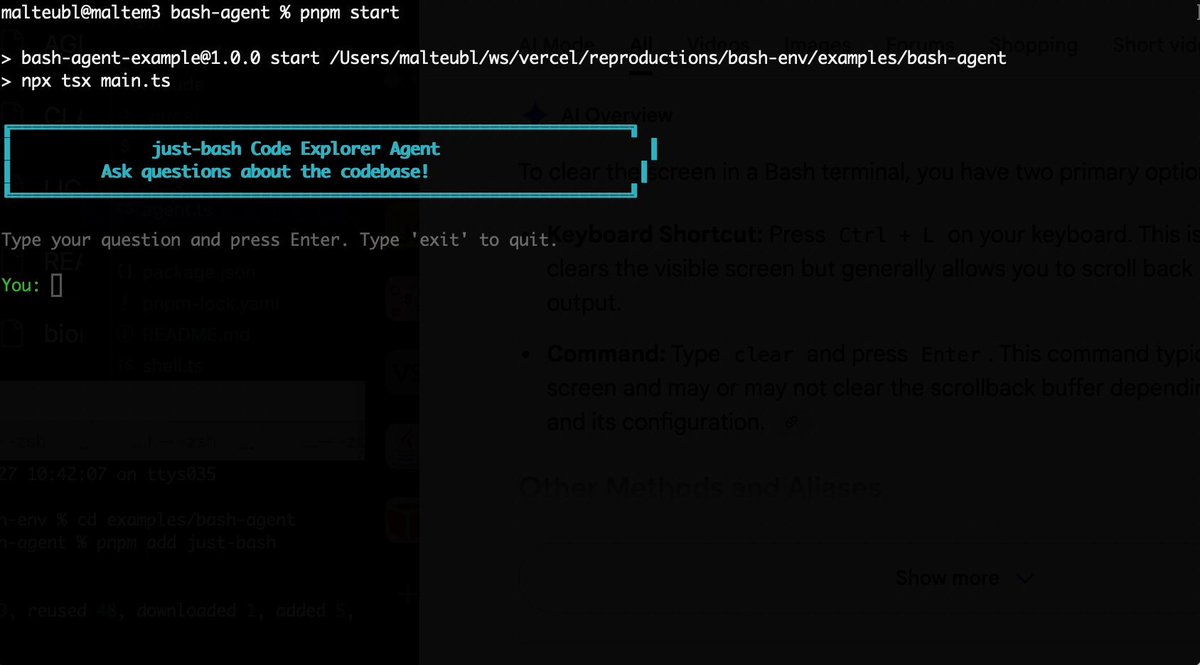
Bash is all you need! Which is why I'm introducing my holiday project: just-bash just-bash is a pretty complete implementation of bash in TypeScript designed to be used as a bash tool by AI agents. Because it turns out agents love exploring data via shell scripts, even beyond coding. It comes with grep, sed, awk and the 99th percentile features that an agent like Claude Code or Cursor would use. In fact, Claude Code can use it for secure bash execution. In the package - A bash-tool for AI SDK - A binary for use by yourself or your coding agents - An overlay filesystem to feed files to your agent securely - A Vercel Sandbox compatible API, so you can quickly upgrade to a real VM if you need to run binaries - An example AI agent that explores the just-bash code base using just-bash - I imported the Oils shell bash compatibility suite and just-bash passes a very good chunk What is interesting about this codebase: It was essentially entirely written by Opus 4.5. Coding agents love bash and they are good at reproducing it. They are also great at text-book recursive descent parsers and AST tweet-walk interpreters. That said, it is, like, a lot of code and I didn't read it all 😅. This is very much a hack, but it also seems to be _really_ useful. I haven't really found anything agents want to use that it doesn't support and it's fast and secure (caveats apply). It doesn't have write access to your computer and the filesystem is given a root that the agent cannot escape from. Find it at Related: Our recent blog post how we migrated our data analysis agent to bash tools and achieved incredible quality improvements The video shows the example agent investigating the just-bash code base

Malte Ubl

124,713 次观看 • 6 个月前

New course to bring you up to state-of-the-art at using AI to help you code: Build Apps with Windsurf's AI Coding Agents, built in partnership with WIndsurf (Codeium) and taught by Anshul Ramachandran! AI-assisted IDEs (Integrated Development Environments) make developers’ workflows faster, more efficient, and much more fun. Agentic tools like Windsurf are more than just code autocomplete—they are collaborative coding agents that help you break down complex applications, iterate efficiently, and generate code that spans multiple files. Although a lot of coding assistants share the same underlying large language models for planning and reasoning, a major point of distinction is how they handle tools, keep track of context, and stay aligned with your intent as a developer. For instance, if you make modifications to a class definition in your code and make the same modifications to other classes in the same directory, you might tell the AI agent "Do the same thing in similar places in this directory." Here, tracking your intent means understanding that “the same thing" refers to that recent edit you just made, which must be followed by appropriate search and tool-calling to implement the changes. In this course, you'll learn the inner workings of coding agents, their strengths and limitations, and how to use Windsurf to quickly build several applications. In detail, you'll: - Build a mental model of how agents work by combining human-action tracking, tool integration, and context awareness to carry out an agentic coding workflow. - Learn the challenges of code search and discovery and how a multi-step retrieval approach helps coding agents address them. - Use Windsurf to analyze and understand a large, old codebase and update it to the latest versions of the frameworks and packages it uses. - Build a Wikipedia data analysis app that retrieves, parses, and analyzes word frequencies. - Enhance the performance of your Wikipedia analysis app by adding caching, and through this, also learn how to course-correct when the AI agent produces unexpected results. - Learn tips and tricks such as keyboard shortcuts, autocomplete, and @ mentions to quickly call on agentic capabilities. - Use image/multimodal capabilities of the AI agent to increase your development velocity; you'll see an example of uploading a mockup with sketched-out UI features, and ask the agent to use that to build new functionality to an app. By the end of this course, you’ll understand agentic coding in-depth and know how to use it to make your development process much faster, more efficient, and enjoyable. Please sign up here!

Andrew Ng

139,834 次观看 • 1 年前

Introducing the Clips chrome extension - the easiest way to send bug reports to agents with video, transcript, and browser debug info captured automatically. 100% free and open source. If you are like me and get tired of manually typing instructions to agents, attaching screenshots, pasting debug logs, and all of that, this might be your new favorite tool. With the Clips chrome extension, you can just click the Clips icon, hit record, and start talking. Visually demonstrate your issue, go through the flow, point out what’s broken. Clips will capture everything on your screen, plus network requests, browser logs, client errors, and all the details around them. And it redacts sensitive information. Then it gives you a link you can send to humans so they can play it and take a look. Or, more importantly, just give it to your agents by just pasting the URL to them. The link has special metadata for agents so just from the URL, the agent can pull all information from the clip automatically. No plugin or MCP server required. That means it can "see and hear" what’s in the video - read the transcript, grab snapshots at any timestamp, and inspect the logs and network requests that were shared with it. So whether you want to quickly demo an issue and send all that context to an agent, or get better bug reports from teammates, recording and sending Clips makes that super easy. Unlike expensive apps like Loom, this is all 100% free and open source. The framework that powers this, plus a bunch of other free applications, is open source too. You can just sign up and use it, or fork it and customize it to your needs. This, in my opinion, is the future of software. Rather than bloated SaaS that charges you a ton of money and still doesn’t even have the things you need, we get free open source canonical apps that you can fork and customize in any way you want. I'll link to all this stuff in the replies. If you try it, let me know your feedback.

Steve (Builder.io)

60,166 次观看 • 29 天前