Video yükleniyor...

Video Yüklenemedi

Ana Sayfaya Dön

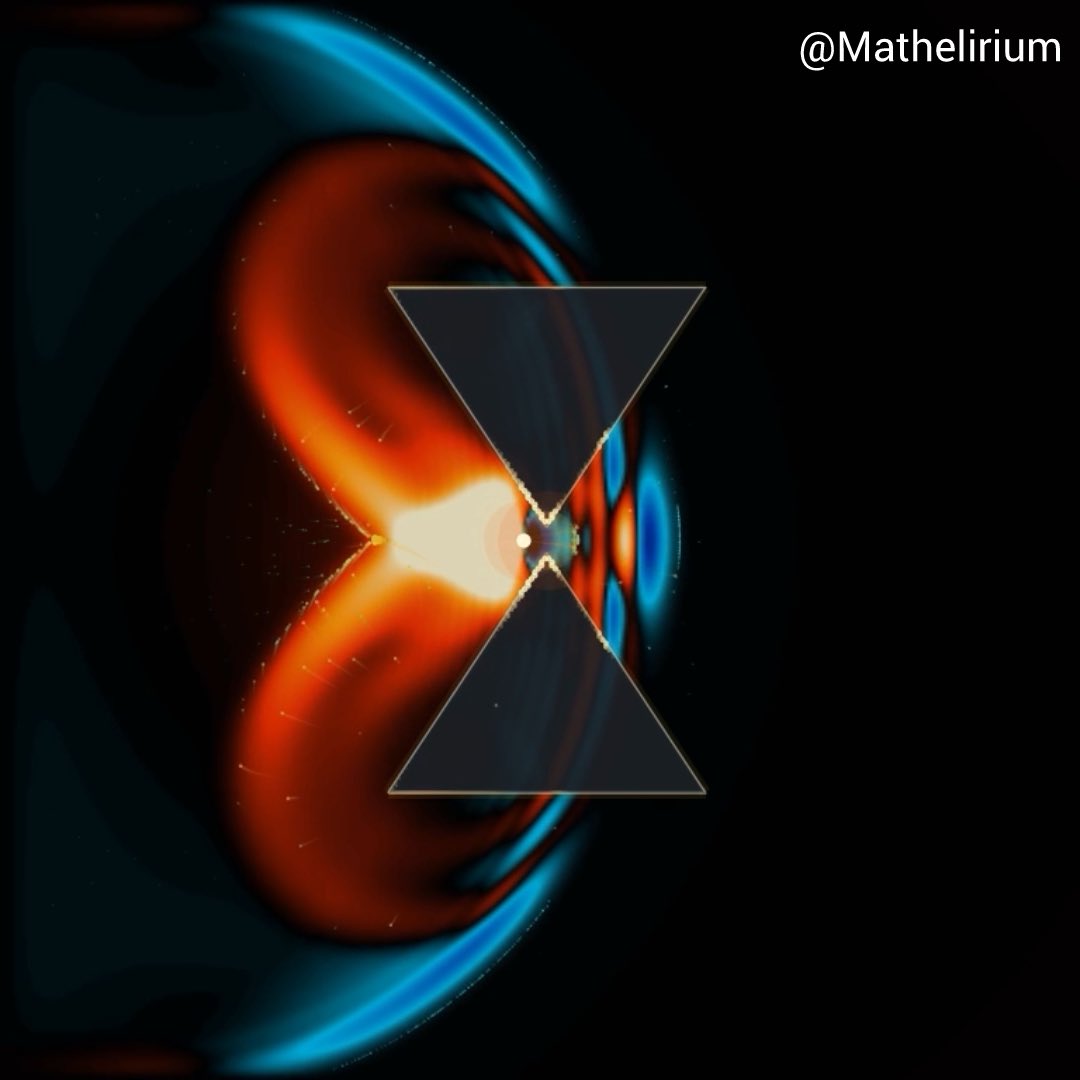
In String Theory, a tiny compact circle can be physically equivalent to a large one. This is known as T-duality.

23,897 görüntüleme • 12 gün önce •via X (Twitter)

0 Yorum

Yorum bulunmuyor

Orijinal gönderinin yorumları burada görünecek

Benzer Videolar

String Theory Lecture 1 A String Does Not Move Like a Point A point particle traces a line through spacetime. A string traces a surface. This is the first geometric shift in String Theory. Particle mechanics asks where one object is at time t, so its history is a curve. String Theory asks where every point of an extended object is at worldsheet time τ, so we need another coordinate telling us where we are along the string. For a point particle x(t) So, for one input of time we get a position in Spacetime. For a string Xᵘ(τ,σ) Here τ plays the role of time on the worldsheet, while σ labels position along the string. Freeze τ and vary σ, and you see the string at one instant. Let τ move, and that curve sweeps out a two-dimensional surface... the worldsheet. The same comparison appears in the action. For a relativistic point particle, the geometric action measures worldline length S = −m ∫ ds If we parameterize the path by t, the action has one integral, one parameter, and one tangent vector dxᵘ/dt For a string, the same idea grows by one dimension. The action measures area, not length. In Nambu-Goto form, S = −T ∫ dτ dσ √[−det hₐᵦ] Here T is the string tension. It plays a role similar to mass, but for an extended object. It weights the area of a surface rather than the length of a line. The particle action has ∫ dt because the history is one-dimensional. The string action has ∫ dτ dσ because the history is two-dimensional. We are no longer summing along a path, we are summing over a surface. The geometry changes for the same reason. For the particle, one derivative is enough dxᵘ/dt For the string, the geometry is built from two derivatives: ∂τXᵘ and ∂σXᵘ The first tells you how the string changes as worldsheet time flows. The second tells you how the embedding changes as you move along the string. Together they define the induced worldsheet metric hₐᵦ = ∂ₐXᵘ ∂ᵦXᵤ In plain terms, hₐᵦ measures tangent lengths and tangent angles on the worldsheet. From it, the area element is dA = dτ dσ √[−det hₐᵦ] This, the Nambu-Goto action is the direct analogue of the point-particle length action. The point particle extremizes length and the string extremizes area. For calculations, people usually switch to the Polyakov action: S = −(T/2) ∫ dτ dσ √[−γ] γᵃᵇ ∂ₐXᵘ ∂ᵦXᵤ This describes the same classical string dynamics, but the algebra is cleaner. After choosing conformal gauge, varying with respect to Xᵘ gives (∂²/∂τ² − ∂²/∂σ²) Xᵘ = 0 This is the first real dynamical payoff... a two-dimensional wave equation on the worldsheet. For a point particle, the equation of motion tells you how one position evolves along one path. For a string, it tells you how an entire curve evolves, with waves traveling along it. The term ∂²Xᵘ/∂τ² measures acceleration in worldsheet time, while ∂²Xᵘ/∂σ² measures curvature along the string. The time evolution is balanced by how the string bends along its own length. This is why strings have oscillation modes. A point particle has one trajectory. A string has many possible vibration patterns, each one a normal mode of the worldsheet wave equation. For a closed string, σ wraps around the loop Xᵘ(τ, σ + 2π) = Xᵘ(τ, σ) For an open string, one standard free-end condition is ∂σXᵘ = 0 at the endpoints. Solving the wave equation gives waves moving in opposite directions along the string Xᵘ(τ,σ) = Fᵘ(τ + σ) + Gᵘ(τ − σ) A function of τ + σ moves one way. A function of τ − σ moves the other. Therefore, a particle has a worldline, its action measures length, and its geometry uses one tangent. The string has a worldsheet, its action measures area, and its geometry uses two tangent directions. #StringTheory #TheoreticalPhysics #MathematicalPhysics #Physics #Spacetime

Mathelirium

31,560 görüntüleme • 1 ay önce

String Theory Lecture 2 In Conformal Gauge, the String Becomes a Wave Equation Episode 1 showed the geometric jump point particle -> worldline string -> worldsheet Episode 2 is the dynamical jump. The Nambu-Goto action measures the area of the worldsheet, S = −T ∫ dτ dσ √[−det hₐᵦ] but the square-root determinant is awkward to work with. So we usually rewrite the same classical theory in Polyakov form, S = −(T/2) ∫ dτ dσ √[−γ] γᵃᵇ ∂ₐXᵘ ∂ᵦXᵤ Here Xᵘ(τ,σ) tells us where each point of the string’s worldsheet sits in spacetime, and γₐᵦ is the metric we put on the worldsheet. The power of this form is that we can choose a convenient gauge. In conformal gauge, the equations of motion simplify to (∂²/∂τ² − ∂²/∂σ²) Xᵘ = 0 So the string’s spacetime coordinates behave like waves living on the worldsheet. The τ-derivative measures how the string changes in worldsheet time. The σ-derivative measures how it bends along its own length. For a closed string, σ is periodic Xᵘ(τ, σ + 2π) = Xᵘ(τ,σ) and the wave equation splits into two traveling pieces, Xᵘ(τ,σ) = Fᵘ(τ + σ) + Gᵘ(τ − σ) One family moves one way around the string and the other moves the opposite way. These are the left-moving and right-moving modes. In the render, the bright loop is the string at the present moment. The glowing cylinder behind it is the worldsheet it has swept out. The cyan curves trace one traveling family, and the gold curves trace the other. They are the visual version of τ + σ and τ − σ. Therefore, the theory has an internal wave equation, and its normal modes are the raw material for the string spectrum. #StringTheory #TheoreticalPhysics #ConformalGauge #Worldsheet #WaveEquation #Physics #Mathematics #MathematicalPhysics #QuantumGravity #ScienceVisuals

Mathelirium

15,295 görüntüleme • 1 ay önce

Today we introduce Stochastic Differential Equations (SDEs), and the main thing to watch for is this: We’ll use Brownian motion as the basic noise source, then see how well-known SDEs drop out of it naturally, without guessing. I still think the best way into these concepts is through an application. We look at the theory behind electromagnetic scattering and radar clutter, which leads straight into anomaly detection on scattering statistics. When a narrowband wave scatters off a messy cloud of particles, the complex field at your receiver is a random phasor sum. At time t you can write the electric field as E_N(t) = Σⱼ₌₁ᴺ e^{iθⱼ(t)}, each term a unit arrow in the complex plane from scatterer j. This is exactly where Brownian motion shows up in the most reasonable way. Think of all the microscopic chaos: tiny motions, index fluctuations, path jitters, Doppler shifts. Over short times, all of that shows up as small random kicks to the phases θⱼ(t). If you made θⱼ(t) random in an ad-hoc way, like resampling a fresh independent angle at every instant, the field would jump around unrealistically with no physical time structure. Brownian motion is what you get when each phase takes the continuous-time limit of many tiny, independent kicks. It’s continuous in t, its variance grows the right way, and it carries just enough temporal structure to look physical. So we model each phase as a Brownian walk, θⱼ(t) = θⱼ⁰ + σ_θ Bⱼ(t), with independent Brownian motions Bⱼ(t) and a phase-diffusion rate σ_θ. Brownian motion here isn’t window dressing. It’s the clean way to compress all the small random stuff into a single process that actually matches how phases wander in time. This is called Rayleigh Scattering, but the same sum of many tiny coherent echoes shows up in lots of places...e.g. wireless multipath fading (phones/Wi-Fi), laser/optical links through atmospheric turbulence, ultrasound speckle in tissue, and sonar/underwater acoustics in rough or bubbly water. #StochasticProcesses #BrownianMotion #ItoCalculus #RadarClutter #RayleighScattering #SignalProcessing

Mathelirium

31,182 görüntüleme • 3 ay önce

Today we introduce Stochastic Differential Equations (SDEs). I find that the best way to introduce these complex concepts is to look at an application. This is part I of the lecture🙂 We look at the theory behind electromagnetic scattering/radar clutter which leads to anomaly detection on scattering statistics. When a narrowband wave scatters off a messy cloud of particles, the complex field at your receiver is a random phasor sum...at time t you can write the electric field as E_N(t) = Σⱼ₌₁ᴺ e^{iθⱼ(t)}, each term a unit arrow in the complex plane from scatterer j. This is exactly where the magic of Brownian motion appears naturally and in the most reasonable way. Think of all the microscopic chaos...tiny motions, index fluctuations, path jitters, Doppler shifts that shows up as small random kicks to the phases θⱼ(t) over very short times. If you just made θⱼ(t) random in an ad-hoc way (say, resampling independent angles at each time), the field would jump around unrealistically with no temporal structure. Brownian motion is what you get when you let each phase take the continuous-time limit of many tiny, independent kicks...it’s continuous in t, it has the right cumulative variance growth, and it remembers just enough of its past to look physical. So we model each phase as a Brownian walk, θⱼ(t) = θⱼ⁰ + σ_θ Bⱼ(t), with independent Brownian motions Bⱼ(t) and a phase-diffusion rate σ_θ. Brownian motion here isn’t window dressing...it’s the clean way to compress all the small random stuff into a single process that actually matches how the phases wander in time. #StochasticProcesses #BrownianMotion #ItoCalculus #RadarClutter #RayleighScattering #SignalProcessing

Mathelirium

55,184 görüntüleme • 5 ay önce

The Trap in Every Mathematics Lecture If you’ve taken a lot of math courses, you start to recognize a pattern. There’s a moment where the lecturer is warming up with the obvious stuff...add matrices entrywise, scale by α, do the row-column product...and you’re thinking, alright… where is this going? Then you relax. You stop resisting. And right there, they slip in one line that changes how you see the whole subject. When Benedict Gross says "matrices represent linear operators,"he’s telling you to stop treating a matrix as a rectangle of numbers and start treating it as an action. A linear operator is a function T: Rⁿ → Rⁿ that respects two rules: T(u+v)=T(u)+T(v) and T(αu)=αT(u). Once you pick a basis, T is completely determined by where it sends the basis vectors e₁,…,eₙ. Put T(e₁),…,T(eₙ) into columns and you get a matrix A. That is what "A represents T" means...A is the coordinate portrait of the transformation. Now the punchline that makes matrix multiplication feel inevitable. If B represents S and A represents T, then doing S first and then T is the composition T∘S. In coordinates that becomes A(Bx)=(AB)x. So multiplying matrices is really composing transformations. That’s why multiplication is usually not commutative: T∘S is generally not the same transformation as S∘T, and the matrices inherit that noncommutativity. This explains half of Linear Algebra because it tells you what the course is really about...functions that move vectors around, not grids of numbers. A matrix is just the written form of that function once you choose coordinates. Then the rules stop feeling random Multiplying matrices means doing one move and then another, an inverse means you can undo the move, eigenvectors are directions that don’t get turned, and changing basis is just describing the same move in a different language. That one idea makes a lot of linear algebra click. #LinearAlgebra #Matrices #GroupTheory #GLn #MathLectures #Mathematics

Mathelirium

66,204 görüntüleme • 4 ay önce

Lecture 1 on Physics-Informed Neural Networks: A Mini-Series Physics-Informed Neural Networks (PINNs) are neural networks trained to satisfy a differential equation by building the PDE residual directly into the loss. They emerged from a very practical problem...classical PDE pipelines can be brilliant, but they often demand heavy discretization work (meshes, stencils, stability tuning), and the method you build is usually tied to one geometry and one solver setup. A PINN flips the workflow by representing the solution itself as a smooth function uᵩ(x,t) and enforcing the physics everywhere you choose to sample the domain. People often meet PINNs in the least helpful way...via a flashy solution plot, and almost no explanation of what was enforced to get it. In this series we keep the enforcement visible. We pick a differential equation, represent the unknown solution as a flexible function, measure how well that function satisfies the equation across the domain, and train it to reduce that mismatch everywhere we sample. A normal neural net learns from labels...you give it inputs and target outputs. A PINN learns from a differential equation...you give it inputs (x,t) and it gets punished whenever its output fails the PDE. By punish we mean that the loss increases when the mismatch is large we reward it if the loss decreases as the mismatch gets smaller. The network isn’t replacing physics, it’s becoming a flexible function that is forced to satisfy the same calculus you’d impose on any candidate solution. The math breakdown: We start with a PDE we want to solve on a domain Ω. Write it as uₜ(x,t) + N(u(x,t), uₓ(x,t), uₓₓ(x,t), …) = 0 for (x,t) in Ω A PINN replaces the unknown function u with a neural network output uᵩ(x,t) Now define the physics residual by plugging uᵩ into the PDE rᵩ(x,t) = ∂uᵩ/∂t + N(uᵩ, ∂uᵩ/∂x, ∂²uᵩ/∂x², …) If uᵩ were an exact solution, we would have rᵩ(x,t) = 0 everywhere. We may also have data points (xᵢ,tᵢ,uᵢ) from measurements or a known initial condition. The training objective is just a weighted sum of squared errors L(ᵩ) = L_data(ᵩ) + λ L_phys(ᵩ) + L_bc/ic(ᵩ) with L_data(ᵩ) = meanᵢ |uᵩ(xᵢ,tᵢ) − uᵢ|² L_phys(ᵩ) = meanⱼ |rᵩ(xⱼ,tⱼ)|² where (xⱼ,tⱼ) are the collocation points in Ω L_bc/ic(ᵩ) = penalties enforcing boundary conditions and initial conditions The key technical step is that the derivatives inside rᵩ are computed by automatic differentiation ∂uᵩ/∂t, ∂uᵩ/∂x, ∂²uᵩ/∂x², … So we can differentiate the total loss L(ᵩ) with respect to ᵩ and train with gradient descent. This is the whole idea behind PINNs. Learn a function, but make the PDE part of the loss, so the network is trained to be a solution, not just a curve-fitter. In the render, the main 3D surface is the network’s current guess uᵩ(x,t), drawn as a living sheet over the (x,t) plane. Hovering above is the neural scaffold...a visible graph of feature nodes and connections. The bright tension threads are the physics residual rᵩ(x,t): each thread tethers a collocation bead on the sheet up to the scaffold, and it thickens and brightens exactly where |rᵩ| is large (color encodes the sign). As training runs, those threads go slack across the domain not because we hid the error, but because the network has actually been pushed toward rᵩ(x,t) ≈ 0. #PINNs #PhysicsInformedNeuralNetworks #ScientificMachineLearning #PDE #DifferentialEquations #Optimization #MachineLearning #AppliedMath #ComputationalPhysics

Mathelirium

47,308 görüntüleme • 4 ay önce

The Trap in Every Mathematics Lecture If you’ve taken enough math courses, you start noticing the same little move. The lecturer warms up with the obvious stuff, add matrices entrywise, scale by α, do the row-column product, and you’re thinking alright, where is this going. Then you relax. You stop resisting. And right there, they drop one line that quietly rewires the whole subject. When Benedict Gross says matrices represent linear operators, he’s telling you to stop treating a matrix as a rectangle of numbers and start treating it as an action. A linear operator is a function T: ℝⁿ → ℝⁿ that respects two rules: T(u+v) = T(u) + T(v) T(αu) = αT(u) Once you pick a basis, T is completely determined by where it sends the basis vectors e₁,…,eₙ. Put T(e₁),…,T(eₙ) into columns and you get a matrix A. That is what A represents T means. A is the coordinate portrait of the transformation. Now the punchline that makes matrix multiplication feel inevitable. If B represents S and A represents T, then doing S first and then T is the composition T∘S. In coordinates that becomes A(Bx) = (AB)x. So multiplying matrices is really composing transformations. That’s why multiplication is usually not commutative. T∘S is generally not the same transformation as S∘T, and the matrices inherit that noncommutativity. This explains half of linear algebra because it tells you what the course is really about: functions that move vectors around, not grids of numbers. A matrix is just the written form of that function once you choose coordinates. After that, the rules stop feeling random. Multiplying matrices means doing one move and then another. An inverse means you can undo the move. Eigenvectors are directions that don’t get turned. Changing basis is just describing the same move in a different language. One idea, and a lot of linear algebra suddenly clicks. #LinearAlgebra #Matrices #LinearMaps #Eigenvectors #ChangeOfBasis #Mathematics

Mathelirium

133,454 görüntüleme • 3 ay önce