Загрузка видео...

Не удалось загрузить видео

На главную

$INTC earns its victory lap after a quarter that beats expectations across revenue, margins, earnings, manufacturing execution and guidance. Agentic AI is creating a second growth curve for server CPUs because every accelerator requires significant general-purpose compute around it giving Intel immediate exposure through its large server market share....

145,525 просмотров • 2 месяцев назад •via X (Twitter)

Комментарии: 0

Нет доступных комментариев

Здесь появятся комментарии из оригинального поста

Похожие видео

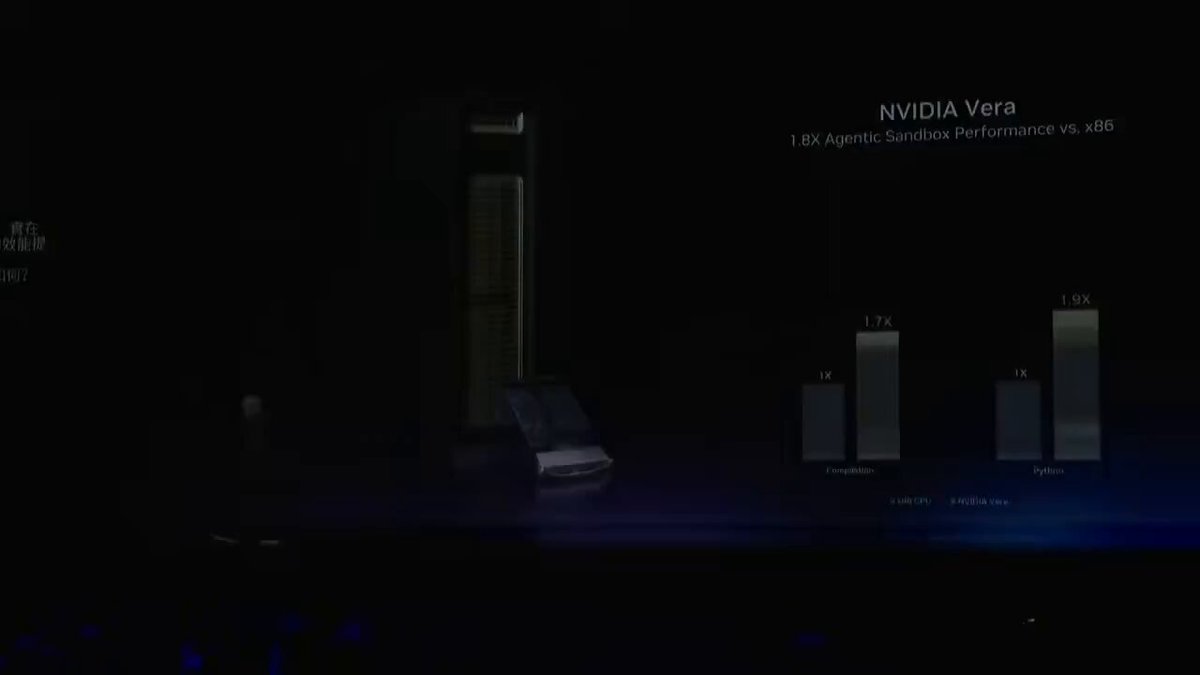
Jensen Huang just identified the next $200 billion market (Save this). The shift starts with a observation about agentic AI that changes everything about infrastructure. In the era of training and inference, the GPU was everything while CPU was a traffic cop, scheduling work, managing memory, dispatching tasks while the GPU did the heavy lifting. Agentic AI breaks that model entirely. An AI agent does not just run a single inference pass but rather it plans, calls tools, executes code in sandboxes, retrieves data from multiple sources and loops through complex multi-step reasoning sequences often thousands of times per second at scale. Every one of those operations runs through the CPU and the GPU sits idle waiting for the CPU to prepare the next task, supply the right context and execute the retrieval and tool calling logic fast enough to keep the accelerators fed. The CPU is now the conductor and the GPU is the orchestra and the bottleneck is the conductor falling behind. This is showing up in production AI factory utilization right now, which is exactly why Jensen built Vera from scratch rather than licensing x86. Vera achieves 40% lower peak memory latency than x86, 50% faster core to core communication, and 1.8 times the agentic sandbox performance of current x86 processors on a purpose-built architecture designed around the agentic loop. Now here is where the investment thesis gets interesting. The obvious beneficiary is Nvidia itself, and that thesis is real. Nvidia's CFO has guided for nearly $20 billion in Vera CPU revenue this fiscal year alone, a market Nvidia had zero presence in just three years ago. Intel held 60% of server CPU market share as recently as Q4 2025 and that transition is now happening at a pace Intel structurally cannot respond to. But the deeper question is, what architecture is Vera actually built on? Vera's Olympus cores are ARM compatible and every single Vera CPU deployed in every Vera Rubin rack in every data center in the world runs on ARM architecture. And ARM Holdings collects a royalty on every one of them. ARM does not make chips but rather licenses the instruction set architecture and CPU core designs that others build on top of. Every time Nvidia ships a Vera CPU, every time a hyperscaler deploys a Vera Rubin rack, every time an enterprise qualifies Vera for their AI factory, ARM earns a royalty. The secular tailwind here is almost perfectly constructed for ARM's business model. Amazon's Graviton, Microsoft's Cobalt, Google's Axion, Apple's silicon stack, and Qualcomm's data center push all run on ARM. And now Nvidia's Vera, which is projected to displace Intel as the largest server CPU supplier by revenue in a single fiscal year, is ARM. ARM's royalty rate on high end server chips is estimated at roughly 1 to 2% of chip selling price. At $5,000 per Vera CPU and 4 million units projected for FY2027, that is a royalty line growing from near zero to potentially $400 million to $800 million annually from Nvidia's data center CPU business alone before counting Amazon, Microsoft, Google, Apple, and Qualcomm. The total ARM addressable royalty base across all the silicon it already licenses is compounding at a rate that the current $130 billion market cap does not fully reflect. Jensen's CPU thesis is the most underappreciated catalyst in ARM's fundamental story, and the royalty compounding has barely started. Come join Milk Road Pro and get our full ARM royalty model and our entire AI trade thesis. Link below!

Milk Road AI

11,819 просмотров • 3 месяцев назад

Intel just pulled off the greatest corporate comeback since Steve Jobs returned to Apple in 1997. 12 months ago, Intel was dying. Stock at $19. CEO fired. Market cap collapsing. Analysts writing obituaries. But on Friday, it had its BEST day since 1987. Stock hit $82. Surpassed its dot-com peak from the year 2000 that nobody thought would ever be touched again. Up 335% from its 52-week low. And the story of HOW this happened is absolutely genius: In December 2024, Intel's board forced out CEO Pat Gelsinger after a brutal tenure. The stock had cratered and market share was bleeding to AMD and Nvidia. The company that invented the modern microprocessor was dying. 3 months later, they hired Lip-Bu Tan. Former Cadence CEO and Intel board member. A guy who'd spent decades in the semiconductor trenches. His first year was ugly: In January 2026, Intel crashed 17% in a single day after Tan admitted they couldn't meet demand and yields were below targets. Worst day since August 2024. "Multiyear journey" became code for "this company might not make it." Then something shifted. Tan went back to Intel's roots: Killed the bureaucracy, cut the bloat, and focused entirely on engineering. "We need to be data driven, paranoid, and engineering driven." Paranoid. The same word Andy Grove used when he built Intel into a superpower in the 90s. And behind the scenes, Tan pulled off 3 moves that changed everything: Move 1: He got Elon Musk. Tesla announced that TERAFAB, the most ambitious chip factory ever proposed, would use Intel's next-generation 14A manufacturing process. Elon said he couldn't think of a better partner. This is the deal Intel's foundry business needed to survive. Tan had previously warned that if Intel couldn't attract outside manufacturing clients, the entire foundry division would be shut down. Move 2: He got Nvidia. Last September, Jensen Huang invested $5 billion directly into Intel. The CEO of Intel's biggest competitor put billions into the company everyone had left for dead. Intel stock jumped 23% that day alone. Move 3: He got the US government. And this is where the story gets really crazy... The CHIPS Act allocated billions to Intel for domestic chip manufacturing. But when Trump took office, his administration opposed the program's conditions - union requirements, buyback restrictions, and a $100 billion investment commitment from Intel. So instead of giving Intel the grants, Trump's team converted $8.9 billion in CHIPS Act funds into equity. Bought a 9.9% stake at $20.47 per share. They didn't want to give Intel free money, so they simply bought stock instead. After Friday's earnings beat, that stake is worth $36 billion. A $27 billion paper gain. One of the most profitable government investments in American HISTORY. And it was a complete accident. Trump tried to kill the CHIPS Act handout. Instead he accidentally created a return that would make most hedge funds jealous. The earnings that triggered all of this were truly insane: - Revenue of $13.6 billion vs $12.4 billion expected - EPS of $0.29 vs $0.01 expected - They beat by 29x on earnings - Data center and AI revenue up 22% - Demand for CPUs exceeded supply for the first time in years Tan's quote on the call: "A year ago the conversation around Intel was about whether we could survive. Today it's about how quickly we can add manufacturing capacity." 6 consecutive quarters beating guidance. 4th CEO in 7 years. And the one who finally cracked it did it by going back to the basics. No flashy pivots like other companies. Just chips, engineering, and paranoia.

Ricardo

67,437 просмотров • 4 месяцев назад

Microsoft is deceiving you by inflating its AI empire with money it handed its OWN customer first. They sold Wall Street a $37 billion AI business, then went silent the moment its own filing showed where that money came from. The line sits in the annual report for fiscal 2026: Microsoft recorded $24.1 billion of revenue from commercial arrangements with OpenAI, including revenue sharing payments. If you run that figure against Microsoft's own AI disclosures you'll find that OpenAI made up more than half, and likely around 70%, of everything the company counts as AI sales. ONE customer. A Microsoft spokesperson confirmed the figure covers all sales and revenue share from OpenAI. The 70% comes by assuming Microsoft's AI run rate kept growing at the 123% pace the company itself reported in March, which is the company's own optimistic math turned around on it. Now follow where that money starts: Microsoft has put around $12 billion into OpenAI since 2019. OpenAI spends its cash on computing power, and Microsoft is the cloud provider selling it. So the money leaves as an investment and comes back as an Azure bill. Microsoft then books that bill as AI revenue and shows it to investors as proof the AI business is "working." Microsoft invests in OpenAI -> OpenAI buys Microsoft compute -> Microsoft records the payment as AI revenue -> the AI growth story goes to Wall Street And a chunk of it never actually arrived. The same filing shows $6 billion of accounts receivable from OpenAI as of June 30. That is $6 billion of AI revenue Microsoft booked and had not been paid when the year closed. Now here's where it gets really concerning for anyone holding the stock... Microsoft has told the public how big its total AI business is exactly twice. Once for the quarter ending December 2024, when it said the unit was on pace for more than $13 billion a year. And once for the quarter ending March 2026, when Satya Nadella put it on pace for $37 billion. That $37 billion number went everywhere. It was the headline proof that Microsoft had won the AI race. Then fourth quarter earnings arrived, and Microsoft did NOT update it. The company that had been announcing the figure as its own scoreboard stopped announcing the figure. In the same stretch, the filing landed showing where most of it came from. So what is actually left underneath? The full year AI business ran near $34 billion. Take OpenAI out and roughly $10 billion remains. Microsoft has spent about $261 billion on capital expenditure since the start of 2022. That is the scale of the bet against what the rest of the AI business currently brings in. And the one customer holding it up is walking further away every quarter. In October, Microsoft's stake in OpenAI dropped to 27% from 32.5%. In April the partnership was rewritten so OpenAI can sell its products across any cloud it likes, which is how Amazon got a seat at the table. The exclusivity that made this arrangement valuable is gone. The compute bill and the unpaid $6 billion are still on Microsoft's books. Nadella spent two years telling the market Microsoft built the largest AI business in software. The filing shows one client bought most of it, on credit, using money Microsoft partly supplied. So watch the next earnings call: If Microsoft puts a fresh total AI number back on the board, the business found customers beyond OpenAI. If you hear a lot about AI momentum and never hear what it adds up to, you already know why the number went missing. But nonetheless, how is something like this even legal?

Ricardo

24,389 просмотров • 1 месяц назад

Lip-Bu Tan with Jim Cramer on Mad Money Key Updates: 18A Execution Intel’s 18A yield is improving around 7–8% per month, which Tan described as the industry-standard scale-up rate. Defect-density targets were also reached ahead of year-end, supporting confidence in Panther Lake volume shipments. Foundry Customer Momentum Tan said outside customers are now knocking on Intel’s door after seeing the progress on 18A yield and defect density. He also said Intel has multiple customers engaged on 14A, with a 0.5 PDK already available. 14A Roadmap For 14A, Intel is targeting risk production in 2028 and volume production in 2029, putting it on an equal timeline with TSMC. EMIB / Advanced Packaging EMIB (which he called the best) and advanced packaging may be much bigger than expected …potentially billions, not just hundreds of millions. Some customers are even prepaying to help Intel secure tight supply-chain materials. Customer Demand Demand is accelerating too. Tan said one customer wanted to triple its forecast, but Intel needs a few quarters to catch up. Government Support Tan also said he updates President Trump and Howard Lutnick from time to time, and credited their support for understanding the strategic importance of U.S.-based semiconductor R&D, manufacturing, and capacity. Bottom line: The market can argue over candles. But the actual Intel story is execution, customers, packaging demand, and U.S. strategic backing all moving in the same direction. We don’t own enough $INTC

A2THEZ

34,838 просмотров • 4 месяцев назад

This is why Nebius will be a trillion dollar hyperscaler (Save this). Nebius is not building another GPU rental shop but rather building a vertically integrated hyperscaler that owns everything from the physical data center, to the server rack hardware it designs in house, to the software stack, to the inference delivery layer. Nearly every other neocloud is essentially a reseller of someone else's infrastructure but Nebius owns the full stack end to end and that distinction is the entire thesis. Here is why vertical integration is the winning architecture for the inference era. AWS and Azure were architected for general purpose computing and every AI workload they run sits on top of infrastructure that was never designed for it, patched, adapted and optimized after the fact. Nebius was built from day one specifically for AI which means every layer of the stack is purpose built and co optimized. The rack design, the networking topology, the cooling systems and the software that orchestrates it all are engineered together as a single system rather than assembled from parts that were never meant to work together. That architectural difference compounds with every passing quarter as AI workloads grow more complex and the performance gap between purpose built and general purpose infrastructure widens. The software layer is where the real competitive moat lives. Most infrastructure companies think of software as a wrapper around hardware while Nebius thinks of software as the product with hardware as the substrate it controls. The company is building an AI native cloud platform where the software layer handles model serving, inference optimization, fine tuning pipelines and developer tooling as first-class primitives. This matters because inference efficiency is almost entirely a software problem. Two companies running identical GPUs can deliver dramatically different performance and cost per token depending on how intelligently the software schedules, batches and routes inference requests across the cluster. Nebius is also building for a fundamental shift in how AI infrastructure gets consumed. Today, enterprise developers navigate massive cloud service catalogs spinning up clusters, managing configurations and building deep expertise in AWS or GCP-specific tooling. The next generation of builders will simply provision agents to interface with infrastructure directly. Nebius is architecting its software layer for that future , one where the interface between the developer and the compute abstraction layer looks nothing like what AWS built in 2006. The entire available capacity has been sold out every quarter. And that is the best possible validation that what Nebius is building is exactly what the market needs and that the market is willing to commit at a scale that makes the current valuation look like the beginning of a much longer story. Long Nebius and make sure to follow me Melvin for more overlooked AI stocks.

Melvin

34,306 просмотров • 2 месяцев назад

$AMD $5 Trillion is Inevitable LT| Agentic AI🧵 Agentic AI is the new $5 Trillion TAM 🚨🚨🚨 This thead will do Comp with $INTC and how to quantify this massive Agentic AI demand spike, and forcing Jensen to rush a CPU design. Global Agentic AI Market size is estimated to be $3-$5Trillion TAM by 2030(McKinsey) Quantifying the demand from agentic AI for AMD involves assessing the broader market growth for agentic systems, their unique computational requirements (particularly for CPUs in orchestration and reasoning tasks), and AMD's positioning very well through products like EPYC processors and partnerships. AMD EPYC Venice is the most superior choice in 2026-2027 for most Agentic AI workloads Agentic AI refers to autonomous AI agents that perform multi-step tasks, involving sequential logic, tool integration, and decision-making workloads that heavily rely on CPUs for handling orchestration, memory management, and context switching, rather than just GPU-parallelized training or batch inference. Agentic AI is often cited as 40-100x more "hungry" than traditional AI due to its continuous, 24/7 operation and complex workflows. This stems from factors like chain-of-thought reasoning (multiple LLM calls per query), API/tool interactions, memory management, and orchestration loops, which can generate 10-100x more tokens and require real-time responsiveness. For example, a single agentic query might trigger 5-20 model inferences, making it 10-20x more compute-intensive than simple chatbots, and the always-on nature compounds this to 40-100x overall. Nvidia's CEO has highlighted this as driving "easily 100x more computation" for inference in agentic/reasoning setups. AMD's EPYC Venice (6th Gen EPYC, codenamed "Venice") and Intel's Xeon 7 Diamond Rapids represent the pinnacle of server CPU technology in 2026, both targeting high-performance data center workloads like AI inference, agentic AI orchestration, cloud computing, and HPC. Venice builds on AMD's Zen 6 architecture, emphasizing core density and efficiency, while Diamond Rapids leverages Intel's Panther Cove P-cores for balanced performance. Both chips adopt similar advancements like 16-channel DDR5 memory and PCIe Gen 6, but differ in core counts, process nodes, and overall design philosophy. Intel has faced acute supply constraints across its Xeon lineup, including legacy nodes (Intel 7/3) and the ramping 18A process for next-gen parts. Intel shortage is expected with lead times up to 6 months or longer. 1. AMD EPYC Venice vs Intel Xeon 7 Diamond Rapids Architecture AMD: Zen 6 chiplet design with 8 CCDs and dual IODs Intel: Panther Cove P-cores; multi-die architecture with 4 compute tiles Core/Thread Count AMD: Up to 256 cores / 512 threads (Zen 6c variant) Intel: Up to 192 cores / 192 threads Process Node AMD: TSMC N2 (2nm) Intel: Intel 18A (1.8nm-class); in-house fab Memory Support AMD: 16-channel DDR5; up to 1.6 TB/s bandwidth. Intel: 16-channel DDR5 ; up to 1.6 TB/s bandwidth I/O and Connectivity AMD: PCIe Gen 6 (up to 128 lanes); twice the CPU-to-GPU bandwidth Intel: PCIe Gen 6 (up to 128 lanes); LGA 9324 socket Power (TDP) AMD: Starting 400-500W, potentially lower due to efficiency gains from TSMC 2nm Intel: Starting 400-500W, as it targets competitive efficiency Performance Projections AMD: Up to 70% uplift vs. 5th Gen Turin (1.7x in multi-threaded/AI tasks) Intel: ~40% faster than Granite Rapids (Xeon 6, 128-core). Lags AMD in per-core perf and 40-50% behind Venice core-for-core comp Target Workloads AMD: AI inference/orchestration, HPC, cloud virtualization. Partnerships Intel: Hyperscale AI, general enterprise. Custom silicon Pricing: AMD: estimated $10k-$20k for top SKUs Intel: estimated $8-$18k Availability: AMD: Significant Ramp H2 2026 due to higher allocation from TSMC Intel: H1-H2 2026 delayed, but trying to catch up Overall: ~Venice's 256 cores provide a 33% edge over Diamond Rapids' 192, making it superior for massively parallel tasks like AI training/inference or virtualization ~TSMC's N2 vs. Intel 18A debates rage on which is "better," but AMD's mature chiplet approach yields better density ( 32 cores/CCD vs. Intel's 48/tile). Venice's redesign reduces latency, aiding agentic AI where CPUs handle orchestration ~ Early projections show Venice widening AMD's lead matching or exceeding Diamond Rapids' perf with fewer watts in multi-threaded benchmarks. Intel's no-SMT design (to prioritize AI) handicaps it vs. AMD's 512 threads, though Clearwater Forest (E-core) could compete in density-focused niches. ~Power & Cooling: Both push above 400-500W, demanding liquid cooling. ~AMD been taking market share now above 40%. AMD EPYC Venice emerges as the superior choice in 2026 for most server workloads. Its higher core/thread count (256/512 vs. 192/192), stronger per-core performance, and architecture optimized for AI-driven tasks (agentic orchestration with GPU integration) provide decisive advantages in throughput, scalability, and efficiency. Projections indicate Venice delivering 1.7x the performance of prior gens while widening the gap over Intel ( 40-70% leads in multi-threaded benchmarks). AMD's fabless model with TSMC ensures reliable scaling, and its ecosystem ( open ROCm) appeals to AI adopters. Intel's Diamond Rapids is competitive in single-threaded enterprise apps and custom hyperscale ( NVLink), with potential fab advantages for supply/security. However, without SMT and lower density, it falls short in core-for-core battles—exposing Intel to another generation of AMD dominance unless 18A yields surprise efficiency gains. For data centers prioritizing raw compute ( AI, HPC), Venice wins; for Intel-centric ecosystems or specialized I/O, Diamond Rapids holds ground. Real benchmarks post-launch will confirm, but logic points to AMD pulling ahead. 2. Market size , Potential Revenue and Supply Global Agentic AI market size is projected to be $3-$5 Trillion by 2030 according to McKinsey, where consensus points to 40-50% CAGR driven by small to large enterprise demand. I also wrote a full thread on how and why Agentic AI is so explosive that AMD will blow all anlaysts estimate for subscribers. Link below if you are interested. AMD's data center segment hit a record $5.4B in Q4 2025 (up 39% YoY), with EPYC shipments ramping due to agentic demand. With 2GW of deployment in H2 2026, AMD AI data center revenue has $40-$50B+ at the lowest or most conservative projection; or Total Revenue in the $77-$94B For FY2026. However, Agentic AI massive demand spike could send EPYC revenue 3x to 4x in the next few years, potentially surpassing MI series GPU demand as enterprises prioritize CPU-dense Rack setups. This is pushing $NVDA Jensen to rush a CPU design and acquired Groq, a new CPU player due to this massive TAM. Noted that this is just popping just in weeks, highlighting we are just so early in this AI Supercycle and the pace of adoption is insane, and clearly productivity will skyrocket. Why? Because Agentic AI is 24/7 Smart AI agent working for you or your businesses is a mad compelling, and it is estimated to be 40-100x more Inference Hugnry! Many experts already said it is impossible to project this kind of Inference Demand. AI CapEx is expected to ramp up even more in 2027-2028-2029 and 2030 as Global Agentic AI is going to scale to $3-$5 Trillion TAM by 2030. The nature of Agentic is driving higher CPU/GPU ratio, with CPUs handling 50-90% of Agentic workflows. For example, The current Helios Rack: 18 compute trays per rack with 72 GPUs + 18 CPUs. The beauty of this $META and $AMD long term partnership is, that it is absolutely flexible to adjust racks to higher CPU rato or equal to service different needs. Helios rack can be easily swap to 2 GPUs 2CPUs or even CPUs only trays for dedicated orchestration/head nodes. You see, the beauty of this open rack-scale is flexibility and evolvability. If Agentic AI demand pushes much higher, AMD should be able to adjust variant trays without abandoning Heilos Rack. We can't talk just about massive Agentic AI demand without talking about the Supply side or TSMC. TSMC, AMD's primary foundry for advanced nodes ( Zen 6/Venice on N2/2nm), is addressing AI-driven shortages through massive expansions. TSMC accelerates fab construction with up to 10 facilities targeted for 2026. TSMC is accelerating its domestic manufacturing expansion, with industry sources indicating that as many as ten fabs could be under construction or preparing to begin operations across Taiwan’s major science parks. TSMC Capex: $52-56B in 2026 (up 37% YoY), with $45B already approved for new/upgraded capacities. 70-80% for advanced processes (2nm/A16), 10-20% for packaging (CoWoS quadrupling to 120-140K wafers/month by late 2026). In addition, Taiwanese companies (led by TSMC) commit to at least $250B in direct investments in US-based advanced semiconductor, AI, and energy production/innovation capacity.Taiwan provides $250B in government credit guarantees to facilitate additional investments and build a full US semiconductor ecosystem (including industrial parks). TSMC completed a second land purchase in Arizona (January 2026) for gigafab scaling, with an additional $100B+ (potentially four more modules) to further expand and qualify for tariff exemptions. AMD with secured 12GW from OpenAI and $META and massive Agentic AI will mean higher priority acess to 20-30% more wafers on TSMC advanced nodes, as TSMC has multi-year agreements with AMD for AI chips. Dr. C. C. Wei, CEO of TSMC quote: "I spend a lot of time in the last three or four months talking to my customer and then customers. Customer. I want to make sure that my customers demand are real. I talk to those cloud service providers, all of them. Their answer is. I'm quite satisfied with their answer. Actually they show me the evidence that the AI really help their business. So they grow their business successfully and he or she in their financial return. So I also double check their financial status. They are very rich." Amid shortages, the US buildout ensures AMD can ramp production of Instinct GPUs and EPYC CPUs without the constraints hitting competitors like Intel. By diversifying away from Taiwan (85% of advanced nodes today), the agreement mitigates supply disruptions, ensuring stable flows for AMD's chips. Scaling production and securing supply will matter for AMD the most in the next 5-10 years growth. The growth could be 80-100% YoY or higher; or it could be in the 60%. The aggressive TSMC supply ramp is reassuring the higher growth point. Conclusion: AMD stands at a pivotal inflection point in 2026, where the explosive rise of agentic AI demanding 40-100x more inference compute through its 24/7, multi-step orchestration positions the company to potentially triple its EPYC CPU revenue to $45-60B+ by 2028 while scaling Instinct GPUs to tens of billions annually by 2027. Agentic AI demand could push AI CapEx closer to $1 Trillion in 2027, far higher than most estimates. Dr. Lisa Su, AMD's visionary CEO, is masterfully securing supply to harness this massive demand by prioritizing operational execution and deep TSMC collaboration, ensuring readiness for the second-half 2026 AI ramp. Dr. Su has explicitly called out surging EPYC demand for agentic tasks where CPUs power head nodes and traditional workloads alongside GPUs while guiding for data center dominance through proactive capacity planning and partnerships like Nutanix ($150M investment for open agentic platforms) or providing tens of millions CPUs for OpenAI, $META, $ORCL, $AMZN, $MSFT, $GOOGL and others. Her strategy includes multi-year TSMC agreements for advanced nodes (N2 for Venice CPUs and future Instincts), diversifying beyond Taiwan to mitigate risks, and unveiling innovations like the MI455X GPU at CES 2026, which she touted as enabling "the next trillion-dollar market opportunity" in physical AI. Dr. Su's forward-looking vision predicting AI reaching 5 billion users emphasizes "AI everywhere," backed by hardware like Ryzen AI chips, all while declaring demand "going through the roof" and committing to scale without bottlenecks. TSMC's aggressive ramp-up, fueled by $52-56B in 2026 capex (up 37% YoY) and 10+ new fabs across Taiwan, the US (Arizona cluster expanding to 6+ modules with $165B+ investment), Japan, and Europe, provides profound reassurance for AMD's supply stability. The January 2026 US-Taiwan agreement committing $250B in investments and credit guarantees for US reshoring accelerates this, granting tariff relief (15% rates with 1.5-2.5x exemptions) tied to capacity buildouts, enabling TSMC to potentially double output over the decade to meet AI wafer hunger. This translates to 20-30% higher wafer allocations on key nodes, sidestepping Intel-like shortages and empowering Dr. Su's team to deliver on hyperscaler demands without disruption. Ultimately, this synergy cements AMD's leadership in the agentic era, promising sustained growth, $5T+ valuations at scale, and a resilient path forward as AI reshapes the world. This is NOT Financial Advice! Video source: AMD CES 2026

Mike

44,460 просмотров • 6 месяцев назад

Broadcom's CEO just exposed the real fight underneath Google's AI chip strategy. It is not Google versus Broadcom. It is Google and Broadcom trying to make Nvidia replaceable. Within two minutes at Bloomberg Tech, Hock Tan was asked whether Google bringing more chip design in house keeps him up at night. His exact words: "So we just compete against my own customer." Then he named the real enemy: "the real competitor facing all this is the GPU out of Nvidia." That is the part most people miss. Custom AI chips are not just cheaper GPUs. They are ownership claims. If Google owns the workload, the compiler stack, the cloud customer, and the TPU roadmap, Nvidia becomes a benchmark instead of the toll booth. But Broadcom is still in the room because independence is not binary. The hard part is not drawing a chip. The hard part is shipping generation after generation at scale, matching Nvidia's cadence, keeping networking tight, and making the whole system useful enough that developers do not care what silicon sits underneath. That is why Tan can say Google is trying to create customer owned tooling and still sound calm. Broadcom is not selling picks and shovels. It is selling the bridge out of Nvidia dependency. The numbers explain why this is suddenly a board level issue. Broadcom reported $22.2 billion of Q2 2026 revenue. Its AI semiconductor revenue hit $10.8 billion, up 143 percent year over year. For Q3, Broadcom guided AI semiconductor revenue to $16.0 billion, up more than 200 percent year over year. In the clip, Tan says Broadcom has exactly 6 custom AI accelerator customers. He says OpenAI has been engaged for over 2 years, its accelerator is already working in labs and data centers, and production is on track for late this year. That is the hidden mechanism: The AI labs are not becoming software companies with some chips attached. They are becoming capacity companies with model interfaces attached. Once your margin depends on tokens, latency, memory bandwidth, power contracts, packaging slots, networking gear, and a private accelerator schedule, the "model company" label starts to look like a costume. The precedent is Apple. Apple did not move into custom silicon because it wanted a cute chip branding story. It moved because the iPhone needed control over performance per watt, release cadence, and differentiation. A series chips in 2010. M1 in 2020. More than a decade of slowly pulling the bottleneck inside the company. But Apple still needed TSMC. That is the useful analogy for Google, OpenAI, and the other AI giants. They want Nvidia's margin pool. They want Nvidia's roadmap power. They want Nvidia's ability to decide who gets capacity first. But the first supplier they replace becomes the supplier they cannot live without. Broadcom is the customs officer at the border of private silicon. Second order consequence: AI company valuation will shift from model demos to infrastructure custody. Who owns the workload? Who controls the accelerator roadmap? Who has memory secured? Who can afford to keep a bad first generation alive long enough to get to the second and third? My bet: by the end of 2027, at least one major AI lab will be judged more by its custom chip execution than by its model benchmark lead. The model race is public. The margin race is being negotiated in silicon.

Andrej Drats

10,572 просмотров • 2 месяцев назад

AMD might have disrupted Nvidia's entire cloud GPU rental business. In January at CES, AMD CEO Lisa Su demonstrated a $1,499 mini PC running the same class of AI model that currently costs companies $2,500 to $3,000 every month to rent from Nvidia-powered cloud servers. AMD's own branded version opened pre-orders this month at $3,999. Third party manufacturers have been selling the same chip since 2025 starting at $1,499. Here is exactly why this is dangerous for Nvidia. Nvidia's $75 billion quarterly revenue is built almost entirely on one business model, companies rent access to Nvidia GPUs through cloud providers like AWS and Lambda Labs to run AI. They pay monthly. Nvidia gets paid every time someone runs an AI model in the cloud. That recurring rental income is what turned Nvidia into a $5 trillion company. The AMD box eliminates that monthly fee permanently. One AI consultant switched from $2,800 per month in Nvidia cloud rental costs to $8 per month in electricity. The hardware paid for itself in 11 days. Over 8 months he generated $47,000 running the same AI workloads that previously left him paying Nvidia's ecosystem $2,800 every single month. Multiply that across thousands of enterprise customers and the revenue erosion becomes structural. Every business that buys this box stops paying cloud rental fees forever. Lawyers, doctors, banks, accountants, and financial advisors, businesses with sensitive data that cannot legally go to a cloud server represent billions in annual cloud GPU fees that Nvidia is now at risk of losing permanently. The threat is also closing in from the top. Google signed deals worth tens of billions with Anthropic and Meta to replace Nvidia with its own chips. Amazon built its own AI chips across AWS. Apple trained its AI on Google's chips, not Nvidia's. Custom silicon has grown from 21% of the AI chip market in 2025 to 28% in 2026. Nvidia's rental model only worked because serious AI compute had no alternative.

Bull Theory

26,765 просмотров • 3 месяцев назад

THE 5 BIGGEST BOTTLENECKS POWERING THE AI ECONOMY The way I'm thinking about AI winners today is that the market is moving beyond the simple question of which mega-cap company spends most on AI and has been rewarding the companies that control the scarce inputs, contracted capacity, data movement, power infrastructure, edge compute and workflow layers that make the AI economy function. These are the five bottlenecks I'm watching most: • Memory | $MU, Samsung, SK Hynix Memory is the clearest scarce input because HBM feeds the accelerator, only a few companies can make it at volume and buyers are locking in supply through long-term agreements that create revenue visibility through the end of the decade. • Connectivity | $AVGO, $MRVL, $ALAB, $CRDO, $AAOI, $ANET Connectivity determines whether AI clusters can move data fast enough because training runs span tens of thousands of chips that need to act like one machine. Once copper runs out of reach that causes the cluster depends on optics, retimers, switches and custom silicon to keep the system moving. • Power | $CEG, $VST, $GEV, $FPS, $VRT, $NVTS, $TLN, $ON Power determines whether new AI data centers can actually come online because the binding constraint is shifting from getting chips to getting megawatts so the value flows to the companies that control generation, grid equipment, power delivery, thermal management and efficiency. • Compute | $NBIS, $CIFR, $IREN, $APLD, $WULF, $CORZ, $CRWV Compute capacity is overflow layer when hyperscalers are sold out. Capital alone doesn't guarantee GPU access which is why buyers are signing multi-year contracts for clusters before they are even fully built. • CPU | $NVDA, $AMD, $INTC, $ARM, $QCOM On-device CPU (edge compute) becomes next bottleneck as AI moves into inference, agents, PCs, phones, vehicles and physical devices.

Shay Boloor

109,467 просмотров • 2 месяцев назад

$TTMI TTM Technologies: The Strategic Nexus of AI and Defense Infrastructure. Investment Thesis. New: 6/22/26. TTM Technologies has moved well beyond its identity as a commodity circuit board manufacturer. The current business is increasingly defined by advanced interconnect solutions for AI server infrastructure and defense electronics — two segments where technical complexity creates qualification barriers and customer switching costs that standard PCB suppliers cannot access. That repositioning is reflected in the financial results: record revenue and earnings forecasts validate that the mix shift is producing real margin improvement rather than just revenue growth. The defense backlog is the most durable component of the demand picture. A $1.6 billion backlog tied to programs like the F-35 and missile defense systems represents contracted, long-cycle revenue with a customer — the U.S. government — whose procurement commitments are structurally more stable than commercial technology spending. That backlog provides a financial foundation that makes the AI infrastructure growth story less binary than it would appear in isolation. AI server infrastructure is the higher-growth but less predictable demand driver. Interconnect complexity in AI server configurations is increasing as rack architectures evolve, which expands content per system and supports TTM's technical differentiation. The risk is that AI infrastructure spending is more cyclical and customer-concentrated than defense, and the technical requirements are evolving quickly enough that manufacturing capability needs to stay ahead of customer specifications on a shorter development cycle than defense programs typically demand. Capital expenditure intensity is the financial constraint that the demand environment doesn't resolve. Simultaneous investment in specialized U.S. and Malaysia facilities alongside European acquisitions represents a heavy parallel deployment of capital that requires each initiative to execute on schedule and at projected returns. Free cash flow conversion will lag revenue growth during this investment phase, and the degree of that lag — and how quickly it normalizes — is the primary financial metric the new CEO needs to demonstrate control over. Leadership transition is well-timed in one sense and risky in another. A technically focused CEO is the right profile for a company whose competitive differentiation rests on manufacturing process capability, but new leadership inheriting a rapid scaling program across multiple geographies introduces execution continuity risk at a moment when the capital deployment decisions being made now will define the return profile for years. The bottleneck supplier positioning is the right long-term frame. Advanced interconnect for AI and defense is not a commoditizing market, and TTM's manufacturing investments are building capability depth that takes time to replicate. Sustaining that technological edge as competition intensifies — particularly from Asian manufacturers with lower cost structures — is the strategic challenge that underlies every near-term financial metric.

TheValueist

12,877 просмотров • 3 месяцев назад

Elon Musk just put a number on the flaw at the center of Nvidia’s empire. Wall Street has not done the math yet. Nvidia’s Blackwell is the most sought-after silicon on Earth. Every AI lab wants it. Every sovereign nation is bidding for it. Blackwell runs every model, for every company, in every data center on the planet. That universality built the empire. It is also the fracture point. Musk: “We believe the AI5 chip will be about a third of the power of an Nvidia Blackwell for roughly comparable performance. And much less than 10% of the cost.” One-third the power. Comparable performance. Less than ten percent of the cost. Musk: “This is a chip that is very much optimized for the Tesla AI software stack. It’s not meant to be a general purpose chip.” Nvidia builds silicon that serves a million different customers. Every transistor spent on universal compatibility is a transistor not dedicated to one task. Tesla is building silicon for exactly one customer. Itself. When you strip away every function you will never call, you do not get a lesser chip. You get a weapon. Here is what the market refuses to see. Data centers drink unlimited power from the grid. Robots run on batteries. Musk: “In order to have a functional robot, you have to have a great AI chip. And it needs to be an inexpensive chip and it needs to be very power efficient.” You cannot put a Blackwell inside a walking machine. It would drain the battery before it crossed the room. The entire AI revolution lives inside air-conditioned buildings bolted to the electrical grid. Musk is not competing for that market. He is engineering the silicon that survives outside of it. One-third the power is not a spec sheet footnote. It is the physics threshold that severs intelligence from the wall socket. Without that number, every robot on Earth stays tethered. With it, the algorithm walks. Less than ten percent of the cost is not a pricing strategy. It is the line where a machine brain stops being a capital expenditure and becomes a commodity component. When the chip inside a humanoid costs less than the motors in its legs, you do not manufacture hundreds of robots. You manufacture millions. Wall Street is valuing the AI revolution by who dominates the data center. Musk is building the only silicon designed to leave one. Nvidia built the brain of the cloud. Musk is building the brain of the physical world. No one has priced that in yet.

Dustin

160,633 просмотров • 5 месяцев назад

$GLW Corning: The AI Optical Infrastructure Springboard Strategy. Investment Thesis. New: 6/29/26. Corning has repositioned a traditional materials manufacturer into a critical supplier at the physical layer of AI infrastructure — a transition that leverages decades of fiber optics and photonics expertise into a market where that expertise is now mission-critical rather than commoditized. High-density fiber and advanced photonics are the connectivity backbone that AI data centers require as networking bottlenecks become increasingly binding constraints on cluster performance, and Corning's manufacturing scale and materials science depth position it as one of the few suppliers capable of meeting that demand at the volumes hyperscalers require. The NVIDIA and Meta partnerships are significant validation points. Both represent demanding customers whose technical requirements and qualification standards are rigorous, and their direct engagement with Corning signals that the company's optical infrastructure capabilities are viewed as strategically necessary rather than substitutable. That kind of direct hyperscaler relationship is difficult for competitors to displace once established, given the integration depth required in data center network architecture planning. The Springboard strategy is the financial framework converting the AI infrastructure opportunity into demonstrated margin improvement. Operating margin expansion that has already materialized provides credibility to the more aggressive 2030 revenue growth targets — this is not a purely forward-looking narrative but one with a track record of execution behind it. That said, the distance between current results and the 2030 targets is substantial, and the growth trajectory assumes continued AI infrastructure capital spending at a pace that has historically been difficult to sustain without periodic digestion phases. Capital intensity is the structural constraint on returns during the buildout phase. Scaling fiber and photonics manufacturing capacity to meet AI-driven demand requires sustained capital deployment, and the return on that investment depends on demand durability matching the capacity being built. Customer concentration compounds that risk — significant revenue exposure to a small number of hyperscaler relationships means that any shift in AI infrastructure capital spending plans at a major customer would disproportionately affect Corning's growth trajectory relative to a more diversified customer base. The Solar business is a complicating factor that sits somewhat apart from the core AI optical infrastructure narrative. Scaling that segment successfully requires different operational capabilities and serves a different demand driver, and management attention split across a capital-intensive solar scale-up alongside the AI infrastructure buildout introduces execution complexity that pure-play AI infrastructure companies don't carry. The valuation reflects multiple years of anticipated growth, which means the premium is justified only if execution stays on pace with the Springboard targets and AI infrastructure capital spending remains robust through the multi-year buildout period the thesis depends on. Corning's market position is genuinely dominant in its core optical infrastructure niche — the question is whether that dominance, expressed through a still-developing financial trajectory, supports a price that has already captured much of the anticipated upside.

TheValueist

16,739 просмотров • 2 месяцев назад