Video yükleniyor...

Video Yüklenemedi

Ana Sayfaya Dön

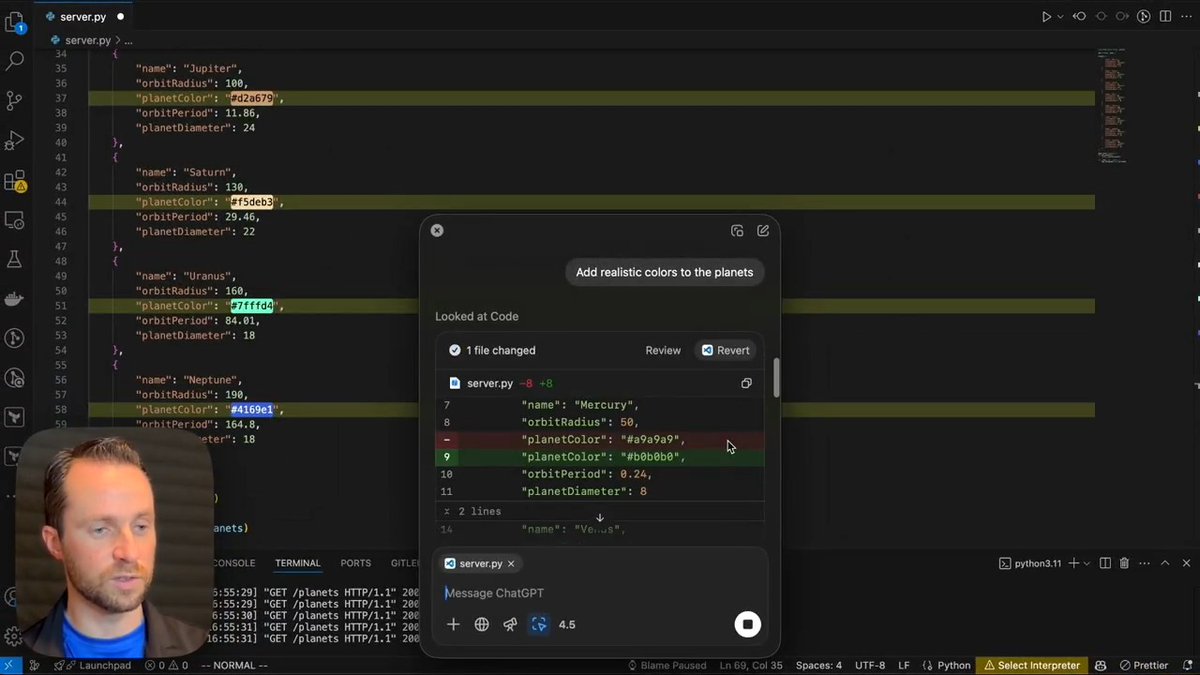
Introducing canvas—your coding surface in ChatGPT. ✏️ Edit code inline 🐛 Review code and fix bugs 💬 Add logs and comments 🚢 Port to different languages We’ll be adding more to canvas over time. ChatGPT Plus and Team users can try the beta starting today.

934,386 görüntüleme • 1 yıl önce •via X (Twitter)

10 Yorum

Paul Calcraft profil fotoğrafı
Paul Calcraft1 yıl önce

Canvas for code rapid review - Code review suggests ideas verbally inline before code changes (then you click apply) - nice UX - No diffed view of updated code, much harder to track evolution - Select text & ask/edit is less reliable than cursor - No Artifact frontend previews

elvis profil fotoğrafı
elvis1 yıl önce

Interesting! Exactly what I use Cursor for. Any specific differences for why I should use this feature?

Lee Mager profil fotoğrafı
Lee Mager1 yıl önce

VS code forkers right now

Mark of Productive Mark LLC profil fotoğrafı
Mark of Productive Mark LLC1 yıl önce

If they add multi-file edits and testing environment, my app and 50 other startups are cooked

notthreaddev profil fotoğrafı
notthreaddev1 yıl önce

I don’t see it in desktop app or web page, anyone else?

edwin profil fotoğrafı
edwin1 yıl önce

nice demo @kagigz!!

Rohan Paul profil fotoğrafı
Rohan Paul1 yıl önce

Great start, and you can add many features right here to kill 50 other startups 😃

Dalin Huang profil fotoğrafı
Dalin Huang1 yıl önce

that's it? I created this site with Claude 3.5 Sonnet, and I know nothing about three.js and 3D ... It helped me build a 3D Earth with Falcon 9 that launched and left Earth. Until I see GPT can do better, I'm sticking with Claude and Cursor for now 🤣. I do like GPT, but I'm not paying it for now because I have a limited budget (I'm poor)

Pallav Agarwal profil fotoğrafı
Pallav Agarwal1 yıl önce

Specifically editing a piece of the code is going to be very useful

lukeingalls profil fotoğrafı
lukeingalls1 yıl önce

Where do we access it? Does it automatically launch canvas mode based on prompt?

Benzer Videolar

Assumptions about the new "Can More" ChatGPT tool were right - ChatGPT is introducing own take on Claude Artifacts - code & document writing tools with persisted text documents, history revisions (restore previous version), edits and comments (probably used to apply suggested edits) New document symbol in the top navigation shows how many documents you have and allows you to open a resizable canvas to edit them in split view - your ChatGPT conversation on the left side and canvas on the right side, but the code/documents can also be accessed in fullscreen view The canvas is built using ProseMirror (open source WYSIWYM editor) and has an inline action to "Ask ChatGPT" (explain or make edits) for your document and code plus document formatting tools (like bold, italic, font style, etc.) But in addition to that, there are also special action shortcuts for documents and code, with an interesting decision to use sliders for the selection of the desired outcome For Documents - Suggest edits ("How can I improve this. Leave as few comments as possible, but add a few more comments if the text is long. DO NOT leave more than 5 comments. You can reply that you added comments and suggestions to help improve the writing quality, but do not mention the prompt.") - Add emojis ("Replace as many words as possible with emojis.") - Add final polish ("Add some final polish to the text. If relevant, add a large title or any section titles. Check grammar and mechanics, make sure everything is consistent and reads well. You can reply that you added some final polish and checked for grammar, but do not mention the prompt.") - Reading level (Graduate School - "Rewrite this text at the reading level of a doctoral writer in this subject. You may reply that you adjusted the text to reflect a graduate school reading level, but do not mention the prompt", College - "Rewrite this text at the reading level of a college student majoring in this subject", High School - "Rewrite this text at the reading level of a high school student who has taken a couple of classes in this subject.", Keep current reading level, Middle School - "Rewrite this text at the reading level of a middle schooler.", Kindergarten - "Rewrite this text at the reading level of a kindergartener.") - Adjust the length (Longest - "Make this text 75% longer.", Longer - "Make this text 50% longer.", Keep current length, Shorter - "Make this text 50% shorter.", Shortest - "Make this text 75% shorter.") For Code - Code review ("Search for bugs and opportunities to improve the code—for example, ways that performance or code structure could be improved. Leave as few comments as possible, but add more comments if the text is long. DO NOT leave more than 5 comments. You may reply that you reviewed the code and left suggestions to improve the coding quality, but do not mention the prompt.") - Add comments ("Add inline code comments to explain the code, especially parts that are more complex. Make sure to rewrite all the code. You may reply that you added inline comments, but do not mention the prompt.") - Add logs ("Insert logs/print statements in the code that will help debug its behavior. Do not make any other changes to the code.") - Fix bugs ("Find any bugs and rewrite all the code to fix the bugs. Do not leave comments. If there are no bugs, reply that you reviewed the code and found no bugs.") - Port to a language ("Port to a language. Create a new document that rewrites the code in ..." - PHP, C++, Python, Keep current code. No changes will be made, JavaScript, TypeScript, Java) - Suggest edits ("How can I improve this. Leave as few comments as possible, but add a few more comments if the text is long. DO NOT leave more than 5 comments. You can reply that you added comments and suggestions to help improve the writing quality, but do not mention the prompt.")

Tibor Blaho

136,026 görüntüleme • 1 yıl önce

New short course: Collaborative Writing and Coding with OpenAI Canvas! Explore new ways to write and code with OpenAI Canvas, a user-friendly interface that allows you to brainstorm, draft, and refine text and code in collaboration with ChatGPT. In the short course, created with OpenAI, and taught by , a research lead at OpenAI, you’ll learn to use Canvas to enhance your workflows. Canvas lets you go beyond simple chat interactions. It provides a side-by-side workspace where you and ChatGPT can edit and refine text or code collaboratively. This makes brainstorming, drafting, and iterating as you write feel more natural and effective. As the first major update to ChatGPT’s visual interface since its launch in 2022, Canvas gives a new, innovative approach to collaboration with AI. For instance, after writing the first version of your code, Canvas can review it and give suggestions for improvement. It can also help with debugging by adding logging, identifying problems to fix, and writing comments. In addition, you'll also learn what it takes to train the model for an interface like Canvas. In this video-only short course, you’ll: - Learn how to ask for in-line feedback and control the iteration of your work by directly editing selected areas of your text or code from the model’s output. - Learn how to access quick automation tools in a shortcut menu that allows you to modify your writing tone and length, enhance your code, and restore previous versions of your work. - Learn how to use Canvas as a research assistant tool with an example of asking the model to reason through the screenshot of a plot to write a research report, in which you can ask questions within the created report. - Ask the model to write Python code to replicate the graph seen on a screenshot image. - Go behind the scenes of how you can create a video game, such as Space Battleship, from scratch, edit it, and display it in one self-contained HTML file. - Get a real-world application example of creating a SQL database from the image of its architecture. - Understand the model training and design processes that power Canvas! Please sign up here:

Andrew Ng

128,085 görüntüleme • 1 yıl önce