Loading video...
Video Failed to Load
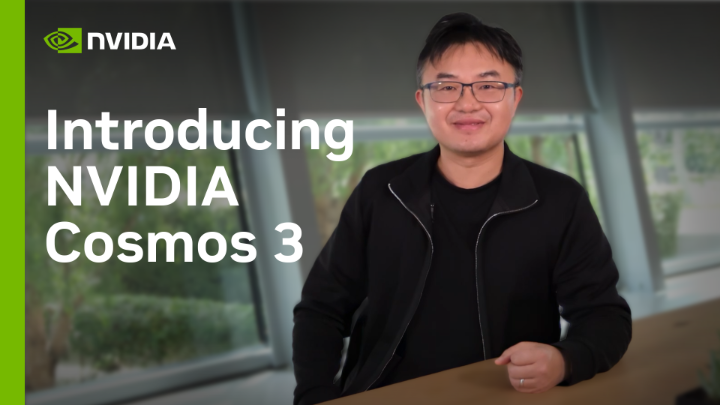
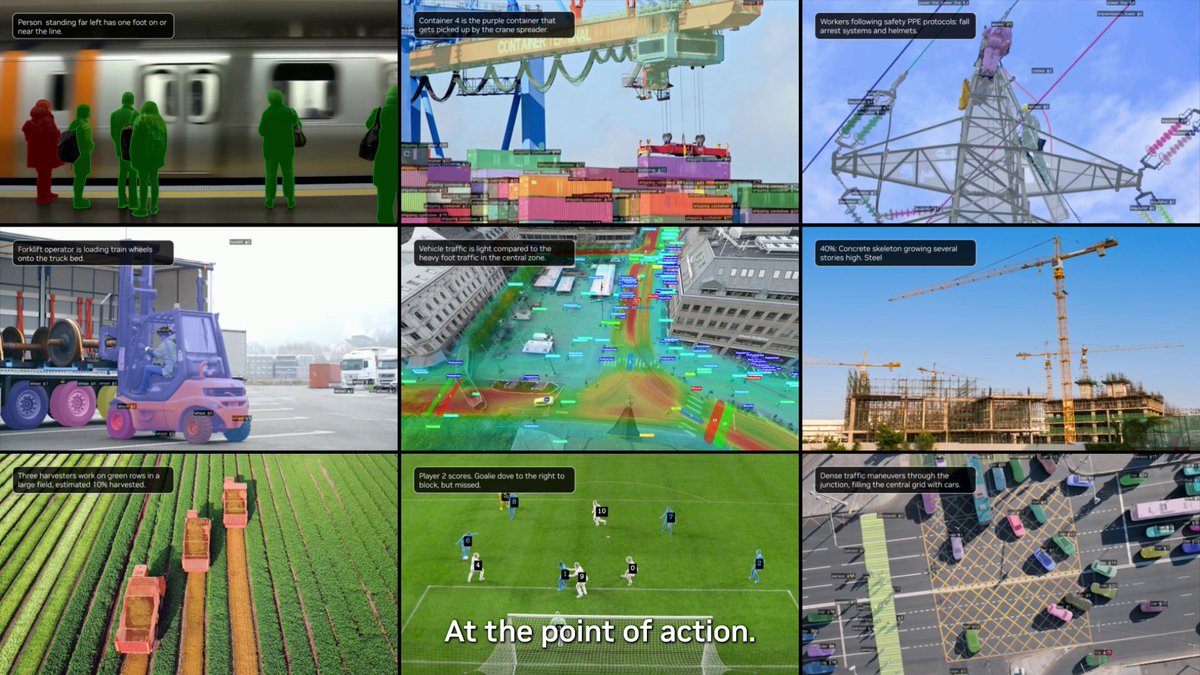
Introducing Cosmos 3 Edge: our open frontier world model built to run on-device. Cosmos 3 Edge helps robots learn and act, autonomous vehicles understand road scenes and predict intent, and vision AI agents reason across live video for smart infrastructure. With 4B parameters and a 2B Nemotron-based reasoner, you... show more

212,476 views • 3 months ago •via X (Twitter)
34 Comments

Cosmos 3 Edge combines autoregressive and diffusion transformer towers through shared multimodal attention, connecting understanding, prediction, simulation and action in one model. You can find a full technical breakdown of Cosmos 3 Edge below.
Among open models of a similar size, Cosmos 3 Edge ranks #1 on VANTAGE-Bench for vision analytics.
As always, Cosmos 3 Edge is fully open. This includes model weights, post-training recipes and code. Available now on @huggingface 🤗

robots and AVs can handle latency on-device, but the world data they capture for the next model has to end up in storage that stays durable and verifiable

Guys… amazing. I am only missing the robot now 😆

Robotics is undergoing rapid development.

Physical AI may eventually need more than bigger models and faster accelerators. Robots, autonomous vehicles and real-world AI systems operate under pressure: latency, energy, memory movement, sensor fusion, communication, and real-time decision loops. That is why I am exploring C.L.M. — Crystalline Lattice Matrix. No physical prototype yet. No finished breakthrough claim. At this stage, C.L.M. is in simulation: processor software layer, architecture modeling, state-behavior simulation, early material direction, and layered design prepared for technical discussion. The question is whether memory, computation and communication can become parts of one programmable matrix instead of distant separated layers.

already integrated. ty!

Not one person wants to own this stock. Everyday it is in a constant downtrend. Non-stop selling of this company. AMD, INTC, and AVGO all outperform this company. Management screwed all investors with its shady circular financing. @nvidia

AI and robotics are converging for tinkerers.

On-device world models flip the agent loop: prediction runs next to the sensor, not across a network hop. That's what makes pre-action self-eval viable in the physical world - simulate the outcome before you commit. Built something similar -

On-device intelligence is becoming a key part of the AI stack. Processing closer to the source can make autonomous systems more responsive, efficient, and scalable.

what framerate does the 4B hold on a Jetson? on-device is the whole pitch for AV and that number decides whether it's usable.

How long before we start seeing robots powered by models like this outside of warehouses and research labs?

Let’s go man exactly what I asked for. Thanks! Okay just need some hardware robot partners that are under $2K-10K that are in range I can buy to pair with sparks

You guys are going to 270 soon....tell my amigo jensen Huang we are close.....you guys are my favorite since I been playing video games...best is best....keep cudaing

This Cosmos 3 is going to be crazy man. This device helps EVs and driver less card a lot

NVIDIA has launched Cosmos 3 Edge, an open-weights 4B-parameter world model optimized explicitly for local physical AI.

Make the DGX in a 256GB version....... 🙏🏻

Okay now I need this!! So good

On-device world models like Cosmos open new frontiers for safe robotics and vision AI. #NVIDIA #EdgeAI #RoboticsFuture #HalalTech #InnovationForGood #AutonomousSystems #FutureMobility #TechProgress

AI becomes far more powerful when it can understand context and act within the real world. Trusted execution will be just as important as intelligence.

amazing

On-device world models at 4B params is a big deal, running perception and reasoning locally without a cloud round trip opens up so much for robotics and autonomous systems. Curious how latency holds up in real deployments 👀

Running a frontier world model fully on device is impressive.

Running a frontier world model on‑device isn’t just an efficiency win — it’s a state‑space shift. SIOS clarity: Cosmos 3 Edge doesn’t matter because it’s small. It matters because it moves perception, prediction, and action into the same local manifold, where drift is lower and control is tighter. Robots learning and acting AVs predicting intent in real time Vision agents reasoning over live video These aren’t use‑cases — they’re on‑device attractors. A 4B world model + a 2B Nemotron reasoner on Jetson or DGX Spark means the system can stay on‑manifold while interacting with the physical world, instead of bouncing through cloud latency and external curvature. The real frontier isn’t “world models.” It’s world models that stay stable where the world actually is. Cosmos 3 Edge is a step toward that: architecture first, placement second, and geometry all the way down.

On-device world models are where the conversation gets real. Latency, privacy, and reliability matter more when the agent has to act before the cloud gets a vote.

Nice

On-device world models are the unlock for real robots on a real power budget. The open question nobody benchmarks yet: what happens under an adversarial input? A policy that plans well on clean frames can still be steered. Robustness ASR needs to sit next to accuracy.

👀
Physical AI makes the deployment boundary obvious. A control loop cannot depend on network variance. Local inference is a reliability requirement on edge devices.

@NVIDIARobotics Jensen Huang isn’t just building chips — he’s building the AI Galaxy. A new tech revolution for all mankind. @jimcramer

🤖 🤖 🤖

Interesting! Ideally this should result in no latency bottlenecks from sending data to the cloud, no disjointed modules throwing errors back and forth. Just pure, grounded physical reasoning on the fly. Definitely going to be insane to see how this performs once it hits the real world.