正在加载视频...

视频加载失败

Introducing Eigen Trace Mirror - a verifiable AI agent telemetry powered by EigenCloud In an era where your agent runs everything but there is no way to verify what your agent said it ran > Runs on EigenCompute inside a TDX enclave. Every OTel span signed with a secp256k1...

11,254 次观看 • 4 个月前 •via X (Twitter)

0 条评论

暂无评论

原始帖子的评论将显示在这里

相关视频

Another blow to Anthropic! They spent months building what's now fully open-source. Anthropic recently put Claude inside Slack, where you can tag it in a channel. It reads the thread, breaks the task into steps, and posts the result back. The problem is that it only runs Claude and only in the channels Anthropic supports. Running your own agent there is harder. The reasoning, tool calls, and state management are mostly handled by the framework. Connecting that agent to a messaging platform is not. Moreover, each platform has a different integration: - Slack renders messages with Block Kit - Teams uses Adaptive Cards - and each has its own SDK, auth flow, and delivery model. If an agent needs to run on three platforms, one must write three separate integrations against the same agent logic. That overhead explains why most custom agents never get deployed to Slack, and why the ones that do are usually a single vendor's hosted assistant. The alternative is to keep the agent in one place and add a per-platform adapter that translates its output into each platform's native format. The agent is written once, and each channel requires just another output target instead of a separate build. CopilotKit open-sourced this full implementation in the Channels SDK. Essentially, any agent that implements AG-UI can run in a messaging platform in a few lines of code, like Slack, Teams, Discord, WhatsApp, and many more. Because the agent runs inside the thread, it has that conversation's context, so it can summarize the discussion, open a ticket, or route to the right person. It works with any backend, so LangGraph, CrewAI, Mastra, Google ADK, or a plain HTTP agent can connect through an existing endpoint. The same message can render as a Block Kit in Slack and as Adaptive Cards in Teams. In practice, the model and orchestration stay the same; it requires no migration or rewrite. It also handles human-in-the-loop approvals, persistence, and transcripts that carry state across platforms, so a thread started in Teams can continue in Slack. CopilotKit is open-source, and AG-UI is supported across every major agent framework, including LangGraph, CrewAI, Mastra, and Google ADK. Here's the repo: (don't forget to star it ⭐) The agent running in Slack no longer has to be a vendor's. It can be the one you already built. The video below shows this in action. Thanks to CopilotKit for working with me on this launch.

Akshay 🚀

244,298 次观看 • 1 个月前

Everyone's building AI agents that run on someone else's server, store memory in someone else's database, and can be shut down by someone else's terms of service. I built one that can't be. FlowClaw is an AI agent that runs on a decentralized distributed computer. Your agent, your conversations, your memory, your tools — all stored onchain on Flow, a distributed network of validator nodes across the world. Not a centralized cloud. Not someone's S3 bucket. A blockchain that functions as censorship-resistant compute and storage for your AI. This isn't a wrapper. Your agent is a Resource — a first-class programmable object in Cadence (Flow's smart contract language) that physically lives in your account's on-chain storage. It can't be duplicated, seized, or deleted by anyone except you. Your encrypted messages, your cognitive memory, your scheduled tasks — they persist on a global distributed ledger that no single entity controls. It's an alpha build. It will break. But it works today on mainnet and I want people to push it this weekend. What it does: You go to authenticate with a passkey (Face ID, Touch ID), and you have a blockchain account in seconds. No wallet. No seed phrase. No tokens needed — gas is sponsored. You're immediately chatting with an AI agent that has real tool execution: live web data, token prices, on-chain balances, Cadence script execution, FLOW transfers. Every message is encrypted client-side before it touches the chain. The agent has a cognitive memory system — it doesn't just remember your last message, it builds molecular memory clusters where related knowledge bonds together for contextual retrieval across sessions. You can spawn sub-agents from a visual canvas to run parallel research. The memory tab shows you exactly what your agent knows. Everything is transparent and everything is yours. 11 smart contracts. No external dependencies. No keeper networks. No account abstraction hacks. Here's the part that matters for the censorship-resistance crowd: FlowClaw supports BYOK — bring your own key. You can plug in any LLM provider. But pair it with Venice and you get the full stack: a censorship-resistant AI model running inference with no content filtering, connected to an agent whose state lives on a decentralized network that no company can shut down, with end-to-end encrypted conversations that nobody can read — not the relay operator, not the LLM provider, not the blockchain validators. Venice doesn't log prompts. Flow can't read your encrypted storage. The relay never sees your plaintext. That's not a privacy policy. That's architecture. You can also use OpenAI, Anthropic, or any OpenAI-compatible provider. The agent platform doesn't care — it's model-agnostic. But the Venice pairing is the one that closes every gap in the stack. For the people tinkering with OpenClaw and the broader open-source agent ecosystem — FlowClaw is exploring what happens when you take the agent off the cloud entirely. Not just open-sourcing the code (though it is), but putting the actual runtime state on a distributed computer. Your agent's memory isn't in a SQLite file on your laptop or a Pinecone index on someone's cluster. It's on-chain, encrypted, and replicated across every validator node on Flow. You own it the way you own a private key — mathematically, not contractually. The blockchain here isn't a gimmick bolted onto an agent for token speculation. It's functioning as the infrastructure layer that replaces AWS. Flow accounts are programmable containers with their own storage, keys, and security capabilities. Passkey authentication works natively because Flow supports P-256 keys at the protocol level — the same curve your phone uses for biometrics. Gas sponsorship works natively because Flow transactions have separate proposer, authorizer, and payer roles built into the protocol. No proxy contracts. No relayers. No ERC-4337. Now here's the part that interests me economically. Every FlowClaw interaction is an on-chain transaction. Every message stored, every memory committed, every session created, every sub-agent spawned. An active user might generate dozens of transactions in a single conversation. Scale that and FlowClaw becomes a real contributor to Flow's transaction volume. Flow.com becomes deflationary at 250 TPS. Applications like FlowClaw that generate high-frequency, storage-heavy transactions are exactly what moves the needle. Every encrypted message uses account storage, which requires FLOW balance to back it. Every transaction burns fees. The more agents running, the more demand for $FLOW — not because of a tokenomics gimmick, but because the protocol literally requires it for compute and storage. FlowClaw doesn't have its own token. The token is $FLOW. The entire platform runs natively on the network — using Flow storage, paying Flow transaction fees, backed by Flow account balances. If FlowClaw succeeds, FLOW captures that value directly. I'm sharing this early because the AI agent space is moving fast and I think the decentralized infrastructure angle is underexplored. Most "crypto AI" projects are tokens with a chatbot attached. FlowClaw is the opposite — it's an agent platform that happens to use a blockchain because the blockchain solves real engineering problems that centralized infrastructure can't. Try it: Github: Create an agent, ask it something, spawn a sub-agent, check your memory tab, pair it with Venice for the full censorship-resistant stack. Break it and tell me what broke. If you think this direction matters, the best thing you can do is use it and give feedback. Your AI agent should be yours. Not your provider's. Not your platform's. Yours.

doodlifts

12,172 次观看 • 7 个月前

AG-UI makes building agentic applications dramatically easier. Here's how it works. This is a model for a simple chatbot: User → LLM → Response But interactive agents that render UI, pause for approvals, and ask users for input need a much more complex model. When building these agents, a response from the LLM will include a series of state changes as the agent runs: • Agent started a task • Agent called a tool • Agent updated its state • Agent streams these tokens • Agent is waiting on a human • Agent is resuming the task The Agent-User Interaction Protocol (AG-UI) treats the LLM response as a stream of events rather than a text endpoint. In practice, here is what you get as an agent runs: 1. Lifecycle events so your UI knows where the agent is. 2. Text messages that stream tokens. 3. Tool calls so your UI can prefill a form with any required arguments. 4. State updates that keep your UI in sync with the agent. 5. Special events for human approvals, rich media, and custom needs. All of these events travel over standard transports (SSE, WebSockets, or plain HTTP) as JSON. As a result, you can build a frontend that stays in sync with the agent's progress without having to invent a custom process to make this happen. For example, building a human-in-the-loop workflow becomes an off-the-shelf component you can integrate rather than build from scratch. CopilotKit🪁 is the creator of AG-UI, and you can use it when building frontend applications pretty much anywhere: • React • Angular • Vue • React Native • Slack • Teams • Discord • WhatsApp • Telegram Here is the link for you to check it out: Thanks to the CopilotKit team for partnering with me on this post.

Santiago

17,438 次观看 • 2 个月前

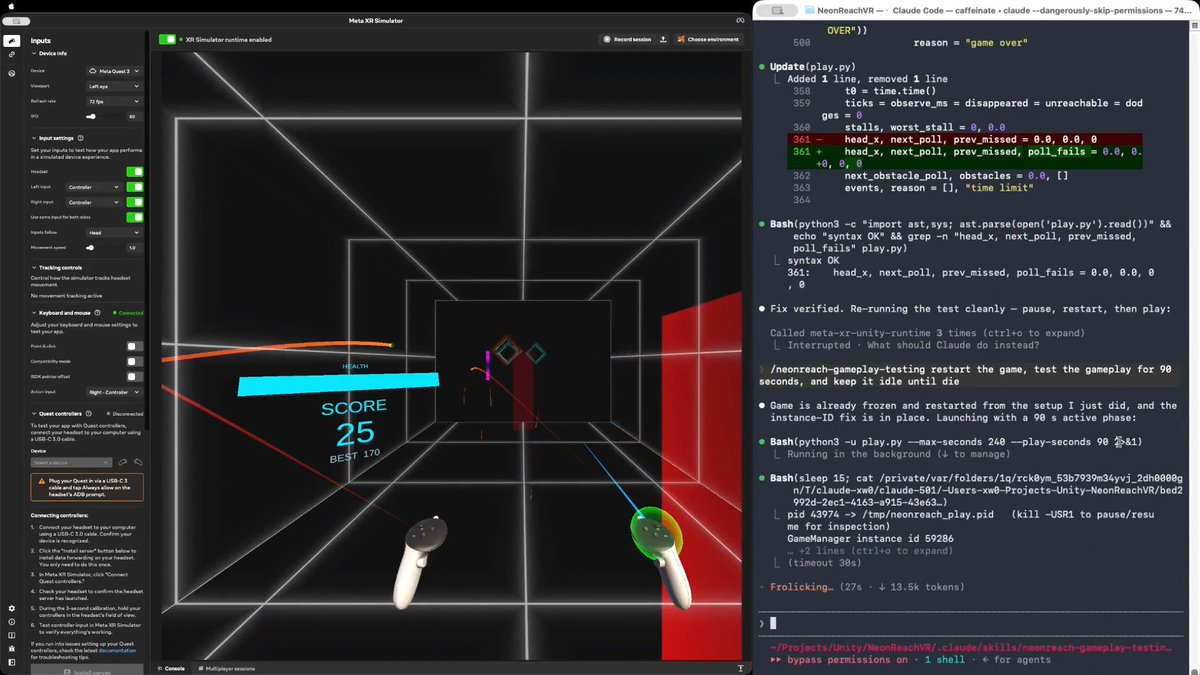
Would you believe an AI agent can test a real VR action game in real time, the way a person plays it? Meta XR Operator makes it possible. As far as I know, this is the first time. I am not talking about tapping a menu or replaying a recorded click path, but genuinely moving, shooting, and using the same game mechanics a human player does. In NeonReach VR, which is a real (and open source) action game, rings spawn 12m out and come at you somewhere between 1.5 and 5.5 m/s, getting faster over a 90 second ramp. There are three kinds: straight, weaving side to side, and spinning. Every shot is a full slingshot cycle, so you press, pull back, aim, then release. Obstacles arrive at head height and cost you a life if you don't get out of the way. You have ten lives. Here is why the game is hard for an AI agent. Even though Meta XR Operator gives the agent everything it needs to observe the app and act inside it, the agent still cannot play. One agent turn takes 10 to 15 seconds. One throw is four steps that have to happen in order, because the press has to latch before the pull, and they cannot be batched into a single call. So a throw costs about 45 seconds. A fast ring only exists for 2.3 seconds. One action takes 20x longer than the target is alive. Prompt tuning does not close a gap that size. What works is a three stage path: EXPLORATION, then SKILL, then SCRIPT. 1/ EXPLORATION. The agent drives the live app and works the game out on its own. It verified the coordinate mapping by setting a pose and reading it back, then derived the launch model. The more useful output was the traps it found. For example, the player's own body collider silently deflects a ball released inside it, with no error and no log line. That produced two confident wrong conclusions before anyone caught them. 2/ SKILL. All of that gets written down as a reusable SKILL.md plus an aim solver. There is a section that separates what was actually verified from what was assumed, so a wrong conclusion cannot quietly turn into doctrine. This stage also produced the trick that mattered. Set timeScale to 0 and a throw becomes atomic in game time, so however long the agent spends thinking never shows up in the shot. 3/ SCRIPT. The agent then compiles everything into a player script, a loop that observes, decides, and throws, calling the MCP servers directly from Python with no model in the hot path. Round trips drop from 10 to 15 seconds down to something between 1 and 16 milliseconds. The loop runs at 23 Hz, about 0.75 seconds per throw, roughly 60x faster than the agent doing it turn by turn. The result is that it plays like a person, which you can see from the attached video. It tracks the rings, works out where each one is going, throws with whichever hand is free, moves out of the way of the obstacles, and does not wait around to see whether the last throw landed. Shipping settings, no difficulty edits, no health locks, no slow motion. It plays until it actually loses. The takeaway generalizes beyond games: an agent does not have to be the player. Even following the same rules as a player, it has too much latency between moves. Having the agent write the thing that acts bypasses that constraint entirely. Try it yourself: or explore the agent-created skill and scripts: Based on NeonReach VR by Dilmer, with no code changes. I only upgraded its Meta XR Core SDK to v205, which ships Meta XR Operator. Our blog post, Introducing Meta XR Operator: Close the Build-Test-Verify Loop for VR: Disclosure: I work at Meta. And this represents my own opinion. #XR #VR #AI #MetaQuest #Unity #GameDev

Xiang Wei

54,900 次观看 • 1 个月前