Video yükleniyor...

Video Yüklenemedi

Ana Sayfaya Dön

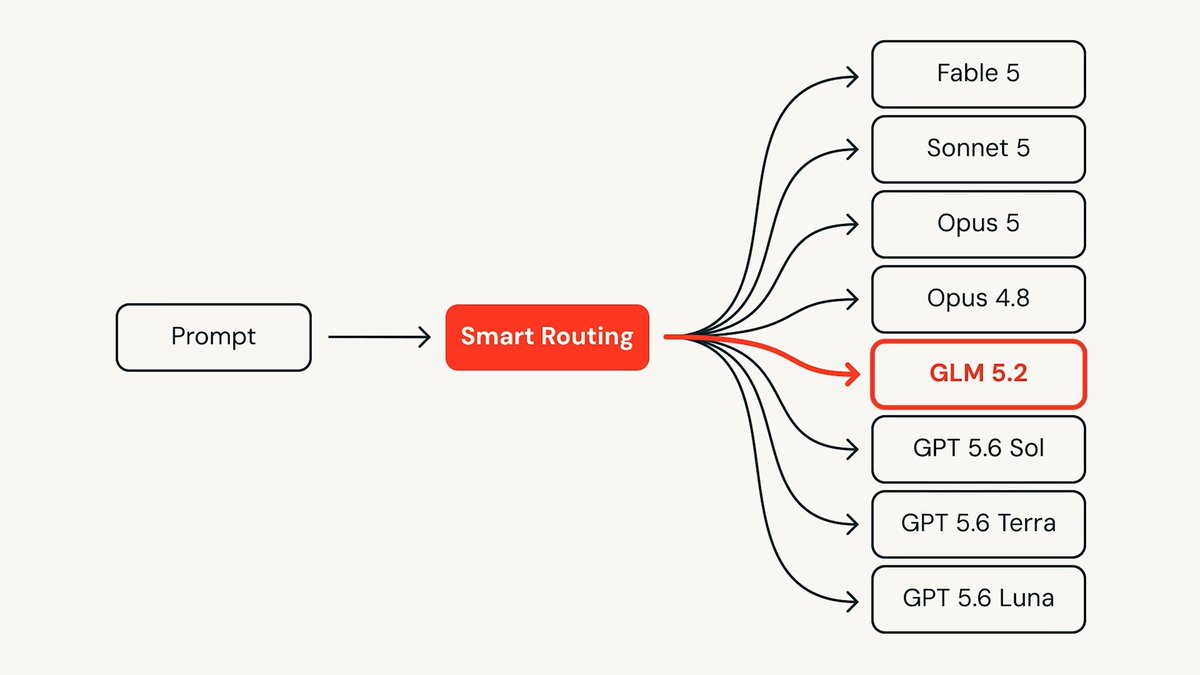
Introducing Entelligence AI Model Router, dynamic turn based routing trained on engineering tasks that cuts costs by over 50% Automatically route every coding turn to the model with the best balance of quality, latency, and cost. Escalate to frontier models when they’re actually needed Balanced mode reduces spend by...

78,802 görüntüleme • 8 gün önce •via X (Twitter)

0 Yorum

Yorum bulunmuyor

Orijinal gönderinin yorumları burada görünecek

Benzer Videolar

Cerebras inference is very fast. So fast that it changes how we think about configuring our LLMs for voice agent use cases. Kimi K2.6 is a 1T parameter reasoning model that Cerebras serves at 650 - 1,000 tokens per second (end-to-end throughput), with time to first token metrics as low as 150ms (latency). These numbers are two to three times faster than other similarly capable models. The biggest lever we get from this kind of speed is that we can use the model in reasoning mode, and still have excellent "time to first non-thinking token." This solves a big pain point we have in 2026 for voice agent use cases. Almost all recent innovation in post-training has focused on making models good at reasoning ("test time compute"). This is great, but it makes the user-facing model latency much, much slower. Which is a problem for conversational voice agents. We can run Kimi K2.6 with reasoning turned on, and get responses faster than other models produce with reasoning disabled. On my 30-turn voice agent benchmark, Kimi K2.6 with reasoning enabled ties GPT 5.1 and Haiku 4.5 with reasoning disabled, and is still about 200ms seconds faster! On my primary task agent benchmark, Kimi K2.6 is now the #2 model. It ranks just behind Gemini 3.5 Flash in "high" reasoning mode, and tied with GLM 5, Sonnet 4.6, and GPT 5.4 with reasoning set to "low." But Kimi K2.6 completes each turn in the agent loop in under 500ms. The other four models are all at least 3x slower. (Models only qualify for this benchmark if they can complete task turns at a P50 <4s.) A couple of other things that this speed buys us, for production voice agents: - Tool calls happen fast enough that we don't have to work around tool call latency in our pipeline design. - We can prompt the model to output structured data at the beginning of a response, followed by plain text for voice generation. This opens up possibilities like asking the model to do complex classification/generation tasks that influence the rest of the pipeline. For example, the model could create a detailed style prompt for a steerable TTS model, for each individual conversation turn. And, of course, you can use Kimi K2.6 with reasoning turned off. Cerebras calls this "instant" mode. Here's a video of a Cerebras Kimi K2.6 voice agent with voice-to-voice response time, measured at the client, under 500ms. This is the true response latency as perceived by the user, including all network and audio codec overhead, transcription and turn detection, Kimi K2.6 token generation, and voice generation. 500ms is, effectively, instant. So the Cerebras naming for this mode is a propos. :-)

kwindla

40,319 görüntüleme • 1 ay önce

The teams shipping AI agents right now are bleeding money on the dumbest possible expense: teaching a 400B-parameter model to read a file name. Every time an AI agent needs to "see" something today, it routes an image through a frontier model. OCR, object detection, checking if a button exists on screen. You're paying GPT-4o or Claude pricing for tasks that require perception, not reasoning. One agent workflow processing a few thousand screenshots per day can burn through more on vision calls than on the actual thinking. Perceptron's Isaac is 2B parameters. Built by the team that created Meta's Chameleon multimodal models. On perceptive benchmarks, it matches or beats models 50x its size. The VQA, OCR, and object detection scores are competitive with models running on infrastructure that costs orders of magnitude more. The MCP wrapper is the distribution play. One install command and every Claude Code agent can offload vision tasks to a model that runs on a single consumer GPU. The agent keeps its reasoning in the frontier model and routes perception to a specialist. That split is how you get vision-heavy agent workflows from "technically possible but expensive" to "cheap enough to run on everything." This is the same pattern that won in every other compute-intensive stack. General-purpose handles orchestration. Specialists handle the heavy lifting. Graphics went through it. Audio went through it. Video encoding went through it. Vision in AI agents is next. The teams building agents that see 10,000 images a day will care about this before anyone else does.

Aakash Gupta

55,978 görüntüleme • 3 ay önce

Chamath is making one of the most important business arguments of 2026. Half of large US companies right now cannot generate returns that exceed their cost of capital, which has normalized back to its long run average of 8 to 11%. Another one in seven companies globally is stuck generating persistent returns between 1 and 5% and most businesses don't have room for error and in this environment walks every frontier AI lab saying the same thing, give us your data, your workflows, your processes and our model will make everything better. And companies by the millions said yes. What they didn't fully account for is what happens on the other side of that door. Every time an employee runs a query through a frontier model API, the prompt goes through external servers, workflows, customer data, pricing logic, internal processes, all of it transmitted through a third party. As Alex Karp said companies are spending on tokens while handing over the exact proprietary advantages that make their business worth owning. Microsoft blocked internal use of Anthropic's Claude Fable 5 but over its 30-day data retention policy and the largest software company in the world decided a frontier model's data handling was too risky for its own employees. A US government action revoked access to another frontier model for foreign nationals overnight. Now here's where the cost math becomes impossible to ignore. Deutsche Bank calculated a roughly 65x cost gap between frontier models like Claude Fable 5 at ~$3.25 per task and open-source alternatives at ~$0.05. For 90% of everyday enterprise tasks, performance is comparable. Open-weight models now match closed frontier systems on core agent tasks at roughly one-tenth the cost, a high-volume deployment that costs $250/day on Claude runs at $12/day on an open-source equivalent. Chamath Palihapitiya tested this directly by running a standard enterprise code migration task through an orchestration layer wrapping an open-source model came in 16.4x cheaper than using a frontier model directly.

Milk Road AI

280,556 görüntüleme • 19 gün önce