Video yükleniyor...

Video Yüklenemedi

Ana Sayfaya Dön

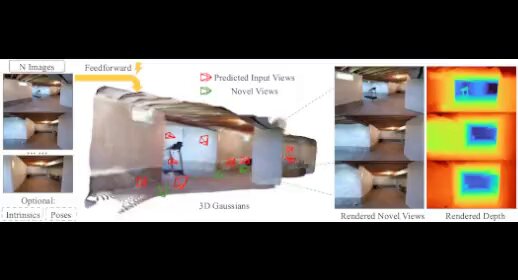
Introducing FLARE #CVPR2026 2025 FLARE is a feed-forward model that simultaneously estimates high-quality camera poses, 3D geometry, and appearance from sparse uncalibrated images. 1/4

29,518 görüntüleme • 1 yıl önce •via X (Twitter)

6 Yorum

Gordon Wetzstein profil fotoğrafı
Gordon Wetzstein1 yıl önce

Our cascaded learning framework comprises three core components: 1. Camera pose estimation without bundle adjustment 2. Geometry reconstruction 3. Appearance modeling using 3D Gaussians 2/4

Gordon Wetzstein profil fotoğrafı
Gordon Wetzstein1 yıl önce

Transform your room into a 3D model with just a few photos! 📸✨Try it out and see your space come to life! GitHub: 3/4

Gordon Wetzstein profil fotoğrafı
Gordon Wetzstein1 yıl önce

FLARE can also perform photorealistic novel-view synthesis. Lots of results on the project site: 4/4

Gordon Wetzstein profil fotoğrafı
Gordon Wetzstein1 yıl önce

with Shangzhan Zhang, Jianyuan Wang, @YinghaoXu1, @NanXue7, Christian Rupprecht, @XiaoweiZhou5, Yujun Shen

Oliver Wang profil fotoğrafı
Oliver Wang1 yıl önce

@CVPR No bundle adjustment ?! Nice nice

Rainmaker profil fotoğrafı
Rainmaker2 yıl önce

Join me as I put several Machine Learning models head-to-head to see which one can beat the market and deliver strong returns. In this free Substack post I share several models that deliver better returns with much lower drawdown compared to Buy-and-Hold approach.
Benzer Videolar

📢📢 𝐀𝐯𝐚𝐭𝟑𝐫 📢📢 Avat3r creates high-quality 3D head avatars from just a few input images in a single forward pass with a new dynamic 3DGS reconstruction model. Video: Project: Our core idea is to make Gaussian Reconstruction Models animatable. We find that a simple cross-attention to an expression code sequence is already sufficient to model complex facial expressions. We then incorporate position maps from DUSt3R and feature maps from Sapiens to facilitate the prediction task. While DUSt3R's position maps act as a pixel-aligned initialization for the Gaussians' positions, the Sapiens feature maps help the cross-view transformer to match corresponding image tokens in the 4 input images. One major challenge in creating a 3D head avatar from smartphone images comes from inconsistent facial expressions when the subject could not remain perfectly static during the capture. We eliminate this static requirement by simply showing our model input images with different facial expressions during training. This technique makes our model robust to inconsistent input images later on. Finally, we show that despite the model has been trained with 4 input images, one can even create a 3D head avatar when only a single image is available. To achieve this, we employ a pre-trained 3D GAN to lift the single image to 3D and then render the 4 input images for our model. This allows us to create 3D head avatars from single images and even highly out-of-distribution examples like AI generated faces, paintings or statues. Great work by Tobias Kirschstein from his internship at Meta with Javier Romero, Artem Sevastopolsky, and Shunsuke Saito

Matthias Niessner

74,698 görüntüleme • 1 yıl önce