正在加载视频...

视频加载失败

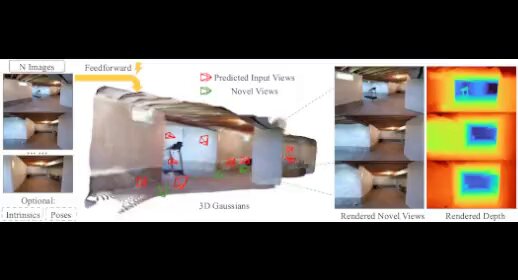
Supervised learning has held 3D Vision back for too long. Meet RayZer — a self-supervised 3D model trained with zero 3D labels: ❌ No supervision of camera & geometry ✅ Just RGB images And the wild part? RayZer outperforms supervised methods (as 3D labels from COLMAP is noisy) 🌐...

69,607 次观看 • 1 年前 •via X (Twitter)

9 条评论

Hanwen Jiang 的头像
Hanwen Jiang1 年前

🔍 How does RayZer work? It performs 3D-aware image auto-encoding, which first disentangles images into scene + camera (reconstruction), then re-entangles them back into images (rendering) and learn via RGB loss. The key is splitting the images into two sets — one set to reconstruct scene, and the other to provide supervision, which avoids trivial non-3D solutions.

Hanwen Jiang 的头像
Hanwen Jiang1 年前

🤯 RayZer outperforms supervised methods — why? Turns out, 3D labels from COLMAP are noisy. GS-LRM and LVSM consistently fail on scenes of glasses, high luminance intensity, and white walls. These are cases where COLMAP usually fail. This highlights the need for self-supervised learning — and shows just how powerful it can be.

Hanwen Jiang 的头像
Hanwen Jiang1 年前

RayZer is similar to video generation models philosophically: ❌ No 3D-aware architecture ❌ No 3D representation & rendering equation ❌ No 3D supervision ✅ But 3D awareness emerges. (We show more inference results)

Hanwen Jiang 的头像
Hanwen Jiang1 年前

Joint work with @HaoTan5 @totoro97_ @Haian_Jin @__yuezhao__ @Sai__Bi @KaiZhang9546 @fujun_luan Kalyan Sunkavalli @qixing_huang @geopavlakos

Dmytro Mishkin 🇺🇦 的头像
Dmytro Mishkin 🇺🇦1 年前

Amazing! Dare to try it in Image Matching Challenge? :)

Hanwen Jiang 的头像
Hanwen Jiang1 年前

haha, I don't think it works on images with different lighting conditions now

relu 的头像
relu1 年前

Super cool. I’ve been looking for pose estimation without any supervision from SfM and couldn’t find any papers! Was super surprised. I’m glad someone finally got this working

Jeffrey Ouyang-Zhang 的头像
Jeffrey Ouyang-Zhang1 年前

cool work!

Jang Hyun (Vincent) Cho 的头像
Jang Hyun (Vincent) Cho1 年前

amazing

相关视频

3D-LLM: Injecting the 3D World into Large Language Models paper page: Large language models (LLMs) and Vision-Language Models (VLMs) have been proven to excel at multiple tasks, such as commonsense reasoning. Powerful as these models can be, they are not grounded in the 3D physical world, which involves richer concepts such as spatial relationships, affordances, physics, layout, and so on. In this work, we propose to inject the 3D world into large language models and introduce a whole new family of 3D-LLMs. Specifically, 3D-LLMs can take 3D point clouds and their features as input and perform a diverse set of 3D-related tasks, including captioning, dense captioning, 3D question answering, task decomposition, 3D grounding, 3D-assisted dialog, navigation, and so on. Using three types of prompting mechanisms that we design, we are able to collect over 300k 3D-language data covering these tasks. To efficiently train 3D-LLMs, we first utilize a 3D feature extractor that obtains 3D features from rendered multi- view images. Then, we use 2D VLMs as our backbones to train our 3D-LLMs. By introducing a 3D localization mechanism, 3D-LLMs can better capture 3D spatial information. Experiments on ScanQA show that our model outperforms state-of-the-art baselines by a large margin (e.g., the BLEU-1 score surpasses state-of-the-art score by 9%). Furthermore, experiments on our held-in datasets for 3D captioning, task composition, and 3D-assisted dialogue show that our model outperforms 2D VLMs. Qualitative examples also show that our model could perform more tasks beyond the scope of existing LLMs and VLMs.

AK

249,708 次观看 • 3 年前

📢📢 𝐀𝐯𝐚𝐭𝟑𝐫 📢📢 Avat3r creates high-quality 3D head avatars from just a few input images in a single forward pass with a new dynamic 3DGS reconstruction model. Video: Project: Our core idea is to make Gaussian Reconstruction Models animatable. We find that a simple cross-attention to an expression code sequence is already sufficient to model complex facial expressions. We then incorporate position maps from DUSt3R and feature maps from Sapiens to facilitate the prediction task. While DUSt3R's position maps act as a pixel-aligned initialization for the Gaussians' positions, the Sapiens feature maps help the cross-view transformer to match corresponding image tokens in the 4 input images. One major challenge in creating a 3D head avatar from smartphone images comes from inconsistent facial expressions when the subject could not remain perfectly static during the capture. We eliminate this static requirement by simply showing our model input images with different facial expressions during training. This technique makes our model robust to inconsistent input images later on. Finally, we show that despite the model has been trained with 4 input images, one can even create a 3D head avatar when only a single image is available. To achieve this, we employ a pre-trained 3D GAN to lift the single image to 3D and then render the 4 input images for our model. This allows us to create 3D head avatars from single images and even highly out-of-distribution examples like AI generated faces, paintings or statues. Great work by Tobias Kirschstein from his internship at Meta with Javier Romero, Artem Sevastopolsky, and Shunsuke Saito

Matthias Niessner

74,698 次观看 • 1 年前