Video yükleniyor...

Video Yüklenemedi

Ana Sayfaya Dön

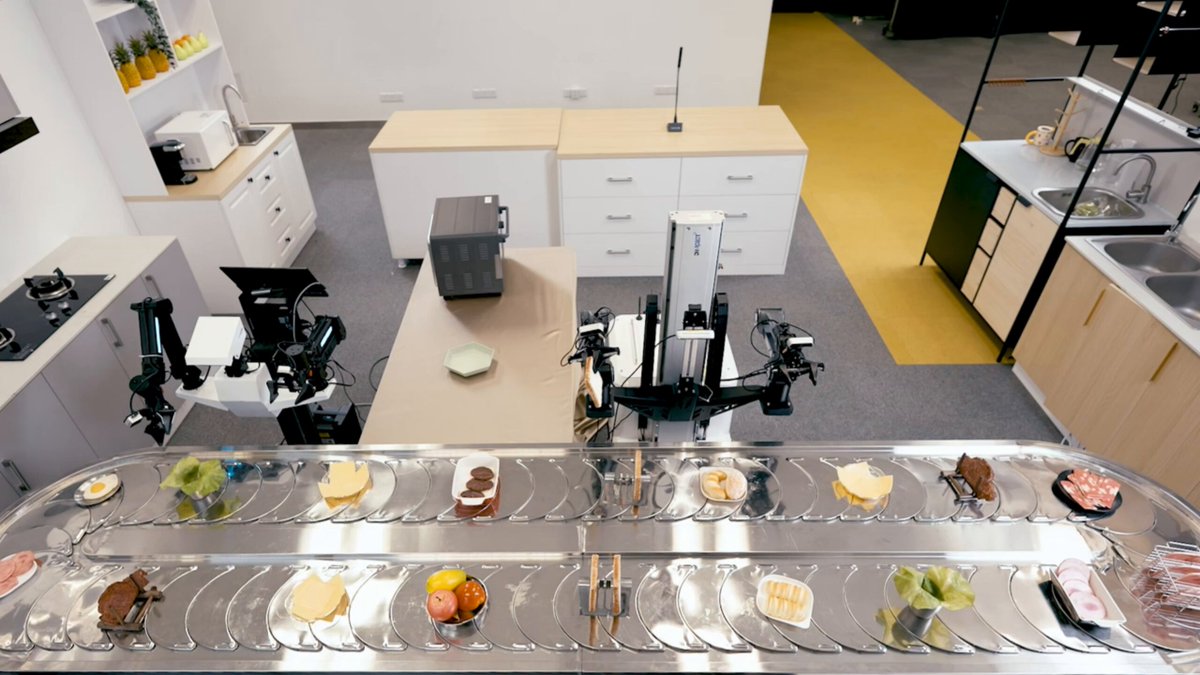
Introducing FoundationMotion. A large-scale, video-derived motion annotation dataset & auto-labeling pipeline + advanced models for motion understanding. Fully open-source: code, datasets, and models, free to use and build on. Understanding motion is core to physical reasoning, yet today’s leading models still struggle with simple spatial actions like “turn right”...

66,999 görüntüleme • 7 ay önce •via X (Twitter)

0 Yorum

Yorum bulunmuyor

Orijinal gönderinin yorumları burada görünecek

Benzer Videolar

Small Language Models (SML) are the future of AI. "Small" (SML) instead of "Large" (LLM). These small models are highly specialized models with superhuman abilities on specific tasks. Here are two techniques to build these models: • Spectrum • Model Merging I give you a short introduction in the attached video, but here is a quick summary: Spectrum helps us identify the most relevant layers to solve one specific task. We can ignore everything else and focus on fine-tuning these layers. Using Spectrum, we can fine-tune models in a heartbeat. Model Merging combines multiple models into a unique, much better model than any of the individual input models. You can also combine models specialized in different tasks and get a model with multiple abilities. This is the state of the art of productizing models. It's what Arcee.ai's platform does behind the scenes. Arcee collaborated with me on this post and is sponsoring it. There are three main steps to produce a model for your particular use case: 1. You create a dataset by uploading your data. 2. You train a model. At this step, Arcee uses Spectrum and Model Merging to produce a highly specialized model for your task. 3. You can deploy that model to any environment you want. Three important notes: • Training process is 2x faster and 2x cheaper than regular fine-tuning. • Resultant models are smaller and have higher accuracy. • They create these specialized models from open-source models. Check this site so you can fully appreciate how this works: If you want to fine-tune an open-source model, consider Arcee's platform. This is the state of the art.

Santiago

164,162 görüntüleme • 2 yıl önce

NEWS: NVIDIA just announced Alpamayo, what CEO Jensen Huang calls the world’s first thinking, reasoning autonomous vehicle AI, launching on U.S. roads later this year, starting with the Mercedes CLA. Jensen: "It's trained end-to-end. Literally from camera in to actuation out; It reasons what action it is about to take, the reason by which is came about that action, and the trajectory." Alpamayo introduces Vision-Language-Action (VLA) models, which enable self-driving systems to interpret what they see, reason about complex driving scenarios, and generate driving actions. The platform includes large reasoning models, simulation tools for testing rare and edge-case scenarios, and open datasets for training and validation. NVIDIA says the approach improves transparency, safety, and robustness in autonomous systems, particularly in complex real-world environments, and supports progress toward higher levels of vehicle autonomy: "With a 10-billion-parameter architecture, Alpamayo 1 uses video input to generate trajectories alongside reasoning traces, showing the logic behind each decision. Developers can adapt Alpamayo 1 into smaller runtime models for vehicle development, or use it as a foundation for AV development tools such as reasoning-based evaluators and auto-labeling systems. Alpamayo 1 provides open model weights and open-source inferencing scripts. Future models in the family will feature larger parameter counts, more detailed reasoning capabilities, more input and output flexibility, and options for commercial usage."

Sawyer Merritt

1,603,583 görüntüleme • 6 ay önce

Open science is how we continue to push technology forward and today at Meta FAIR we’re sharing eight new AI research artifacts including new models, datasets and code to inspire innovation in the community. More in the video from Joelle Pineau. This work is another important step towards our goal of achieving Advanced Machine Intelligence (AMI). What we’re releasing: • Meta Spirit LM: An open source language model for seamless speech and text integration. • Meta Segment Anything Model 2.1: An updated checkpoint with improved results on visually similar objects, small objects and occlusion handling. Plus a new developer suite to make it easier for developers to build with SAM 2. • Layer Skip: Inference code and fine-tuned checkpoints demonstrating a new method for enhancing LLM performance. • SALSA: New code to enable researchers to benchmark AI-based attacks in support of validating security for post-quantum cryptography. • Meta Lingua: A lightweight and self-contained codebase designed to train language models at scale. • Meta Open Materials: New open source models and the largest dataset of its kind to accelerate AI-driven discovery of new inorganic materials. • MEXMA: A new research paper and code for our novel pre-trained cross-lingual sentence encoder with coverage across 80 languages. • Self-Taught Evaluator: a new method for generating synthetic preference data to train reward models without relying on human annotations. Access to state-of-the-art AI creates opportunities for everyone. We’re excited to share this work and look forward to seeing the community innovation that results from it. Details and access to everything released by FAIR today ➡️

AI at Meta

150,222 görüntüleme • 1 yıl önce

3D-LLM: Injecting the 3D World into Large Language Models paper page: Large language models (LLMs) and Vision-Language Models (VLMs) have been proven to excel at multiple tasks, such as commonsense reasoning. Powerful as these models can be, they are not grounded in the 3D physical world, which involves richer concepts such as spatial relationships, affordances, physics, layout, and so on. In this work, we propose to inject the 3D world into large language models and introduce a whole new family of 3D-LLMs. Specifically, 3D-LLMs can take 3D point clouds and their features as input and perform a diverse set of 3D-related tasks, including captioning, dense captioning, 3D question answering, task decomposition, 3D grounding, 3D-assisted dialog, navigation, and so on. Using three types of prompting mechanisms that we design, we are able to collect over 300k 3D-language data covering these tasks. To efficiently train 3D-LLMs, we first utilize a 3D feature extractor that obtains 3D features from rendered multi- view images. Then, we use 2D VLMs as our backbones to train our 3D-LLMs. By introducing a 3D localization mechanism, 3D-LLMs can better capture 3D spatial information. Experiments on ScanQA show that our model outperforms state-of-the-art baselines by a large margin (e.g., the BLEU-1 score surpasses state-of-the-art score by 9%). Furthermore, experiments on our held-in datasets for 3D captioning, task composition, and 3D-assisted dialogue show that our model outperforms 2D VLMs. Qualitative examples also show that our model could perform more tasks beyond the scope of existing LLMs and VLMs.

AK

249,708 görüntüleme • 3 yıl önce

Google presents Still-Moving Customized Video Generation without Customized Video Data Customizing text-to-image (T2I) models has seen tremendous progress recently, particularly in areas such as personalization, stylization, and conditional generation. However, expanding this progress to video generation is still in its infancy, primarily due to the lack of customized video data. In this work, we introduce Still-Moving, a novel generic framework for customizing a text-to-video (T2V) model, without requiring any customized video data. The framework applies to the prominent T2V design where the video model is built over a text-to-image (T2I) model (e.g., via inflation). We assume access to a customized version of the T2I model, trained only on still image data (e.g., using DreamBooth or StyleDrop). Naively plugging in the weights of the customized T2I model into the T2V model often leads to significant artifacts or insufficient adherence to the customization data. To overcome this issue, we train lightweight Spatial Adapters that adjust the features produced by the injected T2I layers. Importantly, our adapters are trained on "frozen videos" (i.e., repeated images), constructed from image samples generated by the customized T2I model. This training is facilitated by a novel Motion Adapter module, which allows us to train on such static videos while preserving the motion prior of the video model. At test time, we remove the Motion Adapter modules and leave in only the trained Spatial Adapters. This restores the motion prior of the T2V model while adhering to the spatial prior of the customized T2I model. We demonstrate the effectiveness of our approach on diverse tasks including personalized, stylized, and conditional generation. In all evaluated scenarios, our method seamlessly integrates the spatial prior of the customized T2I model with a motion prior supplied by the T2V model.

AK

40,474 görüntüleme • 2 yıl önce

VITA Towards Open-Source Interactive Omni Multimodal LLM discuss: The remarkable multimodal capabilities and interactive experience of GPT-4o underscore their necessity in practical applications, yet open-source models rarely excel in both areas. In this paper, we introduce VITA, the first-ever open-source Multimodal Large Language Model (MLLM) adept at simultaneous processing and analysis of Video, Image, Text, and Audio modalities, and meanwhile has an advanced multimodal interactive experience. Starting from Mixtral 8x7B as a language foundation, we expand its Chinese vocabulary followed by bilingual instruction tuning. We further endow the language model with visual and audio capabilities through two-stage multi-task learning of multimodal alignment and instruction tuning. VITA demonstrates robust foundational capabilities of multilingual, vision, and audio understanding, as evidenced by its strong performance across a range of both unimodal and multimodal benchmarks. Beyond foundational capabilities, we have made considerable progress in enhancing the natural multimodal human-computer interaction experience. To the best of our knowledge, we are the first to exploit non-awakening interaction and audio interrupt in MLLM. VITA is the first step for the open-source community to explore the seamless integration of multimodal understanding and interaction. While there is still lots of work to be done on VITA to get close to close-source counterparts, we hope that its role as a pioneer can serve as a cornerstone for subsequent research.

AK

23,958 görüntüleme • 1 yıl önce

🔥 JUST IN: Open-source robotics dataset from 100% real-world scenarios! 🤯 Chinese robotics company AGIBOT just released AGIBOT WORLD 2026, an open-source dataset systematically covering key embodied AI research directions. Built entirely from real-world environments: commercial spaces, and homes. Collected using AGIBOT G2 robots in free-form collection mode, providing structured, accurately annotated, high-quality data. Digital twin technology creates 1:1 scale replicas in simulation matching the real environments. Both real-world and simulation data are open-sourced. The AGIBOT G2 platform collects multiple data types simultaneously: RGB(D) cameras, tactile sensors, force sensors, LiDAR, IMU, and full-body joint states. Whole-body control coordinates arms, waist, and hands for complex tasks. First-person teleoperation lets operators control the robot from its perspective. The tasks covered are fine-grained manipulation, ultra-long-horizon tasks, spatial navigation, dual-arm coordination, and multi-agent/human-robot collaboration. The dataset includes error-recovery trajectories with annotations. Most datasets only show successful demonstrations. AGIBOT includes failures and how the robot recovers, teaching models how to handle mistakes. After collection, data is tested through policy training and real-robot deployment to ensure quality. Then processed through industrial quality control with multiple screening and cleaning rounds. Making it open-source accelerates embodied AI research by giving researchers access to high-quality real-world robot data at scale. 🇨🇳 Learn more here: ~~ ♻️ Join the weekly robotics newsletter, and never miss any news →

Lukas Ziegler

40,583 görüntüleme • 3 ay önce

NOBODY wants to send their data to Google or OpenAI. Yet here we are, shipping proprietary code, customer information, and sensitive business logic to closed-source APIs we don't control. While everyone's chasing the latest closed-source releases, open-source models are quietly becoming the practical choice for many production systems. Here's what everyone is missing: Open-source models are catching up fast, and they bring something the big labs can't: privacy, speed, and control. I built a playground to test this myself. Used CometML's Opik to evaluate models on real code generation tasks - testing correctness, readability, and best practices against actual GitHub repos. Here's what surprised me: OSS models like MiniMax-M2, Kimi k2 performed on par with the likes of Gemini 3 and Claude Sonnet 4.5 on most tasks. But practically MiniMax-M2 turns out to be a winner as it's twice as fast and 12x cheaper when you compare it to models like Sonnet 4.5. Well, this isn't just about saving money. When your model is smaller and faster, you can deploy it in places closed-source APIs can't reach: ↳ Real-time applications that need sub-second responses ↳ Edge devices where latency kills user experience ↳ On-premise systems where data never leaves your infrastructure MiniMax-M2 runs with only 10B activated parameters. That efficiency means lower latency, higher throughput, and the ability to handle interactive agents without breaking the bank. The intelligence-to-cost ratio here changes what's possible. You're not choosing between quality and affordability anymore. You're not sacrificing privacy for performance. The gap is closing, and in many cases, it's already closed. If you're building anything that needs to be fast, private, or deployed at scale, it's worth taking a look at what's now available. MiniMax-M2 is 100% open-source, free for developers right now. I have shared the link to their GitHub repo in the next tweet. You will also find the code for the playground and evaluations I've done.

Akshay 🚀

50,323 görüntüleme • 8 ay önce