Video wird geladen...

Video konnte nicht geladen werden

Zur Startseite

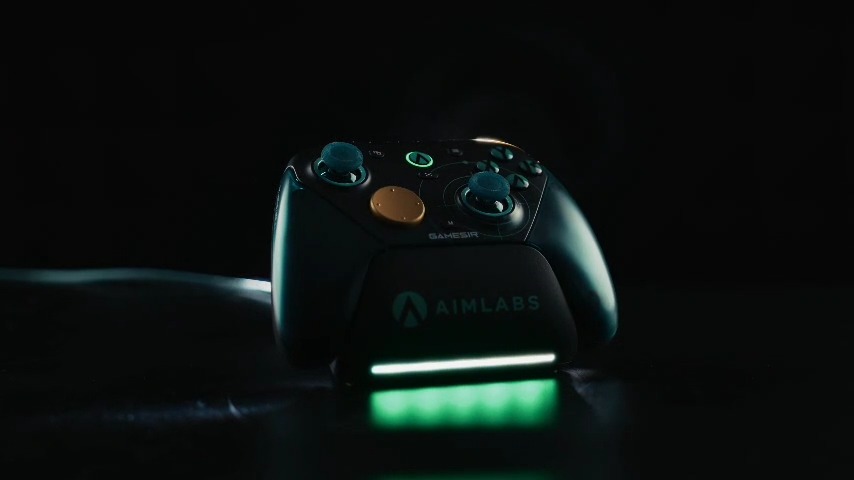
Introducing GameSir Tarantula 8K PC | The Best Controller for Competitive Gaming⚡️ 🫡Built with a highly refined ergonomic contour. 🕹️Anti Stick Drift GameSir Mag-Res TMR Sticks Gen-2. 🚄Native 8000Hz polling. 0.5ms end-to-end latency. 📀Switch between Micro Switch triggers and Hall Effect analog triggers. 🍃Ultra-Lightweight Performance. ONLY 180g. Be competitive....

80,347 Aufrufe • vor 2 Monaten •via X (Twitter)

0 Kommentare

Keine Kommentare verfügbar

Kommentare vom Original-Post werden hier angezeigt

Ähnliche Videos

[New Xbox Controller Review] #ad Special thanks to Qrdgame_offcial for supplying me with a review unit of their Ferrox M5 Xbox & PC Controller QRD Ferrox M5 The QRD Ferrox M5 is a Wireless Xbox One–style gamepad with a transparent design. Since it targets Xbox One natively, it works automatically on PC and Xbox Series S/X. The included 2.4Ghz USB Dongle also supports Switch and Android with the right adapter (USB C), but I was not able to test those in time for this review. A Wireless Xbox Controller The QRD FERROX M5 comes in a familiar Xbox layout with Hall Effect joysticks, RGB rings around the sticks, and a magnetic & detachable clear shell that shows the internals. The controller feels very similar to a standard Xbox pad in terms of shape and size, but it’s slightly lighter at compared to the usual Xbox controller weight. The lighter weight makes it easier to hold for longer sessions without hand fatigue. The D-Pad is surprisingly good at dialing special moves feels as solid and responsive as the official Xbox controller, and that’s impressive at a lower price point. I spent a few days trying out the Mortal Kombat Legacy Kollection exclusively using this controller and I did not notice any difference at all. Capabilities From what I’ve tested, the controller performs extremely well for action games, fighting games, and shooters. The Hall Effect joysticks offer smooth movement and precise control with no drift issues. The D-Pad uses micro switches, so every input is tactile and accurate. The back triggers support an adaptive “trigger stop” mode, which shortens the travel distance for faster reaction time in FPS games or quicker blocks in Fighting Games. You also get 4 back macro buttons, turbo mode, and adjustable joystick sensitivity with deadzone options. Vibration strength and RGB lighting modes are also customizable. What can it do The FERROX M5 includes an 800mAh battery that lasts around 8 hours of gameplay. It only uses the 2.4Ghz wireless connection, not Bluetooth, so it always requires the included USB Dongle. The good thing is once you sync it with your Xbox or PC, you don’t need to sync it again—it carries over between both devices automatically. The 2.4G connection is stable and low latency, and the controller has a 3.5mm headphone jack for audio and mic support. It also features a quick calibration system to keep sticks and triggers accurate over time. The overall grip and shape feel close to the official Xbox controller, comfortable for long gaming sessions, and the transparent shell gives it a distinct look. Areas of improvement I initially had trouble charging the controller while playing because connecting it to the Xbox via USB would disable all inputs, making it unusable in wired mode. But luckily QRD Support helped and provided me with an updat - I had to connect it to a PC, download the firmware tool from QRD’s website, and update the controller manually. After installing the new firmware, the controller can now charge while being used normally on Xbox, so the issue is fully resolved. The Xbox button also behaves differently on Xbox, where the single press acts like hold and the hold acts like single press; this issue doesn’t appear on PC. Syncing with the dongle took a few attempts on both Xbox and PC, but once paired, it never needed syncing again. The wireless mode is strictly 2.4G with no Bluetooth support, so it cannot connect without the dongle, though the benefit is that one pairing works across both Xbox and PC. Final Summary ✅ Hall Effect Joystick ✅ Lights in the dark ✅ Good D-Pad for input dialing ✅ Light Controller ❌ First sync can be annoying on PC ❌ No bluetooth for phone usage - Dongle is necessary ❌ Needs an update for the Xbox Wired issues which require a PC The Controller is available on Amazon for $59.99, and will be part of the Black Friday Deals on their official website for even more discount! Amazon Link Website Link

thethiny 🐰🍉

16,864 Aufrufe • vor 8 Monaten

XBOX Gen-10 details: • Microsoft's next-generation Xbox (Gen-10) is the company's most ambitious and risky gaming platform, built as a Windows 11 gaming PC with a TV-optimized, console-like interface. • It supports full backward compatibility for all Xbox One, Series X|S, and legacy games, plus any Windows 11 PC titles. • Users can exit the Xbox interface to full Windows for tasks like streaming, coding, or music production, akin to Steam Deck's Linux mode. • Core hardware features an AMD semi-custom SoC codenamed “Magnus.” • AMD CEO Lisa Su: “Development of Microsoft's next-gen Xbox featuring an AMD semi-custom SoC is progressing well to support a launch in 2027.” • 2027 launch is a "best-case scenario"; Microsoft insiders are surprised by Su's timeline, pending Windows 11 polish. • Xbox President Sarah Bond confirmed a multi-year Xbox-AMD partnership for hardware and backward compatibility. • Xbox and Windows teams collaborate for a seamless, console-like OS experience atop Windows 11. • Supports multiple storefronts: Xbox Store, Steam, and Epic Games Store, with ports to PS and Switch 2. • The "Xbox Everywhere" strategy offers hardware choices via OEM partners like ASUS (Xbox Ally preview). • OEMs (ASUS, Lenovo, and Razer) to offer a range of Xbox-branded devices at different price/performance points. • Microsoft plans its own first-party Xbox handheld in the future. • NPU-powered features like auto-generated gameplay highlight clips, testing on Xbox Ally X, and rollout in March 2026. • Emphasizes cross-play, cross-saves, and cross-purchasing via Xbox Play Anywhere to grow the industry. • First-party games ported to Steam, PlayStation, and Nintendo Switch 2. • Easier developer publishing tools; major updates at GDC 2026. • Polished software experience is critical; current Ally handhelds highlight Windows issues to fix. • Epic Games Store and Steam are expected to be part of the next Xbox’s multi-store openness, alongside Xbox’s own store. • Price is uncertain (due to tariffs and costs; OEMs for affordability), but the next Xbox may skew more premium (~$1,000)—while lower-end options may persist via partners. Also, Series S support will be extended. • Echoes the original Xbox vision of Windows in the living room; Surface-like premium ecosystem strategy. via: Windows Central Jez

Idle Sloth

69,919 Aufrufe • vor 5 Monaten

$AMD Strategic Price Positioning Long🧵 AMD is increasingly the most hated semi stock that can rival $NVDA dominance in GPUs and software(Cuda v. ROCm). $AMD is also the most under-owned among all Funds in 2025 according to Bank of America! For what I learnt for years as an investor with Dr. Lisa Su, all analysts and market are underestimate Dr. Su leadership. $AMD is capable of raising price, making high quality hardware with software. Dr. Su or AMD choice to adopt a lower price strategy to gain market share is a deliberate and multifacets approach rooted in competitive positioning, market dynamics, and long-term growth objectives. As an investor, it may take time like CPUs and embedded to see margin improving. 1. . Penetration Pricing to Challenge Dominant Competitors AMD has historically positioned itself as a cost-effective alternative to dominant players like Intel in CPUs and Nvidia in GPUs. By setting prices lower than competitors, AMD aims to attract customers and quickly gain market share. This is a classic penetration pricing strategy, where the goal is to capture a significant portion of the market by offering high-performance products at a lower price point. ~CPU Market Example: When AMD launched its Ryzen processors in 2017, it priced them competitively compared to Intel's Core processors, emphasizing a better price-to-performance ratio. Ryzen CPUs offered higher core counts and multi-core performance at lower prices, appealing to cost-conscious consumers, gamers, and professionals. This strategy helped AMD increase its CPU market share to 16.6% by early 2025, narrowing the gap with Intel. ~GPU Market Context: In the GPU market, where Nvidia holds an 88% share compared to AMD's 12%, AMD has been criticized for not launching GPUs at low enough prices to compete effectively. However, posts on X and articles suggest AMD is shifting its GPU strategy to focus on mainstream, cost-effective products rather than high-end enthusiast segments, aiming to regain market share through competitive pricing. 2. Appealing to Cost-Conscious Market Segments AMD targets price-sensitive customers, including gamers, small businesses, and enterprises looking for high-performance computing at a lower cost. This is particularly effective in segments where performance is critical, but budgets are constrained. ~Value Proposition: AMD’s Ryzen and EPYC processors, as well as Radeon GPUs, are designed to deliver performance comparable to or better than competitors in specific workloads (e.g., multi-core processing or AI compute) at a lower price. For example, Ryzen processors have been noted for their superior multi-core performance compared to Intel CPUs at similar or lower price points, making them attractive for tasks like video editing or gaming. ~AI and Data Center: In the AI and data center markets, AMD’s cost-effective Instinct MI300X GPUs and EPYC CPUs target enterprises seeking affordable alternatives to Nvidia’s expensive AI ecosystem. This strategy taps into an underleveraged market segment that Nvidia’s broad, premium-priced AI solutions may not fully address. 3. Building Scale and Developer Support AMD’s leadership, including Jack Huynh, has emphasized the importance of scale—gaining a larger market share to attract developer support and optimize software ecosystems. A lower price strategy helps AMD achieve this by increasing adoption among consumers and enterprises. ~Gaming GPUs: By focusing on mainstream GPUs with competitive pricing (e.g., targeting an 80% addressable market rather than the high-end 10%), AMD aims to build a larger user base. This scale encourages developers to optimize games for AMD’s technologies, such as FSR 3 (FidelityFX Super Resolution) and Anti-Lag 2, improving the ecosystem and competitiveness against Nvidia’s CUDA platform. ~Open Ecosystem in AI: AMD’s open-source ROCm platform contrasts with Nvidia’s proprietary CUDA, appealing to developers who prefer flexibility. Lower-priced hardware makes it easier for developers to adopt AMD’s solutions, fostering a broader AI software ecosystem. 4. Historical Context and Brand Positioning Since its founding in 1969, AMD has positioned itself as a challenger brand, often acting as a “second source” supplier to Intel. This role required competitive pricing to gain a foothold in markets dominated by established players. Over time, AMD has built a reputation for quality and affordability, reinforced by products like the Am9080 (a reverse-engineered Intel 8080) and modern Ryzen and EPYC lines. This historical strategy of undercutting competitors’ prices while delivering comparable performance continues to define AMD’s approach. 5. Countering Competitor Dominance AMD operates in highly competitive markets where Intel and Nvidia have significant advantages in brand recognition, market share, and ecosystems. A lower price strategy is a pragmatic way to disrupt this in CPUs: ~Intel’s historical dominance in the CPU market (servers, desktops, and laptops) has been challenged by AMD’s Ryzen and EPYC processors, which offer better value. For instance, AMD’s EPYC CPUs have driven a 122% year-over-year revenue increase in the data center segment, partly due to their cost-effectiveness, helping AMD capture 94% of CPU sales at some retailers. ~Nvidia in GPUs: Nvidia’s 88% GPU market share and premium pricing (e.g., high-end GPUs like the RTX 4090) leave room for AMD to compete in the mid-to-low range. However, AMD’s failure to launch GPUs at sufficiently low prices (e.g., the RX 7900 XT at $900 instead of its current $680) has limited its success, prompting a strategic shift toward more aggressive pricing in future RDNA 4 GPUs. 6. Market Share as a Long-Term Investment AMD’s lower price strategy is not just about immediate sales but also about long-term market positioning. By capturing market share, AMD can: ~Increase Brand Loyalty: Affordable, high-performance products build customer loyalty, especially among gamers and small businesses, creating a foundation for future sales. ~Drive Revenue Growth: Market share gains in CPUs (e.g., 16.6% in 2025) and data centers (e.g., $3.5 billion in Q3 revenue) translate into higher revenue, even if margins are initially lower. ~Influence Industry Standards: Greater market presence allows AMD to influence hardware and software standards, such as pushing for open-source AI frameworks or gaming optimizations, reducing reliance on competitors’ proprietary systems. 7. Challenges and Risks While effective, AMD’s lower price strategy carries risks: ~Profitability Concerns: Lower prices can compress profit margins, and some analysts note that AMD’s high stock valuation expects future profitability that may be delayed if pricing remains aggressive. ~Perception of Quality: Persistently low prices risk positioning AMD as a “budget” brand, potentially undermining its ability to compete in premium segments. ~Competitor Response: Intel and Nvidia can counter with price cuts or superior features, as seen with Nvidia’s feature-rich GPUs. AMD must balance price with innovation to avoid being outmaneuvered. 8. Strategic Shift in GPUs Recent reports indicate AMD is adjusting its GPU strategy to prioritize market share over competing in the high-end enthusiast segment. For the upcoming Radeon RX 8000 series (RDNA 4), AMD is focusing on mainstream GPUs priced competitively to appeal to a broader audience, rather than chasing Nvidia’s high-end dominance. This shift aligns with AMD’s broader goal of achieving 40–50% market share by targeting the “80%” of the market that prioritizes affordability over premium features. Lastly, AMD’s lower price strategy is a calculated move to disrupt Intel and Nvidia’s dominance, capture market share, and build scale for long-term growth. By offering high-performance CPUs and GPUs at competitive prices, AMD appeals to cost-conscious consumers and enterprises, particularly in the CPU and AI markets, where it has seen significant gains (e.g., 16.6% CPU market share and $3.5 billion in data center revenue). Recent price increase on MI350 and MI355 and more on MI400 signaled #AI chip leadership and pricing power, which will result in significant top and bottom line growth.

Mike

38,006 Aufrufe • vor 10 Monaten

The multi-leader blockchain endgame: competitive information inclusion as a self-reinforcing mechanism for global price discovery - how we got here, and why Aptos is leading the charge Onchain trading is the killer app In the nine years since the launch of programmable transactions on the Ethereum blockchain, onchain trading has revealed itself as the killer use case for blockchains: onchain listings, volume, and total value locked are all growing with no signs of slowing down, due to the censorship-resistant, permissionless, 24/7/365 qualities afforded by decentralized (DeFi) systems. Monolithic parallelism is key In 2020 Solana was first to market with monolithic, parallel execution (as opposed sharded execution which offers parallelism by partitioning global state into separate information silos), establishing a new design paradigm that raised the bar for throughput and latency: put all of the information in one replicated state machine and make it run as fast as possible. This design produces a single, global hub for activity, liquidity, and token launches, a kind of financial data whiteboard in the sky, where anyone can come and trade at any time with everybody else who has plugged into the system. DEXes are becoming more competitive Historically decentralized systems have been juxtaposed with centralized ones since the latter eliminates the overhead associated with distributed systems coordination. And yet despite this overhead, Solana as a decentralized exchange (DEX) is still pulling in billions of trading volume per day, exceeding that of all but the largest centralized crypto exchanges (CEXs), that simply can't compete with the giant DEX in the sky on token listings or fees. After all, CEXs have to pay for server space, salaries, and lawyers, while a DEX outsources everything. The colocation arms race The one place where CEXs have an advantage over DEXs is on end-to-end latency for colocation applications, or in other words: someone sets up a trading bot in the same data center as the exchange, and their trades get to the exchange faster than everyone else's. When there is only one data ingestion point the fastest trader wins, and after the arms race has played out everyone ends up huddling around the trading hub, effectively cutting off the rest of the world from playing the latency trading game. This is the model that traditional securities exchanges like the Nasdaq or the NYSE 🏛 employ, and because they own the server they can effectively charge whatever they want for access to it. The colocation arms race is also why L2s will probably never decentralize: running the sequencer is practically the same as running the NASDAQ, with the same monopoly on transaction fees collected from a nearby cluster of trading bots (I understand from conversations with Logan Jastremski that the Arbitrum arms race has already hit a Nash Equilibrium in Portland, Oregon). Colocation is a trap But once the colocation arms race has played out, trades become less about incorporating new information in the market and more about skimming off the top by spoofing all of the trades coming in from the other bots. High-frequency trading (HFT) bots located in the NYSE New Jersey data center, for example, are constantly placing buys and sell orders that they have no intention of executing, just to spoof the other colocated bots who are playing the same adversarial game. Information inclusion, on the other hand, the synthesis of real-time world events into prices, takes a back seat because anyone who tries to include new information first needs to batch up their order and send it through a series of middlemen before it ultimately ends up on the exchange: you, I, or practically any other individual can not actually "trade on the NASDAQ", no, we have to express our intent to someone like Robinhood, who then sells our order flow to @CitadelSecurities, who then sends it to the exchange, oh and by the way it doesn't actually even "clear" or "settle" once it "executes" because for whatever reason the whole systems splits these things up and prevents them from happening instantaneously even though it's 2024 and we have computers. Onchain trading cuts out middlemen This whole mess is why we have onchain trading, and why it's starting to win: if you want a mainline to the exchange, without setting up a server, and you want to trade on a news event without getting immediately frontrun by an HFT bot that is sniffing out the trades of every other HFT bot who is easing in batched up order flow on their own terms, then you submit your order to a node in the blockchain and the information gets included in the price upon ingestion. Oh, and by the way the trade is actually fully complete: settled, cleared, reconciled, done, whatever you want to call it, because the people who build decentralized finance (DeFi) build it how it should actually work, not in a way that creates a million incumbents and charges exorbitant rents for access to the system. Onchain trading better for price discovery And the beautiful part about this is that even if a distributed system has more latency than a centralized system, DeFi still ends up incorporating more information into the price faster than centralized finance, because with DeFi the information gets included in the system as soon as it is submitted, not after it has been batched up and sent through a series of middlemen. The consensus mechanism of the blockchain disseminates the information around the world in the form of a price update, while the centralized exchange model requires information about the event to first get propagate to the region of the trading hub, then to get submitted to the colocation server. This means that in terms of global price discovery, onchain trading is strictly a better system because the entire consensus model is based around accelerated information propagation. Because price discovery is a global phenomenon, blockchains, which are global, are actually better than the centralized status quo, on a performance basis, not just from an ideological or convenience-based view. And it has to be multi-leader In practice, effective global information synthesis of information has an additional key requirement: multi-leader architecture. That is, in a single-leader blockchain like Solana, where one validator at a time has a monopoly on ordering transactions into blocks, for their duration as a leader they effectively function as a colocation server. This means that if the current leader is in New York, someone in Singapore who wants to trade on local news as soon as it breaks will still need to get their order all the way around the world to the leader, who is effectively serving as the chain's data ingestion point, before the order can start propagating through the network. But this is issue solved by the introduction of multiple distributed leaders, because then anyone with access to new information can submit their order to the leader closest to them, yielding faster information inclusion in the form of price updates. Multi-leader is also required for fair markets A multi-leader architecture is also required for fair markets, because in a single-leader system the leader has the power to censor transactions, reorder them to their advantage, or even replace transactions with copycats that extract maximum value by replacing the sender's address with their own. For example if someone wants to capture an arbitrage opportunity between two onchain DEXes, they'll need to submit a transaction to the leader and trust that the leader won't simply copy the transaction and submit it themselves. But when there are two or more leaders, users whose transactions are censored by one leader will simply work with a different leader the next time around, eventually cutting off transaction fee flow to the extractive leader. Beyond just strict inclusion, in a multi-leader architecture validators are also forced to compete with each other on latency, because the leader who is fastest at disseminating users' transactions across the network will over time gobble up the largest share of the order flow. Transparent priority fees are a must, or a private mempool will emerge But in order to make this work, a multi-leader architecture must also offer users the ability to pay priority fees AKA "tips" or "bribes" to move their transaction to the front of the line: if there is a $5 arbitrage opportunity onchain, users need to have assurance that they if they pay a 4.99 priority fee to take that arb, they will get priority over a different user who is only willing to tip 4.98. If the native blockchain system does not offer this fair market priority fee mechanism, then it is only a matter of time before one spontaneously emerges in the form of a private mempool like Jito, which can create centralization pressures and undermine the integrity of the system as a whole. Competitive payment for order flow is the stable solution With the right architecture in place, the end result is a competitive environment where endpoints running maximum extractable value (MEV) bots compete with one to offer users the best price for their order flow. In other words, if a user wants to submit an order that can get sandwich attacked for as much as $2 of MEV, then the order should ultimately go to the endpoint bot that is willing to pay the user as much as $1.99 for the right to process their transaction. The price that the provider is willing to pay is ultimately a function of how much in priority fees they might need to pay to the current leader (0 they are the current one), but notably at each stage there is a competitive market for order flow, whether in the form of retail trader's orders, or priority fees among bots that might be forwarding orders to one of the leaders. AptosLabs is already building all this With a public mempool and transaction priority fees, Aptos additionally includes a pipelined architecture that already includes concurrent batching of transactions into blocks, with a single consensus leader who propagates the batched blocks out to the network. And the team is already researching running multiple instances of the consensus algorithm in parallel, yielding multiple consensus leaders who can compete with each other on latency and inclusion - just ask pranav | Shelby, Alexander Spiegelman, and Zekun Li. This means that block times can shrink as the number of consensus leaders grows, with each leader having its own geographical radius of inclusion beyond which it makes more sense to submit to a different leader. The starting point? Something like 60 ms blocks and 3 consensus leaders, partitioning the global information space into competitive and constantly-rotating regions of information inclusion. Messaging is important With concurrent pipelined transaction batching, a public mempool, priority fees, and a clear path to a multi-leader architecture, Aptos leads the industry in onchain trading infrastructure that can truly supplant the centralized colocation paradigm that has heretofore dominated global finance - by offering a truly superior product. And I am hopeful that this deep dive is the first step in communicating not how or that superior product is getting built, but what it means from a bigger picture perspective. If blockchains have found product market fit in anything, it is in trading, and the trading game can only be won by building the biggest, baddest, most high performance system that has as its north star a single, concrete goal: constantly reducing, ever lower toward zero, time time it takes to incorporate information from anywhere in the world into the global price discovery computer. Whoever does this, even 1 ms faster than the competitor, wins the price discovery game, as other blockchains are left in the dust, their DEXes arbed away to zero against the fastest chain on the block. And sure, the blockchain that can rise to this challenge can also handle useful things like payments, NFTs, or other solutions that benefit from permissionlessness and low gas costs, but I want to impress that at the core of this pursuit must be the urge to drive down information inclusion latency to the absolute minimum afforded by the laws of physics through a competitive, market-driven environment. I call on avery.apt 🇺🇸 , CTO of Aptos Labs, to lean in on this messaging, to make it clear that Aptos is here for this singular mission, to build the most performant price discovery engine in history, as a rallying call for alignment in development efforts across the ecosystem and broader industry. Where does this go? As the latencies drop, the spreads tighten, and the information inclusion increases with every incremental increase in network bandwidth, we can expect a new class of competing techno-financial hubs that aggregate around the world's largest information sources: New York, Washington DC, London, Tokyo, etc., commanding stake distribution commensurate with the density of information flow in these respective locales. With the right incentives in place, competing concurrent leaders will invest ever more in infrastructure to get their packets out to the network faster than the rest, yielding clusters of fiber optic cable around the world's financial hubs, neurons in the global financial brain connecting not just HFT firms to servers in their city, but connecting every city with every other city, to move pricing information across oceans and continents. And retail traders, who have been left out of the colocation game, will only benefit: this entire system gets faster, more inclusive, with tighter spreads and lower fees, and it is such an amazing opportunity to watch all of this unfold in real time. The future of blockchains is the future of trading, is the future of competitive information inclusion in real-time, is the future of truly unified global markets, because at the the core of this industry is a simple idea: connect the computers, and see where the incentives lead. They lead to this, and Aptos is leading the charge, because its tech is purpose-built for this exact purpose. So tell the world about it.

Alex Kahn

24,432 Aufrufe • vor 1 Jahr

American-made drone smashes performance metrics at Chinese prices | Loz Blain, New Atlas A new drone company has exploded out of stealth mode in the USA with incredible claims about its first product, saying it'll fly 4X longer, 10X further, 10X quieter and carry 5X more payload than leading competitors – while competing with China on cost. Let's start with the numbers. Silicon Valley-based SiFly has announced two industrially targeted models with some absolutely ludicrous stats attached. The smaller Q12 platform carries up to 10 lb (4.5 kg) of payload. It can hover for a remarkable two hours - or manage three hours in forward flight, for an operational range of 90 miles (145 km). The company says it's radically quieter than anything in its class as well, and "nearly silent at 100 meters" (328 ft). Deliveries are slated to begin at the end of the year. The larger Q250 platform is built for heavy lift, and capable of carrying a 200 lb (90.7-kg) payload for 100 minutes of endurance. Set for launch in 2026, it's designed for fire suppression, cargo missions and crop spraying at a fraction of what the usual helicopter would cost. "Commercial drones have long forced organizations to compromise between flight duration, payload capacity, and operational range," said Brian Hinman, Founder and CEO of SiFly, in a press release. "We eliminated those trade-offs. SiFly drones are transforming emergency response, infrastructure inspection, and logistics – delivering helicopter-class performance at drone economics." The company says it's validated its performance claims in real-world operations, naming California's Amaral Ranches as an early pre-launch deployment partner. The question of course is ... how? Drones are a well-understood technology now that's been dominated from the very beginning by Chinese companies. If SiFly's figures hold up and this company truly puts 4-10X multiples on these key performance stats, it's sitting on some revolutionary technology advances in energy storage, propulsion, aerodynamics and/or materials – areas that are already highly optimized after more than a decade of commercial and industrial drone development. Annoyingly, there's nothing particularly revolutionary-looking in the renders, and SiFly has yet to explain exactly how it's achieved such a radical leap in performance – not to mention how it's managed to design and manufacture in the USA at prices competitive with Chinese competition. Or indeed, what these prices are. Which would give this company a strong whiff of vapor... But former NASA Chief Technologist for On-Demand Mobility and current Whisper Aero CEO Mark Moore (who knows a thing or two about quiet propulsion systems at the very least) lends this group some third-party credibility in a LinkedIn post: "SiFly's reveal today is kinda breathtaking in terms of capabilities," he writes. "I've personally been able to see this drone develop through the years, and know the principals as serious players. The specifications they've achieved are really impressive, from the empty weight fraction to the cruise Lift/Drag - this is the best multicopter out there, by far. And while they don't hype it up, they've designed this product to be affordable so that it can be used en masse as a swarming solution. Well worth a watch. Well worth the money. Awesome job!" Read more:

Owen Gregorian

72,742 Aufrufe • vor 1 Jahr