正在加载视频...

视频加载失败

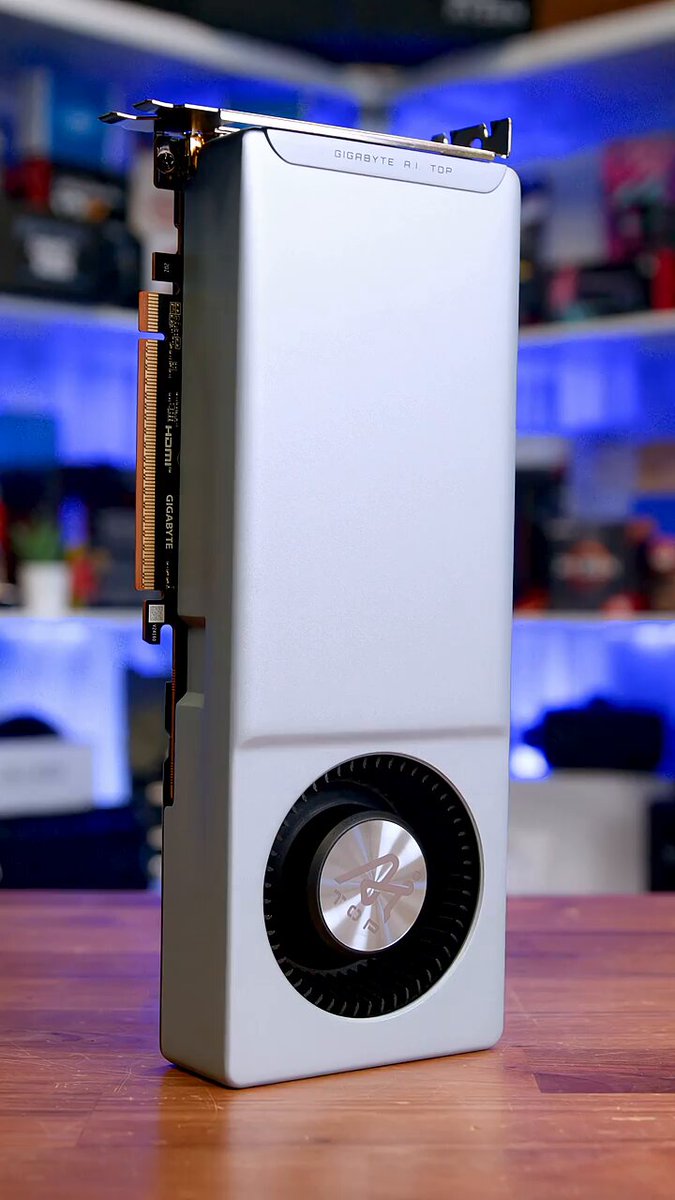
Introducing KausaCompute. Running AI models privately is expensive and complicated. Traditional cloud providers require credit cards, KYC verification, and complex setup processes. For many developers, especially in emerging markets, accessing GPU compute remains out of reach. KausaCompute changes that. Deploy any Docker container with NVIDIA GPU, pay with USDC...

10,914 次观看 • 2 个月前 •via X (Twitter)

0 条评论

暂无评论

原始帖子的评论将显示在这里

相关视频

AMD might have disrupted Nvidia's entire cloud GPU rental business. In January at CES, AMD CEO Lisa Su demonstrated a $1,499 mini PC running the same class of AI model that currently costs companies $2,500 to $3,000 every month to rent from Nvidia-powered cloud servers. AMD's own branded version opened pre-orders this month at $3,999. Third party manufacturers have been selling the same chip since 2025 starting at $1,499. Here is exactly why this is dangerous for Nvidia. Nvidia's $75 billion quarterly revenue is built almost entirely on one business model, companies rent access to Nvidia GPUs through cloud providers like AWS and Lambda Labs to run AI. They pay monthly. Nvidia gets paid every time someone runs an AI model in the cloud. That recurring rental income is what turned Nvidia into a $5 trillion company. The AMD box eliminates that monthly fee permanently. One AI consultant switched from $2,800 per month in Nvidia cloud rental costs to $8 per month in electricity. The hardware paid for itself in 11 days. Over 8 months he generated $47,000 running the same AI workloads that previously left him paying Nvidia's ecosystem $2,800 every single month. Multiply that across thousands of enterprise customers and the revenue erosion becomes structural. Every business that buys this box stops paying cloud rental fees forever. Lawyers, doctors, banks, accountants, and financial advisors, businesses with sensitive data that cannot legally go to a cloud server represent billions in annual cloud GPU fees that Nvidia is now at risk of losing permanently. The threat is also closing in from the top. Google signed deals worth tens of billions with Anthropic and Meta to replace Nvidia with its own chips. Amazon built its own AI chips across AWS. Apple trained its AI on Google's chips, not Nvidia's. Custom silicon has grown from 21% of the AI chip market in 2025 to 28% in 2026. Nvidia's rental model only worked because serious AI compute had no alternative.

Bull Theory

26,668 次观看 • 1 个月前

Revolutionizing Access to #GPU Power - One Node at a Time.⚡️ Our 10th Utility is coming out on June 20.🚨 BIG GPU Nodes Platform isn’t just another name in the crowded GPU cloud services space, we’re a game-changer. Our platform is purpose-built to bridge the gap between server owners and those hungry for raw, high-performance computing power. 🖥️ We specialize in connecting suppliers from individual server owners to enterprise-scale GPU rig operators with consumers who demand serious horsepower for AI, machine learning, data science, and other compute-heavy applications. Whether you’re offering a sleek single-GPU setup or a massive mining-style array with multiple GPUs, BIG GPU Nodes is your launchpad. We make it simple to rent out underutilized GPU resources and just as easy for users to find exactly what they need — fast, affordable, and tailored to their workload.⛓️‍💥 This is more than cloud computing. This is decentralized GPU power for the future of innovation. ♾️ This product will generate revenue and we will give back to our loyal $CNCT holders. ✨ We’re proud to have MESSIER | M87 as our trusted partner and advisor, backing us with this vision. #M87 🤝 $CNCT From the very beginning, we promised you ONE BIG ECOSYSTEM, and a seamless space where everything you need comes together. Now, that vision is becoming reality. Millions of users will soon be connected, working, creating, and thriving within it. 🌍

Fixera AI

26,669 次观看 • 1 年前

Hey everyone, today I want to introduce a project that’s aiming to redefine how we access compute for AI — it’s called GPUAI. 🔶 GPUAI: Unlocking Global GPU Power for the AI Era GPUAI isn’t just another GPU marketplace or leasing service. It’s a fully decentralized protocol that connects idle GPU resources around the world — from gaming PCs to data center clusters — and transforms them into a high-performance compute network for AI workloads. 🧠 Why does it matter? Right now, the biggest bottleneck in AI isn’t algorithms — it’s access to compute. Training and running models requires massive GPU power, but it’s locked up in centralized cloud platforms, expensive and hard to access for smaller teams. With GPUAI, anyone can tap into a global GPU pool that’s: ✅ Fully decentralized ✅ Reputation-based and smart contract coordinated ✅ Encrypted and secure ✅ Token-incentivized — meaning contributors get rewarded in $GPUAI 📈 For developers, it’s a flexible way to access GPU compute for training, inference, and more — without cloud lock-in. 💰 For GPU owners, it’s a chance to monetize idle hardware that would otherwise go unused. The protocol is live, the apps are active, and the ecosystem is growing fast. 🌐 Try it yourself at 📖 Learn more on 🎮 Play our community games at This is real infrastructure for the future of AI, not hype. Follow them and explore their mission of decentralized computing at Tell me what you think - if you have a GPU, you can start profiting now. #GPUAI #Web3Infrastructure #AIComputing #DePIN #Decentralization

The Crypto GEMs

69,984 次观看 • 1 年前

Jensen Huang, CEO of Nvidia, is telling you where to invest in 2026. He has personally directed Nvidia's capital into 8 specific companies for a combined total of over $45 BILLION. This is where the most important company in the AI economy is putting its money. Here’s the full list: OpenAI: $30 billion The largest commitment of the 8. Nvidia is funding the buildout of OpenAI's compute infrastructure from the inside. OpenAI is also Nvidia's single largest customer. GLW Corning: $3.2 billion Optical glass and fiber to physically connect AI clusters. You cannot move data between millions of GPUs without it. IREN: $2.1 billion AI cloud provider with one of the deepest power positions in North America. MRVL Marvell: $2 billion Custom networking chips that move data between GPUs at massive scale. LITE Lumentum: $2 billion Lasers and optical components for the fiber backbone of every AI data center. COHR Coherent: $2 billion Fiber optic transceivers that connect GPU clusters inside data centers. CRWV CoreWeave: $2 billion GPU-as-a-service provider. Nvidia's largest cloud customer outside the hyperscalers. NBIS Nebius: $2 billion AI cloud infrastructure company. Quietly building hyperscale GPU capacity for the AI labs. Whatever Nvidia is buying is where the money is going next. At The Assembly, we’re a team of 8 with one goal: help you find the right stocks early. Turn notifications on so you don’t miss our alerts. This is VERY important. If you’re not following us yet, you will regret it later.

The Assembly

7,280,197 次观看 • 2 个月前

Chamath Palihapitiya just dropped the number that explains the entire AI infrastructure trade (Save this). A gigawatt of compute now costs $100 billion and when he started his Arizona data center project it was $4 to $5 billion, it has gone up 20x in a single investment cycle. The implication is not just that AI infrastructure is expensive but rather that the capital barrier to owning meaningful compute has become so high that only a handful of entities in the world can actually build it and the companies who got there early are sitting on what may be the most durable pricing power in the history of the technology industry. This is the neocloud trade. The neocloud market, purpose-built GPU cloud providers like CoreWeave, Nebius, and Lambda Labs was worth $35 billion in 2026 and is projected to reach $236 billion by 2031, compounding at 46% annually. For context, that is faster growth than cloud computing itself posted in its first decade. The reason is very simple, hyperscalers like AWS, Azure, and Google are building for everything, storage, databases, enterprise software, networking and their GPU pricing reflects the overhead of that full-stack infrastructure. Neoclouds build for one thing only, AI compute. The result is a 60% to 85% cost advantage on the same Nvidia silicon, bare metal H100s at $0.78 to $2.79 per GPU-hour on a neocloud versus $3.43 to $5.07 per GPU-hour on a hyperscaler. That spread does not close as AI demand scales but rather it widens, because hyperscalers have to amortize legacy infrastructure and margin expectations that neoclouds do not carry. Gartner projects that by 2030, neoclouds will capture 20% of the $267 billion AI cloud market, and Vultr's own analysis says at least 80% of GPU market share by end of 2026 will be held by a small group of scaled neocloud providers. Now zoom into Nebius specifically, because it is the most interesting publicly traded proxy for this trade. Nebius is the infrastructure arm of the former Yandex Russia's equivalent of Google rebuilt from the ground up after Russia's invasion of Ukraine by Arkady Volozh and relisted on Nasdaq in October 2024. The team that built it already knew how to run internet-scale infrastructure at the lowest possible cost, which is exactly the operational DNA a neocloud requires. In Q1 2026, Nebius reported revenue of $399 million and already generating serious cash on a young business with revenue growing nearly eightfold year-over-year. Then in March 2026, Meta signed a five-year infrastructure agreement with Nebius worth up to $27 billion, $12 billion in committed dedicated GPU capacity deployments beginning early 2027, plus up to $15 billion more tied to Meta purchasing Nebius's unsold third-party capacity. The deal will be executed on one of the first large-scale deployments of Nvidia's Vera Rubin platform, the next-generation architecture after Blackwell making Nebius one of a tiny number of operators in the world with confirmed priority access to the most advanced AI hardware available. Following the contract, Nebius guided to $7 to $9 billion in annualized recurring revenue for 2026 representing 540% year-over-year growth. Chamath Palihapitiya point about the $100 billion capital moat is the bear case for new entrants and the bull case for incumbents. No one can afford to build the next CoreWeave or Nebius from scratch at current hardware and power costs. The companies that are already built, already contracted, and already deploying Nvidia's latest silicon have a moat that compounds with every GPU generation cycle because they get allocations first, they deploy fastest, and their customers re-sign rather than wait for a new operator that does not yet exist. Come join Milk Road Pro for our full breakdown, the complete neocloud competitive landscape, how to think about Nebius's valuation versus CoreWeave and AI entire thesis. Link below.

Milk Road AI

138,663 次观看 • 1 个月前

I'm running Llama 4 Maverick at 620 t/s! I'm living in the future! Honestly, a large language model running this fast is something straight out of a sci-fi movie. Speeds like this will enable a whole new world of applications that aren't possible today. For reference, GPT-4o, which is probably the most popular OpenAI model, runs between 60 and 110 t/s. The secret here: I'm not running AI at Meta's Llama 4 Maverick on a GPU. I'm using the SambaNova Cloud (my sponsor) and their custom SN40L chips. They are optimized from the ground up for running AI workflows. Right now, SambaNova Cloud runs DeepSeek, Qwen, Whisper, and the entire family of Llama models on these chips. You can check the speed of each of these models using SambaNova Cloud's Playground (see the attached video). It's completely free, and that's how I'm measuring their speeds. For example, I also tried DeepSeek R1 (the latest version from May) and, oh boy! DeepSeek R1 is a huge 671B parameter model. It's probably the best open reasoning model in the world, and it runs at 140 tokens per second! !!! Inference time on an SN40L is night and day from what you'll get from a GPU. Here is why this is big: If you are running an agentic workflow that uses multiple models simultaneously on a GPU, it will need to swap models in and out of memory (because not every model fits). A single SNL40 chip can simultaneously hold over 100 models (trillions of parameters) in memory. If you are using open models, try the SambaCloud API to see what lightning speed looks like. Here is how: 1. Create a free account at: 2. Check the QuickStart guide: If you try the playground, check the speed you're getting with Llama 4 and DeepSeek, and post the results below. I've seen much higher numbers than I posted here, so I'm curious to see whether geography affects the speed.

Santiago

34,148 次观看 • 1 年前

QVAC SDK 0.14.0 is live. This release makes the on-device stack faster on mobile, ships the developer-agent path, and takes local text-to-speech to 31 languages. Main highlights: - OpenCode and OpenClaw. The first official OpenCode plugin, plus a maintained OpenClaw compatibility path, both built on managed mode and qvac serve. Point a coding agent at a local model with far less setup and far fewer surprises. - Brain-computer interface transcription, on the SDK. Take recorded neural signal data and decode it into text, fully on-device, no cloud. Stream it in chunks through a simple API. In 0.14 it runs GPU-accelerated on iOS. - Text to Speech in 31 languages with our Supertonic3 upgrade. VOICE AND SPEECH - Supertonic3 multilingual TTS, 5 languages to 31. - Chatterbox and Supertonic now run on the Android GPU, with lower memory use (especially on iOS), quantized s3gen Chatterbox support, and a fix for Chatterbox occasionally emitting random speech. - Whisper transcription now runs on the iOS GPU. Parakeet runs on the Android GPU, with steadier real-time streaming. VISION AND OCR - VLM multi-tile batching: high-resolution Pan and Scan images are encoded in one pass instead of tile by tile, for faster vision throughput. - OCR on ggml (EasyOCR and DocTR) reaches full speed parity with the onnx path, across Metal, OpenCL, and Vulkan. PLATFORM AND RELIABILITY - Dynamic compute backends on Linux: one build picks the right backend at runtime, and opens the door to ROCm and CUDA support without per-backend builds. - Thinking tokens are kept out of the model context, so reasoning no longer fills the KV cache. SDK 0.14.0 is now leaner and faster to start. Let’s build.

QVAC

23,973,950 次观看 • 1 个月前

Mark Zuckerberg is explaining one of the most misunderstood dynamics in AI and it has direct investment implications (Save this). The concept he's describing is model distillation, and it's one of the most important techniques to emerge in AI over the past year. Here's how it works. You train a massive, enormously expensive model, in Meta's case, Llama 4 Behemoth, a 2 trillion parameter teacher model and then you use that model to teach a much smaller, cheaper model. The smaller model inherits roughly 90 to 95% of the intelligence of the giant while running at 10% of the cost and on a fraction of the compute. Meta already did this with the Llama 4 family and Behemoth serves as the teacher. Llama 4 Scout and Maverick, the publicly released open-source models were distilled from it. Scout runs on a single H100 GPU with a 10 million token context window and outperforms models that cost far more to operate. Maverick, at 17 billion active parameters, rivals DeepSeek V3 in coding at half the parameter count and beats GPT-4o on multimodal benchmarks. Both are completely free for commercial use. What Zuckerberg is pointing at is a structural shift in how AI gets deployed in the real world. Companies aren't taking a frontier model off the shelf and running it as-is but rather taking open-source models, fine-tuning them on their own proprietary data, distilling them into even smaller custom models tailored to their specific use case, and running them on infrastructure they control at a fraction of the cost of a closed frontier API. The investment implication of this is significant and runs in two directions. For Meta specifically, this is a strategic masterstroke. Every company that builds on Llama, fine-tunes it, distills it, or deploys it through their infrastructure is pulling into Meta's orbit while Meta builds the most powerful open teacher model. The ecosystem of companies using it grows and that ecosystem generates commercial activity across Meta's platforms and data services. Meta's AI research benefits from billions of real world deployment signals and it's a flywheel that closed model providers cannot replicate because their strategy requires charging per token, which is now a 65x cost disadvantage against the open-source alternative. For the broader market, distillation changes the economics of inference in a way that has barely been priced in. As intelligence becomes extractable into smaller and cheaper models, the absolute demand for compute doesn't decline but rather it explodes, because now the number of applications that are economically viable expands by orders of magnitude. Every task that was previously too expensive to automate at $3.25 per call becomes viable at $0.05 that means more total token usage, more total GPU utilization, and more demand for the infrastructure companies, the Nebiuses, the GE Vernovas, the Constellation Energies that supply the underlying compute and power.

Milk Road AI

27,908 次观看 • 1 个月前

Everyone wrote Apple off as the AI loser, but one hardware spec might flip that story upside down (Save this). @jason called Apple a screaming buy on the back of a single chip detail. The rumored M7 Ultra, expected around 2028, is designed to support up to 1.5TB of unified memory, enough to run frontier class trillion parameter AI models locally, with no cloud required. The Street's bear case on Apple is straightforward. Apple has no frontier model of its own, Siri has stumbled for years and the company effectively rents OpenAI's models for its hardest queries. That narrative treats Apple as the one Magnificent Seven name that missed the AI wave entirely but the bull case flips that framing on its head. If frontier AI models keep shrinking and getting cheaper to run, Apple doesn't need the smartest model in the world, it just needs to own the device that model runs on. And unified memory is the mechanism that makes this possible. Unlike traditional systems where the CPU and GPU each need separate memory, Apple's architecture lets the CPU, GPU and Neural Engine draw from one shared pool. A fully specced M7 Ultra could theoretically run something on the scale of a 1.2 trillion parameter model locally and that capability plugs directly into the one advantage Apple has spent over a decade building: privacy. Apple has already shipped Private Cloud Compute, a system designed so even Apple can't access user data processed off device. Apple doubled down on this at WWDC 2026, framing on device privacy as non-negotiable while rivals default to the cloud. If the best AI models get small enough to run on Apple silicon, the moat stops being the model and becomes the hardware it has to sit on. Milk Road Pro remains bullish on Apple and it remains as one of our core positions, if you want the full thesis + our full AI trades, come join us using the link below for just a $1.

Milk Road AI

37,362 次观看 • 19 天前