Video yükleniyor...

Video Yüklenemedi

Ana Sayfaya Dön

📍 Introducing Tagger — The Decentralized #AI Data Layer ➡️ Tagger is a full-stack DeCorp platform revolutionizing how high-quality training data is created, authenticated, and traded. - AI-powered labeling tools that turn anyone into a pro annotator - Instant rewards in $TAG via smart contracts - Secure data authentication...

112,954 görüntüleme • 12 gün önce •via X (Twitter)

0 Yorum

Yorum bulunmuyor

Orijinal gönderinin yorumları burada görünecek

Benzer Videolar

Something big is happening in robotics - and it’s hiding in plain sight. This post is not about dancing robots but in the data that powers them. Open robotics datasets have exploded this year, turning the field into a more scalable and collaborative ecosystem. In just two years, Hugging Face datasets grew from 11k to over 600k - and robotics is by far the fastest-growing segment. We went from 1k robotics datasets in 2024 to 27k in 2025! For comparison, text generation, the second-largest category, has only around 5k datasets in 2025. That gap is massive. Open datasets are important because robotics lives and dies by real-world robot data - video, actions, sensors, failures. By making this data easy to upload, reuse, and benchmark, researchers, startups, and large players are now releasing real-robot datasets that would have stayed locked inside labs just a few years ago. Major contributors include NVIDIA, LeRobot initiative, and a rapidly growing maker community. This surge is also enabled by cheaper video storage, better tooling, and an open-source AI culture now spilling into the physical world. And it really matters: open robotics data dramatically lowers entry barriers, accelerates learning-by-doing, and speeds up progress toward generalist and humanoid robots. Robotics won’t scale through hardware alone - but to a large extent through shared data. Viz below from AI World - link to the story and more viz/filters in comment.

Pierre-Alexandre Balland

186,017 görüntüleme • 7 ay önce

🚀 Early Access to Sahara AI Studio is NOW OPEN! The next phase of our testnet is here with exclusive early access to our all-in-one platform designed to transform the AI development lifecycle into a streamlined, integrated experience. Here’s everything you need to know 👇 AI development is fragmented. Devs juggle multiple tools, leading to inefficiencies & high costs. Sahara AI Studio integrates the entire AI lifecycle—from datasets & model training to secure storage & scalable compute—into one seamless experience: 📊 Data Hub: Discover, Manage, and Leverage AI-Ready Datasets Access high-quality, domain-specific, open-source and proprietary datasets through an integrated marketplace. Developers can download, import, or label datasets, making it easier to train and fine-tune models or deploy RAG pipelines. Secure uploads and seamless workflow integration enhance the experience. 🤖 Model Hub: Discover, Customize and Scale AI Workflows with Ease Discover ready-to-use open-source and proprietary models, RAG pipelines, and customizable workflows. Developers can deploy models quickly while maintaining privacy and security through Sahara Vaults. 🖥️ Compute Hub: Flexible, Scalable Compute Resources for AI Innovation Access scalable and secure computing resources tailored to diverse AI workloads. Trusted Execution Environment (TEE) capabilities ensure data privacy, while integration with top compute providers offer flexibility for developers. 🔐 Vaults: Secure Storage for AI Assets Securely store, organize, and manage datasets, models, and other assets in an encrypted central repository. Vaults offer scalability, reproducibility, and user control over AI resources. This is more than just beta testing a platform—it's your chance to help shape the future of decentralized AI development. 📅 How to Apply We're onboarding select developers in a phased approach. Early Access spots are limited, so apply now:

Sahara AI 🔆

2,700,381 görüntüleme • 1 yıl önce

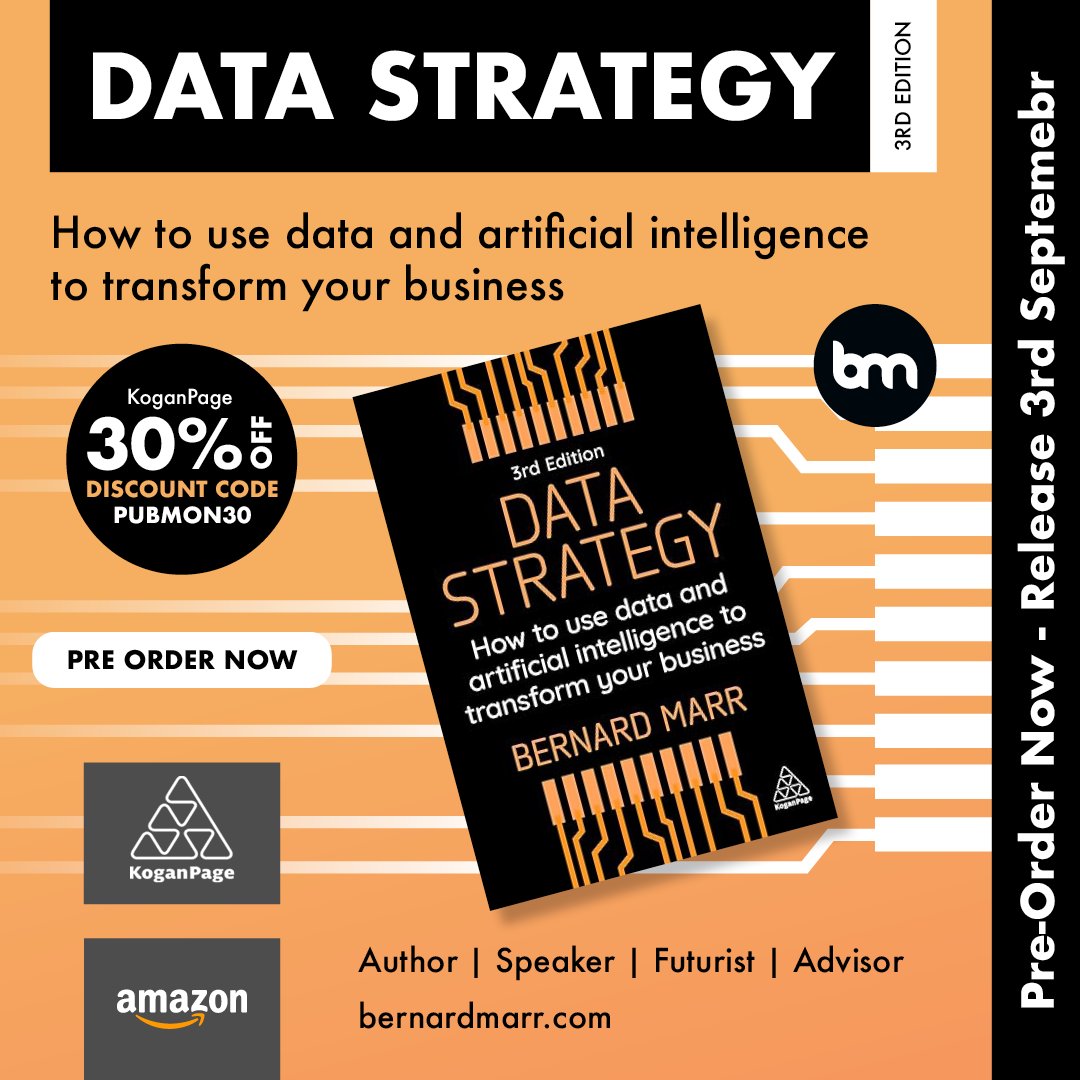
🚀 My New Book is Here: Data Strategy (3rd Edition) 🚀 I’m thrilled to share the release of my latest bestselling book, Data Strategy: How to Use Data and Artificial Intelligence to Transform Your Business. Every business today needs data to survive - but simply having data is not enough. What matters is how you use it. A well-designed data strategy is the key to unlocking value, driving insights, and giving your organisation the competitive edge it needs to thrive in the digital economy. From small organisations to global enterprises, I’ve seen first-hand how a data-driven approach can transform operations, improve decision-making, and unlock entirely new opportunities. That’s why I’ve poured my experience into this book — to help leaders and teams build strategies that don’t just talk about data, but actually deliver measurable impact. 🔍 In this third edition, I’ve expanded the book to reflect the latest developments in data and AI, including: ✅ Generative AI and its role in shaping business innovation. ✅ Synthetic data and how it can accelerate AI adoption. ✅ The potential of quantum computing and what it means for the future of data. ✅ Expanded guidance on cybersecurity, regulations, and ethics in a data-driven world. This isn’t just a theoretical framework - it’s a practical guide to collecting, managing, and using data effectively in order to drive growth, innovation, and long-term success. Whether you’re leading a start-up or a multinational, Data Strategy will equip you with the tools you need to stay ahead in a rapidly evolving landscape. 📖 Pre-order your copy today: 👉 Amazon - 👉 Kogan Page - I can’t wait to hear how this book helps you craft your own data-driven strategy and transform your business for the future.

Bernard Marr

10,980 görüntüleme • 11 ay önce

A Letter to Our Community: The Road Ahead for Robotics To our Community and Partners, As we step into 2026, our mission at Axis is clearer than ever: Constructing the definitive End-to-End Scaling Layer for Robotics. Our goal is to accelerate the transfer of diverse human intelligence into Robotics General Intelligence (RGI). By owning the critical path of intelligence creation, we are turning the physical limitations of robotics into a scalable, software-driven future. Here is our strategic outlook and roadmap for the year ahead. The Core Thesis: Simulation is the Only Way Out The path to RGI is currently blocked by Data Scarcity, Generalization Fragility, and Hardware Fragmentation. At Axis, we believe Simulation is the only way out. Our Simulation Data Platform and Data Augmentation Engine transform raw data into "Synthetic Gold". Backed by academic milestones like Roboverse, Skill Blending, and GraspVLA, we have proven that pure simulation can achieve the generalization required for the real world. We don’t just collect data; we architect it. The Engine: Why Crypto? We believe RGI should come from all, not a few. Crypto is not just a feature; it is the primitive that powers our entire ecosystem flywheel: - Incentive Mechanism: Democratizing contribution and rewarding the trainers and developers. - Assetization: Turning proprietary data and refined models into liquid, ownable assets. - Verifiable Workflow: We are opening the "Black Box" of AI. By bringing total transparency to the Task Generation → Data Collection → Model Training pipeline, we ensure every byte of intelligence is verifiable, traceable, and secure. 2026 Strategic Deliverables This year, we are committed to delivering three foundational pillars: - The World's Largest Training Dataset for Robots: A robot training set—diverse, high-quality interaction data at an unprecedented scale. - A Robotics Foundation Model: A universal robotic brain trained on our pure simulation and synthetic data, capable of robust cross-embodiment transfer and open-world adaptability. - Evolvable Robot Hardware: Robots deployed with Axis models that autonomously evolve through continuous interaction, turning every deployment into a self-improving node within our RGI network. The Ultimate Vision We are building more than models; we are architecting the Distributed Machine Economy. A future where every dataset, model, and robotic embodiment is a verifiable asset in a global, autonomous network. Thank you for building the future of intelligence with us✌️📷

Axis Robotics

27,858 görüntüleme • 6 ay önce

OptimAI Lite Node v1.1: Built for Scale, Designed for You! 💕 In just 2 weeks since the launch, the OptimAI Network has seen explosive growth—130,000+ active node participants powering the future of decentralized AI. With this incredible momentum came a new challenge: ensuring our network could scale seamlessly to support massive concurrent connections and real-time participation. That’s why we’ve rolled out OptimAI Lite Node v1.1—a major upgrade focused on: + Stabilizing infrastructure to handle high traffic from a global community. + Enhancing performance for smoother data mining, validation, and edge compute participation. + Refining user experience with UI updates that make contributing effortless. Every line of code and infrastructure upgrade was made with one goal in mind: to support YOU—the builders, validators, and visionaries of the OptimAI ecosystem. Now’s the time to bring more friends into the journey. 🔥 The more we grow, the smarter and stronger the network becomes—and the greater the rewards. Let’s keep building, validating, scaling. Together we’re not just powering AI—we’re reshaping how it’s built. Join or revisit the node here: 🌐 Chrome Extension: 📱Telegram Mini-App: What’s Coming Next: OptimAI Edge Node & the Rise of Agentic AI 🔸OptimAI Edge Node (Mobile) We’re working hard on the next major release: the Edge Node for mobile, which will allow mining and AI tasks to run in the background—unlocking more earning opportunities and decentralized compute power from your smartphones. 🔸More Task Types & Missions Expect new types of contributions, from AI-enhanced data validation to edge inference and scraping automation—powered by autonomous mining agents. 🔸Expanded Rewards Program As we grow, more reward tiers, bonuses, and campaigns will be introduced. Your participation now paves the way for long-term benefits. Also, do not forget to checkout our article below and learn more about our latest Community Tips & Best Practices!👇 __________________ OptimAI Network #L2 #DePIN Reinforcement Data Network for #Agentic #AI Mine Data. Fuel AI. Earn Rewards. Turn Your Data into Tomorrow’s AI #Agent. Visit our website at:

OptimAI Network

76,427 görüntüleme • 1 yıl önce

🚀 Introducing EgoExo Forge - built on top of Rerun, Gradio, and Hugging Face hub (I’ll be in San Francisco July 21–29 — if you’re into robotics, egocentric AI, large-scale data collection, or just want to chat, DM me!) In my opinion, large-scale, diverse, and high-quality data is still the largest bottleneck for generalized robotics deployment. I believe that some version of imitation learning from human examples will be the most scalable + clean way to train humanoid robots 🤖 (similar to what Tesla did for Full Self Driving). Teleop is too expensive to collect a large enough dataset in a reasonable manner, so passive collection via egocentric (and in certain cases, exocentric) views feels like the right bet. Over the past few months, I've been trying to build out the scaffolding for this and using Rerun as my underlying infrastructure. Data being collected needs to be easily inspectable + time series and rerun provides the right tooling for this. My goal is to first build out a ground truth representative dataset from already existing open source data, generate some reasonable baselines, and then go out and collect my own data that adheres to the defined schema. 🔍 Starting with open-source datasets 1. EgoDex from Apple 2. HOCap from Nvidia and the University of Texas at Dallas 3. Assembly101 from Meta All these different datasets have different sensor configurations + annotations, so my goal with egoexo-forge is to have one consistent labeling scheme + data layout. I built a data pipeline that aligns all of the different datasets in one general schema assuming the COCO133 keypoint layout that allows for exo+ego, ego only, or exo only Since the scaffolding is already there, it becomes MUCH easier to add other datasets. So the next ones that I'll be including are HD-EPIC kitchens dataset, HOT3D, and finally my own personal iPhone + insta360 go collection method. Once I have a diverse variety of datasets, I'll double down on what I believe to be the key algorithms required to make useful data for imitation learning 📊 1. Camera Pose estimation via SLAM/SFM for ego perspective (and automatic calibration for exo) 2. Human pose estimation for both egocentric + exocentric views 3. Metric 3D reconstruction + object tracking I'll be setting up reasonable open-source baselines for each of these to validate that these datasets work, and then finally try to use the generated datasets for some imitation learning via the pi0-lerobot repo I've been working on. I plan on making a blog post + providing more info on all of this in the near future so stay tuned

Pablo Vela

32,085 görüntüleme • 1 yıl önce