Загрузка видео...

Не удалось загрузить видео

На главную

Introducing the New WINBOT W3 OMNI, A Breakthrough in Robotic Window Cleaning! Vortex Wash, Industry’s First Contact-free Wiping Pad Washing Station Self-Cleaning, Consistently Fresh, Always Ready Dual Power Modes, Unlimited Flexibility Two-in-one Compound Cable with Both Safety and Power Cords Anti-Dropping Protection Mechanism Window cleaning has never been this effortless.

64,884 просмотров • 7 месяцев назад •via X (Twitter)

Комментарии: 0

Нет доступных комментариев

Здесь появятся комментарии из оригинального поста

Похожие видео

the (avengers) endgame of rank and rent is owning 6 spots in every search result in your city, and all the leads funnel back to you. become the thanos of rank and rent. here's the full network structure from this week: the setup is a pyramid. your main rank and rent (houston cleaning services) has a page for every sub-service. then each big sub-service ALSO gets its own dedicated rank and rent: houston airbnb cleaning, houston move-in cleaning, houston move-out cleaning. now you have two properties competing for the same keyword, your service page and the standalone EMD site. whichever one they click, the lead routes to you. that's how you go from ranking for searches to owning them. the reason this works right now is an arbitrage window. people search in chatgpt-length sentences now, "team of four for a spring cleaning of a 2,000 square foot house in houston heights." old rank and rents were one page targeting one keyword. these multi-page builds catch every long tail variation, and with AI you can one-shot the pages. EMDs plus citations plus tier twos does the rest. tristan said the quiet part: he hopes not too many people start doing this. then you stack the suburbs. katy is 20 minutes outside houston, so the whole pyramid repeats: katy cleaning services as the hub, sub-service pages on it, then dedicated sub-service rank and rents for katy too. eight sites became the houston core, and the suburbs compound it from there. maximum coverage of a niche within a city. works best in tier one and tier two cities, weaker in small towns where there's nothing to expand into. the build workflow has no magic prompt. tristan literally talks into his mic for ten minutes: "list every core service a concrete contractor gets called for, turn each into a sub-service rank and rent, list every reason someone searches each one, reverse engineer those into pages." codex lists it, the website builder builds it, and then the one part he refuses to automate: manually reviewing every site before launch. noindex tags, internal links pointing the right way, canonicals. one of the network sites went out noindexed. a second pair of eyes still beats a one shot. real talk on costs: one site is cheap, fifteen sites is a real monthly nut. domain renewals, callrail, citations for every property. the model still works the same way though, land one partner per site and you're profitable almost immediately on pay per lead. the leads aren't the hard part anymore. the partners are the constraint. and an offer got born live on the pod: free SEO retainers, the kind tristan charges $5K a month for, for local rank academy members. two conditions, you're a member and you're okay with your business becoming a public case study on youtube. deadline is end of month or until seats fill. backlinks, browser blasts, structure reviews, the same treatment the vet clinic got. ten public case studies running in the background is the plan. jacky's summary of local SEO after watching two businesses rip in real time: "if you can't do it, I swear something's wrong with you guys." the full rank and rent course also dropped today, free for all local rank academy members. full breakdown with Tristan Zheng | SEO Consultant. watch/listen ↓

Jacky Chou (buying online businesses up to $1m)

11,396 просмотров • 1 месяц назад

‼️‼️🇺🇲 BIG | The USA for the first time shot down a fiber-optic drone The American company Epirus reported a significant breakthrough in the field of countering drones. Its microwave system "Leonidas" for the first time hit a drone with fiber-optic control - one of the most difficult targets for modern electronic warfare means. Previously, the complex had already hit a swarm of 49 drones, but the new test was particularly significant. In December 2025, at a closed test range of the US Army, the system was able to disable a fiber-optic UAV, depriving it of control and causing an uncontrolled fall. Fiber-optic drones, which are widely used today, including in the Ukrainian theater of operations, do not use radio control channels. The signal is transmitted via a thin fiber-optic cable, which makes such drones extremely difficult to detect and suppress. In a report by the US Army in 2024, such drones were called "one of the main threats to air defense systems and anti-drone warfare". The CEO of Epirus noted that the mass spread of fiber-optic UAVs has become a turning point in the evolution of unmanned warfare and has revealed a serious gap in anti-drone defense systems - a gap that "Leonidas" is designed to close. In 2025, Epirus received a contract for $43.5 million for the supply of two second-generation "Leonidas" systems. Its range of destruction is more than twice that of the first version; a 30% increase in power; there are built-in high-energy batteries; a reduction in dependence on external power supply. The system can be installed on: Stryker 8×8 armored vehicles, light tactical vehicles, other mobile platforms. See the latest updates with us: Visioner

Visioner

55,027 просмотров • 8 месяцев назад

This Chinese developer linked two $2,999 NVIDIA DGX Sparks into one box and runs the full Qwen3-235B at home, after dropping his $1,999-a-month cloud bill to zero. He wired 2 small boxes into a single computer, split a giant 235-billion-parameter model in half between them, and serves it across his own network at about 10 tokens a second, with no internet, no cloud, right there on the desk. No data center, no thousand-dollar graphics cards, no monthly cloud bill. Just him, 2 gold boxes the size of a sandwich, one cable between them, and 1 power strip. And here is the whole payoff. He used to pay the cloud $1,999 a month for the same model, and the meter ticked on every request. Now he paid $5,998 once for 2 boxes, they covered their cost in 3 months, and after that he sends as many requests as he wants for free, only electricity. The two Sparks talk over one fast cable, each holds 128GB of memory, and together they carry the whole model, about 73GB loaded per box, with the chip inside pinned near the limit at 96%. Both boxes work as one and keep trading data over the cable, with no cloud in the loop and no single word leaking out. The ready model sits on one local address, and any app on his network calls it as easily as ChatGPT. And here is how he described, in plain words, what this pair of boxes does: "this is a pair of boxes that holds the huge Qwen3-235B model and serves it to one network. the model is split in half, and each box owns its half. parts: // Box 1 (holds the first half of the model and starts the answer fast, the first word appears in under a second) // Box 2 (holds the second half and writes out the rest, about 10 tokens a second) // Cable (connects the 2 boxes and moves data between them on every step, with no lag) // Address (one local address where any app sends its request, like to a cloud model) // Test (a script that runs big prompts through and measures speed and delays) // Monitor (checks temperature, power draw, and load on both boxes every 2 seconds). the model never goes to the cloud. he only steps in when a box runs hotter than 80 degrees or the cable between them starts dropping data." So the system knows exactly what it is, what it is for, and where its limits are. It knows it has to hold the whole huge model across 2 boxes on its own. It knows it has to answer every request locally, with no meter, no limits, and no internet. It knows the human is only needed when a box overheats or the link between them stalls. → The setup runs around the clock on 2 boxes, each pulling under 60 watts → However many requests he sends, the monthly bill is $0, only electricity → The first box starts the answer in under a second → The second writes text at about 10 tokens a second → One request at a time: 838 tokens in 85 seconds, first word in 0.8s → Two requests at once: 697 tokens in 108 seconds, first word in 0.7s → Both boxes sit at 96% load and warm up to 76-78 degrees And only when a chip in a box runs hotter than 80 degrees or the cable between the 2 Sparks drops data does the system call the owner. And when he himself is out on a run or in a coffee shop, he still reaches his own model at home from his phone: sends a big prompt to the local Qwen3-235B, gets the full answer back in under a minute and a half, with no token meter ticking and no limit to hit. Here is what the test shows on his screen during one of the night runs: "one request at a time: 838 tokens in 84.9 seconds, first word in 0.8s, then 0.1s per token." "two requests at once: 697 tokens in 107.6 seconds, first word in 0.7s, then 0.15s per token." "Box 1: chip at 96% load, 76 degrees, 56 watts, 73GB used in memory." "Box 2: chip at 96% load, 78 degrees, 56 watts, the Qwen3-235B model fully loaded." And while everyone around is paying for AI by the month and bumping into limits, his top-tier model just sits on the desk and works as much as he wants: his own little power plant instead of a forever meter. He has no server rack of his own and no cloud account behind it. Just 2 DGX Spark boxes on a desk, one model split in half between them, one local address, and a folder of prompts next to it. Out of everything I have seen this year, this is the cleanest way to stop paying for AI: $5,998 of hardware on the desk once, $0 a month to the cloud, unlimited forever, and between them 2 gold boxes, 1 cable, and the full Qwen3-235B answering at home with no internet.

Blaze

93,871 просмотров • 4 месяцев назад

The next two months put $IREN's entire pivot on one milestone. Horizon 1, its first GB300 super cluster at Childress, is targeted to hand off to $MSFT in Q3, roughly July through September, the opening delivery under the five year, $9.7 billion Microsoft contract and the point where that contract starts turning into revenue. For a year the company has been buying the hard things. Power, land, financing. Now it has to turn them into delivered compute. That is the whole test. "The world is structurally short compute, and the bottleneck is delivered data center and GPU capacity," said Daniel Roberts, Co-Founder and Co-CEO of $IREN. Horizon 1 is him putting that to the proof. Capacity nobody can energize is worthless. Capacity handed to a hyperscaler on schedule is the business. The rest of the window fills in around it. The Mirantis acquisition, signed in May, is pending close and adds the software layer to run the fleet. $3.1 billion of ARR sits under contract against a $4.4 billion target, so there is room for another customer, and management is openly chasing one. The $3.65 billion GPU financing that closed June 1 already funds most of the $MSFT hardware, with $NVDA and $DELL on the supply side. Sweetwater 1, energized in May, keeps ramping power behind all of it. The full year FY2026 results that put real numbers on all of this land just past the window, late August into September. The catalysts here are operational first, reported second. What makes that timeline credible is the record behind it. $IREN hit 50 EH/s on the schedule it set, energized Sweetwater 1 on schedule, and has Horizon 1-4 tracking for year-end. This is a team that keeps turning secured power into online capacity on time, and each build makes the next one faster. How many names in this AI buildout are actually delivering capacity on schedule, not just announcing it? It's not a sprint, it's a marathon.

Patient Investor

105,170 просмотров • 3 месяцев назад

INTRODUCING SYMPHONY REWARDS: SWAP, EARN, & POWER UP New Infrastructure Upgrade and Campaign Goes Live at ~1pm ET/5pm UTC tomorrow, Tuesday, October 14, 2025 Symphony Exchange ( was built to be the most efficient, intuitive, and transparent DEX aggregator on Sei. While we're still in the early stages of our journey, one thing has always been clear: our community deserves to be rewarded for participating in the ecosystem we’re building. Today, we're excited to introduce Symphony Rewards, a long-term incentive program designed to reward real traders, build loyalty, and track participation for future rewards, including future Symphony tokens. Rewarding You With $SEIYAN Although Symphony does not yet have a native token, we’re enabling rewards through our sister project SEIYAN on SEI, which will also serve as a foundation for future incentive programs. ~5,000,000 $SEIYAN has been initially allocated for Symphony Rewards in its current phase. 2 basis point rebate (value calculated at the time of your trade) is rewarded per swap, excluding stablecoin-to-stablecoins and wrapping/unwrapping. Rewards claimable weekly, subject to ongoing adjustments and updates to anti-cheating mechanisms (including protections against sybil and wash trading; excessive attempts may result in exclusion of the wallets) This current campaign phase starts mid-day on October 14th and will last until all rewards are distributed. Power Level: Your On-Chain Reputation Every trader on Symphony will have a Power Level, which represents your aggregate trade volume across the platform. Your Power Level is more than just a number -- it's a reflection of your activity, consistency, and contribution to the Symphony ecosystem. This metric will be used as a tracking mechanism for potential future rewards, including the eventual Symphony token and other partner initiatives. Major Product Upgrade Alongside the launch of Symphony Rewards, we’re introducing two key improvements to enhance your trading experience: -Portfolio & Activity Log: You can now view your on-chain holdings and trade history directly by clicking the wallet button after connecting. -Speed Boost: Our quoting system has been optimized for sub-second response times, ensuring faster and more reliable trade execution across supported pools: Average old version API response time: 2828.84ms Average new version API response time: 395.98ms This translates to a whopping ~2.5 second average time difference! The Road Ahead Symphony is committed to building a sustainable and community-driven liquidity layer for Sei. Symphony Rewards is just the first step in that journey -- a way to recognize early adopters and contributors who are helping us shape the future of DeFi aggregation on Sei. We will also continue to explore ways to integrate more tightly with SEIYAN on SEI as well as other tokens on Sei. Trade. Earn. Build your Power Level. And stay tuned -- the Symphony has only just begun.

Symphony Exchange

14,981 просмотров • 1 год назад

🚨 Zelensky blew a bombshell declaration The myth of unlimited power. For decades, the world lived under two opposite myths. One was that Russia possessed an almost unstoppable military machine. The other was that American power was virtually unlimited. Reality has been cruel to myths. Russia spent years projecting the image of the world’s second army. But when it stepped forward in Ukraine, the world discovered that propaganda, corruption, and nuclear threats had concealed profound weaknesses. Much of what looked like overwhelming power proved to be an illusion. Now another uncomfortable reality is emerging. President Zelensky revealed that the United States produces only about 60–65 PAC-3 anti-ballistic missiles per month. During the first day of the Middle East conflict, roughly two years’ worth of production was consumed in just 24 hours. This does not mean America is weak. It means that even the world’s strongest military-industrial power has limits. Factories have limits. Stockpiles have limits. Supply chains have limits. The lesson is not that the United States is declining, just as the lesson from Ukraine was never that Russia was powerless. The lesson is that dependence itself is a vulnerability. Europe cannot build its security on the assumption that America will always have enough missiles, factories, political will, or enough attention to fight multiple crises simultaneously. As Zelensky put it: “We need our own European independent strong system. And we will build it.” Because sovereignty is not a speech. It is the ability to defend yourself. #StandWithUkraine

Gianl1974

238,070 просмотров • 3 месяцев назад

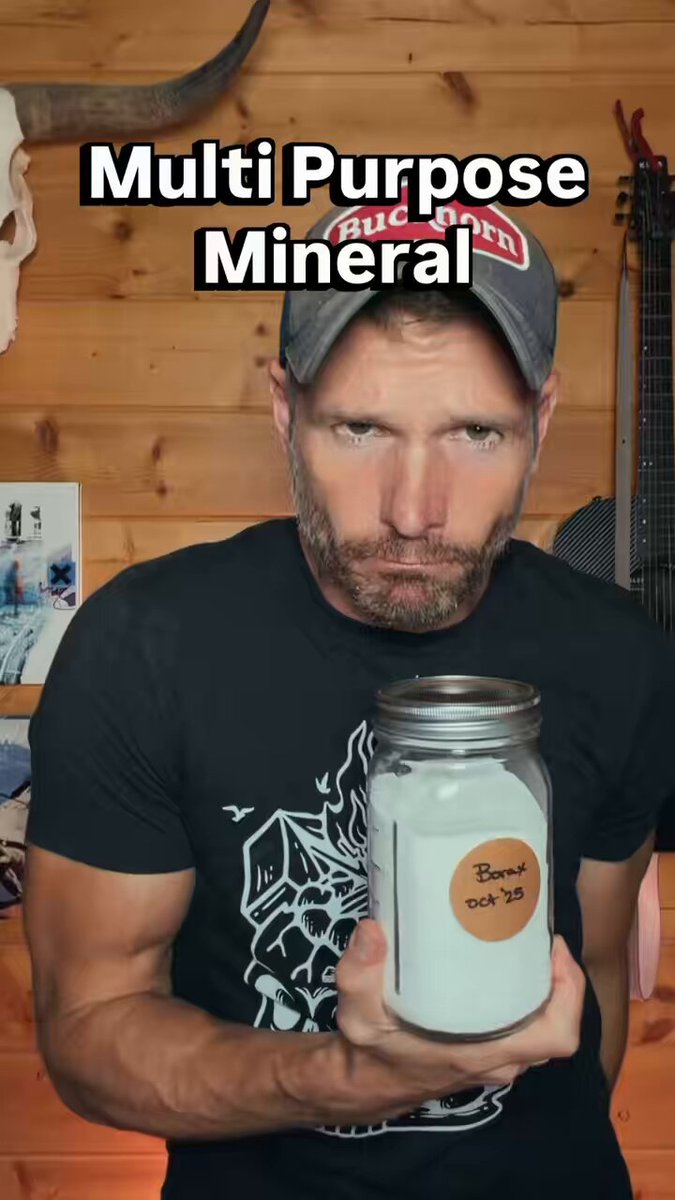
Borax. A mineral salt with indefinite shelf life and a long list of prep uses. Cheap, versatile, and worth stocking deep. What it does: Ant and roach killer. Highly effective. Here's how it works: borax damages the insects' digestive system slowly. It's slow, they carry the contaminated food back to the colony and share it before dying. The whole colony gets wiped out instead of just the visible bugs. Cheaper and more effective than most store bought pest control. Mold prevention spray. Dissolved in water, borax inhibits mold and mildew growth. Perfect for wood, canvas, fabric, and anywhere that gets damp and stays damp. Micronutrient for crops. Small amounts can address boron deficiency in garden soil. Careful though. Too much kills plants. Just the right amount adds needed micronutrients. Alkaline cleaning paste. Combined with baking soda and washing soda, borax creates one of the best homemade heavy duty cleaners. Cuts grease, baked-on food, and grime with real power. Shelf stable laundry formula. Softens water, boosts stain removal, and helps break down oils that regular detergent misses. You know exactly what's in it and it's incredibly effective. Odor stripping soak. For stinky clothes and towels. Removes the bacteria feeding on body oils trapped in fabric fibers. That's where the smell comes from, and this recipe (with washing soda) wipes it out. A few things worth knowing: Store borax sealed and dry. Moisture is its only enemy for storage. Indefinite shelf life when kept dry. Wear gloves in prolonged contact. It's caustic to skin over extended exposure. Don't confuse borax with boric acid. Both are useful but they're different compounds with different applications. Keep away from acids in storage. Neutralizes the compound and wastes both. Borax and many more compounds are covered in depth in the upcoming Prepper's Chemical Survival Guide. Pre-orders open now. 138 recipes, 230 pages, hardcover. Save money and be better prepared for what comes next.

Rob Benson

24,693 просмотров • 29 дней назад

Boston Dynamics just dropped the production-ready Atlas at CES 2026, and the specs are next-level. This isn't just a prototype; it's a rugged, enterprise-grade worker built for the grind of real-world factories.🤖🦾 With 56 degrees of freedom and fully rotational joints, Atlas moves with "superhuman" flexibility. It features human-scale hands with tactile sensing in every finger and palm, allowing for high-precision manipulation. Plus, its 360-degree vision system ensures it always knows who's approaching, keeping human-robot collaboration safe. ➤ Rugged Performance: Lifts up to 110 lbs (approx. 50kg) and operates in extreme temps from -4°F to 104°F (-20°C to 40°C). It’s even water-resistant for industrial wash-downs. ➤ Smart Endurance: Runs for 4 hours on dual swappable batteries. When power gets low, it autonomously heads back to the station to swap its own batteries and get right back to work. ➤ Cloud Intelligence: New tasks can be trained in less than a day. Thanks to the Orbit platform, once one Atlas learns a skill, it’s instantly shared across the entire fleet. The scale is massive: the entire 2026 supply is already spoken for by Hyundai and a new AI partner. Hyundai is also building a specialized "Robotics Metal Plant" and a new factory capable of churning out 30,000 Atlas units annually. We’re officially watching the birth of a humanoid workforce at scale. Source: Boston Dynamics & Hyundai Group

RoboHub🤖

28,554 просмотров • 9 месяцев назад