Loading video...

Video Failed to Load

Go Home

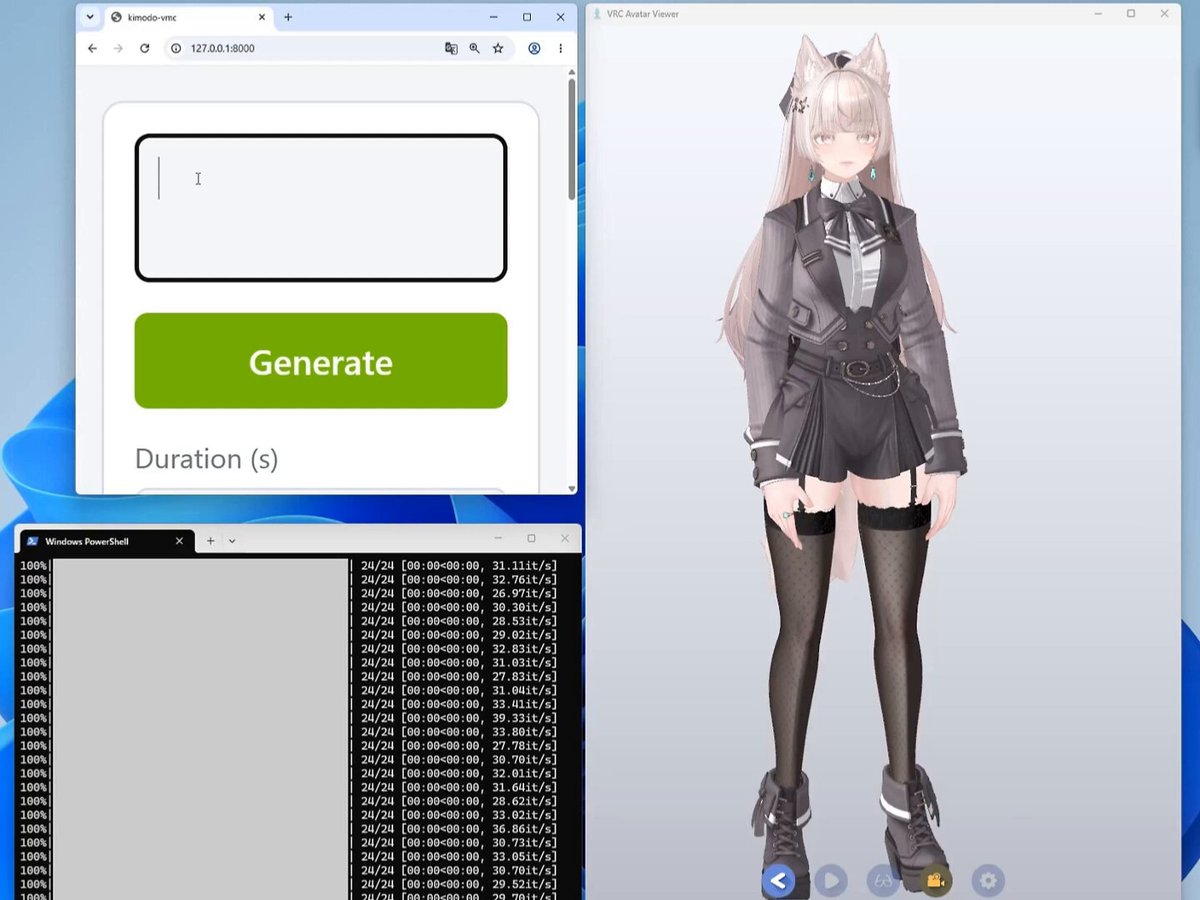
Introducing TopoTaxi: A completely new approach to real-time character motion. TopoTaxi opens a game-changing direction for real-time animation. Instead of selecting from prebuilt animation clips or blending between fixed movement states, TopoTaxi generates a continuously evolving performance from the character’s current intent, movement, posture, style, and environment. Locomotion such...

239,299 views • 6 days ago •via X (Twitter)

0 Comments

No comments available

Comments from the original post will appear here

Related Videos

🏃 Movement + Animation Update: Following feedback on the Official Trailer from December, we've been further tuning and polishing Stuffy's movement to make it more responsive and fluid. We hope this video is a promising glimpse of our much-requested progress in this area! What's New? - Stuffy is now ~10% smaller, granting more playable space and control (to accurately fit inside of a 'layered' segment, land tight jumps, etc.) - Stuffy's run speed was increased, and with better acceleration. - Stuffy now reacts to 'extreme' rising and falling velocities, so they'll flail around dramatically when popping out of a Blink Bubble, bouncing on a Trampoline, or falling from big jumps. - We've updated and added all-new animations and the method of blending them. This includes animations for idle jump and land, running jump and land, quick turn while running, and more. - We've increased Stuffy's max jump height, strength, and overall weight. - We've also increased the global gravity for less floaty physics. - A more visible drop shadow was added to help judge landing. Why these changes? From our own testing and public feedback, we realized the physics were not properly tuned after a big refactoring made in 2023... resulting in a floaty look. Sadly, the fixes weren't investigated in time for the trailer! Our goal was always to improve the animation blending and movement style. Thanks to your feedback, we were able to pinpoint the biggest problems and begin fixing them. 💖 Our work isn't done! You'll notice some bugs in the video. 🐞 We plan to continue polishing the movement with time, including new animations that help Stuffy react to the environment even better. However, this is a step in the right direction and it feels much nicer to use (and look at)! You'll also spot some of the Wardrobe in action!

Restitched 🧵🧸

17,161 views • 1 year ago

This kinetic sculpture, titled Nested Loops, hangs inside The National Museum of Mathematics (MoMath) in New York. It demonstrates exactly how higher-dimensional forms can emerge from the coordinated motion of simple elements moving through time. The circles are pathways of motion…timing mechanisms that guide anchor points along curved trajectories. As the mechanism rotates, strings stretched between these moving anchor points remain under constant tension. Because a taut string always forms the shortest path between two points, each string becomes a straight line, even though the points guiding it are traveling along curves! This is the key insight…circular motion is generating linear geometry. The loops create movement, the strings reveal structure, and as these relationships shift in coordinated time, the eye begins to perceive cubic forms like edges, diagonals, and vertices, all emerging from what is fundamentally a flat plane with moving parts. A cube does not need to be physically present to be perceived. It can be implied through the alignment of edges, the intersection of planes, and the convergence of perspective. What you’re witnessing is a dimensional emergence…a lower-dimensional system producing the visual signature of a higher-dimensional object through synchronized motion. Change the speed of one circle relative to another, and an entirely different geometric form appears. The same strings, the same frame…but a new structure emerges from the new rhythm. This is why the sculpture feels almost alive. It’s revealing that form is relational, temporal, and emergent, so what we perceive as solid objects are often just stable harmonies of moving relationships, frozen in a moment of coherence. This piece asks you to consider: What aspects of your reality are you perceiving as solid, when they’re actually just coherent patterns of motion temporarily aligned? Did this shift how you see structure and emergence? ✨🙌🏾💫 Artist © Chuck Hoberman (MoMath, New York)

🧬Maxpein🧬

48,005 views • 3 months ago

Not a preplanned motion sequence. A robot deciding mid-jump what to do next. [📍 paper + demo] Researchers just showed a humanoid doing real parkour using only onboard perception. No motion script, no fixed obstacle layout. The system is called Perceptive Humanoid Parkour (PHP). Instead of memorizing a path, the robot reads depth from its cameras and continuously chooses actions. Step, vault, climb, or roll depending on what geometry appears in front of it. To make that possible, they combine three ideas: First, they stitch together human motion clips into long movement references so the robot learns fluid transitions instead of isolated tricks. Second, they train tracking policies with reinforcement learning so contacts land at the right time and the robot keeps balance during dynamic moves. Finally, everything is distilled into one perception policy that runs directly from depth input to action selection. The result on a Unitree G1: about 3 m/s vaults wall climbs up to 1.25 m nearly one minute continuous obstacle traversal adapting when obstacles move What matters is not the tricks. It is the shift in capability. Earlier humanoids executed motions. This one navigates situations. Once robots react to geometry instead of replaying trajectories, environments stop needing to be predictable. Warehouses, homes, and outdoors suddenly become the same problem. Thanks for sharing, Zhen Wu! Paper + demo: ——— Weekly robotics and AI insights. Subscribe free:

Ilir Aliu

22,080 views • 6 months ago

What you’re seeing in this video is something no other smartphone can currently replicate besides Samsung, including the iPhone. Samsung Galaxy S26 Ultra, 4K 60fps HDR, fully handheld, with a smooth zoom transition from 1x to 2.9x. This is probably the closest thing to a professional camcorder-style zoom system on a smartphone today. Even the iPhone struggles to achieve this level of ultra slow, precise, and stable zoom movement. Most smartphones still rely on your finger movement to control zoom speed. The moment your finger slightly shifts, the zoom speed changes as well. Samsung’s approach is different. You simply hold your finger at a fixed position, and the phone continues zooming at a perfectly constant speed. It can move incredibly slowly, creating a much more linear and stable transition. The underlying logic is actually related to Samsung’s AI slow-motion technology. The core idea is real-time control over motion trajectory, speed variation, and frame-to-frame transition consistency. This is far beyond simply enlarging the image. The goal is to make the zoom feel continuous, smooth, and controllable throughout the entire movement. Right now, the only thing slightly interrupting the experience is the 3x telephoto switching point. When moving from 1x toward 5x, the lens transition breaks part of that seamless feeling. If the Galaxy S27 Ultra eventually removes the 3x telephoto camera, Samsung could potentially deliver a fully continuous and ultra smooth zoom transition from 1x all the way to 5x. For casual users, it may simply look “smoother.” For video creators, this is the kind of detail that creates a truly professional shooting experience.

Ice Universe

49,138 views • 3 months ago