Video yükleniyor...

Video Yüklenemedi

Ana Sayfaya Dön

Introducing Unsloth Desktop 🦥 The first desktop app to run and train models locally. • Open-source. Runs on Mac, Windows and Linux • Supports MLX, diffusion image/video, audio, GGUF • Connect Claude Code and Codex to local LLMs • 50% more accurate, self-healing tool calls + sandboxed code exec...

185,601 görüntüleme • 8 saat önce •via X (Twitter)

0 Yorum

Yorum bulunmuyor

Orijinal gönderinin yorumları burada görünecek

Benzer Videolar

Introducing Workshop: cloud + on-device agentic AI. And to celebrate, we're giving away $250k in Google Gemini AI credits. (details below). The future of AI work is neither cloud-based nor local. It's both. In Workshop Cloud, you can use agents powered by frontier models like Claude and/or open source models like Z.ai's GLM-5 to build internal tools, dashboards, and AI web apps. Or, breeze through tasks like managing your Google and Meta Ads. In Workshop Desktop, you can do all the same right on your computer, plus make desktop apps, mobile apps, and 3D creations. Our favorite part? You can power the full agent experience with local models like Qwen 3.5 family on your computer. Fully offline. 2026 is the year in which local models for agentic tasks will become viable for mainstream use. But the setup for tools like OpenClaw is like setting up Linux from scratch on your computer. Workshop Desktop is one-click to install on Windows, Mac, and Linux. It recommends which open source model you should use for your hardware and lets you download and run it right in the app. And its agent harness allows you to chat, create websites, build personal utilities, and analyze data. 100% offline. Or multitask with AI models in the cloud while running other agent threads locally. Start in Workshop Cloud when you want flexibility and speed. Download your project and continue in Workshop Desktop when you want local files, privacy, and/or better performance on large code bases. Publish from either. The agent tooling space is maturing and discerning users have come to expect a lot from their tools. We've packed Workshop with features to help you 10x your productivity. - Native support for skills - Autocompaction for seamless context management - Built-in AI for your apps - Dozens of connectors, like Google Drive, Big Query, and Supabase - dbt integration to ground your dashboards in your semantic layer - Native Github integration - Private app deployment - ... and more (+ we're shipping super fast) To access the free credit offer, RT this post and reply with "Workshop". Make sure you are following us so we can DM you the instructions to redeem. - First 100 to RT + comment get $500 in credits. - Everyone else gets up to $250 And thanks to our partners Modal, Google Gemini, and Z.ai!

Workshop AI

28,745 görüntüleme • 4 ay önce

New course: MCP: Build Rich-Context AI Apps with Anthropic. Learn to build AI apps that access tools, data, and prompts using the Model Context Protocol in this short course, created in partnership with Anthropic Anthropic and taught by Elie Schoppik Elie Schoppik, its Head of Technical Education. Connecting AI applications to external systems that bring rich context to LLM-based applications has often meant writing custom integrations for each use case. MCP is an open protocol that standardizes how LLMs access tools, data, and prompts from external sources, and simplifies how you provide context to your LLM-based applications. For example, you can provide context via third-party tools that let your LLM make API calls to search the web, access data from local docs, retrieve code from a GitHub repo, and so on. MCP, developed by Anthropic, is based on a client-server architecture that defines the communication details between an MCP client, hosted inside the AI application, and an MCP server that exposes tools, resources, and prompt templates. The server can be a subprocess launched by the client that runs locally or an independent process running remotely. In this hands-on course, you'll learn the core architecture behind MCP. You’ll create an MCP-compatible chatbot, build and deploy an MCP server, and connect the chatbot to your MCP server and other open-source servers. Here’s what you’ll do: - Understand why MCP makes AI development less fragmented and standardizes connections between AI applications and external data sources - Learn the core components of the client-server architecture of MCP and the underlying communication mechanism - Build a chatbot with custom tools for searching academic papers, and transform it into an MCP-compatible application - Build a local MCP server that exposes tools, resources, and prompt templates using FastMCP, and test it using MCP Inspector - Create an MCP client inside your chatbot to dynamically connect to your server - Connect your chatbot to reference servers built by Anthropic’s MCP team, such as filesystem, which implements filesystem operations, and fetch, which extracts contents from the web as markdown - Configure Claude Desktop to connect to your server and others, and explore how it abstracts away the low-level logic of MCP clients - Deploy your MCP server remotely and test it with the Inspector or other MCP-compatible applications - Learn about the roadmap for future MCP development, such as multi-agent architecture, MCP registry API, server discovery, authorization, and authentication MCP is an exciting and important technology that lets you build rich-context AI applications that connect to a growing ecosystem of MCP servers, with minimal integration work. Please sign up here!

Andrew Ng

142,010 görüntüleme • 1 yıl önce

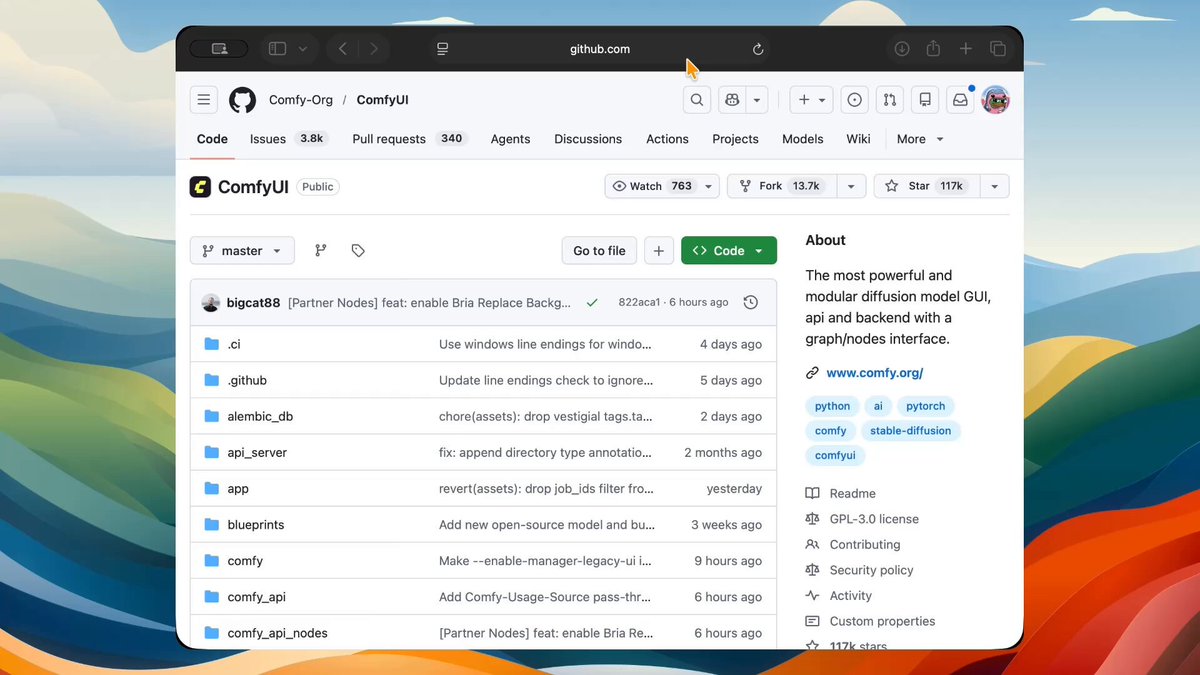
no money for grok or midjourney? this tool is for you. there's a FREE tool created by an anon dev. open-source. runs locally. 117k stars on github. it generates: > images & video > 3d models > audio > 20+ models here's how to set it up in under 5 minutes: 1️⃣download ComfyUI Desktop go to and grab the desktop app for your system. windows 10+, mac (apple silicon), or linux. it installs like any normal app, it sets up python and every dependency for you in the background. no terminal, no config files. 2️⃣open it first launch, it spins up its own environment automatically. you just wait a few seconds and you're in. you'll land on a node canvas, that's the whole interface. 3️⃣load a starter workflow top menu → Workflow → Browse Templates → Image Generation. click it. this drops a ready-made setup onto your canvas so you don't build anything from scratch. 4️⃣grab a model comfyui ships empty on purpose, the model is the brain, and you pick it. in the template, the "Load Checkpoint" node has a Download button when no model is installed. click it. it pulls one in for you (a few GB, this is the only real wait). 5️⃣install ComfyUI Manager this is the one add-on you don't skip. it lets you install models, custom nodes, and updates with a click instead of the command line. grab it from github (link in comments). it's the difference between fighting comfyui and flying in it. one honest note: an NVIDIA gpu makes this fast, apple silicon works great too, and a weak machine still runs it just slower. that's the whole setup. you now own an image, video, and 3D studio that costs you nothing per month. save this. and the next time grok or midjourney asks for your card. you won't need it. disclaimer: comfyui itself is 100% free. so are the local models (sdxl, flux, wan 2.2, ltx-2). some premium models like seedance are pay-per-use api models, only if you want top-tier quality. the free local ones cover most of what you need. (github link in the comments) follow and turn on post notification for daily AI contents.

m0h

14,542 görüntüleme • 2 ay önce

Your OpenAI and Anthropic weekly digest (Week 16, 2026) OpenAI announced Cloudflare Agent Cloud partnership with OpenAI frontier models including GPT-5.4, Agents SDK update with native sandbox execution and model-native harness, Codex update with background computer use, image generation, memory, automations, and 90+ new plugins, introduced GPT-Rosalind life sciences reasoning model in research preview, Trusted Access for Cyber partners with GPT-5.4-Cyber, shared ChatGPT tax queries data, life sciences usage report, and closed gender gap data, re-enabled Study mode in ChatGPT, ChatGPT keyboard shortcut customization, ads rollout on Free and Go plans in Australia, New Zealand, and Canada, TeenAegis AI Danger Index lowest risk score, and Kevin Weil (OpenAI for Science lead and former CPO), Srinivas Narayanan (CTO of enterprise applications), and Bill Peebles (head of Sora) departures, with OpenAI for Science decentralized into other research teams and Prism sunset folded into Codex Anthropic released Claude Opus 4.7, launched Claude Design in research preview by Anthropic Labs, introduced routines in Claude Code research preview for scheduled, API, and webhook-triggered automations, redesigned Claude Code desktop app for parallel agents, appointed Vas Narasimhan to Board of Directors by the Long-Term Benefit Trust, published Automated Alignment Researchers study on weak-to-strong supervision, and made Claude for Word available on Pro and Max plans

Tibor Blaho

11,057 görüntüleme • 3 ay önce