Загрузка видео...

Не удалось загрузить видео

На главную

Inviting early beta testers for our upcoming SWE agent, Asteria. We're solving AI code comprehension, where the context window and the size of your codebase are no longer limitations, and reinventing the UX of how coding agents are currently implemented. We initially built this to address false positives and...

12,408 просмотров • 1 год назад •via X (Twitter)

Комментарии: 0

Нет доступных комментариев

Здесь появятся комментарии из оригинального поста

Похожие видео

New course to bring you up to state-of-the-art at using AI to help you code: Build Apps with Windsurf's AI Coding Agents, built in partnership with WIndsurf (Codeium) and taught by Anshul Ramachandran! AI-assisted IDEs (Integrated Development Environments) make developers’ workflows faster, more efficient, and much more fun. Agentic tools like Windsurf are more than just code autocomplete—they are collaborative coding agents that help you break down complex applications, iterate efficiently, and generate code that spans multiple files. Although a lot of coding assistants share the same underlying large language models for planning and reasoning, a major point of distinction is how they handle tools, keep track of context, and stay aligned with your intent as a developer. For instance, if you make modifications to a class definition in your code and make the same modifications to other classes in the same directory, you might tell the AI agent "Do the same thing in similar places in this directory." Here, tracking your intent means understanding that “the same thing" refers to that recent edit you just made, which must be followed by appropriate search and tool-calling to implement the changes. In this course, you'll learn the inner workings of coding agents, their strengths and limitations, and how to use Windsurf to quickly build several applications. In detail, you'll: - Build a mental model of how agents work by combining human-action tracking, tool integration, and context awareness to carry out an agentic coding workflow. - Learn the challenges of code search and discovery and how a multi-step retrieval approach helps coding agents address them. - Use Windsurf to analyze and understand a large, old codebase and update it to the latest versions of the frameworks and packages it uses. - Build a Wikipedia data analysis app that retrieves, parses, and analyzes word frequencies. - Enhance the performance of your Wikipedia analysis app by adding caching, and through this, also learn how to course-correct when the AI agent produces unexpected results. - Learn tips and tricks such as keyboard shortcuts, autocomplete, and @ mentions to quickly call on agentic capabilities. - Use image/multimodal capabilities of the AI agent to increase your development velocity; you'll see an example of uploading a mockup with sketched-out UI features, and ask the agent to use that to build new functionality to an app. By the end of this course, you’ll understand agentic coding in-depth and know how to use it to make your development process much faster, more efficient, and enjoyable. Please sign up here!

Andrew Ng

139,803 просмотров • 1 год назад

🚀New Amazon Q Developer agent for software development is available to customers: This agent is based on a new agent architecture that has exciting results coming from the SWE-bench scores (on the full and verified benchmarks) representing AI models’ ability to resolve real-world coding problems. Interesting aspect of Q Agent is that with these newest updates, Q drove nearly 50% more successful coding tasks completed. What makes Q Dev Agent remarkable? The agent architecture is not just about using the best LLMs (which we do), but also giving the agent the ability to constantly explore multiple paths to find the best way to resolve a particular problem (and back tracking when it has reached dead end like a developer would do). Needless to say, we are just getting started on the developer agent and we are constantly pushing to advance our AI capabilities while maintaining quality, security, privacy, and reliability to keep Amazon Q Developer an innovative and trusted option available to our customers using agents for software development. We highlighted the results of our first SWE-bench submission of Amazon Q Developer back in June blog post; with these updates, our new agent resolves 51% more coding tasks than its previous iteration on the SWE-bench verified dataset, and 43% more on the full dataset. That’s the difference a few months make, and I can’t wait to share what our teams will deliver at re:Invent this December. Here's a quick demo showcasing our new Agent in action:

Swami Sivasubramanian

28,946 просмотров • 1 год назад

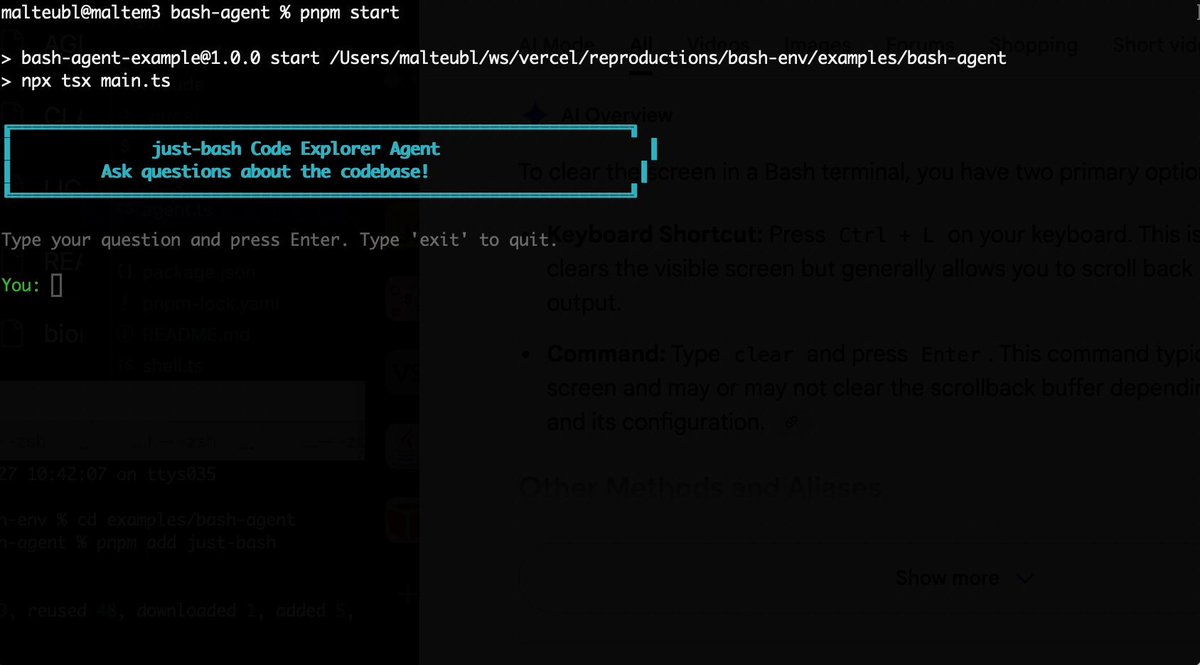
Bash is all you need! Which is why I'm introducing my holiday project: just-bash just-bash is a pretty complete implementation of bash in TypeScript designed to be used as a bash tool by AI agents. Because it turns out agents love exploring data via shell scripts, even beyond coding. It comes with grep, sed, awk and the 99th percentile features that an agent like Claude Code or Cursor would use. In fact, Claude Code can use it for secure bash execution. In the package - A bash-tool for AI SDK - A binary for use by yourself or your coding agents - An overlay filesystem to feed files to your agent securely - A Vercel Sandbox compatible API, so you can quickly upgrade to a real VM if you need to run binaries - An example AI agent that explores the just-bash code base using just-bash - I imported the Oils shell bash compatibility suite and just-bash passes a very good chunk What is interesting about this codebase: It was essentially entirely written by Opus 4.5. Coding agents love bash and they are good at reproducing it. They are also great at text-book recursive descent parsers and AST tweet-walk interpreters. That said, it is, like, a lot of code and I didn't read it all 😅. This is very much a hack, but it also seems to be _really_ useful. I haven't really found anything agents want to use that it doesn't support and it's fast and secure (caveats apply). It doesn't have write access to your computer and the filesystem is given a root that the agent cannot escape from. Find it at Related: Our recent blog post how we migrated our data analysis agent to bash tools and achieved incredible quality improvements The video shows the example agent investigating the just-bash code base

Malte Ubl

124,713 просмотров • 6 месяцев назад

8 rules to improve your AI coding agent. All of these rules work with Claude Code, Cursor, VS Code, and with most programming languages. Automating these rules will 10x the code quality and security produced by your AI coding agents. 1. Dependency checks - Prevent your agent from suggesting insecure libraries based on outdated training data. 2. Secret exposure - Auto-fix the use of hardcoded credentials introduced by your coding agent. 3. File and function size - Automatically refactor any files or functions that exceed a reasonable length. 4. Complexity and parameter limits - Simplify overly complex code written by the agent. 5. SQL Injection - Auto-fix all database interactions with unsanitized user input. 6. Unused variables and imports - Detect and remove dead code. 7. Detect invisible unicode characters in AI rules files - Remove zero-width spaces, direction overrides, and other invisible characters that can hide malicious behavior. 8. Insecure OpenAI API usage - Enforce use of secure OpenAI endpoints, proper authentication, and context isolation Here is how you can automate this: Install the Codacy extension. This will give you access to a CLI for local scanning and an MCP server for agent communication. From here on out, every time you need to generate some code: 1. Your agent will write the code 2. It will then call Codacy's CLI to check it 3. It will find any issues in real time 4. Your coding agent will fix the issues 5. When the code passes all checks, you are done Level of effort on your side: literally zero! Code quality and security because of this: 100x better! Here is the link to download the extension for your IDE: Thanks to the Codacy team for collaborating with me on this post.

Santiago

49,331 просмотров • 8 месяцев назад

New short course: Evaluating AI Agents! Evals are important for driving AI system improvements, and in this course you'll learn to systematically assess and improve an AI agent’s performance. This is built in partnership with Arize AI and taught by John Gilhuly, Head of Developer Relations, and , Director of Product. I've often found evals to be a critical tool in the agent development process - they can be the difference between picking the right thing to work on vs. wasting weeks of effort. Whether you’re building a shopping assistant, coding agent, or research assistant, having a structured evaluation process helps you refine its performance systematically, rather than relying on random trial and error. This course shows you how to structure your evals to assess the performance of each component of an agent and its end-to-end performance. For each component, you select the appropriate evaluators, test examples, and performance metrics. This helps you identify areas for improvement both during development and in production. (If you're familiar with error analysis in supervised learning, think of this as adapting those ideas to agentic workflows.) In this course, you'll build an AI agent, and add observability to visualize and debug its steps. You’ll learn about code-based evals, in which you write code explicitly to test a certain step, as well as LLM-as-a-Judge evals, in which you prompt an LLM to efficiently come up with ways to evaluate more open-ended outputs. In detail, you’ll: - Understand key differences between evaluating LLM-based systems and traditional software testing. - Add observability to an agent by collecting traces of the steps taken by the agent and visualizing them - Choose the appropriate evaluator - code-based, LLM-as-a-Judge, human-annotation based - for each component. - Compute a convergence score to evaluate if your agent can respond to a query in an efficient number of steps. - Run structured experiments to improve the agent’s performance by exploring changes to the prompt, LLM model, or the agent’s logic. - Understand how to deploy these evaluation techniques to monitor the agent’s performance in production. By the end of this course, you’ll know how to trace AI agents, systematically evaluate them, and improve their performance. Please sign up here:

Andrew Ng

126,406 просмотров • 1 год назад