Loading video...

Video Failed to Load

Go Home

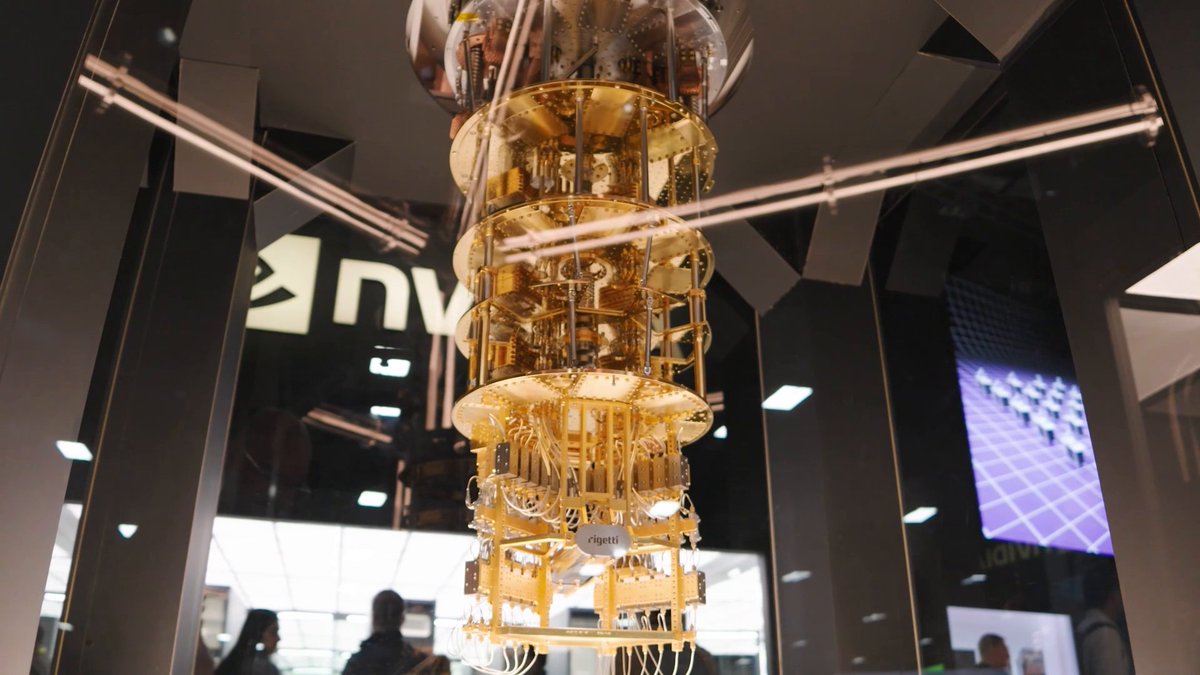
IonQ brought applied quantum networking to #iQuHack2026 at Massachusetts Institute of Technology (MIT), challenging students to simulate the future of the quantum internet. Amazing array of talent using real-world concepts like entanglement distillation. #QuantumComputing #QuantumInternet #STEMCareers

19,658 views • 4 months ago •via X (Twitter)

0 Comments

No comments available

Comments from the original post will appear here

Related Videos

🚨 SCIENTISTS JUST DETECTED QUANTUM ENTANGLEMENT IN A CENTIMETER-SIZED PIECE OF METAL SOMETHING ONCE THOUGHT IMPOSSIBLE AT THIS SCALE. Researchers at the Vienna University of Technology have found clear evidence of high-degree quantum entanglement among particles inside a macroscopic crystal of a “strange metal” made of cerium, palladium, and silicon. This is one of the first times multipartite entanglement has been convincingly demonstrated in a solid object large enough to hold in your hand. Strange metals are already bizarre their electrons don’t behave like normal individual particles. Now it appears large numbers of them can act as a single, highly entangled quantum system even at everyday scales. Why this matters: • Quantum entanglement has almost always been limited to tiny numbers of particles in carefully isolated lab conditions • This experiment shows entanglement can persist collectively across a visible, macroscopic object • It was measured using neutron scattering, which revealed the material responding as one entangled system rather than many independent particles • This bridges the gap between microscopic quantum effects and real-world materials The deeper implication: For decades, physicists have wondered whether the strange, collective behavior seen in certain quantum materials could be explained by underlying entanglement. This result strongly suggests the answer is yes even at scales we can see and touch. It doesn’t mean your coffee mug is in a quantum superposition, but it does show that quantum correlations can dominate the physics of certain solids in ways we’re only beginning to understand. This kind of macroscopic quantum behavior could eventually help us design new materials with exotic properties, or give us new tools to study fundamental questions about quantum mechanics itself. How do you think discovering entanglement at this scale changes our understanding of where the quantum world ends and the classical world begins? Follow for more frontier quantum physics and materials science.

TheNewPhysics

17,001 views • 10 days ago

🚨 AI JUST DISCOVERED QUANTUM EFFECTS THAT SCIENTISTS DIDN'T KNOW EXIST. Researchers at the University of Washington used artificial intelligence to simulate dozens of atomically thin sheets of molybdenum ditelluride stacked in precise twisted patterns. At small scales, these materials look relatively ordinary. But when the AI modeled much larger stacks, completely new quantum behaviors emerged phenomena that only exist because of the complex, repeating moiré patterns formed across many layers. Why this matters: • Many of the most interesting quantum effects only appear at scales that are too large for traditional supercomputers to simulate • AI can act as a fast “surrogate” that learns from smaller calculations and predicts behavior at much bigger scales • These large-scale moiré systems can host exotic quantum states useful for quantum computing and new types of electronics • The same approach could be used to discover many other hidden quantum materials The deeper implication: We are entering an era where AI doesn’t just help us analyze data it helps us discover entirely new quantum phenomena that were previously invisible because they only exist in systems too complex for conventional modeling. This could dramatically speed up the search for materials that power future quantum technologies. What do you find more exciting using AI to uncover hidden quantum effects in materials, or the possibility that these stacked atomic sheets could become building blocks for future quantum computers? Follow for more frontier quantum materials and AI-driven discovery.

TheNewPhysics

29,224 views • 20 days ago