Video wird geladen...

Video konnte nicht geladen werden

Zur Startseite

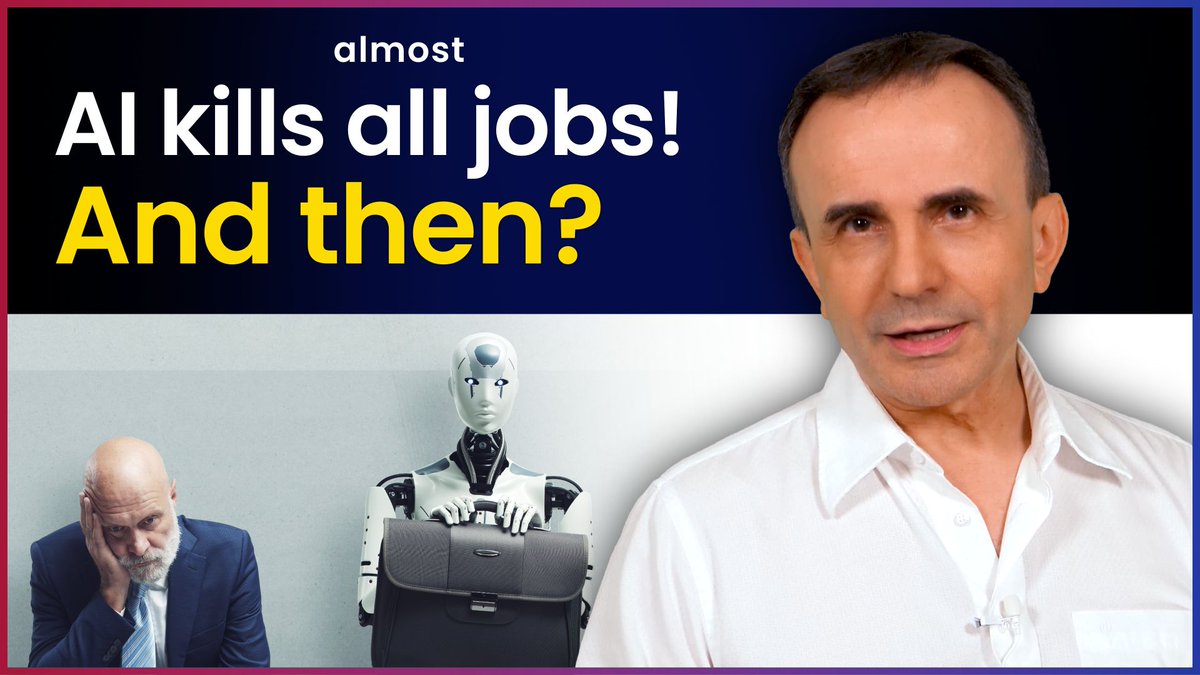
Is robotics a blessing or a curse for the workforce? What doesn’t work: 1. Believing automation only "steals" jobs. 2. Ignoring the real labor shortages. 3. Overlooking unsafe, repetitive tasks humans are forced to do. What does work: > Solving highly repetitive and ergonomically harmful jobs. > Tackling labor...

27,169 Aufrufe • vor 15 Tagen •via X (Twitter)

0 Kommentare

Keine Kommentare verfügbar

Kommentare vom Original-Post werden hier angezeigt
Ähnliche Videos

OPTIMUS: TESLA’S HUMANOID ROBOT IS ABOUT TO TRANSFORM LABOR & ABUNDANCE Optimus isn’t just a cool prototype—it’s Tesla’s bet on solving the biggest economic constraint of the future: physical labor shortages. Designed from the ground up as a general-purpose humanoid, Optimus will handle unsafe, repetitive, or boring tasks at scale, freeing humans for higher-value work and accelerating abundance across industries. Key impacts already in motion: •Factory deployment — Early units are performing real tasks at Tesla Gigafactories, proving reliability in chaotic, real-world environments. •Dangerous & dull jobs — Welding, heavy lifting, sorting, cleaning hazardous sites—Optimus takes the risk so people don’t have to. •24/7 productivity — No fatigue, no breaks, no unions—constant output that scales with demand. •Home & care applications — Helping the elderly, assisting with disabilities, or handling household chores—turning science fiction into everyday reality. •Economic multiplier — When humanoid robots become cheaper than human labor, costs collapse in manufacturing, logistics, agriculture, and services—unlocking massive productivity gains and lower prices for everyone. From first walking demos to factory trials, Optimus is progressing faster than most realize. It’s the physical embodiment of Tesla’s AI + robotics vision: a world where physical work is abundant, safe, and optional. Which Optimus application excites you most—factory scaling, elder care, or seeing it cook breakfast? The age of humanoid helpers is closer than you think. 🤖⚡🚀

Tesla Owners Silicon Valley

46,045 Aufrufe • vor 6 Monaten

Just in case you forgot: Trump wants to give every F1 Visa holding Foreign Student who graduates from an American college (even jr. college) a Green Card. Not a temp work visa - he wants to give them permanent residency which also means the ability to apply for citizenship. Facts: There are about 11 million 'Degreed Stem' Jobs in the U.S. Between foreign born citizens and foreign work visa holders, about 7.5 million of those jobs are already held by foreigners. There are about 4.2 million native born Americans working in these degreed STEM jobs today. We are already a minority in degreed STEM jobs. There are 12 million American citizens with STEM degrees not working in STEM. How many degreed STEM jobs does Trump think there are? Fyi, you'll often hear numbers for STEM jobs in the 30-35 million range. But that includes nurses, electricians, electronics technicans and many important but lower level jobs. When it comes engineers and scientists. there are only about 11 million jobs available. Why does Trump believe we can just flood in and endless supply of foreigners into the STEM workforce? With 1.2 million F1 visa holders here, the numbers just don't work. Note that he's speaking with the Tech Bros on this podcast. They fill his head with endless lies about shortages and skills gaps. But he never seems to ask: How did we build the entire tech world here in the U.S from the '50s through to the late '90s with mostly American engineers and scientists? There was never a shortage. Rather, what we did is crowd Americans out of universities and entry level jobs. Now the labor market for these jobs is filled with the foreign born. It makes me sick to my stomach listening to him prattle on like this.

War for the West

68,342 Aufrufe • vor 6 Monaten

A Few Thoughts on Robotics The criticism that robotics can only be used in a rather one-sided way is, at the same time, the solution to the problem. What do I mean by that? Since the Industrial Revolution, humanity has increasingly made production methods more efficient. Fordism introduced assembly line work, but this comes at the expense of monotonous, repetitive tasks. On the one hand, immense wealth has been created; on the other hand, countless people suffer from repetitive tasks, which are a direct consequence of that industrial revolution and the division of labor- in other words, assembly line work. The debate about whether AI and robotics could impact the labor market is answered in different ways. I have a clear opinion on this: Up to now, technology has merely been an augmentation, an improvement of human labor to make it more effective. Robotics and AI, however, represent a qualitative break with this situation. For the first time in human history, it won't be humans who become more efficient, but rather replaceable, insofar as human augmentation becomes *less* efficient than replacing human labor with robotics. In just a few years, a human using technology will simply be less efficient than a robot that doesn't know an eight-hour day, weekends, or holidays, but can perform monotonous tasks 24/7 on an assembly line without breaking down due to physical ailments or needing medical attention. Wear and tear simply means replacing specific parts of the robot. To return to the initial question: production doesn't require general-purpose robots capable of performing a wide variety of tasks, but rather specialized robots that excel at the specific tasks for which they are needed. Figure02 vividly illustrates why this is only now possible: even the simplest assembly line work still requires delicate manual dexterity because the production line is designed for human hands. This breakthrough has now arrived, but AGI (Automated Generating Intelligence) isn't necessary for robots to be used in production processes. It's sufficient that they can perform monotonous tasks. And that's why I believe 2026 will be the year of the robots. (Clip: Figure02 in production chain at BMW Car-production)

Chubby♨️

15,228 Aufrufe • vor 8 Monaten

Dr. Roman Yampolskiy just predicted 99% unemployment by 2032. The leading AI safety researcher and cybersecurity expert laid out a timeline that's hard to ignore: AGI by 2027, and then five years later, the economy as we know it. Here's his logic: "If you have this concept of a drop-in employee, you have free labor, physical and cognitive, trillions of dollars of it. It makes no sense to hire humans for most jobs." The math is brutal when a $20 subscription does the same work as an employee. Yampolsky breaks it into two waves: Wave 1 — Cognitive labor (now → 2027) "Anything on a computer will be automated." Writing, coding, analysis, design, customer service. Gone. Wave 2 — Physical labor (2027 → 2032) "Humanoid robots are maybe 5 years behind." Once AGI arrives, the robots follow. Then there's nowhere left to hide. "We're looking at a world where we have levels of unemployment we've never seen before. Not talking about 10% unemployment, which is scary, but 99%." The only jobs that survive? "Jobs where for whatever reason you prefer another human would do it for you." Think about what that list actually looks like — it's devastatingly short. Most people are sleepwalking into this while the AI conversation stays stuck on productivity gains, not on what happens when hiring humans becomes economically irrational. Yampolsky is predicting total replacement of the human workforce as we know it. If 99% unemployment arrives by 2032, most people have less than 7 years to figure out what they're building their life around.

Big Brain AI

87,458 Aufrufe • vor 5 Monaten

The End of "Work": US Schools & Learned Obscelence, Why Value Creation Is the Only Survival Strategy ​In this video, we break down the Job Apocalypse from a first-principles perspective. Traditional education and corporate training have prepared us for repetitive tasks, rote memorization, and circular thought—the exact domains where Large Language Models (LLMs) and AI agents now exceed human performance. ​Why AI wins the "Job" game: ​Economics: Faster, cheaper, and infinitely scalable. ​Risk Mitigation: No sick days, no fatigue, and zero discriminatory lawsuits. ​Performance: AI doesn't just do the task; it evolves the process. ​The Contrarian Pivot: Value Creation over Labor ​Staying relevant isn't about working harder; it's about disruption mapping. If you are doing a job an LLM can do, your goal should be to figure out how to automate yourself out of that position. By "obsolescing" yourself, you move from being a cog in the machine to owning the infrastructure that replaces it. ​In this video, we discuss: ​The transition from repetitive labor to Value Creation. ​Why the "Windshield vs. Rearview" mindset is the difference between winners and losers. ​How to position yourself as the "funnel" for value distribution in the age of AI. ​Key Takeaway ​Stop thinking about who you can work for and start thinking about how you can create value for yourself and your family. The economy is retooling. Are you?

Reggie Middleton, Disruptor-in-Chief

12,999 Aufrufe • vor 6 Monaten

Amazon to lay off 600,000? There’s been a lot of noise floating around about Amazon laying off 75% of its workforce. On the surface, it looks like a baseless rumor. But after digging past the initial chatbot denials, the truth is, as usual, more complex and more significant. The “75% layoff” rumor stems from a leaked internal document, reportedly from Amazon’s robotics division. And no, they aren’t planning to lay off 75% of their entire workforce tomorrow. The reality, however, is a clear, data-driven strategy to aggressively automate the company at every level, from the warehouse floor to the corporate office. These leaks are a rare, honest glimpse behind the corporate curtain. They confirm what many of us have been saying for a long time: the story you hear publicly is not what is being discussed behind closed doors. Here’s a breakdown of what the leaked strategy reveals. The “Damage Control” Memo: What the Leak Reveals The 75% figure isn’t about people but processes. The Amazon robotics team is reportedly working toward a goal of automating 75% of the company’s operational processes. This goal is supported by several other staggering numbers: 160,000 Warehouse Roles Cut: The plan aims to eliminate 160,000 warehouse roles by 2027. 600,000 Avoided Hires: Perhaps more significant is the goal to avoid hiring 600,000 new workers by 2033. This will be achieved through attrition, hiring freezes, and replacing human-centric processes with automation. 30,000 Corporate Jobs: This isn’t just about blue-collar roles. The CEO, Andy Jassy, has been explicit that generative AI is expected to reduce the corporate workforce. The current round is targeting ~30,000 jobs in divisions like HR and PXT (People, eXperience, and Technology—Amazon’s HR wing). This isn’t a new direction for Amazon, which already operates over a million robots. But those are mostly “oversized Roombas” shuffling bins in highly controlled environments. A Quick History Lesson: Robotic automation in controlled environments is decades old. I remember seeing a robotic arm in a data center in the early 90s that managed a tape library. It was adapted from a car assembly line, safely in a cage, just picking up and putting down standardized tapes. What we’re seeing now is the next leap: automation moving into dynamic, complex, and administrative tasks. The new plan is about expanding automation’s capability, driven by modern AI and robotics that can handle tasks previously reserved for humans. By 2033, AI will be orders of magnitude more capable, and we will likely have millions of humanoid robots. Amazon is building the foundation for that future today. Follow the Money: $12.6 Billion in Savings Why the aggressive push? The financial incentive is massive. The leaked report estimates these automation efforts will save the company $12.6 billion in labor costs by 2027 alone. This breaks down to an average saving of 30 cents per item shipped. When you’re a company that ships billions of items, that 30 cents isn’t just a rounding error—it’s the entire financial motive. This is the cold, hard math of post-labor economics. Human capital is expensive. Automation, once the capital expenditure is paid, is not. How to Talk About Automation (Without Talking About It) One of the most telling parts of the leak is the section on public relations and messaging. The strategy reportedly included language advising staff to avoid terms like “automation” and “AI.” Instead, they were encouraged to use softer terms like “advanced technology” and “cobots” to suggest partnership instead of replacement. This is a classic corporate messaging strategy. It’s unpopular with employees and consumers to talk about replacing jobs. The only people who love to hear it are on Wall Street, where stock prices jump on news of layoffs because it signals lower operating costs. The other pillar of this PR strategy is to focus on “upskilling.” Amazon’s public defense consistently highlights its programs to upskill employees for higher-paying positions in robotics maintenance and engineering. The problem, as critics note, is that the number of new technical roles created is minimal compared to the hundreds of thousands of lower-skilled jobs being eliminated or avoided. This is the exact dynamic of a heavily automated economy: yes, new job categories are created, but they are far smaller and require a skill set that most of the displaced workforce does not have. The AI Red Pill vs. The AI Blue Pill As a society, we are not having an honest conversation about this transition. The Overton window is broken. Your average citizen either: Doesn’t believe AI and robotics can really take all the jobs. Believes it, but thinks the solutions are impossible and that imagining a better future is futile. I refuse to accept either position. This is the choice I call the AI Red Pill versus the AI Blue Pill. The Blue Pill comes in many forms: “AI is going to kill everyone.” “AI is just a stupid fad.” “The future is techno-feudalism, and you will own nothing and be happy.” The Red Pill is waking up to reality: Yes, hyper-abundance of cognition is coming. Yes, superintelligence is coming. Yes, humanoid robots that are better, faster, cheaper, and safer than humans are coming. And guess what? It’s going to be glorious for humanity. It will be a future where, instead of having to work to survive, any work you do is out of pure joy. This requires a critical distinction: Work: Anything that requires effort (climbing a mountain, running a marathon, growing a garden). Labor: Work that you get paid for. We are headed for a post-labor economy, not a post-work one. The labor is what’s being automated. This Amazon leak is just one more piece of evidence. This hyper-abundant future isn’t a foregone conclusion, and it won’t be easy. But there is a “golden path” to a future where work becomes optional. The first step on that path is to have the honest, clear-eyed conversation that corporations are trying so hard to avoid.

David Shapiro ⏩

17,683 Aufrufe • vor 9 Monaten