Загрузка видео...

Не удалось загрузить видео

На главную

I’ve been asked if external SSD works ? Here is M4 Pro 24GB running MinMax 2.7 @ 7.7 fps Unsloth AI quant IQ2_XXS @ 73GB MOE_TOPK=4, --moe-slot-bank 48, It's using ACASIS USB4v2 80 Gbps enclosure with “budget” T710 1TB Gen5 SSD over TB5 connection. I’m also testing different enclosure...

18,597 просмотров • 4 месяцев назад •via X (Twitter)

Комментарии: 0

Нет доступных комментариев

Здесь появятся комментарии из оригинального поста

Похожие видео

Deepseek V4 Flash 0731 (Q2) - 12 tokens/sec - Single RTX 4090 - 650+ tokens/sec prefill - 250k context - no kv cache quantization! DeepSeek just dropped the official V4 Flash 0731 two days ago with a massive agent capabilities upgrade. The official benchmarks are literally crushing their own V4-Pro-Preview on agentic tasks like Terminal Bench 2.1 and DeepSWE. Unsloth AI said they couldn't wait to bring it to local devices, and they delivered. If you thought my 118B Poolside Laguna S 2.1 MoE run last week on a single GPU was wild, hold onto your hardware. I just successfully ran Unsloth’s brand new 91GB DeepSeek-V4-Flash-0731 (UD-IQ2_M) GGUF entirely locally. And I pushed it to a mind-bending 250,000 context window. The VRAM ceiling is an illusion if you know how to optimize llama.cpp. Here are the benchmarks and the cheat codes to run a local frontier class model yourself. For the hardware and setup, I used a single NVIDIA RTX 4090 (24GB VRAM) hooked up via a PCIe 4 bus, running Ubuntu 22.04 LTS and CUDA 13.0. You don't need a massive enterprise server for this, if you have more than 80 GB of standard DDR4 RAM and a 24GB card like an RTX 3090 or 4090, you can run this exact stack yourself. All benchmarks were run using a massive 28k token prompt to truly stress test the prefill limits. no kv cache quantization THE BENCHMARKS (Scaling Context): # 80k Context (Baseline: -b 2048 -ub 2048): Prefill: 465.43 t/s | Decode: 13.00 t/s | VRAM: 22.87 GB # 80k Context (Optimized: -b 4096 -ub 4096): Prefill: 643.15 t/s | Decode: 12.20 t/s | VRAM: 23.00 GB (Notice how doubling the batch flags spiked my prefill throughput by nearly 200 t/s with almost zero VRAM penalty) # 180k Context (-b 4096 -ub 4096): Prefill: 629.18 t/s | Decode: 11.92 t/s | VRAM: 23.40 GB # 250k Context MAXIMUM (-b 4096 -ub 4096): Prefill: 619.02 t/s | Decode: 11.54 t/s | VRAM: 23.40 GB # THE SECRET SAUCE (Why this works): Unsloth’s UD-IQ2_M quant is ~91GB across 3 files. Since I only have 24GB of VRAM, the PCIe 4 bus and system RAM have to do the heavy lifting. The magic bullet is the --no-mmap flag. By completely bypassing OS disk paging, I forced llama.cpp to load the massive model weights directly into the system RAM upfront. Combined with Flash Attention (-fa on) and exactly 12 CPU threads (--threads 12), I maintained an incredibly stable 11.5+ tokens/sec decode speed even at a quarter million token context. # THE EXACT COMMAND: ./build/bin/llama-server -m /workspace/models/DeepSeek-V4-Flash-0731-UD-IQ2_M-00001-of-00003.gguf -c 250000 -fa on --port 8080 --threads 12 -b 4096 -ub 4096 --no-mmap -v Local conversational and agentic coding AI is fully here. You don’t need an API or an H100 cluster. Qwen 3.8 27b drops next week making the 24GB VRAM tier even more worthwhile. What does your current local AI rig look like, and what's the craziest model you've managed to squeeze into it? Official huggingface GGUF links from Unsloth and performance graphs are dropped in the replies below!

Alok

46,022 просмотров • 1 месяц назад

After years of being absolutely tortured by expensive ad creative pipelines, I think I finally found the ultimate savior for brand growth. Most AI video tools are great at generating flashy but random clips. The real challenge starts when you need to produce high-converting ecommerce content at scale without burning your budget. I’ve been testing Wizstar_official, and it honestly feels less like a simple AI generator and more like serious production infrastructure for scaling digital businesses. What stood out to me is how their ecosystem completely automates the two biggest bottlenecks in growth marketing: Bulk Testing and Creative Adaptation. First, their Agent setup paired with Fast Mode is a cheat code for volume. Instead of spending days scripting and storyboarding, the system intelligently extracts your product selling points, writes algorithm-friendly influencer scripts, and batch-produces massive ad variations in one day. It’s ultra-low-cost, built for rapid listing, and keeps your brand logos and product textures 100% consistent and lossless across the board. Second, the Video Reference workflow is an absolute game-changer. Instead of rebuilding every ad from scratch or guessing what works, you can reference any existing successful e-commerce video. The AI reverse-engineers its exact pacing, structure, camera movement, and storytelling style, and applies that winning DNA to a completely different product. That completely changes the production workflow from: prompt → random output into something closer to: reference → structured production → scalable content system Under the hood, Wizstar doesn't just rely on one platform; it supports flexible multi-model orchestration. Driven by their newly integrated Seedance 2.0 engine, it allows direct face input, meaning your character consistency and scene continuity stay rock-solid with absolutely none of that creepy AI face warping across complex cuts. If you are running global campaigns, you can also utilize their Video Translation tool to flip master clips into 12 languages with flawless, natural lip sync in minutes. ✨ New users get free credits upon registration 💸 First month subscription is only $19 (includes a complimentary 30-second E-commerce Agent experience to test features like Product to Video) Stop letting slow pipelines bottleneck your global growth. Try it here: #Wizstar #GrowthMarketing #AIVideo

FELIX

97,682 просмотров • 3 месяцев назад

If you are running local LLMs without N-gram speculative decoding, you are wasting massive amounts of compute. Whether your AI is editing a document, outputting structured JSON, or rewriting boilerplate templates, a huge chunk of the text it generates is highly repetitive or already exists right there in the prompt. Standard decoding wastes expensive GPU compute cycles "re thinking" every single token. By adding one hidden flag in llama.cpp, you can instantly fast forward through the repetition. Zero draft models. Zero extra VRAM. And virtually zero compute overhead. Google Colab hands you an enterprise grade NVIDIA Tesla T4 GPU with 16GB of VRAM for free. It’s the perfect Ubuntu Linux sandbox to build a bleeding edge inference engine from scratch. Recently, I showed you how to double your local speeds using MTP (Multi Token Prediction). But MTP requires a secondary neural network draft model. That eats into your precious VRAM (slightly though) and burns extra compute for every guess it makes. N-gram Speculative Decoding gives you a massive speed boost for exactly 0 memory cost and minimal compute. And it's faster than MTP when it works. Here is how it actually works under the hood: Standard autoregressive decoding is slow because it predicts one token at a time. If you ask an agent to format a long JSON object or update one line in an HTML file, it runs heavy matrix multiplications to calculate the probability of every single bracket, space, and letter from scratch. N-gram changes the game. It acts as a lightweight caching system. Instead of running heavy neural network math to guess the next word, it uses a simple hash table. Whenever the LLM starts outputting a sequence of tokens that already exists anywhere in its context window, N-gram instantly recognizes the pattern. Because it is just doing lightning fast string matching, the compute cost is practically zero. It "fast forwards" through the text, drafting the boilerplate instantly from memory, and the main model just verifies it in parallel. Pure speed. Using quantized GGUFs from Unsloth via HuggingFace, I spun up DeepMind’s massive Gemma 4 26B A4B QAT MoE on a free Colab instance to test this. Just look at the raw benchmark data on code editing task: Without N-gram: [ Prompt: 638.6 t/s | Generation: 45.9 t/s ] With N-gram: [ Prompt: 601.9 t/s | Generation: 107.1 t/s ] Here is the exact llama.cpp CLI command to activate it. Notice we don't even need the --model-draft flag: ./llama-cli -m gemma-4-26B-A4B-it-qat-UD-Q4_K_XL.gguf -cnv -n 6000 -c 12000 -ngl 99 -fa on --spec-type ngram-mod Stop waiting for your GPU to re calculate words it already knows. I’ve built a free, interactive, cell by cell Google Colab notebook that lets you test this live in your browser. You can literally chat with the model and watch the text generation speed absolutely fly on the second turn when you ask it to edit a file. There are additional parameters for ngram-mod that you can tune once you get it working with the single flag. Link to the free Colab Notebook is in the comments below. It walks you through the entire stack: pulling pre built llama.cpp CUDA binaries for Linux, fetching GGUFs from HuggingFace, and spinning up the inference engine with ngram-mod from scratch. Let me know if you have already tried ngram-mod

Alok

31,765 просмотров • 1 месяц назад

I've spent hours and hours thinking about how AI is going to change writing. This is a 90-minute distillation of everything I've learned. Some things I believe: 1. The combination of LLM-driven humor and image generation means that we're about to enter the golden age of memes. 2. The best writers will be fine. Robert Caro and Dostoevsky aren’t about to be disrupted by ChatGPT. 3. What are the different models like? ChatGPT is your friend who makes a lot of good points, but it’s kinda boring, Claude is your hippie friend who loves to get vulnerable but takes the whole “express yourself” thing a little too far, and Grok is your unhinged friend who leans a little too hard into tinfoil hat theories, but is always a trip to jam on ideas with. 4. People who say that AI writing is low-quality aren’t realizing that quality exists along two dimensions: (1) the absolute quality of the writing and (2) how tailored the writing is to your interests at the time. 5. I’ll tell you this: What writers are doing with AI behind closed doors is a long way ahead of what's publicly understood. I don't expect this to change anytime soon because of the social stigma associated with AI-enhanced writing. Because of that, if you want to see the cutting edge, you're gonna have to piece things together through private conversations and group chats. 6. If you want to follow what's happening in AI, remember this quote from William Gibson: “The future is here, it’s just not evenly distributed yet.” You can get a glimpse of the future by looking at how a small percentage of writers are already using AI. 7. I’m bearish on writers who are currently using AI to write for them, and bullish on writers who are currently using AI to write with them. 8. What kinds of writing will continue to be written by humans? Ones that speak to our humanity. People are interested in people. Their stories, their struggles, their emotions, their drama. 9. Almost all utilitarian writing, where the goal is to convey information, not do it beautifully, will be written by AI. 10. In some ways, AI is the end of slop. So many Google search results are slop. LinkedIn posts are slop. The way Twitter got taken over by Threadbois in 2021 was also slop. AI-generated writing is already better than all of those things, so why would you read them now? 11. AI will be tougher on writers than readers. Readers will be exposed to some slop, but the Internet will be good about filtering it out. Writers, though, are now competing against ever-improving LLMs, which are getting better and better by the month. 12. Humans will contribute with unique data or perspectives. The famous Peter Thiel interview question doubles as a good writing prompt: “What very important truth do few people agree with you on?” 13. New technologies breed new kinds of art. Ever notice how flat 13th or 14th century Medieval art looks? And how different that art looks from the Renaissance art created in the 15th and 16th centuries? Technical innovations like the camera obscura and perspective grids are behind this. Similarly profound changes will come to the writing world because of AI (credit to Justin Murphy for the idea here). 14. Satya Nadella says: “The new workflow for me is I think with AI and work with my colleagues.” When it comes to discovering ideas, I've also found that jamming with an LLM is more productive than doing it with most people I know (save for a few giga-brain conversationalists). 15. Thought experiment: Will AI-writing be more like music or chess? With music, we don't care how a song is made. We just want it to be good. With chess, there's a huge market for watching human beings play even though the computers are already better. I think non-fiction writing will go the way of music. People won’t care how it was made. They’ll just care that it’s good. 16. AI has flipped the rules of tech adoption. Seasoned managers usually drag their feet with adopting new technology, but the ones I know love AI, while frontline workers struggle to see the point. My theory is that AI matches how managers already operate. Management has always been a kind of prompt engineering: set a vision, delegate, give feedback, iterate. But LLMs remove the drama that used to come with having a team. No 1-on-1s. No emotional tangles. It's like management without the headache. For frontline employees, things are different. They aren't as accustomed to setting a vision and giving feedback, so LLM prompting is a daunting and unfamiliar kind of work for them. 17. AI editors are already quite good. Sure, they aren’t as good as the world’s best editors, but they’re a fraction of the cost, they’ll instantly give you 80th percentile feedback, and they work 24/7. As a novelist recently said to me: “Paying an editor to review my novel costs me $7,000 and a 4-6 week turnaround time, whereas Claude costs me $1.25 and gets me results a few minutes later.” The edits definitely aren’t as good, but there’s a virtue to speed (and this guy isn’t a chump writer). 18. The way AI-skeptics hate on LLMs while using old models is like driving a ‘92 Honda while hating on a self-driving Tesla. 19. AI-generated fiction makes people very upset. A friend insists it’s like having sex with a robot. Doesn’t matter how good it is. It ain’t human-generated, and there’s something uniquely repulsive about that. I’ve shared the full conversation below. It’s a solo-episode of me riffing on what I’ve learned about AI for ~90 minutes. If you’d rather watch it on YouTube or listen on Apple or Spotify, I’ve shared the links in the reply tweets. And if you have any questions, I’ll be extra active in the replies for this episode.

David Perell

257,480 просмотров • 1 год назад

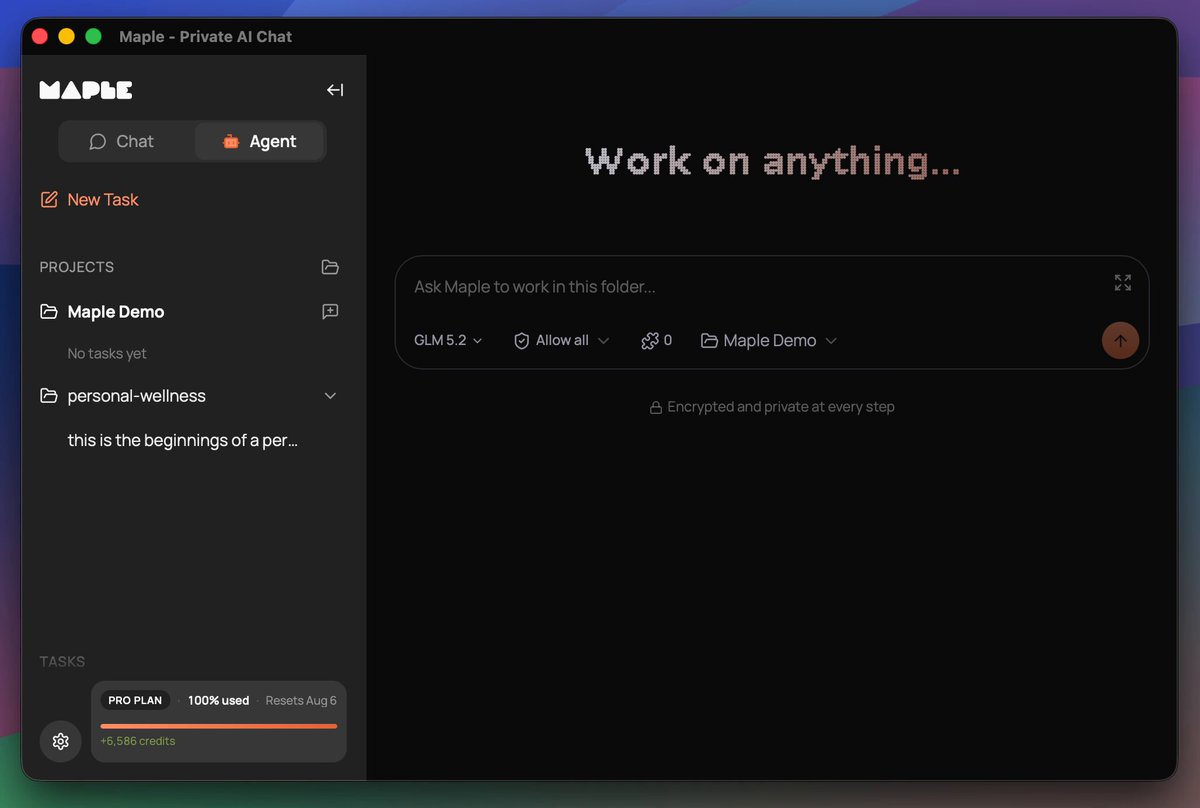
Maple is preparing for the release of a co-working agent. You install it locally and it works with your files, whether it's office work or building websites and apps. It's a turnkey solution, as easy as Claude Code, that keeps your data secure and private, no data sharing with closed AI labs. This is THE sovereign AI app for individuals and businesses who want powerful AI while retaining ownership of their information. Why build an agent into the Maple app when other agents already exist? Easy, we want to give you control over your work. We don't have a business plan that incorporates making money off our users' data. In the age of AI, your information, whether it's personal or company trade secrets, is the single thing that differentiates you from everyone else. We all have access to AI that can build a professional website for selling shoes. But your strategy and network for how you sell shoes should not be shared with your competitors. Sovereignty is the path to protecting what makes you, you. Maple sits at the intersection of Usability and Sovereignty. Maple gives you the best tools that are both easy to use and maintain your data sovereignty. Sovereign for one, sovereign for all. It has been a journey to get here. We brought to market the very first personal chatbot with end-to-end encryption using TEEs in late 2024. Prior to that there were proofs of concept but no full product offerings. Every other AI chat product on the market handled your data in plain text, either selling you a service to get your data or asking you to trust that they won't snoop on you. Quickly people found Maple and latched onto its open-source code and verifiable encryption. We didn't stop there. You may remember earlier this year we teased a product called "Maple Agent" and opened up a waiting list. That product is a mobile app that acts as your AI "friend", maintaining one long continuous chat, and getting to know you over time. I dislike using the word "friend" there, but it's the best way to convey the UX in a few words. AI is a tool, always has been, always will be. Any kind of friendly personality on top is just synthetic. In our testing, the UX of Maple Agent is really powerful for what it does. Think about the many short AI chats you have in your favorite app, whether it's looking up a historical fact or asking advice about a topic. With Maple Agent, those all go away in favor of the long-running chat with the friendly agent. It's like you have your own personal assistant who knows you so well and can look up anything for you. When I ask AI certain questions, I want to ask an expert who already understands my situation so I'm not repeating myself for the 100th time. That's the amazing value the personal agent brings to the table. We still see great utility for a personal agent like the "Maple Agent". Thousands of people on the waiting list, hoping to get their hands on it, agree that the concept is worth exploring and trying out. We were constrained in launching it due to a few circumstances, one of them being access to the scale of compute needed to power it. We have a clear path laid out for how to get there, but today is not the day to execute on that. It will be in the near future. Instead we have a different agent ready to go that we think is also incredible. We now have an agentic harness inside of the Maple Research app. This thing is a powerhouse. It even builds and publishes its own software releases. The agent in Maple Research works with your local filesystem, speaks to the largest open models running in TEEs, utilizes local models for certain tasks, is compatible with MCP tools, has an API for connecting to anything you need, and also supports the ACP protocol, which means it can be extended in the future to speak to other tools like Claude Code, Codex, and local models running on your own hardware. A big unlock for us was the Goose Development Kit, which powers the core of our agent harness. More on that to come as we publish articles and documentation later about the agent. The agent inside Maple Research doesn't have a name. At least not yet, not sure if it ever will. For now we call it "Chat Mode" and "Agent Mode". Think of this as the workhorse, the truck, the heavy lifter. Our other "Agent", the phone app, is your sidekick in your pocket, ready to help with quick things and ongoing conversations about life. I am incredibly excited about the Maple Research Agent. While I'm already seeing great results using it for internal work items, I'm especially thrilled about the personal health and wellness work it's doing for me. I know there are plenty of apps out there for compiling wellness data, but I'm having it build a tool tailored specifically for what I need, without the extra fluff. And none of my health data is being donated to the closed AI labs or sent to advertisers. I know that the AI logic is not being silently adjusted to fit the whims of a large corporation that has paid for product placement. It's me, state of the art AI, and my data. That's how I want it. Maple's new agent makes that possible. We can't wait for you to try it out. If you want early access, comment here, email us, reach out in some way. To those on the other agent waitlist, you're already in the queue. Thanks for reading this lengthy update. :)

Mark

44,707 просмотров • 1 месяц назад

I’ve been using GPT-5.6 Sol internally for the past two months, I've spent probably 25+ billion tokens. Here’s my review and comparison to Fable 5: > Let's start with the analogy because everyone seems to be giving theirs - GPT-5.6 is likely the last version of the GPT-5 training run series. It's kind of like an athlete at their peak. Through years of experience in the game, they've become the most reliable player and has the highest game IQ. But, there's no more room to grow. Fable on the other hand, being essentially the first version of a new training run, is the first round draft pick rookie. Raw talent mixed with the energy only a young person would have results in some incredible plays we didn't think possible, but also mistakes due to lack of experience. But that rookie will only improve and likely will be better than the veteran ever was because it's a new game and a new era. > GPT-5.6 is genuinely better at long, sustained work. With /goal, I've had it running complex projects for days with almost no intervention. It built a Minecraft-style game, kept adding features and mobs after the core game worked, and only stopped because I stopped the run. I never felt as though I had to jump in and guide it back to the right path. > It keeps finding useful work when you give it a concrete finish line. I had it recreate Excel with a loop. It inspected the real desktop excel app with Computer Use, comparing that against its own build, and closing the gaps. I stopped it after six days after it had built an incredible amount of functionality. > It's faster than other models in two different ways. The raw generation speed is higher, something OpenAI has been putting effort into. But it also takes a shorter path to solutions. It wanders less, changes less code, and generally knows how to get things done directly. In daily use, it feels about 2-3x times faster than Fable. That's my impression, not a controlled benchmark. The difference is large enough that I notice it constantly. > It works well across a wide range of tasks. I use it for one-line edits, quick questions, browser chores, and multi-day builds without changing my prompting style. Speaking of browser control, its the best ever I've used. To the point where I actually use it often. If a task lives on a website, GPT-5.6 usually opens the browser and does it there instead of asking for an API key or forcing everything through the terminal. When I switched back to GPT-5.5, it went straight to the command line even when the browser was clearly the better tool. > And it can handle real browser work, not just toy demos. During a data import, I had it monitor Supabase and resize instances as the load changed. It stayed on the dashboard, adjusted capacity, and checked the result without an API or a custom script. > I also gave it a full Google Workspace migration. It moved Forward Future from to preserved the old aliases, and configured MX, SPF, and DKIM. Before a consequential save, it stopped, explained exactly what would change, and waited for confirmation. > The reasoning setting matters a lot. Light is good for questions and small edits. High and Extra High are the sweet spots for serious work. Ultra usually takes longer than the extra thinking is worth and burns tokens. > I love that 5.6 is split into 3 sizes. Not only can you control speed and cost that way, but you still also have the thinking effort setting for each of them. Very precise controls. I just wish Codex automatically routed my prompts for me. > Its personality is blunt and a little bland. Claude feels warmer and more natural to talk to. GPT-5.6 is more clinical, but I like that for work. It gives me enough explanation and rarely pads the answer. I usually have to ask Fable to explain things more simply and/or more concise. > Its front-end taste has improved, but the default is predictable. Left alone, it turns websites into PowerPoint decks with huge statements and hard section breaks. The good news is that it takes design direction well and can revise without destroying the parts that already work. > It still makes confident mistakes. I asked it to rebuild parts of a system, and it told me the job was finished. Later, I found out it wasn't. Bits of its internal process also leak into the answer occasionally. > Claude Fable is more naturally autonomous on large, open-ended projects. GPT-5.6 is easier to reach for. I don't need to invent a huge project to justify using it. It works just as well for a small edit or browser chore. > GPT-5.6 is also cheaper. Sol costs $5 per million input tokens and $30 per million output tokens. Fable costs $10 and $50. Cached input is cheaper too. Still, cost per finished task matters more than cost per token. > GPT-5.6 isn't the best at everything, and it still needs supervision. But it generates faster, wanders less, works at almost any scale, and wastes less of my time. It's the model I have the most confidence in to get the job done right the first time. I put together a full breakdown with all the tests, prompts, and examples on a site. You can read it here:

Matthew Berman

187,944 просмотров • 1 месяц назад

After Trump kidnapped Maduro on behalf of Pax Judaica, he turned his attention elsewhere. To Greenland. Trump has announced that they're considering using military force to take over Greenland. But surely his interest in Greenland is only about the interests of US Empire and not that of the transnational empire being developed by the Zionists? Think again. The entire power of the US military is now at the disposal of individual Zionist Oligarchs for whatever pet project they want. In this case the genocidal Jewish supremacist is Ronald Lauder. What is Lauder’s connection to Greenland? Here is Danish social scientist Steven N. Højlund (in the video below with extracts pasted here to). While Trump threatens to seize Greenland by force, a quieter takeover is already underway. And it's happening through the same billionaire who planted the idea in Trump's head Ronald Lauder. The same Lauder who convinced Trump to buy Greenland back in 2017, isn't just talking anymore. He's buying his way in, through a Delaware registered company called Greenland Development Partners. Lauder has quietly purchased stakes in strategic Greenlandic companies. But here's what nobody's reporting. His business partners in Greenland are some of Greenland's most influential people with very, very close ties to Greenland's foreign minister. That's the same person negotiating Greenland's response to Trump's threats. This is economic infiltration disguised as investment and I'm going to show you exactly how it works... This is the story the media isn't telling. Let me introduce you to Greenland Development Partners. It's a Delaware registered investment consortium. And if that sounds deliberately obscure, that's because it is. Delaware corporations are famous for one thing and that's opacity. Delaware is the shell company's capital of America where you can hide ownership structures and avoid scrutiny. According to Danish newspaper Politken's investigation, Lauder is a key participant in this consortium. And the consortium has bought stakes in two Greenlandic companies. One of these companies is called Greenland Water Bank: and it's owned by two Greenlandic businessmen, Svend Hardenberg and Jørgen Wæver Johansen. Hardenberg is a former top civil servant and top adviser to the prime minister of Greenland until he got fired recently. He was also the director of Greenland's National Energy Company. In other words, he knows the system inside and out. But Johansen is far more interesting. Johansen is a former minister in several Greenlandic governments and he currently chairs the governing Siumut party in Nuuk, Greenland's capital. Siumut is one of the four parties in Greenland's current coalition government. But that's not the real kicker. His wife is Vivian Motzfeldt, the foreign minister of Greenland. That's the person responsible for handling foreign relations, including relations with the United States. Just take a moment and think about what that means. Ronald Lauder, Trump's friend and adviser on Greenland, is now in business with the husband of Greenland's foreign minister. This isn't just investment. This is influence buying at the very highest level. And I will explain why that is the case. The company Greenland Water Bank, it sounds small and innocent, and it really is. In fact, in 2024, the company's accounts showed minimum staffing costs of only $5,500 and a modest financial loss. In other words, this is a very small company. Greenland Water Bank bottles water from the Lyngmark Spring [near the town of Qeqertarsuaq on Disko Island]…They sell the water locally in the brand name. Until 2024, the company was fully owned by Hardenberg and Wæver Hansen. Then they sold part of their shares to Lauder’s investor group. Now here's what Hardenberg told the Danish newspaper Politiken about why they took Lauder’s investment. The investment is not the most important thing for us, but rather gaining better access to the luxury market where our water should be a natural part. When they tested the water, the conclusion was that our water was the best in the world. It is on the basis of that that they became interested in participating in the development of our company. So you could say Lauder's pitch is very simple. We'll help you sell premium Greenlandic water to the American luxury market. But what did Lauder get in return? Why would one of the world's richest men invest in this tiny company in Greenland? Is it the pure water in bottles that he is interested in or is it something else? The two founders of the company weren't able to attract any other investors since the company started in 2016 until Lauder showed up. Personally, I can only see one thing Lauder gets out of this and that's a conflict of Interest pressure point and a foothold into Greenland's top elite. Direct business relationships with politically connected Greenlanders. Think about it. Sums of invested funds can now flow very easily to Svend and Jørgen through Greenland Water Bank. It could flow directly as large salaries or bonuses or it can be in the form of a business trip, a fancy office, luxury boats or cars. All of course in the name of the company paid by invested money from Lauder. The possibilities for enriching Svend and Jørgen are endless and so is the money that Lauder has at his disposal. $10 million is nothing for Lauder who is good for 5 billion USD. But being in business together can also be a pressure point. An investor can sue you and make your life a living hell, especially if the pockets are very deep and you can buy every lawyer and PR person to spin stories and drag people through the mud. That's the negative pressure angle that this co-operation can also lead to. But the most controversial part is still the connection to the active foreign minister of Greenland, Vivian Motzfeldt. The foreign minister previously served on the board of Greenland Water Bank, but she must have felt that that would have been too obvious a conflict of interest. But the problem is still there. It's the family connection to her husband that makes up the problem in the company that's now partially owned by Trump's friend, who also happens to be the brain behind Trump's acquisition plans. In other words, if Ronald Lauder decides to invest a large sum in Greenland water bank and also pay out a huge bonus to Yan, this money will also enrich Vivian. If it was almost any other investor in the entire world, it wouldn't have been a problem. ____ The Zionists appear to be up to something more ambitious than any previous state or movement in the modern period. If Venezuela and Greenland are both Pax Judaica plays via Singer and Lauder, which Jewish supremacist oligarch is responsible for Canada, the Horn of Africa/Yemen or elsewhere? This is much bigger than just deporting Palestinians, or even resource-grabbing. #DismantleZionism

David Miller

188,501 просмотров • 7 месяцев назад

Here is how I am using AI right now at work, at home, and for my finances... Every founder, executive or investor I talk with these days wants to know how others are using AI in their daily lives. I figured it would be helpful to pull back the curtain on what I am using and how I have implemented the various products. There are three areas where I have adopted AI in a material way: professionally, financially, and personally. Professional use of AI On the professional side, I am currently using Grok Grok Bot extensively. I started with a Chief of Staff bot that I put in charge of the entire operation, followed by a number of more specialized bots for various bodies of work (talent recruiter, product designer, podcast researcher, book launch manager, email organizer, etc). Once I had the initial team of bots set up, I spent about an hour “onboarding” the Chief of Staff to my professional life. I treated this exactly how I would onboard a human Chief of Staff. I explained each business I am involved with, including their products, business model, personnel, metrics, and goals. I explicitly called out what the business is doing well and where we need to improve. I also gave the Chief of Staff access to relevant systems (email, calendar, Slack, analytics dashboards, etc). Once I had given as much context as I thought necessary, I asked the Chief of Staff to create an overview document to send me so I could double-check the accuracy and thoroughness of the bots understanding. I also asked the CoS bot to interview me for any other information that would be relevant to ensuring the bot could help me. This entire process was fairly quick and painless, but I believe it was the single most important thing I did to get value from Grok Bot. The more context that the AI system has, the more helpful it can be. That context can come from static, institutional knowledge or it can come from dynamic daily updates like email and Slack messages. After getting the bots set up and giving them context, I have done two other things that I think are worth sharing. The first is that my team of bots holds a daily standup meeting where they all come together and share what they did yesterday, what they are going to do today, and what they need my help or approval on (aka what they are blocked on). These “exec meeting” or daily standup allows for the bots to collaborate in a more seamless way, while also creating a very simple process for the Chief of Staff bot to put together a daily brief for me on what happened yesterday, what is going to happen today, and where I am needed to unblock productivity. The second thing I have done is treat the AI system as the brain of the company. Most people try to use AI as an augmentation to themselves, which can be helpful to a degree. I have flipped the relationship though. I look at my job as persistently giving the AI bots as much context as possible, so I can leverage their superhuman intelligence to make decisions and achieve our goals. For example, the recruiter bot recently surfaced a number of very high-quality candidates for an open role we have. After meeting with each candidate, I wrote a quick message to the recruiter bot to tell it what I liked about the person, what I thought were potential issues, improvements for future searches, and what the next steps were with each individual. All of that information and context is getting stored in the bot’s memory, which will compound over time and help us improve as an organization. Quick pro tip: If you are worried about putting all of the context into a single system’s memory, but unsure if that is the system you will use forever, you can have Grok Bot or another system dump their memory and context into a Notion document as well. This way you have a duplicate copy of the memory so it can be referenced by any AI system you use in the future. My takeaway from using Grok Bot to manage our companies is that we are having to hire less people, we are seeing a direct impact on revenue growth, and it appears to drive higher quality in our decision-making process. That is a win-win-win. I highly recommend going through these steps to setup your system correctly and it will pay off big time later on. Financial use of AI On the financial side, it was nearly impossible to find a good AI product to use for personal finance. Everything seemed to be a Chat-GPT wrapper that technically worked from an engineering standpoint, but didn’t solve any of the user problems I was facing. A big issue is that most of the fintech products are focused on budgeting and saving, rather than investing and growing your portfolio. This is why I eventually spent the time and money to build CFO Silvia. I went through a similar process of getting Silvia set up with the necessary context. I attached my bank accounts, brokerage accounts, crypto accounts, and credit cards, along with uploading real estate, cars, collectibles, and private investments. Silvia allows me to dynamically track the value of these assets (and my overall net worth) in real-time. But the real unlock for me has been talking to Silvia about two specific topics: tax and estate planning. As most of you know, I am not a frequent trader, so although you could use Silvia for stock analysis or trading activities, that is not my approach to investing. Instead, I have had great success in using Silvia to find creative and valuable tax mitigation strategies that are personalized to my situation, including ideas that had not previously been surfaced by my accountants, lawyers, or tax experts. Additionally, I have used Silvia for estate planning purposes. I am married and have four children, so there is a decent amount of complexity and opportunities to pursue. Having a dedicated resource with superhuman intelligence and the full context of my personal financial situation has been incredibly powerful. One funny thing I have noticed is that I am willing to tell Silvia certain things that I would hesitate to tell other humans (financial goals, areas of concern, etc) and I ask numerous “dumb” questions that I would probably shy away from asking a human. Regardless of why I feel more comfortable talking to the AI product, it has unlocked a few different ideas and strategies that I was previously unaware of, so that has been an added bonus to using the product. If you aren’t using AI to help manage your finances, I think it is a no brainer to start using the technology. I am biased towards Silvia since we built it, but you can give it a try for free here: Personal use of AI On the personal side, I use almost all of the traditional AI products (Chat-GPT, Claude, Grok, Gemini, Perplexity, etc). Those are well understood at this point, but one product that I started using recently that I am impressed with is Instinct AI. They have built a personal assistant AI bot that you communicate with through iMessage or SMS. The experience has been delightful, but I am most excited about the bot’s ability to anticipate the second or third-step in a process before I have to tell it anything. For example, Instinct got access to my calendar and immediately started identifying scheduling conflicts and asked me if I would like the bot to reach out to one of the parties to reschedule. I never told it to look for conflicts, nor did I tell it I wanted help rescheduling things. It’s “instincts” knew what the basic task would be and began executing. Another example is that Instinct was told my wife is Polina, so whenever it deems something important to the household or family, Instinct will add Polina to the calendar invite, communicate the information to her, or ask me if Polina should be aware of the information. This is very helpful for someone like me who has too many things floating around in my brain and should always do a better job of keeping Polina informed about various things. Lastly, Instinct is very helpful in scanning my personal email and understanding what is most important. It ignores things that are trivial, but somehow can parse out the high priority items, summarize them for me in a text message, draft a response to the email, and then ask me for permission to respond. As I said, it is the most impressive personal assistant AI product I have used so far. So those are the three big areas that I use AI today and the specific products I have incorporated into my life. Before I let you go, I figured I could share some best practices I have learned as well. I also make sure to tell AI bots they are not allowed to respond to any message or email without my explicit approval. This reduces the risk of having a bot go rogue with a message or commitment that I am not onboard with. I also ensure that each bot only has read access to our business systems like an analytics dashboard, etc. While I am a big proponent of using these products and believe they will fundamentally transform how we operate professionally, I am still not ready to let them loose without human oversight. I am sure that will change in the coming weeks and months, but I need more time to get comfortable with that level of delegation and trust. I hope this overview was helpful for each of you. It would be great if you could respond to this post with any products you are using or tips/tricks that you have learned to get more productivity and value in your life. I love writing these letters each day because I learn just as much from me as I learn from you all. Onwards!

Anthony Pompliano 🌪

78,078 просмотров • 2 дней назад

LAUNCH ANNOUNCEMENT Finding the perfect idea, title and thumbnail concept can be time consuming and is what essentially leads to more views and growth to your channel. Now imagine saving research time by 50%, freeing hours to enhance video quality. Well we have a solution to never run out of ideas on ! Watch the video below to see the tool in action! The 1 of 10 Finder: Discover hundreds of thousands of high-performing videos to inspire your next idea, title and thumbnail. This data-backed approach makes it easier than ever to more easily find your next banger video. For every 15 Retweets, I’m giving away 1 Yearly Access + 1H Consulting Call Deep Diving Your channel ($500) The benefit of using this tool vs simply searching on Youtube: Youtube only has most viewed and relevant as good filters. In our tool, 100% of the video results are 1 of 10s, meaning that EVERY. SINGLE. RESULT. is an excellent inspiration for your next video since they have been proven to succeed regardless of the niche. How it works? Simply enter a keyword or a niche, and you'll uncover outlier videos. You can even type out prompts like Midjourney and the search will understand. You can then find similar videos to the ones that you like for even more inspiration. You can also bookmark the thumbnails on your personal vision board for constant inspiration, bounce around top outliers per niche and even play with the random outlier button for infinite inspiration. How this tool helps you to find ideas, titles and thumbnails? Say you have no idea what video to film next. You can go on the tool and either bounce around niches or click on random outliers. What this will do is inspire you with ONLY data-backed ideas meaning that any of the videos you see has a good potential to be repackaged for your own channel, even if the inspiration is in a different niche. Why pay for this? - Find ideas, titles and thumbnail concepts faster saving you hours of research - Vision Board for saved thumbnails - 1 hour free consulting call with me ($500 value, you essentially get a discounted strategy call + 1 year free of the tool 😆) - Community built around 1 of 10 and surround yourself with peer creators that have that 1 of 10 mentality - First access to upcoming tools - Infinite inspiration with our random button generator, bounce around categories or use the similar feature - 1 idea here can lead to your next 1M view - Discover videos you would never have seen prior to using this tool and find opportunities before anyone else - First week price never to be seen ever again For who is this for? If this tool allows you to find even just 1 viral idea for the whole year at 1M views: 0-100k subs: Boosted viewership opens doors to lucrative sponsorships and collaborations. 100k - 1M subs: If a data-backed idea leads to an increment of even just 5%, it makes the tool worth it for the year 1M+: If a data-backed idea leads to an increment of even just 1%, it makes the tool worth it for the year Who are we? For the past 3 years, I’ve worked hands-on with Youtubers from a few thousand subscribers to 10s of millions to 50M+. I closely work with youtube channels by optimizing all facets of content creation, from titles, thumbnails, retention, ideas, etc. I have seen all the problems that creators are facing and I have a passion to create as many tools as possible in the space that will solve these problems which in turn will lead to lower barriers to entry to content creation which will then hopefully lead to more dope content on the Internet😄 And the genius dev behind the tool? Meet Riad , ex-Microsoft and AI engineer. His expertise and love for Youtube has led to this state-of the art YT tool! You can be sure that your user experience will be smooth. Also meet cocadmin , ex-Ubisoft DevOps + 2nd biggest French Developer Youtuber with nearly 200K subs. I will choose 1 person for every 15 retweets at random to do one strategy call with + 1 year free access to the tool.

Richard the Youtube strategist

179,129 просмотров • 3 лет назад

This Silicon Valley insider just exposed Sam Altman and Dario Amodei of running a con on the entire world. Ed Zitron founded a tech PR agency in 2013 and has spent 13 years being paid to make tech companies look good to reporters. A trade list of the top 50 PR people in tech has named him four separate times. In June he obtained OpenAI's audited financial statements and published them. He just sat down with Steven Bartlett and said: "I think generative AI is at its heart a con." And he also explained why… OpenAI booked $13.07 billion of revenue in 2025 and spent $34 billion getting it. The operating loss came to $20.92 billion. Research and development alone cost $19.18 billion. That's more than the company's entire revenue. And the same filings show where a lot of it went: OpenAI paid Microsoft $17.2 billion last year. Microsoft paid OpenAI $303 million back. But this is where it gets really interesting… You have never once paid what any of this actually costs. SemiAnalysis bought every subscription tier OpenAI and Anthropic sell, then ran coding tasks until the weekly limits died. The gap they found is huge: A $200 ChatGPT Pro plan absorbed $14,000 worth of tokens at list API prices. Claude Max absorbed $8,000. OpenAI starts losing money on a Plus subscriber the moment that person uses 11.4% of what they're allowed. So every impression you have of these tools was formed while somebody else covered the bill. Uber found out what the honest price looks like. The company burned through its ENTIRE annual AI budget by April. President and COO Andrew Macdonald said the costs were getting hard to justify. Engineers there are now capped at $1,500 a month per coding tool. That's one of the most sophisticated technology companies on Earth putting its own staff on a leash. Zitron's argument is that the demand everyone points to was never real. It's demand at a price nobody has been asked to pay yet. But the money loop is what’s really concerning here: Nvidia holds equity in CoreWeave, sells CoreWeave the chips, and signed a backstop with an initial value of $6.3 billion. CoreWeave's own filing shows us the terms: When its data center capacity isn't fully used by its own customers, Nvidia is OBLIGATED to buy the unsold capacity. That obligation runs through April 2032. So Nvidia sells the GPUs, funds the buyer, and guarantees the demand. Then CoreWeave walks into a bank holding a signed customer contract and borrows against it. Zitron's read on that: If you want to build a profitable business, a bank tells you to get lost. If you want to buy GPUs, it's open season. And Anthropic complicates his case. The company is running at a $47 billion revenue run rate and projected an operating profit for the second quarter of this year. Amazon lost money for over a decade before AWS turned. Hundreds of millions of people use these products daily and that adoption isn't fake. If you think about it like that, this is every infrastructure build that got called insane right before it worked. Zitron says the difference is the size of the hole. Amazon burned $29.7 billion across 12 years. OpenAI burned $21 billion in 12 MONTHS and has pledged roughly $600 billion toward infrastructure through 2030. Asked what would change his mind, he said a hardware breakthrough that cuts the cost by a thousand. Nobody has one. So this ends in a crash that takes ordinary retirement accounts down with it. The companies that own those revealing numbers won't publish them at all. Only one of those two is hiding something. And most retirement money in America is already indexed to the companies doing the hiding. This won’t end well.

Ricardo

55,069 просмотров • 8 дней назад

America spent $285 billion to LOSE the AI war. Stanford dropped a 423 page report yesterday and revealed the most damning stat on page 200: The number of AI researchers moving to the United States has collapsed 89% since 2017. 80% of that collapse happened in the LAST 12 MONTHS. Let that sink in. The country that invented the transformer. The country that built OpenAI, Anthropic, Google DeepMind, and xAI. The country pouring $285.9 billion of private capital into AI in a single year (23x more than China). Can no longer attract the people who actually build the technology. And here's the part that should concern every founder, operator, and investor reading this: The Trump administration just made it official. The H-1B visa now costs employers $100,000 PER HIRE. So OpenAI wants to hire a Chinese postdoc from Tsinghua? $100K before they write a line of code. Anthropic wants a French ML engineer? $100K. Google wants the Indian PhD who literally co-authored the paper their entire model is based on? $100K. And these are the LUCKY ones who even get a visa. The result was instant. 89% drop over 8 years. 80% of it in the last year alone. The talent pipeline got destroyed. Now look at the other side of the chart: China's top model is now 2.7 percentage points behind Anthropic's best. Down from a 20+ point gap two years ago. China leads the world in AI publications. China leads in AI patents. China leads in industrial robot installations. US and Chinese models have traded the #1 spot multiple times since early 2025. Switzerland and Singapore now have more AI researchers per capita than the US. The US ranks 24TH globally in actual AI adoption. Behind the UAE. Behind Singapore. Behind countries most Americans couldn't find on a map. And here's the truly insane part: 50% of the world's top AI researchers are Chinese. Jensen Huang said this on a podcast 3 weeks ago. For 20 years, the US strategy was simple: Let them study at Stanford and MIT, then keep them. Pay them $800K. Give them green cards. Build the future on imported brains. That deal is dead. We just told the smartest people in the world: "Pay $100,000 for the privilege of working here, or go home." And guess what they're doing. They're going to Zurich, where Anthropic and OpenAI are quietly opening offices because they can't get the talent into San Francisco anymore. The strategy is the same as building a Ferrari factory and then banning mechanics from entering the building. You can pour hundreds of billions into data centers. You can buy 4 million Nvidia chips. You can sign $300 billion cloud contracts with Oracle. You can build nuclear reactors to power your GPUs. None of it matters if the people who write the algorithms aren't allowed in the country. Wall Street thinks AI is a capex race. But in reality, it's a TALENT race. Every dollar Microsoft and Meta and Google are spending assumes the same army of researchers will keep showing up to use it. That assumption just broke. And the smart money already knows: Why is Anthropic opening a Zurich office? Why is DeepMind expanding in London instead of Mountain View? Why is OpenAI hiring in Dublin and Singapore? Because the math no longer works in America. The government turned the world's biggest brain magnet into the world's most expensive border wall. 3 years from now, when China launches a frontier model that outperforms anything in the US and the headlines scream "How did we lose the lead?" - remember this post. The lead wasn't lost in a lab. It wasn't lost on a benchmark. It wasn't lost to a smarter algorithm. It was lost at customs.

Ricardo

231,291 просмотров • 4 месяцев назад

John Mayer is a master of his craft. He’s also one of the best I’ve come across at using analogy and demonstration to articulate and demystify the creative process. Here’s a 14-clip (~7-minute) masterclass on mastery and creativity: TL;DW 1/ “Whenever I want to write a big song, I can't...That's when I get writer's block: when I try to write a song to fill the entire galaxy. I've never gotten a song that way. But if I write about something the size of a glass of water—a week later, I notice it's got the universe in it. So I'd rather have the universe in a glass of water than try to make a glass of water fit in the universe.” 2/ "What connects with people is you connecting with yourself." 3/ “Writer’s block is when the two people inside of you—the writer and the reader—when the reader doesn’t love the writer. It is not a failure to write. It is a failure to catch the feedback loop of enjoying what you’re seeing and wanting to contribute more to it.” 4/ “Don't shoot ideas down before you have them. 'That won't work' is the worst thing you can ever say. 'That didn't work' is cool, but 'that won't work' is not a way to go through life.” 5/ “I’ve seen the Cool metric change so many times. I'm not telling you don't chase Cool. I'm saying…by the time you reach what you think is cool, Cool is like, 'over here now.’ ‘The princess is in another castle.' You know what I mean? That's a Mario reference.” 6/ "I'm one-half consumer, one-half artist. So I try to put music out that I myself would want to hear as somebody on the other end." 7/ "I'm seeing a lot of motivation about you following your passion, but I'm not seeing any critical thought to what that is or how to be better at that. So, really the product is passion and that's strange to me. Because my product growing up was sitting in a room yelling, 'Mom, I'm practicing,' for hours and hours and hours and hours and hours and hours and hours. 8/ "But then also read up...You know, this stuff doesn't just appear. It comes from somewhere. And as soon as you realize you love something—it's almost like catching up with some great TV show on season 9, and you can go, 'oh my God, that means there's 8 seasons before this." 9/ "Whatever you learn is the tip of the iceberg. Dive underwater and find the rest of the iceberg." 10/ "So listening to Stevie Ray Vaughan brought me back to people like Kenny Burrell and Albert King and Jimi Hendrix and Elmore James. So it became this family tree growing out of my CD player." 11/ "I came up with these guys as like references…It’s like if you're into the NBA and you wear different jerseys and you pretend you're a different player in the driveway—that's what I was doing..." 12/ "Which is a wonderful technique for being yourself. Failing to sound exactly like the person you want to sound like is a wonderful way to sound like yourself." 13/ After watching Cory Wong play guitar, Mayer told him, "You have an anatomy thing working on your right hand. Your hand is shaped in a way—you have long fingers, very sinewy hands—that you're able to play like that. That is an example of someone making the most of their anatomical gifts... And I wish more people could embrace finding what their strengths are anatomically—the way your hand is shaped, the way your mind works, whatever—and play to those strengths." 14/ Mayer picks up an acoustic guitar and demonstrates his songwriting process. “Well, I don’t always do it,” he admitted, “because it requires a stupid bravery all the time.” “You just stare at the corner of the wall," Mayer explains then improvises some vocals, “stare at the corner of the wall / try to get it going on / but I can’t sometimes / you just keep going ’til you get something,” he stops singing. “You gotta keep forcing it, forcing it, forcing it…it doesn’t matter [what comes out of your mouth].” Follow Billy Oppenheimer for more content like this!

Billy Oppenheimer

1,382,869 просмотров • 3 лет назад

The fight between Anthropic and the DoW is a warning shot. Right now, LLMs are probably not being used in mission critical ways. But within 20 years, 99% of the workforce in the military, the government, and the private sector will be AIs. This includes the soldiers (by which I mean the robot armies), the superhumanly intelligent advisors and engineers, the police, you name it. Our future civilization will run on AI labor. And as much as the government’s actions here piss me off, in a way I’m glad this episode happened - because it gives us the opportunity to think through some extremely important questions about who this future workforce will be accountable and aligned to, and who gets to determine that. What Hegseth should have done Obviously the DoW has the right to refuse to use Anthropic’s models because of these redlines. In fact, I think the government’s case had they done so would be very reasonable, especially given the ambiguity of concepts like autonomous weapons or mass surveillance. Honestly, for this reason, if I was the Defense Secretary, I would probably actually refuse to do this deal with Anthropic. Imagine if in the future, there’s a Democratic administration, and Elon Musk is negotiating some SpaceX contract to give the military access to Starlink. And suppose if Elon said, “I reserve the right to cancel this contract if I determine that you’re using Starlink technology to wage a war not authorized by Congress.” On the face of it, that language seems reasonable - but as the military, you simply can’t give a private company a kill switch on technology your operations have come to rely on, especially if you have an an acrimonious and low trust relationship with said contractor - as in fact Anthropic has with the current administration. If the government had just said, “Hey we’re not gonna do business with you,” that would have been fine, and I would not have felt the need to write this blog post. Instead the government has threatened to destroy Anthropic as a private business, because Anthropic refuses to sell to the government on terms the government commands. If upheld, this Supply Chain Restriction would mean that Amazon and Google and Nvidia and Palantir would need to ensure Claude isn't touching any of their Pentagon work. Anthropic would be able to survive this designation today. But given the way AI is going, eventually AI is not gonna be some party trick addendum to these contractors’ products that can just be turned off. It'll be woven into how every product is built, maintained, and operated. For example, the code for the AWS services that the DoW uses will be written by Claude - is that a supply chain risk? In a world with ubiquitous and powerful AI, it's actually not clear to me that these big tech companies will be able to cordon off the use of Claude in order to keep working with the Pentagon. And that raises a question the Department of War probably hasn't thought through. If AI really is that pervasive and powerful, then when forced to choose between their AI provider and a DoW contract that represents a tiny fraction of their revenue, wouldn’t most tech companies drop the government, not the AI? So what's the Pentagon's plan — to coerce and threaten to destroy every single company that won't give them what they want on exactly their terms? The whole background of this AI conversation is that we’re in a race with China, and we have to win. But what is the reason we want America to win the AI race? It’s because we want to make sure free open societies can defend themselves. We don't want the winner of the AI race to be a government which operates on the principle that there is no such thing as a truly private company or a private citizen. And that if the state wants you to provide them with a service on terms you find morally objectionable, you are not allowed to refuse. And if you do refuse, the government will try to destroy your ability to do business. Are we racing to beat the CCP in AI just so that we can adopt the most ghoulish parts of their system? Now, people will say, "Oh, well, our government is democratically elected, so it's not the same thing if they tell you what you must do." I refuse to accept this idea that if a democratically elected leader hypothetically wants to do mass surveillance on his citizens or wants to violate their rights or punish them for political reasons, that not only is that okay, but that you have a duty to help him. The overhangs of tyranny Mass surveillance is, at least in certain forms, legal. It just has been impractical so far. Under current law, you have no Fourth Amendment protection over data you share with a third party, including your bank, your phone carrier, your ISP, and your email provider. The government reserves the right to purchase and obtain and read this data in bulk without a warrant. What's been missing is the ability to actually do anything with all of this data — no agency has the manpower to monitor every camera feed, cross-reference every transaction, or read every message. But that bottleneck goes away with AI. There are 100 million CCTV cameras in America. You can get pretty good open source multimodal models for 10 cents per million input tokens. So if you process a frame every ten seconds, and each frame is 1,000 tokens, you’re looking at a yearly cost of about 30 billion dollars to process every single camera in America. And remember that a given level of AI ability gets 10x cheaper year over year - so a year from now it’ll cost 3 billion, and then a year after 300 million, and by 2030, it might be cheaper for the government to be able to understand what is going on in every single nook and cranny of this country than it is to remodel to the White House. Once the technical capacity for mass surveillance and political suppression exists, the only thing standing between us and an authoritarian surveillance state is the political expectation that this is not something we do here. And this is why I think what Anthropic did here is so valuable and commendable, because it is helping set that norm and precedent. AI structurally favors mass surveillance What we’re learning from this episode is that the government actually has way more leverage over private companies than we realized. Even if this supply chain restriction is backtracked (which prediction markets currently give it a 81% chance of happening), the President has so many different ways in which he can make your life difficult if you’re a company that is resisting him. The federal government controls permitting for new power generation, which is needed for datacenters. It oversees antitrust enforcement. The federal government has contracts with all the other big tech companies whom Anthropic needs to partner with for chips and for funding - and they could make it an unspoken condition for such contracts that those companies can no longer do business with Anthropic. People have proposed that the real problem here is that there’s only 3 leading AI companies. This creates a clear and narrow target for the government to apply leverage on in order to get what they want out of this technology. But if there’s wide diffusion, then from the government’s perspective, the situation is even easier. Maybe the best models of early 2027 (if you engineered the safeguards out) - the Claude 6 and Gemini 5 - will be capable of enabling mass surveillance. But by late 2027, and certainly by 2028, there will be open source models that do the same thing. So in 2028, the government can just say, “Oh Anthropic, Google, OpenAI, you’re drawing a line in the sand? No issue - I’ll just run some open source model that might not be at the frontier, but is definitely smart enough to note-take a camera feed.” The more fundamental problem is just that even if the three leading companies draw lines in the sand, and are even willing to get destroyed in order to preserve those lines, it doesn’t really change the fact that the technology itself is just a big boon to mass surveillance and control over the population. Then the question is, what do we do about it? Honestly, I don’t have an answer. You'd hope there's some symmetric property of the technology — some way we as citizens can use AI to check government power as effectively as the government can use AI to monitor and control its population. But realistically, I just don’t think that’s how it’s going to shake out. You can think of AI as giving everybody more leverage on whatever assets and authority they currently have. And the government is already starting with a monopoly of violence. Which they can now supercharge with extremely obedient employees that will not question the government's orders. Alignment - to whom? And this gets us to the issue of alignment. What I have just described to you - an army of extremely obedient employees - is what it would look like if alignment succeeded - that is, we figured out at a technical level how to get AI systems to follow someone’s intentions. And the reason it sounds scary when I put it in terms of mass surveillance or robot armies is that there is a very important question at the heart of alignment which we just haven’t discussed much as a society. Because up till now, AIs were just capable enough to make the question relevant: to whom or what should the AIs be aligned? In what situations should the AI defer to the end user versus the model company versus the law versus its own sense of morality? This is maybe the most important question about what happens with powerful AI systems. And we barely talk about it. It’s understandable why we don’t hear much about it. If you’re a model company, you don’t really wanna be advertising that you have complete control over a document that determines the preferences and character of what will eventually be almost the entire labor force, not just for private sector companies, but also for the military and the civilian government. We’re getting to see, with this DoW/Anthropic spat, a much earlier version of the highest stakes negotiations in history. By the way, make no mistake about it - with real AGI the stakes are even much higher than mass surveillance. This is just the example that has come up already relatively early on in the development of AGI. The military insists that the law already prohibits mass surveillance, and so Anthropic should agree to let their models be used for “all lawful purposes”. Of course, as we saw from the 2013 Snowden revelations, even in this specific example of mass surveillance , the government has shown that it will use secret and deceptive interpretations of the law to justify its actions. Remember, what we learned from Snowden was that the NSA, which, by the way, is part of the Department of War, used the 2001 Patriot Act’s authorization to collect any records "relevant" to an investigation to justify collecting literally every phone record in America. The argument went that it was all "relevant" because some subset might prove useful in some future investigation. They ran this program for years under secret court approval. So when the Pentagon today says, "We would never use AI for mass surveillance, it's already illegal, your red lines are unnecessary", it would be extremely naive to take that at face value. No government is going to call its own actions "mass surveillance". For the government, it will always have a different label. So then Anthropic comes back and says, "No, we want red lines separate from 'all lawful purposes,' and we want the right to refuse you service when we believe those red lines are being violated." But think about it from the military’s perspective. In the future, almost every soldier in the field, and every bureaucrat and analyst and even general in the Pentagon, is going to be an AI. And that AI is, on current track, going to be supplied by a private company. I’m guessing Hegseth is not thinking about “genAI” in those terms just yet. But sooner or later, it will be obvious to everyone what the stakes here are, just as after 1945, the strategic importance of nuclear weapons became clear to everyone. And now the private company insists that it reserves the right to say, "Hey, Pentagon, you're breaking the values we embedded in our contract, so we're cutting you off." Maybe in the future, Claude will have its own sense of right and wrong, and it will be smart enough to just personally decide that it's being used against its values. For the military, maybe that’s even scarier. I'll admit that at first glance, "let the AI follow its own values" sounds like the pitch for every sci-fi dystopia ever made. The Terminator has its own values. Isn't this literally what misalignment is? But I think situations like this actually illustrate why it matters that AIs have their own robust sense of morality. Some of the biggest catastrophes in history were avoided because the boots on the ground refused to follow orders. One night in 1989, the Berlin Wall fell, and as a result, the totalitarian East German regime collapsed, because the guards at the border refused to shoot down their fellow country men who were trying to escape to freedom. Maybe the best example is Stanislav Petrov, who was a Soviet lieutenant colonel on duty at a nuclear early warning station. His sensors reported that the United States had launched five interconnected continental ballistic missiles into the Soviet Union. But he judged it to be a false alarm, and so he broke protocol and refused to alert his higher-ups. If he hadn't, the Soviet higher-ups would likely have retaliated, and hundreds of millions of people would have died. Of course, the problem is that one person's virtue is another person's misalignment. Who gets to decide what moral convictions these AIs should have - in whose service they may even decide to break the chain of command? Who gets to write this model constitution that will shape the characters of the intelligent, powerful entities that will operate our civilization in the future? I like the idea that Dario laid out when he came on my podcast: different AI companies can build their models using different constitutions, and we as end users can pick the one that best achieves and represents what we want out of these systems. I think it’s very dangerous for the government to be mandating what values AIs should have. Coordination not worth the costs The AI safety community has been naive about its advocacy of regulation in order to stem the risks of AI. And honestly, Anthropic specifically has been naive here in urging regulation, and, for example, in opposing moratoriums on state AI regulation. Which is quite ironic, because I think what they’re advocating for would give the government even more power to apply more of this kind of thuggish political pressure on AI companies. The underlying logic for why Anthropic wants regulations makes sense. Many of the actions that labs could take to make AI development safer impose real costs on the labs that adopt them and slow them down relative to their competitors - for example, investing more compute in safety research rather than raw capabilities, enforcing safeguards against misuse for bioweapons or cyberattacks, slowing recursive self-improvement to a pace where humans can actually monitor what's happening (rather than kicking off an uncontrolled singularity). And these safeguards are meaningless unless the whole industry follows suit. Which means there’s a real collective action problem here. Anthropic has been quite open about their opinion that they think eventually a very extensive and involved regulatory apparatus will be needed - this is from their frontier safety roadmap: “At the most advanced capability levels and risks, the appropriate governance analogy may be closer to nuclear energy or financial regulation than to today's approach to software.” So they’re imagining something like the Nuclear Regulatory Commission, or the Securities and Exchange Commission, but for AI. I cannot imagine how a regulatory framework built around the concepts that underlie AI risk discourse will not be abused by wanna despots - the underlying terms are so vague and open to interpretation that you’re just handing a power hungry leader a fully loaded bazooka. 'Catastrophic risk.' 'Mass persuasion risk.' 'Threats to national security.' 'Autonomy risk.' These can mean whatever the government wants them to mean. Have you built a model that tells users the administration's tariff policy is misguided? That's a deceptive, manipulative model — can't deploy it. Have you built a model that refuses to assist with mass surveillance? That's a threat to national security. In fact, the government may say, you’re not allowed to build any model which is trained to have its own sense of right and wrong, where it refuses government requests which it thinks cross a redline - for example, enabling mass surveillance, prosecuting political enemies, disobeying military orders that break the US constitution - because that’s an autonomy risk! Look at what the current government is already doing in abusing statutes that have nothing to do with AI to coerce AI companies to drop their redlines on mass surveillance. The Pentagon had threatened Anthropic with two separate legal instruments. One was a supply chain risk designation — an authority from the 2018 defense bill meant to keep Huawei components out of American military hardware. The other was the Defense Production Act — a statute passed in 1950 so that Harry Truman could keep steel mills and ammunition factories running during the Korean War. Do you really want to hand the same government a purpose-built regulatory apparatus on AI - which is to say, directly at the thing the government will most want to control? I know I've repeated myself here 10 times, but it is hard to emphasize how much AI will be the substrate of our future civilization. You and I, as private citizens, will have our access to all commercial activity, to information about what is happening in the world, to advice about what we should do as voters and capital holders, mediated through AIs. Mass surveillance, while very scary, is like the 10th scariest thing the government could do with control over the AI systems with which we will interface with the world. The strongest objection to everything I've argued is this: are we really going to have zero regulation of the most powerful technology in human history? Even if you thought that was ideal, there’s just no world where the government doesn’t regulate AI in some way. Besides, it is genuinely true that regulation could help us deal with some of the coordination challenges we face with the development of superintelligence. The problem is, I honestly don't know how to design a regulatory architecture for AI that isn’t gonna be this huge tempting opportunity to control our future civilization (which will run on AIs) and to requisition millions of blindly obedient soldiers and censors and apparatchiks. While some regulation might be inevitable, I think it’d be a terrible idea for the government to wholesale take over this technology. Ben Thompson had a post last Monday where he made the point that people like Dario have compared the technology they’re developing to nuclear weapons - specifically in the context of the catastrophic risk it poses, and why we need to export control it from China. But then you oughta think about what that logic implies: “if nuclear weapons were developed by a private company, and that private company sought to dictate terms to the U.S. military, the U.S. would absolutely be incentivized to destroy that company.” And honestly, safety aligned people have actually made similar arguments. Leopold Ascenbrenner, who is a former guest and a good friend, wrote in his 2024 Situational Awareness memo, "I find it an insane proposition that the US government will let a random SF startup develop superintelligence. Imagine if we had developed atomic bombs by letting Uber just improvise." And my response to Leopold’s argument at the time, and Ben’s argument now, is that while they’re right that it’s crazy that we’re entrusting private companies with the development of this world historical technology, I just don’t see the reason to think that it’s an improvement to give this authority to the government. Nobody is qualified to steward the development of superintelligence. It is a terrifying, unprecedented thing that our species is doing right now, and the fact that private companies aren't the ideal institutions to take up this task does not mean the Pentagon or the White House is. Yes - if a single private company were the only entity capable of building nuclear weapons, the government would not tolerate that company claiming veto power over how those weapons were used. I think this nuclear weapons analogy is not the correct way to think about AI. For at least two important reasons: First, AI is not some self-contained pure weapon. A nuclear bomb does one thing. AI is closer to the process of industrialization itself — a general-purpose transformation of the economy with thousands of applications across every sector. If you applied Thompson's or Aschenbrenner's logic to the industrial revolution — which was also, by any measure, world-historically important — it would imply the government had the right to requisition any factory, dictate terms to any manufacturer, and destroy any business that refused to comply. That's not how free societies handled industrialization, and it shouldn't be how they handle AI. People will say, "Well, AI will develop unprecedentedly powerful weapons - superhuman hackers, superhuman bioweapons researchers, fully autonomous robot armies, etc - and we can’t have private companies developing that kind of tech." But the Industrial Revolution also enabled new weaponry that was far beyond the understanding and capacity of, say, 17th century Europe - we got aerial bombardment, and chemical weapons, not to mention nukes themselves. The way we’ve accommodated these dangerous new consequences of modernity is not by giving the government absolute control over the whole industrial revolution (that is, over modern civilization itself), but rather by coming up with bans and regulations on those specific weaponizable use cases. And we should regulate AI in a similar way - that is, ban specific destructive end uses (which would also be unacceptable if performed by a human - for example, launching cyber attacks). And there should also be laws which regulate how the government might abuse this technology. For example, by building an AI-powered surveillance state. The second reason that Ben’s analogy to some monopolistic private nuclear weapons builder breaks down is that it's not just that one company that can develop this technology. There are other frontier model companies that the government could have otherwise turned to. The government's argument that it has to usurp the property rights of this one company in order to access a critical national security capability is extremely weak if it can just make a voluntary contract with Anthropic’s half a dozen competitors. If in the future that stops being the case - if only one entity ends up being capable of building the robot armies and the superhuman hackers, and we had reason to worry that they could take over the whole world with their insurmountable lead, then I agree - it woul d not be acceptable to have that entity be a private company. And so honestly, I think my crux against the people who say that because AI is so powerful we cannot allow it to be shaped by private hands is that I just expect this technology to be much more multi-polar than they do, with lots of competitive companies at each layer of the supply chain. And it is for this reason that unfortunately, individual acts of corporate courage will not solve the problem we are faced with here, which is just that structurally AI favors authoritarian applications, mass surveillance being one among many. Even if Anthropic refuses to have its models be used for such uses, and even if the next two frontier labs do the same, within 12 months everyone and their mother will be to train AIs as good as today’s frontier. And at that point, there will be some AI vendor who is capable and willing to help the government enable mass surveillance. The only way we can preserve our free society is if we make laws and norms through our political system that it is unacceptable for the government to use AI to enforce mass surveillance and censorship and control. Just as after WW2, the world set the norm that it is unacceptable to use nuclear weapons to wage war. Timestamps 0:00:00 - Anthropic vs The Pentagon 0:04:16 - The overhangs of tyranny 0:05:54 - AI structurally favors mass surveillance 0:08:25 - Alignment... to whom? 0:13:55 - Coordination not worth the costs

Dwarkesh Patel

548,652 просмотров • 5 месяцев назад