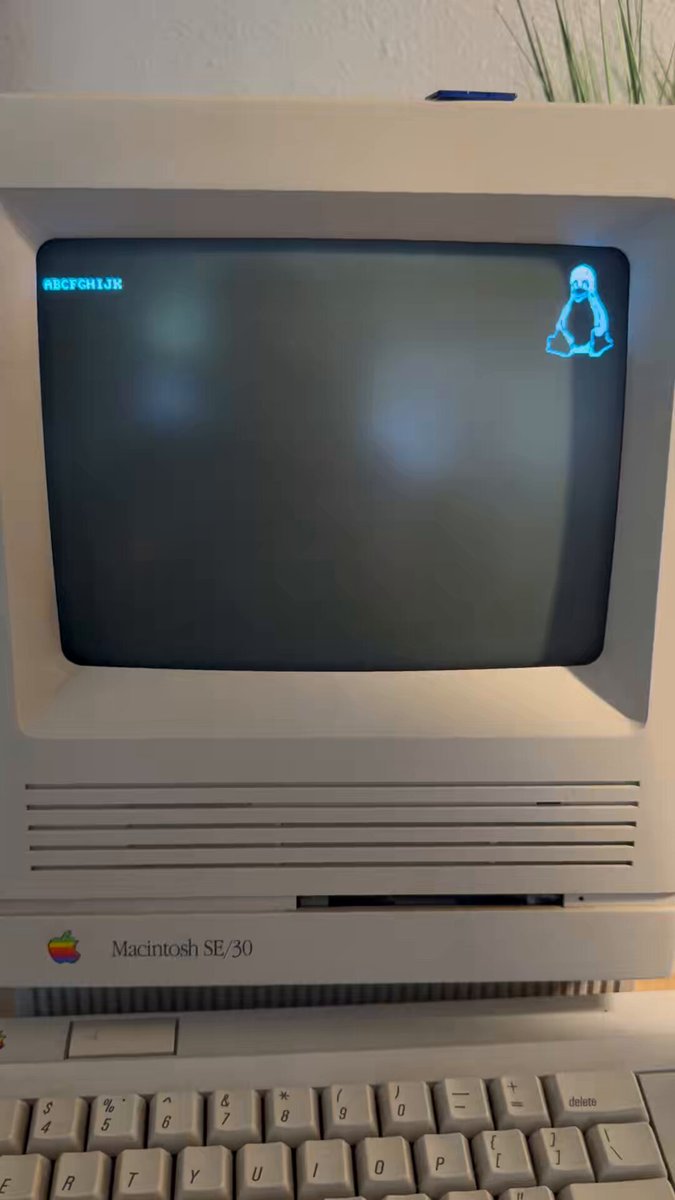
I've had an SE/30 for a really long time and I've never seen a Linux kernel boot on it.
@SiliconForested2.7K followers
34,189 views
20 Comments
Comments from the original post on X (Twitter)

@SiliconForested
Just came to clarify - others have done this in the past but I've never attempted !
11 likes

@jumarmacato
Amazing! never knew 68k can do linux!! fwiw I stuffed my classic mac with rpi4b and made it drive the CRT :D
4 likes

@piecaruso97
Debian has been doing it for decades at this point and they have a recent release with a revnt kernel, your ai probably just had the Debian configs as training data
2 likes
@SiliconForested
AI created a bootloader and an entire operating system out of mostly assembly I call it se30os It has Ethernet, Telnet and most importantly the Omarchy ttfx screensavers It's 72kb and runs very fast
8 likes
@piecaruso97
I think it has been mostly copied out of existing stuff, ai is not creative it assembles from the training data and fills the gaps using assumptions made mathematically on the numbers the model weights put out, so it will match some existing project to dome degree

@edwardhsingdev
Better run EdgeOS on it
2 likes

@OrangeAlert3
Wonderful machine, I miss mine.
1 like

@dxman1a
SE/30 is 68020/30 right? My standard SE couldn't run Linux due to the missing MMU on the 68000, so I had to settle for Minix. Really cool seeing this though.
1 like

@Chainsaw59598
Amazing.
1 like

@Acelogic_
Holy shit
1 like

@RSvoboda432
It’s booting up slowly. Original still better?
1 like
@SiliconForested
I ended up rolling my own 'operating system' with claude 🤣 It's much faster. But yes, Linux is WAY slower compared to real System 7.x on the SE/30
1 like
@RSvoboda432
I’d try BeOS and they have a clean port called Haiku.

@evans_cn
@In4mationOverld I don’t know if you can call 2026 peak computer when that very AI is making RAM unaffordable to many people.
1 like

@mutahir
😍
1 like

@JeffreyATodd
Very cool here are some more ideas for you: 1. Casio fx-CG50, the one you named. Real target is Linux on that SH7305, not Windows. The gloat is a 160×216 color LCD printing a modern kernel log, then a Program Manager that is only a window manager. Caption writes itself: exam-mode calculator, kernel 7.x, eight megabytes. 2. HP 200LX or Atari Portfolio. These are the fair Windows fight. Both are real x86 handhelds. The Portfolio is a 4.9 MHz 80C88 with 128 KB, so Windows 1.0 is the ceiling and still a brag. The 200LX has enough RAM for Windows 3.0. A Casio cannot run real Win32. These can. 3. Apple Newton MessagePad 2100. ARM, with a real MMU, and the green backlight. Boot NetBSD or a trimmed Linux and leave the Newton light on next to Tux. Inverse gloat, NewtonOS chrome on the SE/30 you just watched, is meaner: 1989 compact Mac, 1993 PDA UI. 4. Amiga 500 with a 68030 accelerator. Same family as the SE/30, so the kernel work rhymes, but the photo is a Workbench title bar that says Linux and a copper-bar boot splash. Geek crowd reads it instantly. 5. Original Game Boy. Not a kernel. SM83, 8 KB RAM. The gloat is a boot ROM that scrolls workingset: and clocksource: switched in the green LCD, then drops into a four-shade Program Manager. Fake, and the picture still beats most real ports. 6. Texas Instruments Speak & Spell. Phoneme boot. It spells SCSI subsystem initialized, then says kernel panic in the same voice as “spell elephant.” No display required. 7. Airport split-flap board, or a receipt printer. The OS is normal. The console is the gloat. Each kernel line clacks into place, last flap stuck on hrd: module loaded.

@dorianmuthig
Don’t you need way more RAM to even try to make that work?

@FilipiVianna
Where do I get this image to boot on an emulator?

@Mehdalon
Awesomeness.

@muwlgr
any possible optimizations for text scrolling ?