Загрузка видео...

Не удалось загрузить видео

На главную

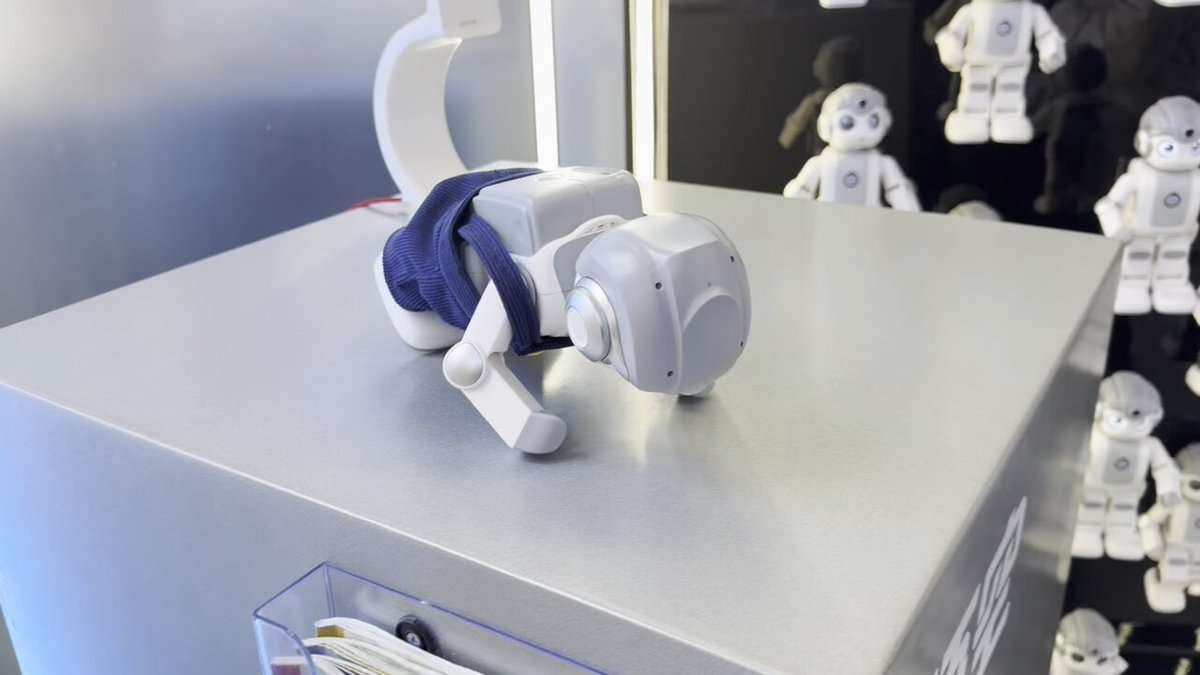
JACK JUST ORDERED 2,000 HUMANOID ROBOTS. SOFT FABRIC WAS SUPPOSED TO BE THE ONE THING ROBOTS COULDN’T HANDLE.🤖👕 Sewing has always been the automation-proof job. Cloth wrinkles, shifts, deforms — machines are built for rigid parts, not soft ones. Now watch the clip. Alignment deviations for cut pieces like...

28,317 просмотров • 8 дней назад •via X (Twitter)

Комментарии: 0

Нет доступных комментариев

Здесь появятся комментарии из оригинального поста

Похожие видео

Figure 03 just finished an 8-hour work livestream, imperfect, but already good enough to replace a lot of repetitive warehouse labor. 🤖 Brett Adcock put a team of F.03 robots on a factory-style package sorting task for a full shift. The job was simple and brutal: detect the barcode, pick the package, flip it label-side down, place it on the conveyor, repeat. Soft poly bags, rigid boxes, moving belts, messy orientations. That is exactly the kind of boring physical work factories pay humans to do all day. Early in the stream, the system handled 230 packages in 10 minutes. That is roughly 2.6 seconds per item — already in human-speed territory for this narrow workflow. The more important part: it was not one robot pretending to work all day. It was a team of Figure 03 robots keeping the line running. When one robot ran low on battery, it left the station and another robot stepped in. That is the real factory signal: not just autonomy, but shift continuity. F.03 is rated for about 5 hours of runtime, so the 8-hour result depends on fleet orchestration, charging, and handoff. That matters more than a single clean demo. The stream was not perfect. There were pauses, hesitations, missed orientations, and small recovery moments. Good. A perfect short clip hides failure. An 8-hour livestream exposes the parts that actually matter: endurance, recovery, throughput, and whether the robot can stay useful after the novelty wears off. Figure says this was fully autonomous on Helix-02, with zero human intervention. For logistics and manufacturing, that is the threshold worth watching. Not “can it do one impressive task?” Can it keep doing the boring task for an entire shift? Figure is not showing a general human replacement yet. But for structured, repetitive factory work, the gap just got much smaller. The timing is also interesting: Figure says BotQ has already delivered 350+ F.03 units and reached a 1 robot/hour production cadence. And F.04 is now in full design lock, with parts starting to ship. The next test is obvious. 8 hours was the proof of endurance. 24/7 is the proof of labor economics.

RoboHub🤖

16,818 просмотров • 3 месяцев назад

For the first time in the history of automation, the people most likely to be replaced are the ones building their own replacement, frame by frame, for a few dollars an hour. Across India, Nigeria, China, and Argentina, workers are strapping cameras to their heads and recording every fold of laundry, every stitch, every washed dish, and that footage is training the robots designed to do those exact jobs. This is documented, not rumor. No jokes! Garment workers in Tamil Nadu, India have been filmed wearing head-mounted cameras on the factory floor, sending point-of-view footage to data firms whose clients include Fortune 500 companies. One US company alone has hired thousands of workers across more than 50 countries to record themselves cooking, cleaning, and folding clothes. More than 6 billion dollars poured into humanoid robots last year, and the one ingredient every maker is starved for is precisely this: real human hands doing real human work. The endpoint is stated plainly by the buyers. In China, one supplier said his pitch to factories is to let workers wear the cameras now, because trained robots will eventually work there instead. The quiet part is the exchange itself. The worker is paid for the hour and keeps nothing after it. No share, no royalty, no ownership of the movements their own body is teaching the machine. The skill leaves their hands and becomes someone else's product, and almost no one along the chain sees the full shape of the trade, not always the person filming, not the millions who watch the clip and scroll on. One scene holds all of it. A humanoid robot spent an hour folding three shirts while a human housekeeper, hired to guide it, quietly finished the rest of the chores. Every automation before this arrived from the outside. A machine showed up and took the job. This one is being built from the inside, by the workers themselves, handing over the last thing they had left to sell. UBI ? or something totally else should pave the way in the future? Thoughts?

Shanaka Anslem Perera ⚡

95,414 просмотров • 1 месяц назад

BOOM! Humanoid Robots Just Performed Surgery for the First Time! REAL VIDEO! In a groundbreaking preclinical breakthrough, researchers at UC San Diego have achieved what many thought was years away: teleoperated humanoid robots successfully completing live surgeries. Published in Nature, the study marks the world’s first use of humanoid robots for in-vivo laparoscopic procedures on large animals (pigs). Two separate surgeries were completed: Key Details •. Procedure: Laparoscopic gallbladder removal (cholecystectomy) •. Team 1: Human surgeon + one humanoid robot (the robot performed core tasks while the human assisted) •. Team 2: Two humanoid robots working together with no human at the operating table •. Robots: Custom “Surgie” humanoids (~5 ft tall, ~60 lbs) using standard surgical tools •. Control: Fully teleoperated by surgeons (remote human control, not autonomous) •. Significance: First demonstration of humanoid robots handling real surgical workflows in a live setting, proving compatibility with existing OR tools and spaces This proof shows humanoid robots could one day help address surgeon shortages, enable remote procedures in rural areas, battlefields, or even space all at a fraction of the cost and space of traditional surgical robots like da Vinci. Read the full publication here: Project page with video: The future of surgery just got a whole lot more interesting. And medical cost for the first time in decades will be scheduled to go down, much further down.

Brian Roemmele

107,600 просмотров • 1 месяц назад

I spent a month in Shenzhen visiting factories and robotics companies, and the contrast with the U.S. was striking. While Figure and Boston Dynamics hide their humanoids behind closed doors, Chinese companies have massive showrooms open to the public. But what really stood out wasn't just the transparency, it was how good they are at selling. Take UBTech: they've already sold 1,200 humanoid units at $200k each to factories. And here's the kicker, these robots aren't even that useful yet. They can only pick up and drop boxes at 1/10th the speed of a human, and factories still need to hire system integrators to train them for specific tasks. My theory is that these factories are terrified of getting left behind in the robotics/AI wave. They're investing in new tech not because it's ready, but because they can't afford to wait. The second surprise was the breadth of their robotics portfolio. These companies aren't just building humanoids, they're deploying service robots everywhere: restaurants, hotels, apartments. Consumer robots are cleaning houses, pools, pet waste, dishes. They're covering the entire spectrum. But the education piece shocked me most. I picked up what I thought was a high school or college robotics textbook, it was for primary school. The government mandated AI and robotics education starting in elementary school. Almost every single school in China now has AI and robotics curriculum, complete with education robots so kids can learn by building. They're creating a generation that grows up fluent in robotics and AI. China owns the supply chain and the hardware stack. But here's what I think people are missing: the race isn't just about who can build robots faster or cheaper. The U.S. advantage has always been in the layer between hardware and human, the interaction design, the software intelligence, the intuitive interfaces that make complex technology feel natural. China is building the physical infrastructure, but they're also learning fast. Every deployed service robot, every classroom full of kids building with education kits, every factory running humanoids, that's all data collection at scale. The window for the U.S. to establish its wedge is narrowing. It's not enough to be better at AI or software anymore. We need to be building the integration layer, the intelligence that makes physical AI actually useful, not just impressive in a showroom. Because right now, China isn't just manufacturing robots. They're manufacturing a robotics-native culture, and that might be the most defensible moat of all.

Miyu Horiuchi

90,718 просмотров • 6 месяцев назад

🚨 AMERICA JUST BUILT THE WORLD’S MOST POWERFUL METAL 3D PRINTER AND IT’S ABOUT TO MASS-PRODUCE ROCKETS AND MISSILES. Divergent Technologies has unveiled the Monolith One, a giant industrial metal printer standing over 8 meters tall and armed with 12 high-powered lasers delivering a combined 24 kilowatts of energy. Unlike typical 3D printers used for prototypes, this machine is built for serious, high-volume production. It can print large, complex aerospace and defense parts in aluminum, titanium, steel, and nickel alloys and it roughly doubles the output of current systems. Why this matters: • Divergent plans to install 64 more of these machines in a massive new 430,000 sq ft factory in Long Beach, California • Once running, the facility aims to produce tens of thousands of munition airframes per year plus hundreds of thousands of critical metal components • It slashes manufacturing time from months down to weeks or even days • The company already supplies major players like Lockheed Martin and RTX The deeper implication: This isn’t just another 3D printer. It represents a shift toward software-defined, on-demand manufacturing at industrial scale for mission-critical hardware. As defense and aerospace demand skyrockets, traditional supply chains are too slow. Systems like Monolith One could become a cornerstone of faster, more resilient domestic production especially for complex structures that are difficult or impossible to make conventionally. We’re watching the industrialization of additive manufacturing in real time. How do you think large-scale 3D printing will change aerospace and defense manufacturing over the next decade? Follow for more frontier manufacturing and defense technology.

TheNewPhysics

80,575 просмотров • 1 месяц назад

As I sit here in DC this week, we are closer to something I was not sure I would ever see. I have been working in this industry since 2015. For most of those years, the defining feature of crypto in Washington was not policy. It was the absence of it. A gray zone where serious people built serious things under a constant cloud, never quite sure which rules applied or whether the ground would move beneath them. This week the CLARITY Act sits on the Senate calendar. A federal framework for digital asset market structure, the thing this industry has wanted for the better part of a decade, is closer than it has ever been. It is not law yet, and there are real hurdles left. But the distance between where we stood a few years ago and where we are sitting today is hard to put into words. I keep thinking about the work that got us here. Over the past year I watched Chainlink move from outside these conversations to inside them. Sergey at the White House for the signing of the GENIUS Act. The Department of Commerce putting government economic data onchain. Meetings with the SEC that became real interpretive guidance. Conversations with the lawmakers now writing the rules. None of that happens by accident. It happens because people keep showing up, year after year, and make the case in rooms where it is not yet obvious. And there is something fitting in it. The entire premise of what we build is verification. Making truth provable. Removing the question of what is real. The work here in DC is the same thing in a different form. Trading a decade of ambiguity for something the industry has never actually had. We are not at the finish line. But sitting here, it is hard not to feel the weight of it. The gray zone is ending. What comes next is something this industry has never had. Clarity.

Chris Barrett

14,798 просмотров • 2 месяцев назад

It's 2030 and you are reviewing humanoid robots. A Tesla. A Google. An Apple. An OpenAI. A Meta. A Figure. And a bunch of Chinese-made ones. Which one is best, and why? I think the Tesla understands the world much better. Why? There were eight Teslas around me on the freeway today. Start there. No other robot company has that data. But my robot is parked at the local high school twice a day. Its cameras see humans in all of our weirdness. How we move. Where we go. Where we walk. Who we talk with. What you are wearing. Whether your hair was combed this morning. That data will lead to robotics breakthroughs. Apple might keep up with its Vision Pro data, but it is too freaked out by the privacy implications of using said data. (On the front are six cameras and a couple of TOF -- Time Of Flight -- sensors that can see everything in your home in great detail). Google has a lot of data, for sure. All my: 1. Email. 2. Calendars. 3. Photos. 4. TV watching behavior. 5. Contacts. 6. Documents and spreadsheets. 7. Files. 8. Location data. So I expect Google's robot will be attractive to many. But how do you see the others shake out over the next five years? Make some guesses. But remember what an AI pioneer told me years ago about AI: it's all about the data. The Chinese ones have huge advantages: the Chinese have more data on their citizens, and many more citizens to boot AND they can make robots cheaper than we can. But now that you know OpenAI is building its own robot you have caught wind of what I've heard from many in San Francisco and Silicon Valley: that humanoid robots are the real prize of AI and will be highly profitable for those that can make them and find customers willing to buy them. Here, too, I learned long ago never to bet against Elon Musk. Will you?

Robert Scoble

33,804 просмотров • 1 год назад

Just weeks ago I considered this to be a map of Superchargers. The foundation that made EV’s a going concern for the first time. But it’s not. These dots represent fully permitted and built power stations in an era where every AI player is trying to figure out how to get power for compute. This is the largest electrical power moat I’ve ever seen that can fully supply current and future charging needs while collecting and storing cheaper power during off-peak to supply an AI revolution. Elon doesn’t care who knows anymore. 2nd place is… crumbs. AWS was built from excess server space needed during peak demand. Now it’s bigger and more valuable than the core Amazon retail business. Tesla is about to drop a hardware smackdown right in the face of software engineers. AI prototypes are easy. Scaling is hard. If only Tesla had a factory pouring out millions of chips each year that are underutilized 95% of the time. Each with their own battery storage. Imagine that. Tesla could call them ‘cars’. And that power moat? It’s all fully upgradable. It’s primed to be tripled. Only a handful of Tesla charging stations currently have solar and/or Megapacks. For 14 years Tesla has permitted and built the gas stations of the future around the world. Everyone said it would fail. All of them were wrong. And now Tesla is in a process of creating a possible 10x value stamp on those stations that should have never been built. It makes you wonder, When a vehicle now leaves the Tesla factory; how do we even begin to calculate the economic production that it will generate during its lifetime? It’s a Robotaxi, energy storage, and a fully sealed/cooled compute processor. They may as well start shitting gold out of a tailpipe.

No Safe Words

56,727 просмотров • 1 месяц назад

Snapshot of something Mike Vrabel expressed frustration with this morning: He sees Hunter Henry (bottom of screen) trying to communicate with the official 15 yards away/do the right thing alignment-wise … and still get penalized. “I’ll have to try to get some clarification on that — how we are going to do this going forward,” Vrabel says. Earlier today, in his radio interview, Vrabel shared that he was irked with over-officiating at the line of scrimmage. “If our guys are going to look over; I get that we have to be legal. But for as long as I can remember in this league, the refs are going to try to officiate proactively and work with the players. “If it’s a hold, call a hold. If it’s defensive pass interference, call defensive pass interference. But at the line of scrimmage, if players are going to try to get the formation correct … we’re not going to tell them that they are either on the line of scrimmage or they have them off? They’re just going to sit there and tap their knee? “I don’t know what that is. That’s frustrating that we are that literal as an officiating department — if that is indeed what they are telling them. … “I didn’t know when we were going to start officiating the line of scrimmage and not communicate with our players. Because in the end, the relationship the players have with officials, I think can be really positive and they can explain the mechanics they’re looking for.”

Mike Reiss

474,637 просмотров • 10 месяцев назад

Europe is quietly becoming what the United States once promised the world. More and more people are looking at their best years ahead and choosing a place where everyday life is designed to work. Where the future feels stable enough to plan for. Where safety is not a luxury product. Where you can build a good life without gambling your health, your family, or your dignity on one bad month. In much of Europe, the “dream” is not about becoming a billionaire. It is about becoming unafraid. It is the freedom of walking home at night without scanning every shadow. The comfort of knowing that if you get sick, you do not need to calculate whether you can afford to be treated. The relief of having a society that still believes children should carry backpacks, not trauma, and definitely not weapons. The calm of streets built for human beings, not just cars. The ability to take a holiday without feeling like you are committing career suicide. The basic decency of labor protections that assume you are a person first and a resource second. And then there is the part people underestimate until they live it: the texture of life. The cities are older and more beautiful than you expect. The distances are smaller. Weekends are real. Food is real. Public spaces are not just decorative, they are functional. Parks are full. Cafes are full. Trains take you somewhere, often across borders, without turning travel into a stress test. You can live in one country, work with another, and visit a third like it is normal because, in many places, it is. The European dream is also a quiet confidence in the social contract. That if you contribute, the system does not abandon you. That you can raise a family without feeling like you are one accident away from ruin. That “getting ahead” does not require burning out. That a good society is one where normal people can live normal lives and still feel proud of them. This is why more and more Americans are not just visiting Europe, but staying. Some come for studies and never leave. Some arrive for a job and realise the lifestyle is the real promotion. Some originally planned a one year experiment and then cannot imagine going back to a place where stress is treated as a personality trait and insecurity is marketed as freedom. Europe is not perfect. It has bureaucracy. It has politics. It has problems that deserve criticism. But in many European countries, life is still built around a simple idea: society should reduce fear, not monetise it. That is the new dream. And people can feel it the moment they arrive. If you could choose one thing to trade for a better life, what would it be: more income, or more security? And what do you think your country would have to change for people to stop leaving, and start staying? Stay connected, Follow Gandalv Gandalv

Gandalv

989,023 просмотров • 5 месяцев назад

🚨 BREAKING: Walden Robotics has just come out of stealth with $300 million in funding and a $1.1 billion valuation. Another unicorn in the robotics space. 🦄 Just 6 months after incubation. The company was spun out of Toyota's robotics research lab by co-founder Russ Tedrake, a former Toyota Research Institute executive and MIT professor who taught a course on robotic legs. The seed round was co-led by Deviation Capital and Toyota, with participation from: NVIDIA, Boeing, Samsung Ventures, CoreWeave Ventures and AE Ventures. The robot is already working. A pilot is live at a North American Toyota factory where a Walden humanoid is pulling eight-hour shifts alongside human workers, loading and unloading car parts, cleaning machinery, kitting for assembly. A shift. Every day. Walden builds its own hardware, software and AI models, designed to continuously learn and improve in real production environments. Tedrake's words on the opportunity are worth noting: "Everyone recognises the magnitude of the opportunity and the technology feels ready, but success is not assured. You have to think through the business case, the unit economics, and how to marry the best of manufacturing and logistics with disruptive AI technology." Rare honesty in a space full of hype. The race to own that market is accelerating every single week. 🤖 Great story by Bloomberg here: ~~ ♻️ Join the weekly robotics newsletter, and never miss any news →

Lukas Ziegler

74,725 просмотров • 29 дней назад

Jeff Bezos just described the era you are living in. It sounds nothing like what you have been told. Bezos: “The world is so interesting right now. We’re in multiple golden ages at once.” Not one golden age. Multiple. Simultaneous. Overlapping. Bezos: “I think there’s never been a more extraordinary moment to be alive.” He was not being poetic. He was being literal. For the entire history of civilization, humanity got one revolution at a time. Fire. The wheel. The printing press. Electricity. The transistor. One breakthrough. Then centuries of silence before the next. That pattern just shattered. Artificial intelligence. Space access. Gene editing. Energy storage. Quantum computing. Five revolutions running inside the same decade. That has never happened before. Not once in ten thousand years of recorded progress. And the story being sold to you every single day is that everything is falling apart. That the future is something to survive. That the best days are behind you. The people closest to the actual technology do not believe a single word of it. They are not debating whether the world is ending. They are too busy building the next one. Fear is the most profitable product on Earth. It moves faster than any breakthrough ever will. The greatest concentration of technological revolutions in human history is unfolding right now. Most of the world is too busy arguing about which version of collapse to believe in to notice. Bezos did not say a golden age might be approaching. He said you are already standing inside several of them. The gap between that statement and what you currently believe about the world is the most expensive blind spot of your lifetime. You were not born at the end of anything. You were born at the exact point where the entire curve bends upward. That does not happen twice.

Dustin

21,007 просмотров • 3 месяцев назад

Alaska. Putin and Trump. The meeting that was both awaited and feared. The outcome. By Roman Alekhin To discuss this further, the key point to understand is this: Two and a half hours behind closed doors is too little for leaders of nuclear powers if they are just starting a conversation—but too much if they were merely posing for cameras. This means the real work happened earlier—quiet, working discussions “behind the door” that never made it into the official communiqué. These are what stopped Trump from imposing secondary sanctions; this is where the exchange of conditions took place, terms that won’t be disclosed until both leaders decide the time is right. I suspect Syria was discussed, as well as the “Trump Bridge” (instead of Zangezur), the Middle East, and much more that isn’t yet visible to the naked eye. The public part? Pure theater. The point wasn’t to negotiate in front of the world or sign something, like Trump did with Armenia and Azerbaijan—minor players, important only tactically. The point was to send a signal: the presidents of Russia and the U.S. are shaking hands and smiling again, no knives behind their backs. This signals that a new reality has arrived, one that Europe, Ukraine, and everyone accustomed to building their worldview around the idea of “Russia’s isolation” will now have to reckon with—including those within our own countries. Trump’s comments on Fox News were deliberately vague—he’s a master at leaving room for maneuver. But the key takeaway is clear: the pressure will now shift from Moscow to Kyiv and Brussels. This is evident even in the final format—not a word about a “no-conditions” ceasefire, which was Europe and Zelensky’s main demand. This means the discussion on a final peace has been postponed, but within a clear framework: Zelensky must exit the war in a way that lets Europe save face. Russia’s red lines have long been clear: non-aligned status for Ukraine, return of Kherson, Zaporizhzhia, Donetsk, and Luhansk regions within their administrative borders (not the frontlines), lifting of sanctions, and real democracy in Ukraine without persecution of the Russian language or the Orthodox Church. These conditions will prolong the conflict for some time. Zelensky will need to stage a fighting retreat to the administrative borders—this will allow Europe to save face. But the logic is already visible: Ukraine’s defeat will be framed not as a “crushing” but as a “peaceful settlement.” Six months—that’s the timeframe in which we’ll see the dynamics. If the front accelerates, the deal is working. If it stalls, not all pieces are in place yet. But the main thing is already done: Russia is back in the game, not through gray negotiating formats but through a handshake on American soil—even if it’s chilly Alaska. (Though we have warm ties to the region, as seen in the wreath-laying for the “Heroes of ALSIB” and the meeting with Archbishop Alexy of Sitka and Alaska.) For the world, this is an image where smiles are worth more than signatures. For Trump—a chance to show he’s the only one who can “make peace.” For Putin—a symbolic victory: Russia is not a besieged enemy but an equal player. For Europe and Ukraine—the beginning of a painful new phase where they’ll have to accept the inevitable. In these talks, there were no winners or losers in Alaska. In Alaska, both presidents won, while those who weren’t there—lost, or at the very least, didn’t win.

🅰pocalypsis 🅰pocalypseos 🇷🇺 🇨🇳 🅉

13,487 просмотров • 1 год назад

NEW ROBOT: SOLAR PANEL DEPLOYER 🌞 San Francisco Gritt (a.k.a. Gritt AI) is probably one of the hottest robotics startups you have never heard of. Founded in 2023 by two CMU roboticists, it came out of stealth on July 21, 2026 with a $26M Series A ,led by Obvious Ventures . Gritt does not make robots. It bolts an off-the-shelf Kawasaki robotic arm onto heavy equipment for construction, and runs its own AI to unload utility-scale solar panels. They also carry them, and set them onto metal racking with sub-millimeter precision. A human then has to fasten them. It replaces the manual overhead lifting of ~100-lb glass panels on solar farms. Solar is for now their only market, but they will expand to data centers (of course) and other large infrastructures. Solar was chosen first because it's the most factory-like task on an outdoor site. Gritt is making the bet on buying, while most of its competitors are building the robots. Their own capex is therefore near-zero, and moves the scaling constraint to ops crews and software -> it does not make it necessarily easier! All depends where your strengths lie. Gritt has currently two systems deployed in the field, over signed contracts to install ~2.8–3 GW of solar over 18 months. They plan to reach 48 systems within six months -> a ~24× deployment ramp in half a year! Gritt says the first skills took weeks to train but rebar tying took a single day on the same software pipeline after the solar work. That's a ~10–30× drop in per-skill training cost! And goes against the idea that deployment data is near-worthless, since novelty is the scarce input. Also worth mentioning: Gritt has a Chinese competitors, Trinabot. Trinabot is vertically integrated: tied to Trina, a giant Chinese solar-panel maker. Make the panel and the robot that installs it, while Gritt's hardware-agnostic. Interesting to see another example where China integrates manufacturing plus robot, and the US startup goes capex-light software on rented equipment.

Léo

42,379 просмотров • 14 дней назад