Video wird geladen...

Video konnte nicht geladen werden

Zur Startseite

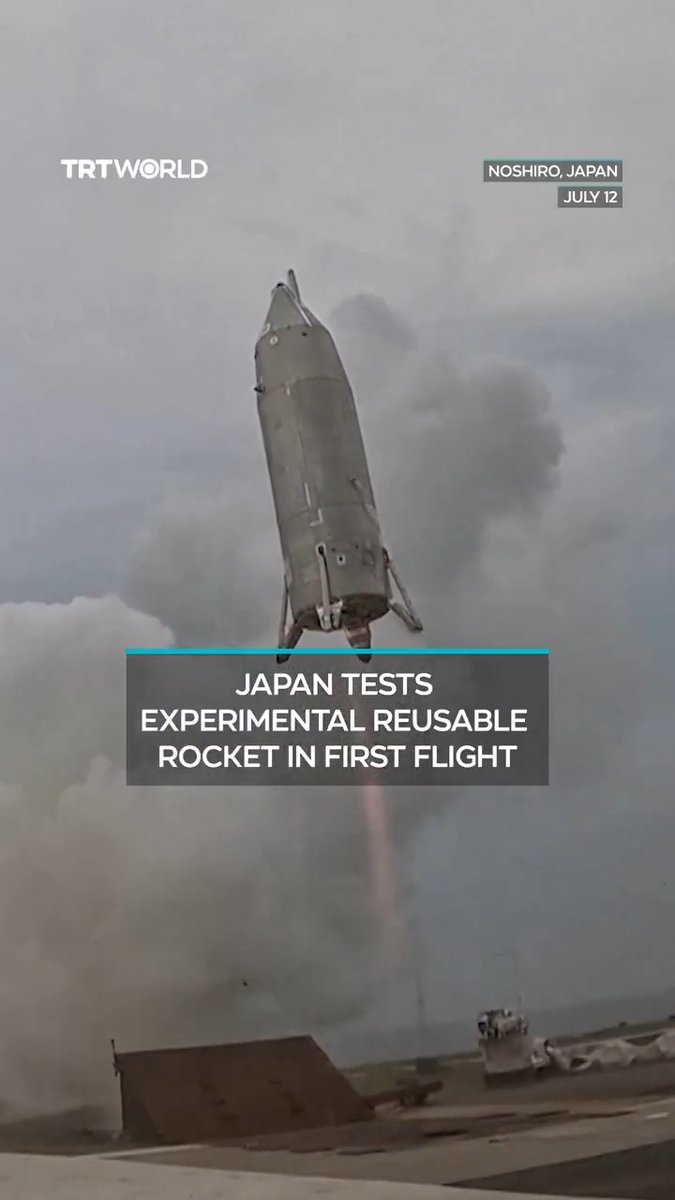
🚀 Japan Successfully Tests Reusable Rocket Prototype Japan’s space agency JAXA has completed the first flight test of its RV-X experimental reusable rocket at the Noshiro Rocket Testing Center. * Reached an altitude of approximately 11 meters. * Traveled around 16 meters horizontally. * Landed vertically as planned. *...

15,829 Aufrufe • vor 1 Monat •via X (Twitter)

0 Kommentare

Keine Kommentare verfügbar

Kommentare vom Original-Post werden hier angezeigt
Ähnliche Videos

China Achieves First Successful Net Recovery of Reusable Long March 10B Rocket China successfully launched the Long March 10B (CZ-10B) reusable launch vehicle today (10 July 2026) from the Hainan Commercial Space Launch Site, marking a major milestone in the country’s commercial space ambitions. The mission achieved China’s first successful controlled recovery of a rocket first stage and the world’s first successful net-based recovery of an orbital-class launch vehicle. The launch took place around midday from Launch Pad No. 2 at the Hainan Commercial Space Launch Site. Approximately six minutes after stage separation, the rocket’s first stage executed a controlled vertical return to the designated recovery zone at sea. Instead of landing on a conventional drone ship, the booster was successfully captured by the offshore recovery vessel “Navigator” (领航者) using a flexible net capture system, representing the first time such a recovery method has been successfully demonstrated for an orbital launch vehicle. The Long March 10B is a new-generation commercial reusable liquid oxygen-kerosene rocket featuring a 5-metre-diameter core stage and standing nearly 70 metres tall. It is powered by seven reusable YF-100N engines. Even when configured for first-stage recovery, the rocket is capable of delivering at least 16 tonnes to low Earth orbit (LEO). The successful mission represents a significant breakthrough for China’s commercial space sector and reusable launch technology. It fills a longstanding gap in China’s capability to operate a large-lift reusable commercial launch vehicle while demonstrating an innovative recovery approach that could reduce launch costs and improve operational efficiency for future missions. The achievement also positions China among the leading nations advancing reusable launch systems, with the successful net recovery introducing a novel alternative to traditional landing platforms used by other space-launch providers.

BRISL

63,848 Aufrufe • vor 1 Monat

Why Japan Is Teaching Rockets to Come Home The concept of a reusable rocket is deceptively simple: instead of discarding an expensive stage into the ocean after every launch, land it and launch it again. SpaceX built its competitive edge on this very principle—and now others are mastering the same technology. Japan joined this club over the weekend. Its space agency, JAXA, conducted the first flight of the RV-X—a small experimental rocket developed in partnership with Mitsubishi Heavy Industries. The flight was brief, lasting less than a minute: it rose 11 meters, shifted 16 meters laterally, and executed a soft, vertical landing. Keeping a rocket upright on a column of thrust is akin to balancing a pencil on your fingertip—except the pencil weighs tons and is powered by a flame. A split-second error is all it takes to lose that vertical stability. Engineering features play a crucial role here: an upgraded engine that has undergone 165 hot-fire tests and four shock-absorbing legs designed to cushion the impact with the ground. All of this serves as a rehearsal for a far more ambitious goal: a future reusable successor to the current expendable H3 rocket, intended to deliver payloads to orbit at a significantly lower cost. Japan is not acting alone; it is developing the RV-X in collaboration with France and Germany, while just a day earlier, China successfully recovered a first stage for the first time. The world is gradually shifting toward rockets that do not burn up after a single flight but instead return to pick up their next payload.

Black Hole

16,771 Aufrufe • vor 1 Monat

Here is one of our experimental 3D printed Hadfield liquid rocket engines going through some thrust vector control (TVC) profiles! As we scale to our first light-lift orbital launch vehicle, Tundra, and then our medium-lift reusable launch vehicle, Titan, precise control of the rocket at every phase of flight is critical to mission success. Guiding a rocket to orbit, and eventually back to Earth, demands close coordination across every sub-team. Some of the key challenges we’re tackling: ➡️ Reliable & repeatable TVC actuation: ensuring the engine gimbal responds consistently across every test and flight ➡️ High-frequency control loops: real-time systems that keep the vehicle stable from liftoff to orbital insertion ➡️ Propellant sloshing: accounting for the movement of fluids in tanks and its effect on vehicle dynamics ➡️ Wind shear compensation: countering atmospheric disturbances during ascent ➡️ Structural bending & flex modes: managing how the vehicle’s primary structure responds to aerodynamic and thrust loads ➡️ Precision payload delivery: hitting the exact target orbit, every time Our team at NordSpace has been advancing our propulsion systems on many fronts, as we work to unveil our orbital-scale, pump-fed Hadfield and Garneau rocket engines in the near future — the engines that will carry Canada to orbit for the first time, and unlock sovereign access to space. Check out some of our rocket hardware, meet our engineers, join over 400 attendees and over 40 speakers at the Canadian Space Launch Conference, taking place this May 5th in Ottawa. National Defence Defence Research and Development Canada Canadian Space Agency NSERC / CRSNG

NordSpace 🇨🇦

48,970 Aufrufe • vor 6 Monaten

BREAKING: For 10 years the world believed there was one way to reuse a rocket: land it upright on its engines, the way SpaceX does. Today China refused to copy it, and pulled off something SpaceX never managed on a first flight. It caught the rocket instead. The Long March 10B lifted off from Hainan, China this morning, and about 6 minutes later its first stage came back down toward a 25,000-ton ship at sea. It did not land. Hooks on the falling booster snagged a net of tensioned steel wires strung across the deck, the wires riding robotic rails that slid into place to meet it. No landing legs. No touchdown. A rocket plucked out of its own descent by a moving net, on the maiden flight of a brand-new vehicle. No one handed China this. SpaceX guards its rocket tech as “trade secrets”, not “patents”, precisely so it cannot be read and copied. China watched a decade of public flights and then built an entirely different machine to reach the same prize, catching instead of landing, which sheds the heavy legs and spares the fuel a soft touchdown burns to hover. And this was never about cheaper satellites, though it delivers those too, feeding the thousands of birds in China's Starlink rival. Its deeper purpose is the Moon. That booster shares its core with the rocket meant to land Chinese astronauts on the lunar surface by 2030. In the same season, America's own Moon rocket, Starship, has flown 12 times and still has not shown the single maneuver its lunar plan depends on. One flight does not dethrone SpaceX. It has landed hundreds. What ended today is not SpaceX's lead. It is Uncle Sam’s belief that it owns the only road to the Moon. The piece works out which way of coming home actually wins.

Shanaka Anslem Perera ⚡

2,631,754 Aufrufe • vor 1 Monat