正在加载视频...

视频加载失败

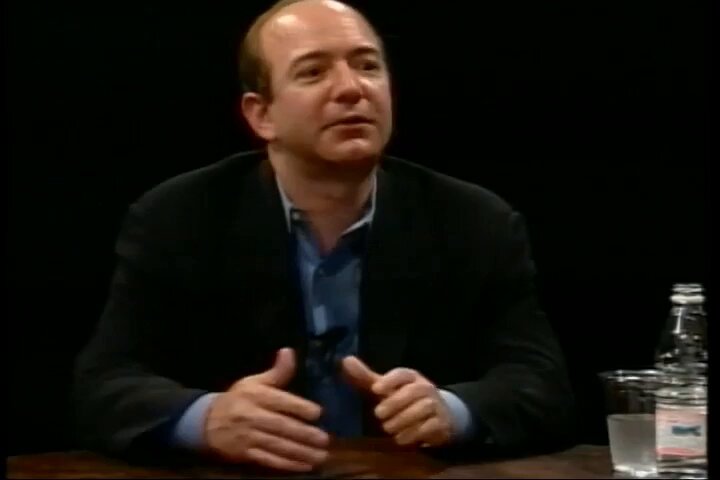
Jeff Bezos explains Amazon’s process for expanding into new products like Kindle and AWS “I would definitely advise a small startup company to be as narrow and as focused as is possible to be. If you look at the original Amazon business plan, there was no hint of anything...

63,593 次观看 • 9 个月前 •via X (Twitter)

0 条评论

暂无评论

原始帖子的评论将显示在这里

相关视频

Jeff Bezos on how to build a business strategy “I very frequently get the question: ‘What’s going to change in the next 10 years?” And that is an interesting question… But I almost never get the question: ‘What’s not going to change in the next 10 years?’ And I submit to you that that second question is actually the more important of the two.” Jeff argues: “You can build a business strategy around the things that are stable in time. In our retail business, we know that customers want low prices, and I know that’s going to be true 10 years from now. They want fast delivery. They want vast selection. It’s impossible to imagine a future 10 years from now where a customer comes up and says, ‘Jeff I love Amazon, I just wish the prices were a little higher.’ Or, ‘I love Amazon, I just wish you’d deliver a little slower.’ Impossible. And so we know the energy we put into these things today will still be paying dividends for our customers 10 years from now.” He gives AWS as another example. It’s impossible to imagine AWS customers asking for a less reliable or more expensive service. ”When you have something that you know is true, even over the long term, you can afford to put a lot of energy into it… The big ideas in business are often very obvious, but it’s very hard to maintain a firm grasp of the obvious at all times. But if you can do that and continue to spin up those flywheels and put energy into those things, over time, you build a better service for your customers on the things that genuinely matter to them.” Video source: Amazon Web Services (2012)

Startup Archive

22,420 次观看 • 2 个月前

Jeff Bezos on how to build a business strategy “I very frequently get the question: ‘What’s going to change in the next 10 years?” And that is an interesting question… But I almost never get the question: ‘What’s not going to change in the next 10 years?’ And I submit to you that that second question is actually the more important of the two.” Jeff argues: “You can build a business strategy around the things that are stable in time. In our retail business, we know that customers want low prices, and I know that’s going to be true 10 years from now. They want fast delivery. They want vast selection. It’s impossible to imagine a future 10 years from now where a customer comes up and says, ‘Jeff I love Amazon, I just wish the prices were a little higher.’ Or, ‘I love Amazon, I just wish you’d deliver a little slower.’ Impossible. And so we know the energy we put into these things today will still be paying dividends for our customers 10 years from now.” He gives AWS as another example. It’s impossible to imagine AWS customers asking for a less reliable or more expensive service. ”When you have something that you know is true, even over the long term, you can afford to put a lot of energy into it… The big ideas in business are often very obvious, but it’s very hard to maintain a firm grasp of the obvious at all times. But if you can do that and continue to spin up those flywheels and put energy into those things, over time, you build a better service for your customers on the things that genuinely matter to them.” Video source: Amazon Web Services (2012)

Startup Archive

61,775 次观看 • 1 年前

Jeff Bezos on the 4 principles that differentiated Amazon from other companies “The thing that connects everything that Amazon does — our #1 conviction, philosophy, and principle — is customer obsession, as opposed to competitor obsession. We are always focused on the customer, working backwards from the customer’s needs, and developing new skills internally so that we can satisfy what we perceive to be future customer needs.” Jeff Bezos continues: “It seems like we’re in a bunch of different businesses. We have Amazon Web Services, which is completely different from our Amazon Prime business or Amazon Marketplace or Amazon Studios and so on. But really the way that those businesses run are very similar, and it all starts with customer obsession. But it’s not just customer obsession.” Pioneering is another critical principle for Amazon: “We have a very inventive culture. We like to pioneer and invent. There are other very effective business strategies. Pioneering is not the only effective business strategy. In fact, some people would argue it’s not the most effective one. Close-following can be a very good business strategy, and it’s worked many times if you look at the history of business. But it just isn’t who we are.” Willingness to think long-term is another one: “That’s another common thread that runs through everything we do. We are very happy to invest in new initiatives that are very risky for 5-7 years. Most companies won’t do that. Companies will invest for very long periods of time in the cases where the outcomes are more certain, but it’s the combination of the risk-taking and the long-term outlook that make Amazon special.” Taking pride in operational excellence is the final one: “Doing things well. Finding defects and working backwards. That’s all the incremental improvement that most successful companies are very good at. If you’re not good at finding the root cause of defects and fixing that root cause — you don’t ever want to let defects flow downstream — that’s a key part of doing a good job in any business, in my opinion.” Video source: Charlie Rose (2016)

Startup Archive

31,625 次观看 • 6 个月前

Jeff Bezos explains the “releasing the work” framework he used to build Amazon In the early days of Amazon, Jeff Bezos had too many ideas. Then Jeff Wilke, a new Amazon executive at the time, told his boss, “Jeff, you have enough ideas to destroy Amazon.” “This was just a shocking idea for me,” Bezos recalls. “As a founder, I had the great luxury of always being able to hire my tutors. I would hire these experienced, senior executives . . . And I would listen to them and they would teach me.” When Bezos asked Wilke what he meant by this, Wilke responded, “You have to release the work at the right rate so that the organization can accept it.” Bezos reflects on this point: “Every time I released an idea, I was creating a backlog of work in process. And because it was just stacking up, it was adding no value. In fact, it was creating distraction . . . This sounds so obvious, but it was not obvious to me at the time. And this was a profound insight for me. So I started prioritizing the ideas better, keeping lists of them, and keeping ideas to myself until the organization was ready for the ideas.” He continues: “I also started figuring out how to build an organization that can be ready for more ideas. That’s about having the right senior team and leadership and giving those people the executive bandwidth so they could do more ideas per unit of time. And that is what we built. We built a company that’s very good at inventing and doing more than one thing at a time. And as the company gets bigger, you do want to be able to do more than one thing at a time. But that idea of ‘releasing the work’ was very profound for me. It made us operationally more effective while still being inventive.” Video source: Reuters (2025)

Startup Archive

674,940 次观看 • 8 个月前

Jeff Bezos in 1999 on why "Internet Shminternet" doesn't matter: Jeff was being challenged on whether Amazon is still an internet company. They had 3,000 employees and over 4 million square feet of distribution centers. The interviewer pushes back: "You're not really a pure Internet company anymore either. You've got millions of square feet of real estate, growing inventory, thousands of employees." Jeff's response: "I'm very proud of that because with that distribution center space and half a dozen distribution centers around the country, it allows us to get product close to customers so we can ship it in a timely way which improves customer service levels. That's what we're about." The interviewer tries again: "But you're not a pure Internet play." Jeff fires back: "It doesn't matter to me whether we're a pure Internet play. What matters to me is we provide the best customer service. Internet Shminternet. That doesn't matter." On what investors should care about: "They should be investing in a company that obsesses over customer experience in the long term. There is never any misalignment between customer interests and shareholder interests." The interviewer accuses him of corporate arrogance: "Isn't it corporate arrogance to assume that you can come into these businesses which you have no experience in and virtually overnight become the best and the market leader?" Jeff's response: "When we first started selling books four years ago, everybody said 'you're just computer guys, you don't know anything about selling books.' And that was true. But we really cared about customers and now we know a lot about books. We hired the right people. We take the commitment to the customer very seriously." On the risk: "There's no guarantee that Amazon(.com) can be a successful company. What we're trying to do is very complicated. There's huge execution risk involved. We have a terribly complicated business. But this is the less risky of the two approaches because scale is important in this business." Customer obsession beats everything else.

Jaynit

28,602 次观看 • 5 个月前

🇨🇳🇺🇲 The meeting between Donald Trump and Xi Jinping has officially begun. The presidents of the two countries addressed each other with opening remarks: President of China, Xi Jinping: The whole world is watching our meeting. Currently, a transformation not seen in a century is accelerating across the globe, and the international situation is fluid and turbulent. The world has come to a new crossroads. Can China and the United States overcome the Thucydides Trap and create a new paradigm for major country relations? Can we meet global challenges together and provide more stability for the world? Can we, in the interest of the well-being of our two peoples and the future of humanity, build a brighter future together for our bilateral relations? These are the questions vital to history, to the world, and to the people. They are the questions of our times that you and I, as leaders of major countries, need to answer. I always believe that our two countries have more common interests than differences. Success in one is an opportunity for the other, and a stable bilateral relationship is good for the world. China and the United States both stand to gain from cooperation and lose from confrontation. We should be partners, not rivals. We should help each other succeed and prosper together and find the right way for major countries to get along well with each other in the new era. I look forward to our discussions on major issues important to our two countries and the world, and to working together with you to set the course for and steer the giant ship of China-U.S. relations. Let us make 2026 a historic landmark year that opens a new chapter in China-U.S. relations. President of the United States, Donald Trump: First of all, that was an honor like few have ever seen before. I think I was particularly impressed by those children they were happy, they were beautiful. The military is obvious it couldn't be better. But those children were amazing, and they represent so much. And I know they represent so much to you. You and I have known each other now for a long time the longest relationship of our two countries that any president and president has had. And that is, to me, an honor. We have had a fantastic relationship. We have gotten along even when there were difficulties. Whenever we had a problem, we worked it out very quickly. And we are going to have a fantastic future together. I have such respect for China and the job you have done. You are a great leader. I say it to everybody. Sometimes people do not like me saying it, but I say it anyway because it is true. I only say the truth. It is an honor to be with you. It is an honor to be your friend, and the relationship between China and the USA is going to be better than ever before.

Visioner

26,443 次观看 • 1 个月前

Arteta on his role to re-energise the Arsenal team. 💪 “Certainly, when you lose a game, you have a lot of feelings because, especially, this group of players are so competitive and they seek for excellence and when you don't reach it, you ask yourself questions, and we did that. “But I think my role there as well is to bring optimism and reality about where we are, and yeah, our club has a long history. And to find a moment where, in February, we're in the position that we are, is very difficult to find. So guys, we are doing so many things so well, and let's focus mainly on that. And for sure, we want to improve, we want to be better in every area, but with that sense as well of self-confidence and conviction that we are in the right path. Anyone need to lift Arteta? “No, in these moments, no. Normally, I'm the opposite and when we are doing so well, I'm there with a stick to say, 'This is not good enough,' 'This is not good enough.' The other day, no, because I know how much they wanted the amount of games and the demands that we put on those players every day. “In those moments, they need to understand and feel that we are right behind them. I'm mainly responsible for that and they keep playing with that freedom, with that enjoyment, as I discussed the other day, and I make sure that that journey is beautiful because what is ahead is great and everybody has to be part of that but in a good sense and with good humor and with good optimism and looking forward to it.”

Connor Humm

17,767 次观看 • 4 个月前

Marc Andreessen explains the 3 Necessities for Start-up Success: "The general criteria for a successful high-tech startup, in my view, you see different sort of rules of thumb from different people. But the three big things you always come back to are, is there a big market? And by the way, that comes in two parts. Is there a big existing market that you think you can go after and sort of displace incumbents or do you believe there will be a new market that will be big? So big market. Is there a fundamental technology or economic change that causes you to basically justify having a new company? And that's really important. And the way I always think about that is, is there a 10X change happening in the technology landscape? Is something 10X faster or 10X cheaper or 10X better? And if it's not 10X, we as both VCs and entrepreneurs, we really have to ask ourselves like, is it really worth doing? Because it's really hard. I mean, it's really hard to start new companies. new companies generally shouldn't exist. Existing companies are usually pretty good at what they do. And so for a new company to exist, it not only has to like come in and go into business and bring a product to market, but it has to bring a product to market that's so much better than what already exists that it punches through the sort of status quo. And most customers in most markets are pretty happy buying from the current suppliers and so there has to be a real kind of edge on the thing and we look for that in either a technology change, usually a technology change or an economic change. which are often the same thing. And then the third is team. Is the team outstanding? And if you think about this as an entrepreneur, it becomes a question of the founding team. Some companies are solo founders and they can work, but generally most of us, like myself, we're human beings, we're mortal. You want to have a founding team of complementary skill sets. And so you want to have at least one super strong technologist, quite possibly more than one. Some of the best startups are actually more than one founding technologist and then it often helps to have somebody who's like a product or who's a market or sales person or has a sort of really good understanding of business on the team, certainly helps a lot. And so we sort of look at market, product, and team. And the reality is you need all three. I would say, interestingly, if you're going to compromise as an investor, if we're going to compromise on one of those, it would actually be the product. And the reason I say that is because a great market is a lot easier to make up for with iterative product execution than a poor market. Because the problem with a poor market, a small market, is even if you do a great job on the product, there just aren't that many customers. It's hard to ever get big."

Founder Mode

39,005 次观看 • 5 个月前

Jeff Bezos: “Missionaries build better products” In the clip below, Jeff tells Charlie Rose that Amazon’s mission is to be “Earth’s most customer-centric company.” When asked what that means, Jeff shares the example: “Right after World War II, Akio Morita—the guy who founded Sony—set as the mission for Sony that they were going to make Japan known for quality. You have to remember, this was a time when Japan was known for cheap, copycat products. And Morita didn’t say ‘we’re going to make Sony known for quality’. He said ‘we’re going to make Japan known for quality.’ He chose a mission for Sony that was bigger than Sony.” And Jeff wanted to do the same with Amazon: “We want other companies to look at Amazon and see us as a standard-bearer for obsessive focus on the customer—as opposed to obsessive focus on the competitor.” He cites this as one of the reasons Amazon takes such a long-term view—he argues you can’t really do the right thing for customers if you’re short-term oriented. This mindset also a key factor in their success versus Walmart: “Our profitability is not our customer’s problem. We don’t take the point of view that we’re going to price products at a particular margin for ourselves… We’re going to price products competitively. And if that means on that product we lose money, that’s ok because we need to take care of the customer to earn trust. And we’ll figure it out over time… But we’re not going to make customers pay for our inefficiencies.” As an example of the company’s long-term thinking, Jeff shares that most businesses Amazon starts have either no impact on financials for the first 5-7 years or a negative impact. “It’s an outcome of customer obsession.” In 1997, George Colony of Forrester Research called the company “Amazon.toast.” Jeff knew that every employee—and perhaps more importantly: every employee’s mother—had read the article. So he called an all-hands meeting with all 150 employees at the time and told the team: “You should wake up terrified every morning. But don’t be worried about our competitors because they’re never going to send us any money anyway. Let’s be worried about our customers and stay heads-down focused.” He tells Charlie: “[Our competitors] can succeed fabulously and it won’t stop us from succeeding. These retail markets are huge…. Sometimes people think of business as a sporting event: there’s a winner and a loser. But it usually isn’t. Most often, industries succeed—I can tell you, e-commerce is succeeding. And the way we think about it: nobody else has to fail for us to do well… I have a list of 50 competitors we could walk through all over the world doing different things… We’re going to pay attention to those competitors, but we’re not going to obsess over them. We’re going to obsess over customers… And it’s not just a business for us, it’s a mission. And missionaries build better products.”

Startup Archive

119,372 次观看 • 2 年前

YOKO ONO: ONOCHORD, VENICE, 2004 Yoko: The world is divided in two industries. One is the War Industry and the other is the Peace Industry. The people in the War Industry are totally together. They don't have to talk to each other, even. They know exactly what they want to do. They want to go out there, kill and make money. But the people in the Peace Industry, which are us - we are so idealistic that each one of us criticises the other Peace Person in the Peace Industry. And we are always just arguing and we are wasting our energies doing that. So let's just forgive each other and see that we are in the Peace Industry and that's all that counts. Even if you are not marching for peace, just be yourself, being a florist, being a merchant, being a talior, anything. That way you're contributing to the Peace Industry. People are just concentrating on fear, confusion and anger. And therefore just for a moment, I'd like us to think about Love. In a very magical, straight way, John and I met in London and from then on we stood for Peace and Love. And when I do this kind of event. Well it is... I was inspired to do it, but I still think that I'm still with John in spirit. John and I created the country called Nutopia. Not Utopia, because there was Utopia as a concept already. And we wanted to create a new concept, so we just added N on it - Nutopia - and as a country. Well, that is the concept of a country. And we all are citizens of that country. And in my apartment in the Dakota Building, we put a little plaque on the back door, the kitchen door. It says 'Nutopian Embassy' and even now we have that. (laughs). Nutopia exists in our minds. And because of that, some people want to rebel against it. The reason some want to rebel against it is a good proof that it exists. I think that it was a terrible thing that happened in Chechnya. But we have to still keep our hopes up. And instead of giving up, we have to keep on sending the message of Love to each other. You say that I am the Ambassador of Peace. We are all Ambassadors of Peace. You are too. Everybody in this room are Ambassadors of Peace. Just the fact that we are not participating in War. The fact that we are here, and we are what we are, means that we are in the Peace Industry. All of us. John and I used to say that our apartment in the Dakota is a conceptual monastry, just for the two of us. And when we go out of the Dakota, we get so many people communicating with us, so it's very important that we had silence and quietness. And my apartment is a very small space compared to the world. And I need that for my peace of mind. You should be kind to each other. You should come together, hug each other, love each other, express our love to each other and we should make it work. We should finally create a world that is a totally an Earth for Us. So let's do it. Yoko Ono, OpenAsia Press Conference, whilst exhibiting Onochord, 2004 by Yoko Ono (Nutopia) at the Venice Biennale: OpenAsia 2004, Lido Di Venezia, Venice, Italy, 9 September 2004.

Yoko Ono

35,208 次观看 • 2 年前

President Trump just delivered a glowing two-minute address to the Chinese delegation in Beijing. He praised President Xi Jinping as a “great leader” and vowed to have a fantastic future together. TRUMP: “That was an honor like few have ever seen before.” “And I think I was particularly impressed by those children. They were happy. They were beautiful.” “You and I have known each other now for a long time. In fact, the longest relationship of our two countries that any president and president has had, and that’s to me, an honor.” “We’ve had a fantastic relationship. We’ve gotten along. When there were difficulties, we worked it out.” “I would call you and you would call me. And whenever we had a problem, people don’t know, whenever we had a problem, we worked it out very quickly, and we’re going to have a fantastic future together.” “Such respect for China, the job you’ve done.” “You’re a great leader. I say it to everybody. You’re a great leader. Sometimes people don’t like me saying it, but I say it anyway because it’s true. I only say the truth.” “And I just want to say, on behalf of all of the great delegation that we have, we have the greatest businessmen, the biggest, and I guess the best in the world.” “We have amazing people and they’re all with me. Every single one of them. We asked the top 30 in the world. Every single one of them said yes. And I didn’t want the second or the third in the company. I wanted only the top.” “And they’re here today to pay respects to you and to China.” “And they look forward to trade and doing business. And it’s going to be totally reciprocal on our behalf.” “So I really look very much forward to our discussion. It’s a big discussion. There are those that say this is maybe the biggest summit ever.” “They can never remember anything like it. It’s I can say in the United States, it’s people aren’t talking about anything else.” “But it’s an honor to be with you, it’s an honor to be your friend.” “And the relationship between China and the USA is going to be better than ever before.” Trump is laying the groundwork for a major breakthrough with China.

Overton

34,971 次观看 • 1 个月前

"We Need to Employ $50 Trillion": Larry Fink on Why the Private Sector Must Lead the Green Transition "Well, if they don't get it done, then we are going to have more risk as societies, we're going to have more issues related to rising climate and importantly, which will create more societal issues." "Already we're seeing an impact in society right now from climate risk and climate change. are seeing insurance premiums going up 18 % a year right now. So we're seeing a real impact from what climate risk is doing from flooding, from fires. So we're seeing a big impact." "And so the faster that we could find ways to mitigating the rising temperatures, I would say the more just society could be. And so to me, we don't have much time. And this is why when I learned about catalyst and I learned about what Bill was doing was very clear to me why we needed to be a part of this, why we needed to invest the time and the money." "And the key is also the time because we need to be learning about these new the new technologies and how to move forward. And we need to then inform our investors ultimately where we think the next opportunities are going to be too as Bill in his book wrote about, we need to employ $50 trillion to get to a green world." "With the rising deficits that we see in governments, from our perspective, the 50 trillion is mostly going to have to come from the private sector. And I do believe that money will be well spent, well spent for returns. It will transform our economies. It will build new jobs. will build new cities and new opportunities." "So I look at this as an optimist. I don't look at this as a pessimist. But the key is to be that optimist. We have to jump on it now. We have to be investing today. We need to talk about it today, although much of the problems in the future but we're seeing more and more evidence of the problem today."

Camus

55,462 次观看 • 10 个月前

Jeff Bezos on how to be innovative “To me, true innovation is something that is not only an invention but an improvement,” Jeff explains. “It’s not hard to make things different, but it is hard to make things different and better.” In Jeff’s view, there are endless opportunities for innovation: “Most of the problems in the world already have solutions of one kind or another, and all of those solutions can be improved upon. There’s no chance that anything is perfected yet. I don’t believe that . . . People have been working on solutions to most problems for a long time, but it wasn’t that long ago that somebody figured out that you should add wheels to suitcases. Pretty good improvement!” It’s hard work though, Jeff caveats: “It’s easy to have ideas. It’s very hard to turn an idea into a successful product. There are a lot of steps in between and it takes persistence and relentlessness. I always tell people who think they want to be entrepreneurs that you need a combination of stubborn relentlessness and flexibility. And you have to know when to be which.” Jeff explains: “Basically you need to be stubborn on your vision because otherwise it’ll be too easy to give up. But you need to be very flexible on the details because as you go along pursuing your vision, you’ll find that some of your preconceptions were wrong, and you’re going to need to be able to change those things.” He concludes: “Taking an idea successfully all the way to market and turning it into a real product that people care about and really improves people’s lives is a lot of hard work.”

Startup Archive

12,823 次观看 • 5 个月前

Jeff Bezos explains what it means to disagree and commit “Disagree and commit is a really important principle that saves a lot of arguing.” There will be disagreements in any endeavor in life where you have teammates. “In society, and inside companies, we have a bunch of mechanisms we use to resolve disputes. And a lot of them are really bad. An example of a really bad way of coming to an agreement is compromise.” He continues: “The advantage of compromise as a resolution mechanism is that it’s low energy, but it doesn’t lead to truth… You shouldn’t allow compromise to be used when you can know the truth.” Another bad resolution mechanism is the more stubborn person winning: “You have two executives who disagree and they just have a war of attrition. And whichever one gets exhausted first, capitulates to the other one. Again you haven’t arrived at truth and it’s very demoralizing.” Jeff tells people on his team to never get to a point where you’re resolving something by who gets exhausted first: “Escalate that. I’ll help you make the decision.” When making decisions, you want to get as close to the truth as possible: “Exhausting the other person is not truth-seeking. And compromise is not truth-seeking.” But there are a lot of cases where no one knows the real truth and that’s where “disagree and commit” comes in: “Escalation is better than war of attrition. Escalate to your boss and say ‘we can’t agree on this. We like each other and respect each other, but we strongly disagree with each other and need you to make a decision so we can move forward.’ Decisiveness and moving forward on decisions as quickly as you responsibly can is how you increase velocity. Most of what slows things down is taking too long to make decisions.” Companies tend to organize hierarchically in which the more senior person ultimately makes the decision. But as Jeff explains in the clip below, that wasn’t always the case—he would often be the one to disagree and commit: “I would often say: ‘You know what, I don’t think you’re right. But I’m going to gamble with you and you’re closer to the ground truth than I am. I’ve known you for 20 years—you have great judgement. I don’t know that I’m right either—all of these decisions are complicated. Let’s do it your way.’ But at least then you’ve made a decision, and I’m agreeing to commit to that decision. I’m not going to be second guessing it. I’m not going to be sniping at it. I’m not going to be saying ‘I told you so.’ I’m going to actively try to make sure it works. That’s a really important teammate behavior.”

Startup Archive

1,034,826 次观看 • 2 年前

Jeff Bezos explains what it means to disagree and commit “Disagree and commit is a really important principle that saves a lot of arguing.” Jeff Bezos begins. “In society, and inside companies, we have a bunch of mechanisms we use to resolve disputes. And a lot of them are really bad. An example of a really bad way of coming to an agreement is compromise.” He continues: “The advantage of compromise as a resolution mechanism is that it’s low energy, but it doesn’t lead to truth… You shouldn’t allow compromise to be used when you can know the truth.” Another bad resolution mechanism is the more stubborn person winning: “You have two executives who disagree and they just have a war of attrition. And whichever one gets exhausted first, capitulates to the other one. Again you haven’t arrived at truth and it’s very demoralizing.” Jeff tells people on his team to never get to a point where you’re resolving something by who gets exhausted first: “Escalate that. I’ll help you make the decision.” When making decisions, you want to get as close to the truth as possible: “Exhausting the other person is not truth-seeking. And compromise is not truth-seeking.” But there are a lot of cases where no one knows the real truth and that’s where “disagree and commit” comes in: “Escalation is better than war of attrition. Escalate to your boss and say ‘we can’t agree on this. We like each other and respect each other, but we strongly disagree with each other and need you to make a decision so we can move forward.’ Decisiveness and moving forward on decisions as quickly as you responsibly can is how you increase velocity. Most of what slows things down is taking too long to make decisions.” Companies tend to organize hierarchically in which the more senior person ultimately makes the decision. But as Jeff explains, that wasn’t always the case—he would often be the one to disagree and commit: “I would often say: ‘You know what, I don’t think you’re right. But I’m going to gamble with you and you’re closer to the ground truth than I am. I’ve known you for 20 years—you have great judgement. I don’t know that I’m right either—all of these decisions are complicated. Let’s do it your way.’ But at least then you’ve made a decision, and I’m agreeing to commit to that decision. I’m not going to be second guessing it. I’m not going to be sniping at it. I’m not going to be saying ‘I told you so.’ I’m going to actively try to make sure it works. That’s a really important teammate behavior.” Video source: Lex Fridman (2023)

Startup Archive

69,872 次观看 • 9 个月前